
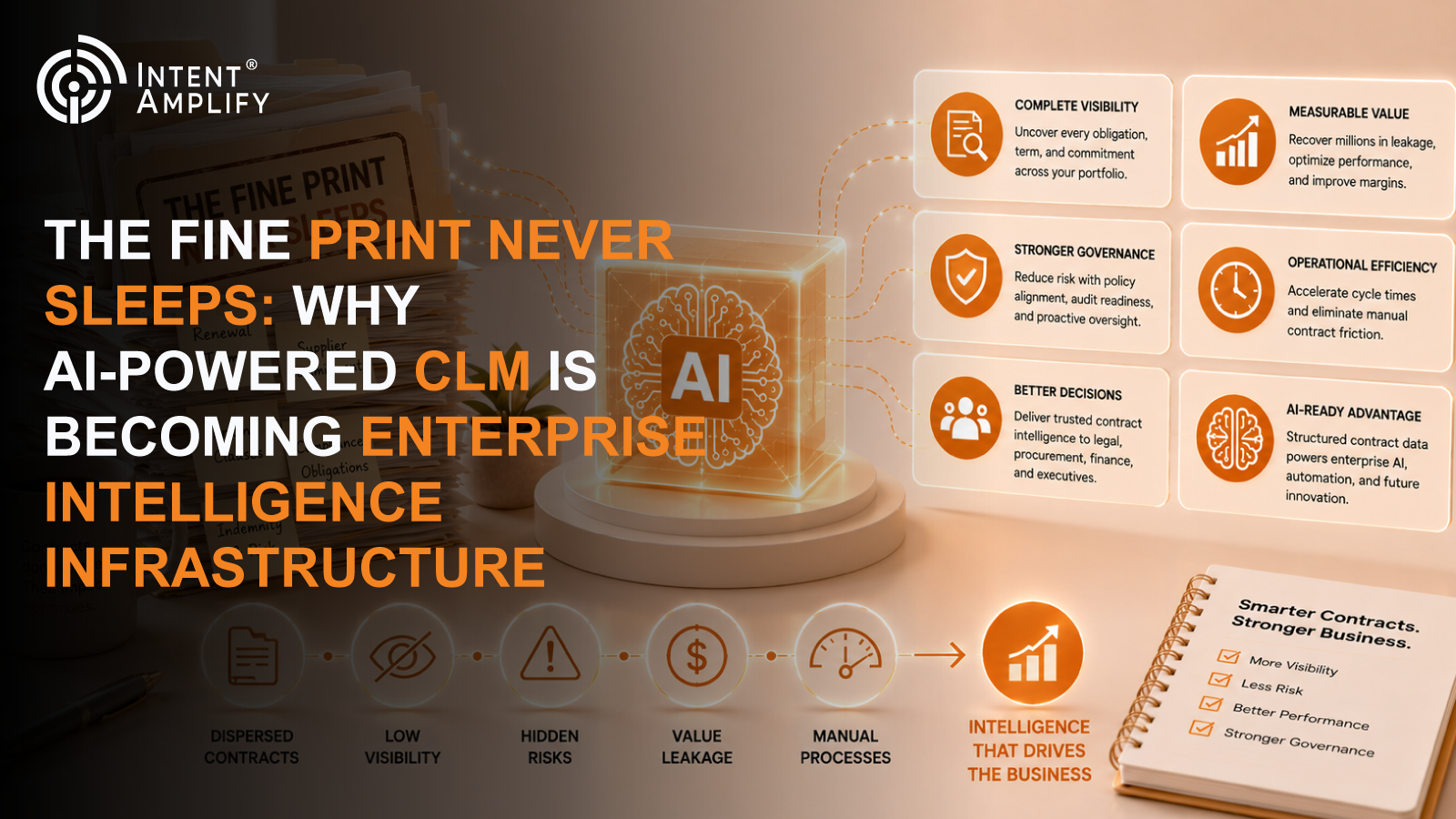
Every enterprise runs on agreements. Vendor contracts, customer commitments, regulatory terms, partnership obligations, service-level clauses, and renewal language quietly shape how business actually operates. Yet after signature, many of those documents move into shared drives, email threads, legacy repositories, or disconnected folders, where they are rarely revisited until something breaks.
That is the risk hiding in plain sight.
Contract language is precise, conditional, and time-sensitive. Deadlines move. Terms expire. Obligations accumulate. Pricing clauses activate. Auto-renewal windows close before anyone notices. Inside indemnification provisions, service-level thresholds, data-processing commitments, and escalation terms are exposures that do not announce themselves. In many organizations, no system is watching closely enough.
Artificial intelligence-powered contract lifecycle management, or CLM, changes that equation. It does more than digitize files. It turns contract data into a live, searchable, risk-aware intelligence layer that reflects how complex enterprise operations have become.
The Revenue Exposure Nobody Talks About Loudly Enough
Most organizations underestimate the cost of poor post-signature execution. The financial damage rarely appears as a single dramatic loss. It shows up as missed savings, weak renewal discipline, unmanaged service credits, delayed renegotiations, and commercial terms that were negotiated well but never enforced.
Research cited by Deloitte found that organizations lose an average of 8.6% of contract value through poor post-execution management, meaning the real leakage often begins after the ink dries.1
In a separate Deloitte engagement with a financial services firm, natural language processing applied to 20,000 contracts uncovered revenue leakage equal to 3% to 4% of annual business revenue in just 10 weeks, with one person doing work that previously required 10 people at 30% lower cost than manual staffing.2
Most security leaders know exactly where their cyber risks are monitored. Fewer can say the same about the contractual obligations that govern them.
Across vendor agreements, data-processing addendums, service-level commitments, indemnification clauses, and regulatory requirements, critical security obligations are often buried in documents that disappear into repositories after signature. The exposure is not always a missing control. More often, it is a missed obligation, an expired protection, or a contractual commitment no one realized required action.
At enterprise scale, those blind spots can create compliance gaps, third-party risk exposure, audit findings, and financial consequences that surface long after the agreement is signed. The problem is rarely the language itself. In many cases, the organization already negotiated the right protections. It simply lacks the intelligence infrastructure to continuously monitor, interpret, and operationalize them.
These are not isolated incidents. They are predictable outcomes in organizations that treat contracts as static records rather than active sources of risk intelligence.3
From Static Files to Living Intelligence
The difference between traditional document management and AI-powered CLM is not cosmetic. A repository stores a file. An intelligent CLM platform helps the organization understand what the file means, when it matters, and who needs to act.
IBM’s analysis of large language model applications in contract review describes this shift clearly: AI can extract entities, validate requirements, enable dynamic dialogue with contract text, and flag compliance deviations against internal policy standards, helping reduce noncompliance risk and potential legal exposure. 4
The business case becomes practical when organizations can act on contract intelligence in real time.
AI-powered CLM can identify vendor security obligations, surface non-standard risk provisions, monitor breach notification requirements, compare contract language against internal security policies, and connect contractual commitments to operational workflows. Security and risk teams can quickly locate agreements containing data-handling obligations, audit rights, cyber insurance requirements, or incident response commitments. Compliance teams can identify contracts that may require review as regulations evolve. Legal can compare security-related clauses across vendors, regions, and business units to uncover inconsistencies before they become exposures.
Agiloft has built its CLM platform around this principle. Through its AI-powered CLM capabilities, unstructured legal documents become actionable risk intelligence. Critical obligations that once remained buried in dense contract language can be surfaced, monitored, and escalated before compliance gaps, vendor disputes, or governance failures create operational consequences.
For CISOs, the value extends beyond contract management. It provides a more complete view of third-party risk by making contractual security commitments visible, measurable, and enforceable throughout the agreement lifecycle. What was once locked inside static documents becomes part of the organization's broader security and governance intelligence framework.
Get the Executive Case Studies:
CLM + AI: from locked files to living intelligence For Legal & Procurement Leaders at Enterprise Organizations
For chief information officers, chief information security officers, procurement leaders, and legal teams working in regulated sectors, this matters operationally. Contracts connect directly to risk, compliance, vendor performance, renewal control, and enterprise governance. Once those terms become visible, they stop being passive records and start becoming management intelligence.
The Silent Threat Hiding in Post-Signature Risk
Risk does not end when an agreement is signed. It usually becomes harder to see.
Legal and compliance teams know this pattern well. A renewal clause buried in section 14.2 becomes visible only after the auto-renewal has triggered. A service-level threshold that looked acceptable during negotiation becomes costly when operational conditions change. A price escalation clause applies, but no one has tied it to a financial review. An indemnification provision expires without anyone realizing the protection has weakened.
That is the quiet danger of post-signature risk. It rarely announces itself as a crisis at the beginning. It builds in fine print, exceptions, missed actions, and expired rights.
McKinsey’s analysis of agentic AI in procurement quantifies what continuous monitoring can change. Procurement agents that monitor vendor performance, benchmark historical rates, validate invoices, and surface renegotiation triggers can unlock 5% to 15% in cost savings that periodic review cycles often leave uncaptured. 5
For a $500 million procurement portfolio, that range represents $25 million to $75 million in recoverable value. 5
The point is worth emphasizing: this value does not always come from renegotiating better terms. Sometimes it comes from enforcing the terms the enterprise already owns.
AI Agents That Review, Flag, and Escalate Before the Damage Spreads
Purpose-built contract AI does not wait for a quarterly review cycle. It monitors, flags, and routes issues before they become expensive.
IBM’s enterprise AI work shows what this can look like in procurement environments. A risk and compliance agent embedded in procurement workflows can review contracts and statements of work for financial and regulatory risks, flag concerns early, and suggest remediation before those concerns become operational problems. 6
Consider a healthcare system managing thousands of vendor agreements across supplies, services, technology, data access, and compliance commitments. A document repository can preserve those agreements. It cannot reliably distinguish between a clause that is merely unusual and a clause that should be escalated to legal, finance, or compliance before a problem materializes.
That distinction is not a feature. It is a governance capability.
Contracting Data as Enterprise Intelligence
The most underused asset in many enterprises is not customer data or financial modeling. It is the contract portfolio.
Pricing benchmarks, obligation histories, supplier performance patterns, renewal cadences, regulatory commitments, and commercial exceptions are all embedded inside agreements. Without the right extraction and integration infrastructure, that data remains functionally invisible.
Accenture finds that organizations with the highest operations maturity are 3.3x more likely to succeed at scaling high-value AI use cases and report 2.5x higher average revenue growth compared with lower-maturity peers. 7
Gartner’s November 2025 Magic Quadrant for Contract Lifecycle Management documented the market’s movement toward AI-first contract intelligence, with capabilities extending beyond clause extraction into risk detection, deviation scoring, and full-lifecycle obligation monitoring. 8
McKinsey’s State of AI in 2025 survey found that less than one-third of firms had scaled AI use across the company, not because the technology was unavailable, but because many lacked the operating and metrics model needed to scale.9
That is what makes contract intelligence such a practical starting point. The use case is measurable. The data already exists. The business outcomes are visible: fewer missed renewals, stronger vendor management, better compliance visibility, faster reviews, and recoverable savings.
The Contract Intelligence Inflection Point
The gap between organizations that manage contracts reactively and those that manage them intelligently is widening. The cost of staying on the wrong side is no longer theoretical.
Revenue leakage, compliance exposure, missed renewal windows, underused rights, and unmanaged obligations compound quietly across portfolios that have not been connected to an intelligence layer. AI-powered CLM sits at the intersection of legal risk, financial control, procurement discipline, regulatory readiness, and operational visibility. Each of those domains reports to the C-suite in one form or another.
McKinsey’s analysis of agentic AI applied to procurement and contract operations found that moving from periodic review to continuous monitoring can unlock 5% to 15% in cost savings that traditional review cycles often miss.5
For a $500 million procurement portfolio, that equates to $25 million to $75 million in recoverable value when those savings are operationalized. 5
The organizations that close this gap usually start with the same decision: they stop treating agreements as static documents. They treat them as data.
They connect obligation tracking to the systems where work happens. They build the business case in financial language that CFOs can evaluate. They give legal, procurement, compliance, finance, and sales teams different views of the same trusted source. Most importantly, they stop waiting for the fine print to become a problem.
Accenture’s research puts the operational stakes in context. Organizations with the highest operations maturity are 3.3x more likely to scale high-value AI use cases and report 2.5x higher average revenue growth than lower-maturity peers. 7
The fine print has always been there. The difference now is whether the organization has the intelligence layer to read it before it becomes a cost.
Explore the Full Agiloft Resource Series
CLM + AI: From Locked Files to Living Intelligence
Get the Executive Briefing
Listening for the Silent Threat: How CLM Transforms Risk into Opportunity
Get the Risk Intelligence Report
Eliminating the Silent Threat: How Agiloft Minimizes Risk
Download the AI Risk Minimization Playbook
Contracting Data You Can Trust
Read the Guide
CLM Buyers Toolkit: Building a Business Case for CLM Success
Get the Complete Toolkit
About Intent Amplify
Intent Amplify helps B2B technology brands connect with high-value decision-makers through intent-led demand generation, content strategy, account-based marketing, lead generation, and performance-focused digital campaigns.
We support cybersecurity, technology, SaaS, cloud, artificial intelligence, and enterprise solution providers by turning market insight into measurable pipeline opportunities. Through strategic content, targeted outreach, and data-driven campaign execution, Intent Amplify helps brands improve visibility, strengthen buyer engagement, and accelerate growth.
Learn more or connect with our team.
References
-
Deloitte, Upping Contract Management Lifecycle ROI, 2023
-
Deloitte, Stopping Revenue Leaks with Natural Language Processing, 2024
-
Accenture, AI Approach to Maximizing Value in Supply Chain Procurement, May 2026
-
IBM, LLMs Drive Information Analysis and Compliance Validation, November 2025
-
McKinsey, Reimagining Tech Infrastructure for Agentic AI, April 2026
-
IBM, Shaping Your Agentic Enterprise: How AI Is Rewriting Procurement’s Playbook, December 2025
-
Accenture, Procurement Managed Services, 2026
-
Gartner, Magic Quadrant for Contract Lifecycle Management, Kaitlynn Sommers, Kerrie McDonald, Lynne Phelan, November 2025
-
McKinsey, The State of AI in 2025: Agents, Innovation, and Transformation, November 2025