
logo
logo
From Automation to Agentic Service: How Enterprises Can Build Practical Frameworks for Scalable AI Adoption

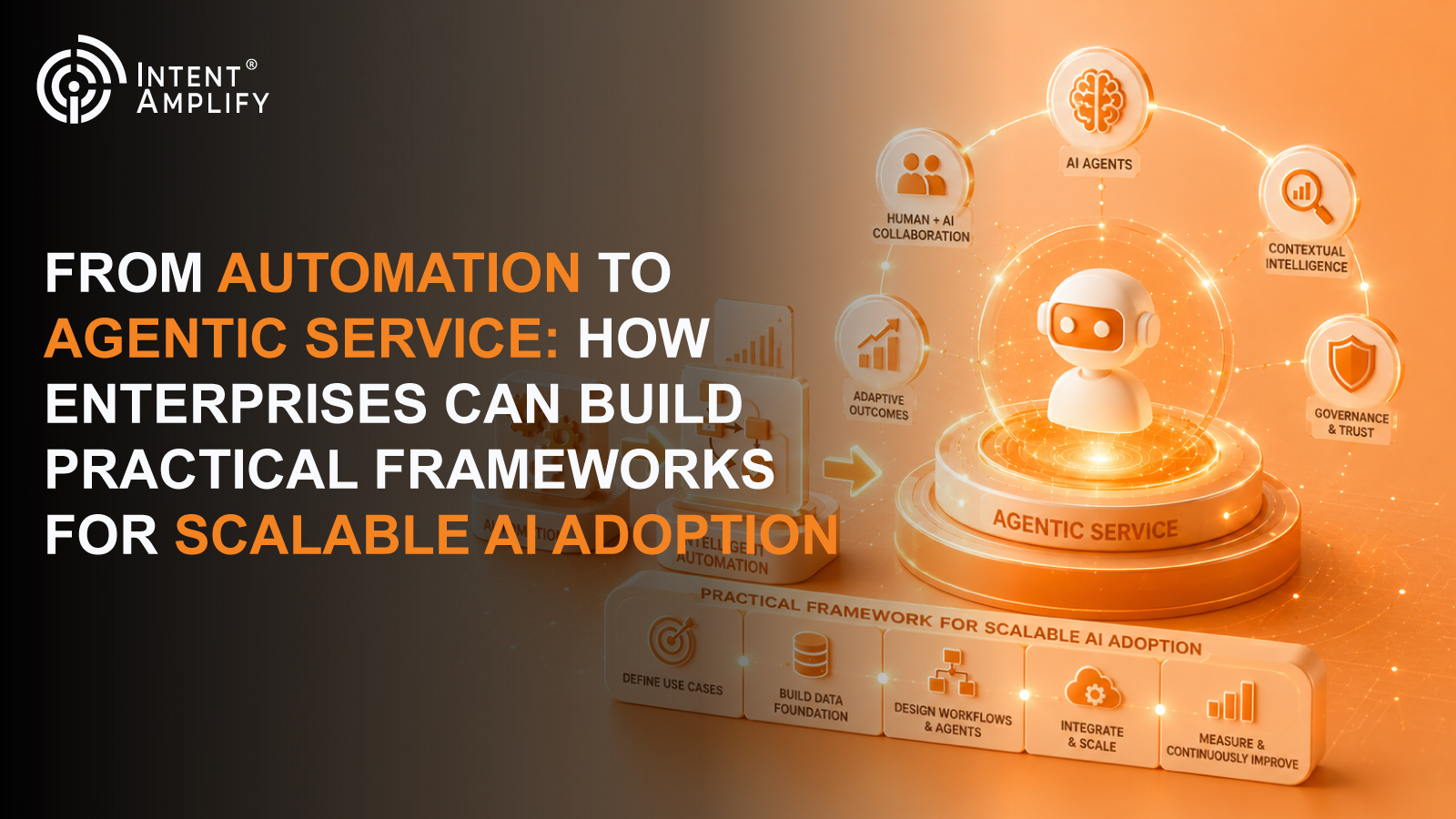
From Automation to Agentic Service: How Enterprises Can Build Practical Frameworks for Scalable AI Adoption

For years, enterprise service teams have tried to make support operations faster and more predictable through automation. Chatbots, routing logic, self-service portals, knowledge repositories, ticket deflection models, and service desk workflows have all helped reduce manual effort. In many organizations, these tools gave customer support, IT service management, help desk, and contact center teams a more efficient way to handle rising interaction volumes.

Yet the next phase of AI customer service is not simply more automation. It is an agentic service.

Agentic service refers to an AI-enabled service model in which AI support agents can understand context, use approved knowledge sources, take defined actions, escalate when needed, and support measurable service outcomes. Traditional automation follows rules. Agentic AI interprets intent, coordinates workflows, and operates within governed boundaries.

For United States enterprise executives, this shift is an operating-model decision. The real question is not whether AI agents can answer more questions. The harder question is whether the enterprise is ready to scale AI adoption without weakening service quality management, compliance, customer trust, data governance, or financial discipline.

Why Automation Alone Is No Longer Enough

Automation works well when tasks are predictable. Password resets, order-status checks, ticket routing, appointment reminders, and case categorization are practical use cases because the decision logic is clear. Modern service, however, is rarely that simple.

A customer may begin with a chatbot, move to live chat, add a screenshot, reference a previous issue, request a refund, and expect the company to remember the entire journey. An employee may open an internal information technology service ticket that touches access management, cybersecurity, device support, procurement, and incident management. A customer success team may need context from product telemetry, entitlement records, account history, and renewal risk.

That is where agentic service becomes strategically relevant. Zendesk's CX Trends 2026 report finds that 74% of consumers now expect customer service to be available 24/7 due to AI, while 88% expect faster response times than one year ago.1

Those numbers reveal a new executive mandate. Customers are not evaluating service only by whether a company offers digital support. They are judging whether the experience is responsive, contextual, transparent, and continuous. A rules-based bot may answer a narrow question quickly, but it cannot deliver a scalable AI customer experience if it cannot preserve memory, interpret context, or move work across functions.

Readiness Comes Before Scalable AI Adoption

Many enterprises begin with use cases. Leaders ask which interactions can be automated, which tickets can be deflected, and which AI customer service platform can produce the fastest return. That sequence is understandable, but incomplete.

Scalable AI adoption starts with readiness. If the enterprise does not understand its data quality, workflow maturity, knowledge gaps, integration dependencies, and AI governance posture, agentic AI may simply accelerate weaknesses already embedded in the service model.

Salesforce's 2026 service research found that agentic AI adoption in customer service organizations rose from 39% in 2025 to 66% in 2026.2

Executives should read that signal as an operating model warning. Service teams usually encounter the weakness before it appears in the boardroom dashboard: knowledge content that has not been refreshed, customer records that do not reconcile, product information that varies by system, case histories that lack context, and escalation notes that leave the next agent guessing. In that environment, AI does not create order by default. It can amplify inconsistency unless the underlying service foundation is repaired first.

A practical AI readiness assessment should examine whether customer data is accurate, whether knowledge content is current, whether workflows are documented, whether integrations are stable, whether escalation paths are clear, and whether AI performance can be measured beyond surface-level automation metrics.

The Five Dimensions of Enterprise Agentic Service Readiness

The Five Dimensions of Enterprise Agentic Service Readiness™ provide a practical framework for evaluating whether an organization is prepared to move from basic automation to scalable agentic service. The framework gives executives a way to assess readiness across the operating conditions that determine whether AI agents can work safely, consistently, and measurably.

Intent Amplify Research Desk Observation: Organizations successfully scaling agentic service consistently strengthen governance, trusted knowledge, workflow discipline, and performance measurement before expanding AI autonomy. The strongest programs do not begin by asking how many interactions can be automated. They begin by determining which service decisions can be trusted, measured, explained, and safely improved over time.

Dimension

Executive Question

Why It Matters

Readiness

Are the right use cases, data sources, and workflows ready for AI-supported execution?

Prevents AI from scaling fragmented processes or weak service foundations

Governance

Are access, escalation, compliance, audit, and decision controls embedded into the system?

Reduces operational, legal, regulatory, and trust risk

Workflow Design

Have service journeys been redesigned for human-AI collaboration?

Ensures AI agents improve work rather than adding another disconnected layer

Monitoring

Can leaders track resolution quality, cost, risk, escalation, and customer effort?

Converts AI adoption into measurable operating performance

Business Outcomes

Can AI service performance be connected to customer experience, productivity, cost, and retention?

Helps executives prove value beyond automation volume

This framework helps leaders avoid treating agentic service as a tool rollout. It positions AI adoption as an enterprise operating model that requires readiness before scale, governance before autonomy, and measurement before expansion.

Governance Must Become Embedded Control

Agentic service changes the governance equation because autonomous systems do more than answer questions. They may retrieve sensitive data, interpret policy, initiate account actions, recommend concessions, trigger workflow automation, or escalate cases based on probability and context. That makes AI governance a core control plane for enterprise service operations.

IBM's June 2026 Institute for Business Value research found that only 11% of surveyed technology executives believe they are completely prepared for the scale of AI agent deployment expected in the next year, while 77% say AI adoption is already outpacing governance capability.3

This is how AI sprawl begins. A customer experience team deploys one assistant. IT operations tests another. A support function adds AI help desk capabilities. A business unit experiments with workflow automation. Each effort may be rational locally, but enterprise risk compounds when no one can see the whole system.

AI governance must therefore be embedded into the operating environment through role-based access, data boundaries, workflow permissions, escalation triggers, model evaluation, audit trails, incident response, and AI monitoring. IBM found that organizations embedding control directly into AI systems experience 25% fewer incidents than those relying on manual governance.3

A Practical Framework for Scalable AI Adoption

A practical agentic service framework should separate automation, augmentation, and autonomy. Automation handles fixed tasks. Augmentation supports employees with recommendations, summaries, and next-best actions. Autonomy allows AI agents to execute approved workflows within defined boundaries.

This staged approach gives leaders a more controlled path to AI adoption. Rather than giving every service workflow the same level of autonomy, enterprises should classify work by risk, complexity, customer impact, and compliance exposure. Routine, policy-driven tasks may be ready for supervised automation; sensitive or ambiguous interactions should remain guided by human expertise until the organization has enough evidence, governance, and performance confidence to expand AI authority.

PwC's 2026 Digital Trends in Operations Survey found that 83% of operations and supply chain leaders believe AI agents and automation will accelerate the breakdown of traditional functional silos, but only 27% have fully embedded an AI strategy across business units.4

For enterprise executives, the lesson is clear. Agentic service cannot scale through isolated pilots alone. It requires a cross-functional framework that connects customer experience, IT operations, cybersecurity, compliance, workforce planning, finance, and business-unit leadership.

The first step is an AI readiness assessment. The second is an AI data strategy. The third is governed by workflow automation. The fourth is human oversight. The fifth is an AI performance review. Together, these disciplines turn AI transformation from a set of experiments into a scalable operating capability.

Measuring AI ROI Beyond Ticket Deflection

Ticket deflection matters, but it is too narrow to define AI ROI. A company can reduce ticket volume while frustrating customers through poor self-service support. It can improve average handle time while weakening resolution quality. It can automate responses while increasing repeat contacts.

A better scorecard for agentic service should measure customer outcomes, operational outcomes, workforce outcomes, financial outcomes, and risk outcomes. Customer experience metrics should include resolution quality, satisfaction, effort reduction, transparency, repeat-contact rate, and escalation effectiveness. Operational metrics should include first-response time, mean time to resolution, case routing accuracy, workflow completion, and backlog reduction.

Salesforce found that 70% of organizations using AI service agents observed measurable value within 60 days of deployment.2

Financial discipline is equally important. IBM found that AI spend is projected to rise from just under 15% of IT budgets in 2025 to nearly 25% by 2027.3

The implication is uncomfortable but necessary. AI initiatives that are not financially observable may become expensive faster than they become strategic. AI ROI should be built into the roadmap, not calculated after deployment

Executive Scorecard for Agentic Service Performance

A board-level scorecard should measure whether agentic service is improving customer outcomes, operating discipline, workforce productivity, and governance control. The goal is not to track AI activity alone. The goal is to determine whether AI agents are improving service performance without increasing hidden risk.

Metric

What It Measures

Executive Relevance

Resolution Quality

Accuracy, completeness, and usefulness of AI-supported resolutions

Shows whether AI is improving service outcomes, not only reducing ticket volume

Customer Effort Score

How easy it is for customers to resolve issues through AI-supported journeys

Connects AI performance to customer experience, loyalty, and friction reduction

AI Containment Rate

Share of interactions resolved by AI without unnecessary escalation

Measures whether autonomy is working in appropriate service scenarios

Human Override Rate

Share of AI-handled interactions requiring human correction or intervention

Reveals where AI authority may be too broad, unclear, or poorly governed

Knowledge Freshness Index

Currency, accuracy, duplication, and approval status of knowledge sources

Indicates whether AI agents are using trusted and current information

Workflow Success Rate

Share of AI-triggered workflows completed correctly within policy and process boundaries

Shows whether AI agents can execute service actions reliably, not just answer questions

This scorecard gives executives a more practical way to assess agentic service maturity. A service model can appear efficient while still increasing repeat contacts, customer frustration, policy exposure, or untracked cost. Balanced measurement helps leaders determine where AI autonomy should expand, where human judgment should remain, and where the service foundation needs repair.

Trust and Transparency Will Define Adoption

Agentic service cannot scale if customers do not trust it. Speed may win the first interaction, but transparency earns the next one.

Zendesk reports that 95% of consumers expect an explanation for AI-made decisions, while only 37% of customer experience leaders currently offer reasoning behind AI decisions.1

That transparency gap matters because AI customer service often touches sensitive moments: account access, refunds, service eligibility, claims, pricing exceptions, technical outages, data privacy, and complaints. If the AI system cannot explain why it responded or acted a certain way, the enterprise may create avoidable distrust.

NIST's AI Risk Management Framework notes that on April 7, 2026, NIST released a concept note for an AI RMF Profile on Trustworthy AI in Critical Infrastructure, intended to guide operators toward risk management practices for AI-enabled capabilities.5

Even when customer service is not formally categorized as critical infrastructure, the governance lesson applies. Responsible AI requires risk identification, explainability, monitoring, accountability, and continuous improvement.

Where the Zendesk Webinar Fits

The Zendesk webinar, Build Frameworks to Scale Agentic Service, is timely because the enterprise conversation has moved beyond AI enthusiasm.

Executives need practical frameworks for AI readiness, AI governance, workflow design, service quality management, AI monitoring, and measurable outcomes.

For customer experience, IT operations, contact center, help desk, customer success, and service delivery leaders, the practical value lies in moving from automation projects to scalable service architecture. Zendesk's 2026 research gives the discussion urgency: customers want faster service, memory-rich experiences, multimodal support, promptable insights, and clearer explanations for AI decisions.

Attend the Webinar: Build Frameworks to Scale Agentic Service

For teams evaluating their next stage of AI service maturity, an Enterprise Agentic Service Readiness Assessment can help identify governance gaps, workflow dependencies, knowledge-quality risks, measurement blind spots, and practical opportunities before broader AI autonomy is scaled.

Conclusion

The transition from automation to agentic service is not a cosmetic upgrade to customer support. It is a broader shift in how enterprises design service, manage work, govern AI, measure outcomes, and preserve trust.

Automation made service faster in specific moments. Agentic service can make it more adaptive, contextual, and scalable across the enterprise, but only if leaders build the right framework first.

For U.S. enterprise executives, the mandate is clear. Start with readiness. Build governance into the system. Strengthen data foundations. Redesign workflows around human and AI collaboration. Measure AI ROI through customer, operational, workforce, risk, and financial outcomes. Most importantly, treat agentic AI as an enterprise capability, not a departmental experiment.

The organizations that succeed will not be the ones that deploy the most AI agents. They will be the ones who know where autonomy belongs, where human judgment must remain, and how both can work together in the service of better customer outcomes.

References

  1. Zendesk, CX Trends 2026, 2026
    https://cxtrends.zendesk.com/

  2. Salesforce, New Research: AI Service Agents Are Scaling and Delivering CSAT, May 20, 2026
    https://www.salesforce.com/news/stories/ai-service-agents-improve-customer-satisfaction/

  3. IBM Institute for Business Value, New IBM Study Finds CIOs and CTOs Face Growing AI Control Gap as Enterprise Deployment Scales, June 8, 2026
    https://newsroom.ibm.com/2026-06-08-new-ibm-study-finds-cios-and-ctos-face-growing-ai-control-gap-as-enterprise-deployment-scales

  4. PwC, 2026 Digital Trends in Operations: How AI Reinvents Enterprise Performance, 2026
    https://www.pwc.com/us/en/services/consulting/supply-chain-operations/library/digital-trends-operations-survey.html

  5. NIST, AI Risk Management Framework, 2026 update note
    https://www.nist.gov/itl/ai-risk-management-framework

Frequently Asked Questions

What is agentic service?+
Agentic service is an AI-enabled service model in which AI agents can understand intent, use approved knowledge sources, take defined actions, escalate when needed, and support measurable service outcomes.
How is agentic service different from traditional service automation?+
Traditional service automation follows predefined rules. Agentic service uses AI agents that can reason across context, coordinate workflows, and execute approved actions within governance boundaries.
Why does AI readiness matter for customer service?+
AI readiness matters because agentic AI depends on accurate data, structured knowledge, documented workflows, clear permissions, and measurable outcomes. Without readiness, AI customer service can scale with inconsistent or risky responses.
How should enterprises measure AI ROI in service operations?+
Enterprises should measure AI ROI through customer satisfaction, resolution quality, effort reduction, productivity, cost per resolution, reduced repeat contacts, risk reduction, financial visibility, and improved service quality management.
Yash Lad

Yash Lad

Research Analyst

Related Blogs