
logo
logo

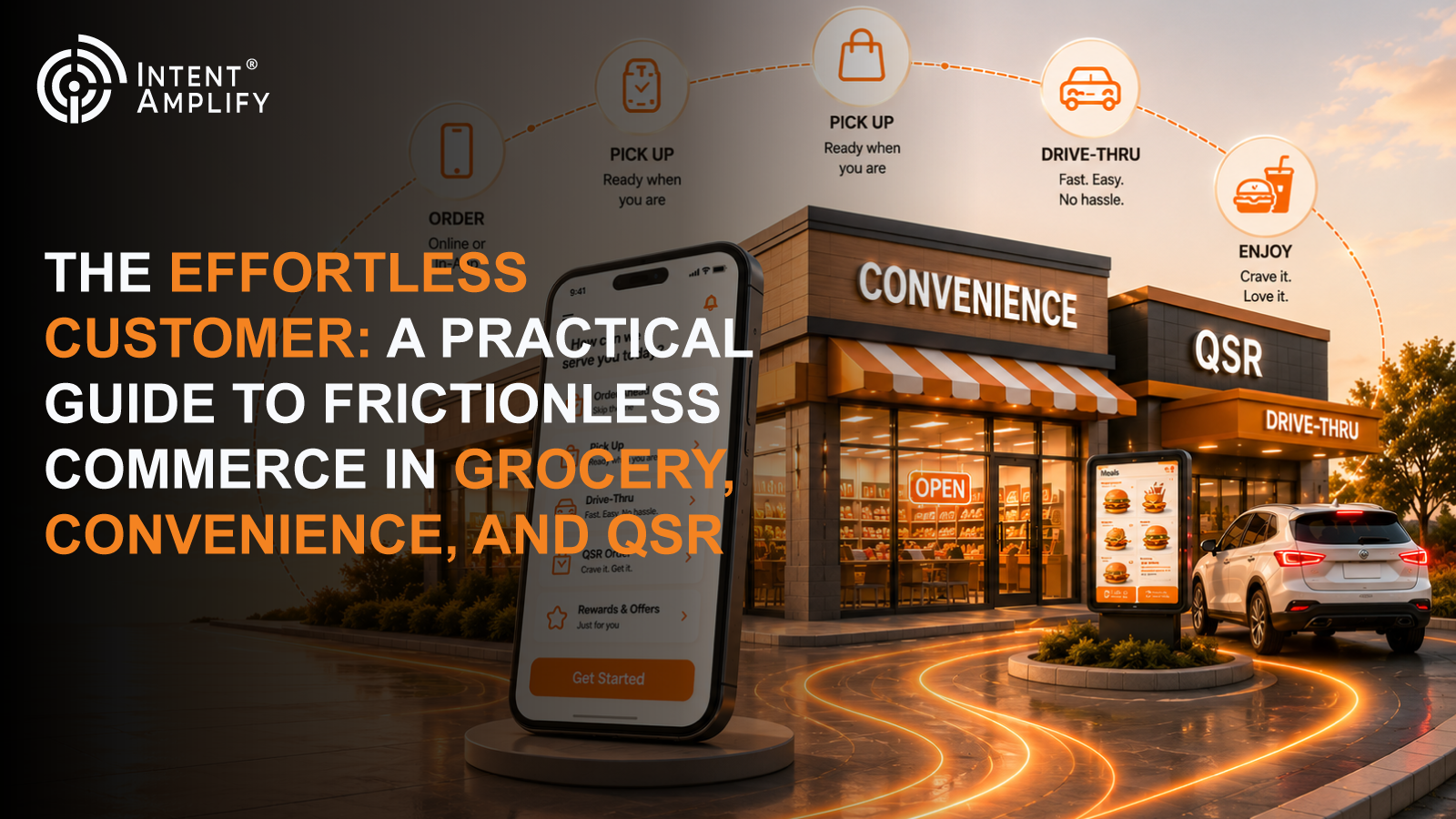
The Effortless Customer: A Practical Guide to Frictionless Commerce in Grocery, Convenience, and QSR

A practical guide for grocery, convenience, and QSR leaders on reducing customer effort, improving loyalty, and driving growth through frictionless commerce.

The Effortless Customer: A Practical Guide to Frictionless Commerce in Grocery, Convenience, and QSR

Executive Summary

Retailers have become highly skilled at adding convenience. Grocery chains have built pickup models, loyalty apps, digital coupons, and inventory-aware shopping tools. Convenience stores have expanded prepared food, mobile payment, loyalty programs, self-checkout security, and fuel-to-food journeys. Quick-service restaurants have scaled mobile ordering, drive-thru optimization, self-ordering kiosk options, and off-premises fulfillment.

Yet many customers still feel that ordinary transactions require too much work.

That is the tension shaping the next era of frictionless commerce. The customer does not judge a journey by the number of technologies inside it. They judge whether the experience feels easy, reliable, and worth repeating. A shopper does not care if a retailer has invested in a retail technology platform if the coupon fails at checkout. A QSR guest does not think about production sequencing when a mobile order is late. A convenience-store visitor does not admire checkout automation if age verification delays a two-minute mission.

The effortless customer expects the brand to remove the burden before the burden becomes visible.

In a U.S. retail market that the National Retail Federation expects to reach $5.42 trillion to $5.48 trillion in 2025, friction is too large to treat as a minor service inconvenience. The NRF also expects retail sales to grow between 2.7% and 3.7%, showing that the market still offers growth, but not growth that can be taken for granted.1

For grocery, convenience, and QSR leaders, the business case is clear: reducing customer effort protects revenue, improves retail throughput, supports labor productivity, and strengthens loyalty in categories where shoppers can switch quickly.

RETHINK Retail’s report, The Frictionless Frontier: Why Grocery, Convenience, and QSR Need a Reset, gives this shift a practical lens. It reports that 84% of consumers prefer self-service kiosks, that kiosk deployments can generate 30% higher ticket sizes, and that AI age estimation can reduce human intervention by 75%.

The lesson is not that retailers need more visible technology. They need more coordinated journeys.

The New Retail Mandate: Remove the Work

For years, retailers defined convenience through proximity, speed, and availability. A store was convenient because it was nearby. A restaurant was convenient because the meal arrived quickly. The checkout experience was convenient because the customer did not wait too long.

Those expectations still matter, but the definition has widened. Today, convenience is also about how much thinking, waiting, correcting, repeating, and asking a customer must do.

The shift is subtle but important. A journey can be fast and still feel frustrating. A checkout lane can move quickly, but still disappoint if the loyalty offer does not apply. A self-service kiosk can reduce the line, but still create effort if it cannot handle exceptions. A mobile pickup order can save time, but still weaken trust if substitutions feel careless.

This is why customer journey mapping has become more important across grocery, convenience, and QSR. Leaders need to examine not only where customers go, but where they struggle. Every repeated entry, failed payment, unclear pickup instruction, delayed age check, or associate intervention is a sign that the operating model is transferring work to the shopper.

Deloitte’s commerce research points to the same gap from another angle. While 80% of business-to-consumer leaders said they believed their organizations were delivering impressive online shopping experiences, fewer than half of consumers agreed. Deloitte also found that consumers spend 37% more with brands that deliver consistent and positive commerce experiences.2

Many retailers may overestimate the quality of the experience they provide. Internal teams see investment and capability; customers experience outcomes and friction.

Why Customer Effort Now Shapes Loyalty

Loyalty used to be treated as a post-purchase function. A customer bought something, collected points, received an offer, and returned if the value felt worthwhile. That view is now too narrow.

Loyalty forms during the journey itself.

It forms when the grocery app reflects actual availability. It forms when a convenience store's offer works across the pump, app, and counter. It forms when a QSR mobile order is ready, where and when the customer expects. It forms when a self-checkout exception is resolved without embarrassment or delay.

It also weakens in those same moments.

This is why frictionless retail should be viewed as loyalty infrastructure. A points program can invite customers back, but an effortless experience gives them a reason to accept the invitation. When a shopper learns that a brand will save time, honor value, and reduce hassle, loyalty becomes less dependent on discounting.

Unified commerce is central to that goal. Customers do not experience channels as separate departments. They move between app, store, kiosk, drive-thru, pickup lane, and loyalty account fluidly. When those systems fail to share context, the customer becomes the connector.

Customers should not be responsible for connecting disconnected systems and processes.

The strongest brands will build journeys where checkout, fulfillment, personalization, payment, inventory, and loyalty behave like one operating system. That is where customer experience becomes measurable business performance.

Grocery: Reliability Is the Customer Experience

Grocery retail has always been operationally demanding. The sector combines large assortments, perishable goods, fresh-food expectations, thin margins, frequent shopping missions, local demand variation, and heavy promotional activity. Even small execution gaps can change how shoppers feel about a store.

In grocery, effort often begins as doubt.

Is this item actually available? Will the substitution respect my preference? Will the digital price match the shelf? Will my loyalty savings appear without a conversation? Will pickup be ready during the selected window?

These questions sound ordinary, but they define the emotional contract between grocer and shopper. A customer can forgive an occasional issue. They are less forgiving when uncertainty becomes routine.

McKinsey’s State of Grocery Retail research highlights how grocery leaders are navigating margin pressure, evolving consumer behavior, digital shifts, private-label momentum, and rising interest in artificial intelligence and automation.3

For U.S. grocers, the practical lesson is clear. Reliability is now a form of convenience. Predictive analytics retail capabilities can improve replenishment planning. Computer vision retail systems can strengthen shelf awareness. Retail intelligence can help identify where shoppers abandon baskets or reject substitutions. Strong POS integration can reduce the risk that shelf, app, promotion, and checkout data conflict.

The customer does not need to see any of this. In fact, the best grocery technology often disappears. It shows up as a basket that is complete, a substitution that makes sense, a promotion that works, and a store that feels dependable.

That is where grocery loyalty is built.

Convenience Stores: Where Speed Meets Complexity

Convenience stores are built around short missions, but the operating model behind those missions has become increasingly complex.

A single visit may include fuel, coffee, prepared food, packaged goods, digital loyalty, mobile payment, age-restricted products, and checkout automation. The customer may spend only a few minutes on-site, but the trip can touch multiple systems before it is complete.

That is why convenience retailers need platform unification. A disconnected forecourt, counter, app, loyalty engine, foodservice workflow, and compliance process will eventually show up as a delay. The customer may not know which system failed. They only know the trip took longer than it should have.

RETHINK Retail’s report is useful here because it calls attention to the friction that appears between fuel, convenience, and QSR-style journeys. The modern convenience site is no longer one simple format; it is a hybrid operating environment where customer flow depends on integrated systems.

The most important question for convenience leaders is not whether to deploy more retail technology. It is whether each tool reduces effort across the mission.

AI checkout can support faster payment. AI loss prevention can help with retail shrinkage and retail theft prevention. Age verification software can reduce repeated associate intervention. Self-service kiosk workflows can support food ordering and reduce counter pressure. Retail automation software can improve workforce efficiency during peaks.

But only if the pieces connect.

A convenience-store experience feels effortless when fuel, food, loyalty, compliance, and checkout behave as one journey rather than five separate interactions.

QSR: Off-Premises Growth Has Changed the Journey

QSR operators have always been disciplined about speed. The next challenge is orchestration.

A modern QSR may receive orders through the counter, drive-thru, mobile app, delivery marketplace, curbside lane, and self-ordering kiosk during the same service window. The customer sees one brand. The store team sees several demand streams landing in one kitchen.

That complexity now sits inside a very large market. The National Restaurant Association expects the U.S. restaurant industry to reach $1.5 trillion in sales in 2025, employ 15.9 million people by year-end, and add more than 200,000 net new jobs.4

Scale alone does not guarantee profitability. It raises the cost of inefficiency. A small breakdown in kitchen flow, pickup sequencing, or payment can affect thousands of transactions across a network.

Off-premises dining makes this even more important. The National Restaurant Association reports that nearly 75% of restaurant traffic now happens off-premises. It also found that 57% of adults recently used mobile ordering, including 74% of millennials and 65% of Gen Z adults.5

The restaurant journey is no longer anchored in the dining room. It lives in the app, the digital menu, the drive-thru lane, the pickup shelf, and the handoff. That means customer experience depends on order accuracy, transaction speed, production timing, and clean communication across channels.

Self-ordering kiosks improve ordering efficiency but do not solve broader operational constraints. Ordering gains lose value when kitchen capacity, fulfillment processes, or pickup workflows cannot absorb additional demand. Mobile ordering creates similar challenges when higher order volumes introduce pickup congestion, communication gaps, or fulfillment delays.

QSR technology investments should be evaluated through operational flow. Key measures include handoff accuracy, demand visibility, labor utilization, throughput, and repeat-purchase behavior. The strongest technology environments improve coordination across ordering, production, fulfillment, and customer engagement rather than optimizing a single transaction point.

The Technology Foundation for Frictionless Commerce

Frictionless commerce is built on systems customers rarely think about.

The first layer is POS integration. If pricing, promotions, loyalty, payments, inventory, and order routing do not communicate with the point-of-sale environment, friction appears at the most sensitive point in the journey. Customers may tolerate browsing friction. They have far less patience at checkout.

The second layer is unified commerce. A shopper should not have one experience online and another in the store. A loyalty member should not need to explain the offer they were shown. A customer who orders ahead should not have to guess whether the order is being prepared, staged, or delayed.

The third layer is retail analytics. Leaders need to see where effort concentrates. Which stores generate the most checkout exceptions? Which kiosks lose customers mid-session? Which pickup windows produce delays? Which substitutions are rejected most often? Which loyalty offers create confusion? Which age-check moments slow transaction speed?

The fourth layer is AI retail technology. Smart checkout, predictive analytics retail, computer vision retail, AI checkout, and retail intelligence can all create value when they are tied to clear operating problems. The goal should be specific: fewer manual overrides, stronger inventory accuracy, faster flow, better substitution logic, cleaner fulfillment, and improved labor productivity.

The retail labor shortage makes this foundation more urgent. When systems fail, employees become the workaround. They clear the self-checkout exception, explain the delayed order, handle the coupon issue, correct the pickup error, or intervene during age verification. That work is necessary in the moment, but expensive when repeated at scale.

Good technology should reduce effort for customers and employees at the same time. If it helps one group by burdening the other, the journey is not truly frictionless.

Checkout, Trust, and the Data Responsibility

The more seamless the journey becomes, the more dependent it becomes on data.

Retailers now manage payment credentials, loyalty profiles, mobile-order histories, preference signals, delivery details, identity inputs, and behavioral data. These inputs can support personalization, faster checkout, better inventory planning, AI loss prevention, and smoother customer flow management. They can also create risk.

IBM’s Cost of a Data Breach Report 2025 reported that the global average cost of a data breach reached USD 4.44 million, while the U.S. average reached USD 10.22 million.6

For grocery, convenience, and QSR operators, trust is not separate from customer experience. A loyalty program cannot grow if shoppers do not trust how their data is handled. A mobile ordering journey cannot be considered effortless if customers worry about payment security. A personalized offer loses value if it feels intrusive or inaccurate.

Security also has to be balanced with ease. Self-checkout security and retail shrinkage controls are essential, but heavy-handed interventions can damage honest shopping experiences. AI loss prevention should help operators detect risk more precisely, not make every customer feel suspicious.

Age verification is another important test. RETHINK Retail’s report states that AI age estimation can reduce human intervention by 75%, helping operators protect compliance while reducing repeated delays in age-restricted transactions.

A frictionless strategy that weakens trust is not sustainable. A trust strategy that ignores convenience is incomplete. Retailers need both.

The Effortless Customer Framework

A practical frictionless commerce strategy begins with one question: where is the customer doing work the business should be doing?

The first step is mission mapping. Grocery pickup, QSR mobile ordering, drive-thru, self-checkout, fuel-to-food, loyalty redemption, prepared-food purchasing, and age-restricted transactions should each be examined as complete journeys. Leaders should avoid evaluating channels in isolation because customers do not experience them that way.

The second step is a friction audit. This audit should identify where shoppers wait, repeat information, abandon orders, reject substitutions, require associate help, face unclear pickup instructions, encounter failed payments, or experience inconsistent promotions. These moments should be tied to business outcomes such as lost sales, weaker retail throughput, higher labor intervention, and reduced loyalty engagement.

The third step is root-cause analysis. Visible friction is often only the symptom. A long line may reflect payment architecture. A failed kiosk journey may reveal poor exception design. A pickup delay may expose weak inventory visibility. A self-checkout security issue may require better risk scoring. A loyalty failure may come from disconnected promotion rules.

The fourth step is platform unification. Retailers should prioritize systems that share context across POS, loyalty, inventory, payment, kiosks, workforce management, compliance, and fulfillment. More tools will not fix a fragmented journey. Better system integration will.

The fifth step is effort-based measurement. Leaders should track transaction speed, kiosk completion rate, checkout exception volume, mobile order abandonment, substitution acceptance, pickup readiness, age-verification interventions, associate overrides, loyalty redemption success, and repeat purchase behavior.

The final step is loyalty linkage. Retailers should ask whether each operational improvement makes the next visit more likely. If a journey becomes easier, loyalty becomes more durable. If effort remains high, discounts may only hide the weakness temporarily.

Where RETHINK Retail’s Report Fits

The Frictionless Frontier: Why Grocery, Convenience, and QSR Need a Reset is valuable because it frames frictionless commerce as a platform and operating-model issue, not a surface-level customer experience theme.

The report focuses on the places where friction tends to hide: checkout flows, kiosk exceptions, age-check moments, forecourt-to-counter transitions, disconnected systems, labor constraints, and retail throughput bottlenecks. For leaders evaluating unified commerce, self-service kiosk strategy, retail automation, POS integration, platform unification, AI checkout, and customer journey mapping, the report offers a practical lens.

Its value is not simply that it says convenience matters. Most leaders already know that. Its value is in helping retailers identify where customer effort is being created by current architecture and where technology decisions can remove that effort before it affects revenue, labor, loyalty, or margin.

Download the full report here:
The Frictionless Frontier: Why Grocery, Convenience, and QSR Need a Reset

What Leaders Should Do Next

Leaders should begin by making their efforts visible. Broad satisfaction measures may show whether customers are generally pleased, but they rarely reveal where the journey forces unnecessary work.

Grocery teams should examine inventory accuracy, substitution intelligence, pickup readiness, loyalty reliability, and pricing consistency. Convenience-store operators should study the fuel-to-food journey, especially where payment, foodservice, age verification, and loyalty overlap. QSR leaders should evaluate mobile ordering, drive-thru flow, kitchen sequencing, pickup accuracy, and loyalty recognition.

Technology investment should follow the friction audit. Retailers should not deploy checkout automation, retail automation software, or AI checkout simply because the tool is available. They should deploy technology where customer effort, associate workload, and business leakage are visible.

Store teams should be involved early. Associates know where friction lives because they resolve it every day. Their observations can reveal where workforce optimization, retail operations management, system integration, and customer flow management need attention.

Finally, loyalty teams should rethink the meaning of loyalty. Points and offers still matter, but effortless execution may matter more. A customer who trusts a brand to save time, honor value, and reduce hassle has a stronger reason to return.

About Intent Amplify

Intent Amplify helps B2B revenue teams turn buyer intent into a qualified pipeline through GTM strategy, demand intelligence, pipeline activation, roundtables, research-led content, webinars, panels, vendor intelligence, and strategic consulting.

We help technology, SaaS, cybersecurity, AI, manufacturing, agency, and business services teams move beyond lead volume by identifying high-intent accounts, mapping buying-group signals, and building narrative-led campaigns that engage the right decision-makers at the right stage.

Contact us to learn how Intent Amplify can help your organization convert audience intent into qualified demand and stronger go-to-market outcomes.

Conclusion

The effortless customer is not asking retailers to remove every step. They are asking retailers to remove the unnecessary work that makes ordinary missions feel harder than they should.

For grocery, convenience, and QSR operators, the path forward is not more technology for its own sake. It is better orchestration across checkout, loyalty, payment, inventory, fulfillment, compliance, security, and store operations. Every handoff either strengthens confidence or creates friction.

The strongest retailers will build journeys that feel simple because the operating model behind them is coordinated. Checkout will move faster. Pickup will feel more reliable. Kiosks will resolve more tasks. Loyalty will become more relevant. Security will feel less intrusive. Associates will spend less time fixing preventable failures and more time improving the moments that still require human judgment.

That is the practical meaning of frictionless commerce.

Not a store without people. Not a journey without controls. Not automation as theater.

The operating model centers on lower customer effort, stronger trust, cleaner execution, and more durable loyalty.

References

  1. National Retail Federation, NRF Forecasts 2025 Retail Sales to Hit $5.42 Trillion, Despite Economic Uncertainty, April 2, 2025
    https://nrf.com/media-center/press-releases/nrf-forecasts-2025-retail-sales-to-hit-5-42-trillion-despite-economic-uncertainty
  2. Deloitte, What Do Consumers Really Think About Commerce Experiences?, April 2024
    https://deloitte.wsj.com/cmo/what-do-consumers-really-think-about-commerce-experiences-b492c8f7
  3. McKinsey & Company, The State of Grocery Retail, 2026
    https://www.mckinsey.com/industries/retail/our-insights/state-of-grocery-retail-global
  4. National Restaurant Association, Restaurant Industry Poised for Growth in 2025: Industry Expected to Employ 15.9 Million People and Reach $1.5 Trillion in Sales, February 6, 2025
    https://restaurant.org/research-and-media/media/press-releases/restaurant-industry-poised-for-growth-in-2025-industry-expected-to-employ-15-9-million-people-and-r/
  5. National Restaurant Association, From Trend to Transformation: Off-Premises Dining Now Essential for Restaurant Consumers, Operators, April 16, 2025
    https://restaurant.org/research-and-media/media/press-releases/from-trend-to-transformation-off-premises-dining-now-essential-for-restaurant-consumers,-operators/
  6. IBM, Cost of a Data Breach Report 2025, 2025 
    https://www.ibm.com/reports/data-breach

Download E-Book