
Executive Summary
The fastest supply chains will not be managed by dashboards alone. They will be coordinated by artificial intelligence (AI) agents that can sense change, interpret context, recommend action, and help planners move before latency becomes risk.
For years, dashboards helped leaders see what had already happened. They visualized inventory positions, shipment delays, forecast gaps, supplier risk, and service performance. That visibility still matters. Yet in today’s operating environment, knowing what happened is no longer enough.
This is why agentic workflows are becoming central to supply chain planning. Gartner forecasts that spending on supply chain management software with agentic AI capabilities will grow from less than $2 billion in 2025 to $53 billion by 2030.1
Gartner also predicts that by 2030, 50% of cross-functional supply chain management solutions will use intelligent agents to execute decisions within the ecosystem autonomously.2
The message is clear. Planning speed is becoming a competitive advantage. The organizations that move fastest will not simply collect more signals. They will turn those signals into coordinated, governed, and adaptive decisions.
Why Dashboards Are No Longer Enough
Dashboards helped modernize supply chain management by making performance more visible. They created a common view for planners, executives, logistics managers, procurement teams, and finance leaders. In many organizations, that was a major step forward.
The limitation is that most dashboards remain passive. They display exceptions, but people still have to interpret the issue, compare alternatives, align with stakeholders, and decide on the next move. In stable conditions, that delay may be manageable. In a market defined by frequent disruption, that lag becomes costly.
Gartner predicts that by 2031, 60% of supply chain disruptions will be resolved without human intervention as AI enables increasingly autonomous operations.3
That does not mean planners disappear. It means their role changes. Instead of manually chasing every exception, they need systems that can detect signals, propose choices, execute routine moves, and escalate the most consequential trade-offs.
PwC’s 2025 Digital Trends in Operations Survey found that 91% of operations and supply chain leaders say they will significantly change strategies because of U.S. trade policy changes.4
That statistic captures the pressure facing U.S. leaders. Static review cycles cannot keep pace with shifting policy, changing demand, inventory exposure, cost pressure, and service expectations. The future belongs to operating models that react continuously rather than periodically.
From Decision Support to Decision Velocity
The next source of planning advantage is not analytics alone. It is decision velocity.
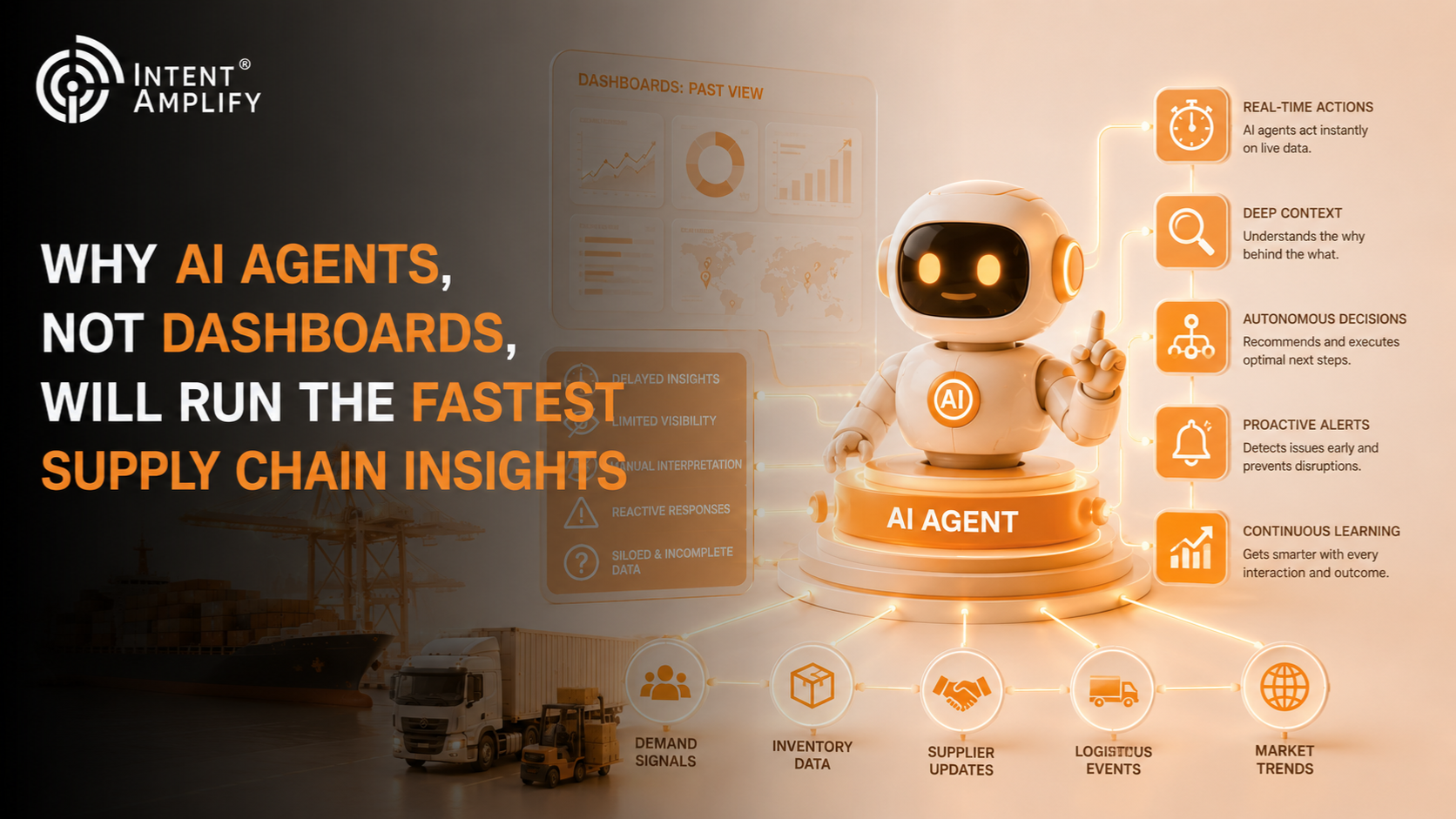
Decision velocity reflects an organization's ability to recognize change, evaluate options, and respond quickly without sacrificing governance or accountability. This is where AI agents begin to extend beyond traditional dashboards. A dashboard highlights what happened. An AI agent can help interpret the issue, assess alternatives, recommend a course of action, and coordinate the next steps.
Gartner predicts that 70% of large organizations will adopt AI-based supply chain forecasting by 2030, reinforcing the growing role of AI in planning and decision support. 5
Forecasting is only one part of the transformation. The greater opportunity lies in connecting forecast signals with inventory positioning, capacity planning, supplier commitments, logistics constraints, financial targets, and service priorities.
McKinsey's 2025 Global Survey on AI found that 88% of respondents report regular AI use in at least one business function, while only about one-third say their organizations have begun scaling AI initiatives. That gap highlights an important challenge: creating value requires more than deploying AI. It requires integrating AI into the decisions and workflows that shape business outcomes.6
That gap matters.
Many enterprises have moved beyond curiosity and into experimentation, yet relatively few have embedded intelligent decision-making into the operating model. Supply chains do not become faster because another AI pilot is launched. They become faster when AI-supported workflows are integrated into the decisions and processes that shape daily planning and execution.
The Latency Problem in Modern Planning
Most supply chains are not short on data. They are short on timely interpretation.
A demand signal arrives. A supplier updates capacity. A customer changes an order. A port delay affects inbound flow. A tariff decision changes landed cost. Each event triggers a chain reaction. Yet many planning processes still run through weekly meetings, monthly cycles, spreadsheet exchanges, and manual exception reviews.
That delay is the real bottleneck.
The OMP and Supply Chain Now webinar, “AI That Moves at Velocity: Cut Through Latency with Agentic Workflows,” frames this issue directly. The webinar notes that most supply chains are not short on data; they are short on decision velocity. It also highlights that planning often still runs in weekly or monthly cycles, even as demand, supply, and financial conditions can shift hourly.
This is why agentic workflows matter. They can help planning teams move from periodic review to continuous adaptation. Instead of waiting for a meeting to diagnose the issue, an AI agent can surface the signal, assess downstream impact, recommend actions, and route the decision to the right stakeholder.
Signal-to-Plan: Where Agents Change the Planning Rhythm
One of the most valuable applications of agentic workflows is the move from signal to plan.
In conventional planning environments, signals often arrive faster than teams can interpret and act on them. Market shifts, customer behavior, supplier constraints, and logistics disruptions may be visible, but they are not always translated into plan changes quickly enough.
The OMP webinar highlights Signal-to-Plan as one of the two workflows where leading organizations are moving from periodic planning to continuous, adaptive planning.
This shift matters because signal interpretation is where many planning processes lose time. AI agents can help compare demand changes against supply availability, inventory thresholds, production constraints, and financial goals. They can suggest scenarios and prompt decision-makers before the problem becomes visible to customers.
For U.S. businesses operating across complex supplier networks, this is not theoretical. It is the difference between spotting a change and acting on it.
Inventory-to-Service: Turning Stock Decisions into Customer Outcomes
The second workflow featured in the OMP webinar is Inventory-to-Service. That focus is timely because inventory decisions now carry greater business weight.
Overstocking will lock up capital. Understocking can create service disruption, lost revenue, and customer dissatisfaction. What is difficult is not just determining the optimal amount of inventory. It is knowing where the inventory needs to be located, what customers or routes are more important than others, and how service promises need to be safeguarded under changed circumstances.
The webinar positions Inventory-to-Service as an end-to-end workflow that connects signals, plans, and execution as conditions change.
That is where AI agents can create practical value. They can monitor changes in demand, available supply, lead times, allocation rules, and service priorities. They can also help planners evaluate trade-offs faster: protect margin, protect availability, preserve strategic accounts, or reduce excess exposure.
This is the future of planning. Not more dashboards. More coordinated decision intelligence.
Governance Will Decide Whether Agents Scale
Agentic AI will not scale on novelty. It will scale on trust.
As AI becomes more involved in planning and execution, leaders will need clear governance. Which decisions can be automated? Which recommendations require human approval? Which data sources are authoritative? How are exceptions tracked? How are agent actions audited? What happens when commercial, financial, and service goals conflict?
KPMG’s Q1 2025 AI Pulse Survey reported that U.S. enterprise leaders plan to invest nearly $114 million in generative AI over the next year, up from $89 million in the prior quarter.7
KPMG’s later AI Quarterly Pulse report noted that organizations projected average AI spending of $207 million over the next 12 months, nearly double the level from the same period a year earlier.8
Those numbers show rising commitment. They also raise the stakes. Greater spending brings greater scrutiny. Executives will expect AI agents to improve response speed, reduce manual work, and support better outcomes without creating unmanaged risk.
Gartner has also warned that “agent washing” creates risk in the supply chain planning technology market as organizations face pressure to show AI results.9
That warning is useful. Buyers should look beyond the label. A real agentic workflow should connect goals, context, action, and governance. It should not simply rename automation as intelligence.
The OMP Perspective: Moving from Periodic to Adaptive Planning
OMP’s role in this conversation is relevant because the webinar focuses on how agentic workflows can help organizations cut through planning latency.
The session brings together Supply Chain Now, Zero100, and OMP to explore how leading organizations are moving from periodic to continuous, adaptive planning. It specifically examines Signal-to-Plan and Inventory-to-Service workflows, using examples from consumer goods and pharma to show what changes for processes, people, and results.
OMP’s AI-powered planning platform is positioned in the webinar as a technology backbone for making adaptive, agentic workflows operational.
This matters because enterprise leaders are not looking for another screen. They need planning environments that reduce delay, coordinate functions, and help teams adapt as reality changes. The OMP discussion is strongest when viewed through that lens: not as a product pitch, but as a practical discussion of how decision-centric planning is evolving.
The webinar also addresses barriers that leaders cannot ignore: talent, organizational readiness, new skills, team structures, and governance.
Honesty is important. AI agents will not fix weak operating models by themselves. They require teams that understand planning, technology, data, and business trade-offs.
Benefits for Supply Chain and Business Leaders
Agentic workflows can create measurable value when they are applied to the right problems.
First, they reduce the lag between signal and response. Planning can focus more on decision shaping rather than issue discovery. Second, they improve coordination by connecting demand, inventory, operations, finance, and customer priorities in one flow. Third, they promote resilience through quicker evaluation during periods of disruption.
Gartner reports that more than half, 55%, of supply chain leaders expect advancements in agentic AI to reduce the need to hire for entry-level positions, while 51% believe the technology will drive a shift to overall workforce reductions.10
This statistic should be interpreted carefully. The stronger message is not simply labor reduction. It is a role redesign. As routine work becomes more automated, planners will need to move toward orchestration, exception judgment, scenario design, and cross-functional decision support.
The best agentic workflows will not remove humans from planning. They will help people focus where judgment matters most.
What Leaders Should Do Now
Leaders should begin by identifying where latency creates the most business risk. That may be demand sensing, supply response, inventory allocation, service recovery, production replanning, or financial scenario evaluation.
Next, they should define which decisions can be assisted, which can be automated, and which must remain human-led. This distinction is essential. Agentic AI should expand decision capacity without weakening accountability.
Third, organizations should review data readiness. Agents require reliable signals, clean master data, clear business rules, and trusted system integration. If the foundation is weak, speed can amplify error.
Finally, leaders should measure outcomes that reflect business value. Useful metrics include time to decision, forecast response time, service recovery speed, planner productivity, inventory exposure, revenue protected, and exception-resolution rate.
The goal is not to replace dashboards overnight. The goal is to move beyond passive visibility toward execution.
Conclusion
Dashboards will remain valuable for visibility and performance management, but they do not close the gap between insight and action. As supply chains become more dynamic, organizations need capabilities that can interpret signals, recommend responses, and coordinate execution across functions.
Competitive advantage will increasingly depend on how quickly those capabilities translate change into action.
For enterprise leaders, that marks a fundamental shift in planning. The focus is moving from periodic review to continuous adaptation, with AI agents helping teams manage complexity, accelerate response cycles, and improve decision-making in real time.
The organizations that advance fastest will not simply add more analytics. They will build governed agentic workflows that combine automation with human judgment, speed with accountability, and intelligence with operational discipline.
In a market where conditions change hourly, the strongest supply chains will not be the ones with the most dashboards. They will be the ones who decide, adapt, and execute faster.
Learn More
Are your supply chain teams still waiting for weekly planning cycles to catch up with market reality?
The OMP and Supply Chain Now webinar, “AI That Moves at Velocity: Cut Through Latency with Agentic Workflows,” explores how leading organizations are moving from periodic to continuous, adaptive planning. The discussion focuses on two practical workflows, Signal-to-Plan and Inventory-to-Service, and explains how agentic AI can help reduce latency, improve readiness, and support faster planning decisions.
Watch the webinar to hear how Supply Chain Now, Zero100, and OMP frame the shift from dashboards to agentic workflows, and what leaders should consider as they pilot AI-enabled planning at scale.
About Intent Amplify
Intent Amplify helps B2B technology organizations engage high-value audiences through demand intelligence, content-led programs, and go-to-market strategies built around measurable business outcomes. By combining audience insights, editorial expertise, and intent-driven engagement, Intent Amplify supports technology brands in reaching decision-makers with content that educates, informs, and advances meaningful buyer conversations.
For organizations looking to turn market interest into qualified demand, Intent Amplify provides the strategic foundation to connect trusted content with the right audience at the right stage of the buying journey.
Contact us to learn how Intent Amplify can help your organization convert audience intent into qualified demand and stronger go-to-market outcomes.
References
-
Gartner, Gartner Forecasts Supply Chain Management Software with Agentic AI Will Grow to $53 Billion in Spend by 2030, April 7, 2026
-
Gartner, Gartner Predicts Half of Supply Chain Management Solutions Will Include Agentic AI Capabilities by 2030, May 21, 2025
-
Gartner, Gartner Predicts 60% of Supply Chain Disruptions Will Be Resolved Without Human Intervention by 2031, March 18, 2026
-
PwC, 2025 Digital Trends in Operations Survey, May 1, 2025
-
Gartner, Gartner Predicts 70% of Large Organizations Will Adopt AI-Based Supply Chain Forecasting to Predict Future Demand by 2030, September 16, 2025
-
McKinsey & Company, The State of AI: Global Survey, 2025
-
KPMG, Q1 2025 AI Pulse Survey, April 2025
-
KPMG, AI Quarterly Pulse Survey, 2025
-
Gartner, Gartner Warns of Agent Washing Risks in Supply Chain Planning Technology Market, May 20, 2026
-
Gartner, Gartner Survey Shows 55% of Supply Chain Leaders Expect Agentic AI to Reduce Entry-Level Hiring Needs, February 25, 2026