
Executive Insight
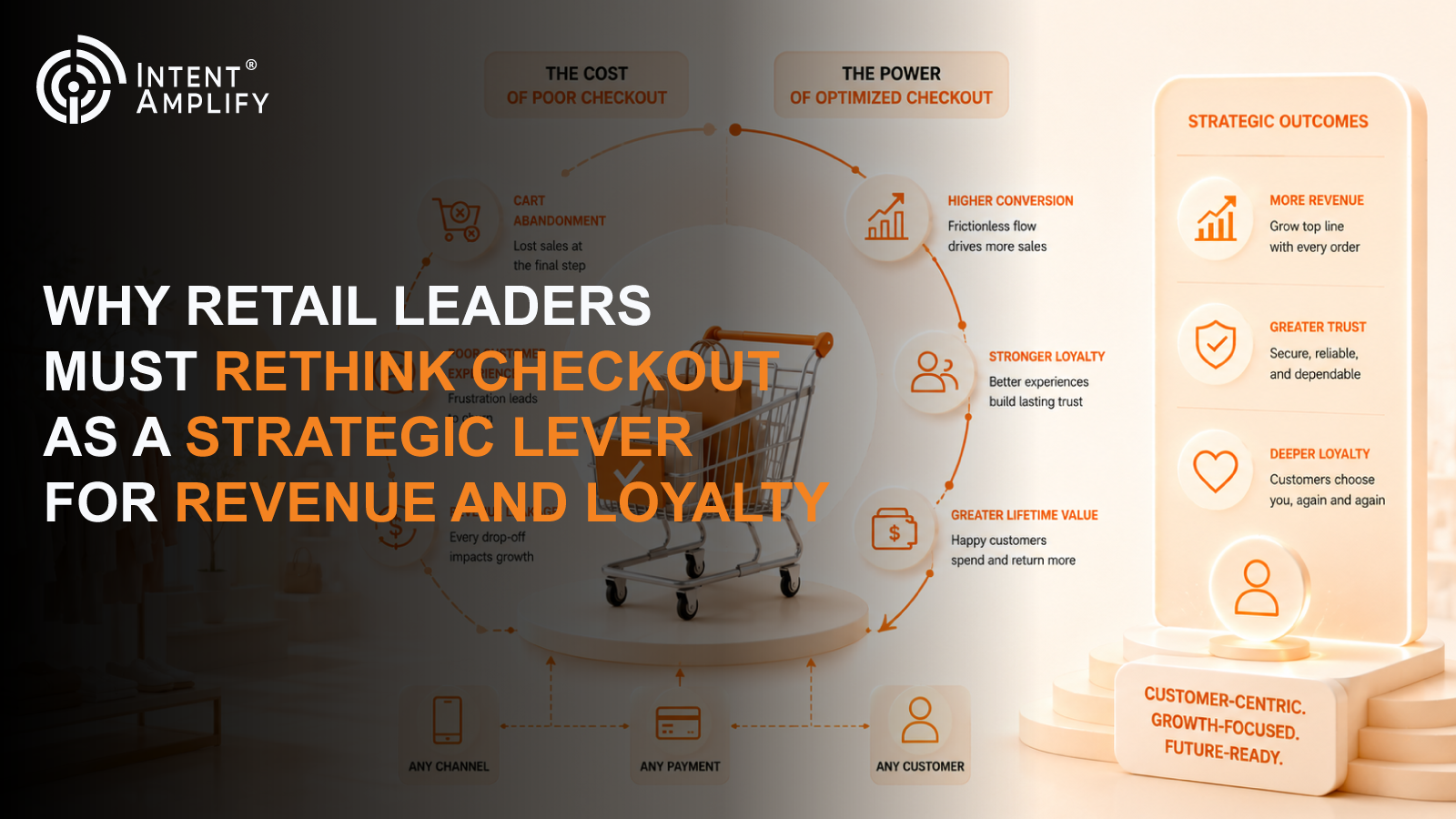
Checkout has become one of the most underexamined revenue levers in retail. For years, many retailers treated checkout as a functional endpoint: a payment screen, a card terminal, a point of sale system, or a final confirmation page. The view no longer reflects how customers buy or how retailers capture value. In a market shaped by mobile commerce, digital wallets, buy-now-pay-later, omnichannel payments, AI-assisted discovery, and rising customer expectations, checkout now determines whether customer intent becomes revenue or disappears into friction.
Payment approval alone provides an incomplete measure of checkout performance. Retail leaders need to understand how checkout performance affects conversion, loyalty, margin, fraud exposure, store throughput, and customer trust. A customer who abandons a cart, leaves a queue, fails a mobile checkout, or encounters unnecessary identity verification represents more than a lost transaction. The impact can include reduced lifetime value, weaker brand trust, and measurable revenue leakage across the commerce ecosystem.
McKinsey's 2025 Global Payments Report found that the global payments industry generated $2.5 trillion in revenue from $2.0 quadrillion in value flows and 3.6 trillion transactions worldwide, underscoring the scale at which payment performance now influences commercial outcomes. 1
Checkout Is No Longer a Back-Office Payment Function
Retailers have invested heavily in customer acquisition, personalization, loyalty programs, and digital storefronts. Yet many still lose customer intent at the last commercial mile. Checkout friction appears in multiple forms: slow payment processing speed, limited payment methods, long in-store queues, mobile checkout complexity, payment latency, failed wallet handoffs, excessive form fields, confusing authentication, and inconsistent omnichannel experiences.
Checkout optimization has become an enterprise performance discipline rather than a tactical e-commerce initiative. Cart abandonment and checkout abandonment are commonly associated with digital commerce, yet the same performance dynamics apply in physical retail environments.
A long queue, an unavailable smart POS terminal, a declined contactless payment, or a disconnected loyalty profile can produce the same outcome as an abandoned online checkout: the customer's intent is not converted.
Microsoft's July 2025 retail payments analysis described payments as a strategic inflection point where customer expectations, brand trust, and operational efficiency converge. It also emphasized that wallets, BNPL, Pay by Link, and mobile SoftPOS are becoming part of a broader retail payment strategy rather than isolated payment features. 2
Retail leaders should measure checkout performance beyond approval rates. Transaction approval does not guarantee a positive customer experience. Excessive effort, delays, or uncertainty can undermine the purchase journey despite successful authorization.
Mature retailers should monitor checkout performance metrics such as authorization latency, failed attempts, payment retries, cart abandonment, checkout abandonment, queue duration, false declines, tender mix, fraud review rates, mobile checkout completion, and abandoned cart recovery outcomes.
Revenue Leakage Is Often Hidden in Checkout Data
Revenue leakage in retail is rarely visible as a single line item. It is distributed across abandoned baskets, interrupted store purchases, avoidable payment declines, slow checkout lanes, failed digital wallet transactions, and customers who do not return after a poor experience. This makes checkout performance analysis essential for both revenue recovery and conversion rate optimization.
Many retailers continue to manage checkout data in silos.
E-commerce teams may track cart abandonment. Store operations may track queue management. Finance may track payment costs. Fraud teams may track chargebacks and losses. IT may track platform uptime. Each metric provides value independently. Separation limits visibility into how checkout friction affects overall retail performance.
Gartner's 2025 Market Guide for unified commerce platforms stated that POS applications anchor unified commerce platforms for seamless customer experiences across retailer touchpoints. This reinforces the view that POS software and payment infrastructure are no longer only store execution tools; they are central components of unified commerce. 3
Retailers should therefore assess modern POS systems, Android POS, mobile POS, and cloud-based POS solutions based on their contribution to checkout performance. The best POS system for retail stores is not only the one that processes transactions. The strongest platforms reduce checkout wait times, support digital payments, enable omnichannel returns, improve associate mobility, connect customer identity, and provide actionable operational data.
Payment Choice Has Become a Conversion and Loyalty Signal
Payment choice directly affects conversion because customers increasingly expect checkout to adapt to their preferred payment behavior. Digital wallets, BNPL payments, installment payments, alternative payment methods, and emerging stablecoin payments all reflect a broader shift toward customer-directed payment experiences.
However, adding payment methods without governance can increase operational complexity. Retail leaders should avoid treating payment choice as a checklist. The question is not simply which payment methods are available. Retail leaders should evaluate which payment methods improve conversion, reduce friction, protect margin, and align with customer retention goals.
Accenture's 2026 banking trends research estimated that $13 trillion in transaction value could shift to alternative payment methods by 2030, placing $13 billion in payment fees at risk. While the report focuses on banking, the retail implication is direct: payment preferences are fragmenting, and merchants need a payment infrastructure strategy that balances conversion, cost, and customer experience. 4
Retailers should evaluate digital wallet adoption, BNPL checkout integration, mobile payment solutions, and omnichannel payment solutions through four lenses: customer demand, transaction economics, risk exposure, and operational readiness. For example, BNPL may increase average order value in some categories but may not be suitable for every basket or margin profile.
Digital wallets may reduce payment friction and improve mobile checkout conversion, but integration quality determines whether the experience is genuinely faster. Stablecoin payments may become more relevant in cross-border or digitally native segments, but retailers must evaluate settlement, compliance, and volatility considerations before adoption.
Trust, Identity, and Security Are Now Part of the Checkout Experience
Checkout security is not separate from customer experience. It directly shapes whether customers trust the transaction enough to complete it. Fraud prevention, payment security, digital identity verification, customer verification, and age verification software are necessary in modern retail, especially for high-risk, regulated, or high-value categories. The issue is how these controls are applied.
Over-verification can increase checkout abandonment. Under-verification can increase fraud losses, chargebacks, and compliance exposure. The mature approach is risk-based checkout security: apply stronger controls when transaction risk is elevated, but reduce unnecessary friction for trusted customers, returning users, tokenized wallets, and low-risk baskets.
This is particularly important as agentic commerce develops. In agentic commerce, AI assistants may influence or complete purchases on behalf of customers. Retailers will need machine-readable product data, reliable payment methods, clear incentives, secure authentication, and trusted transaction flows. If an AI agent detects poor payment reliability, unclear return conditions, or weak checkout execution, it may route the customer elsewhere.
Deloitte's 2026 retail and consumer trends research states that retail is moving away from shoppers manually searching and comparing products toward shoppers delegating decisions to AI assistants. 5
Accenture's 2026 agentic commerce research further argues that payment performance will be key to boosting conversions, reducing disputes, limiting fraud exposure, reducing servicing costs, and being selected by agents. 6
The implication is significant: checkout performance will increasingly influence visibility and selection, not only transaction completion. Retailers that cannot prove payment reliability, trust, and execution consistency may lose demand before the customer reaches their own checkout environment.
What Retail Leaders Should Do Next
Retail leaders should rethink checkout as a strategic lever across five areas.
First, establish checkout performance ownership. Checkout should not sit only with e-commerce, payments, IT, or store operations. It requires shared governance across digital, finance, fraud, customer experience, store operations, and technology leadership.
Second, build a checkout performance dashboard. This should include cart abandonment, checkout abandonment, payment latency, payment retries, failed wallet transactions, false declines, queue duration, mobile checkout completion, fraud review rates, BNPL usage, digital wallet adoption, and revenue recovery outcomes.
Third, prioritize friction by revenue impact. Not all checkout friction has equal commercial significance. Retailers should identify where lost revenue is concentrated: mobile checkout, in-store queue management, payment authorization, digital identity verification, specific payment methods, or omnichannel payment gaps.
Fourth, modernize payment infrastructure around measurable outcomes. Payment orchestration, unified commerce platforms, cloud-based POS solutions, Android POS, and smart POS terminals should be evaluated based on conversion, throughput, reliability, security, and data visibility.
Fifth, align checkout security with customer trust. Secure checkout identity verification, fraud prevention methods, and age verification at the point of sale should protect the retailer without creating unnecessary friction for legitimate customers.
Why This Matters for IntentAmplify
For retail technology vendors, payment providers, POS platforms, fraud prevention firms, and commerce infrastructure companies, checkout performance is becoming a high-intent market conversation. Buyers are actively researching how to reduce cart abandonment rate, improve mobile checkout conversion, recover lost sales from checkout abandonment, modernize retail payment infrastructure, and create frictionless checkout experiences that drive loyalty.
IntentAmplify helps organizations identify, interpret, and act on these demand signals. Our work supports companies that need to understand which accounts are engaging with topics such as checkout optimization, point of sale system modernization, digital wallet payment trends, BNPL checkout integration, omnichannel payments, checkout security, payment orchestration, and unified commerce platform adoption.
For a deeper view of how checkout performance affects revenue capture and customer intent, readers can access the benchmark asset here.
Retail and commerce solution providers looking to strengthen market positioning, content strategy, buyer intelligence, or demand generation around checkout performance can connect with Intent Amplify.
Strategic Takeaway
Checkout is where customer intent is either converted, delayed, or lost. Retailers that continue to treat checkout as a transaction endpoint will understate its effect on revenue and loyalty.
Leaders who treat checkout performance as a strategic operating metric will be better positioned to reduce revenue leakage, improve conversion, strengthen trust, and compete in a commerce environment shaped by unified commerce, AI-assisted buying, and increasingly selective customers.
References
- McKinsey & Company (2025) The 2025 McKinsey Global Payments Report: Competing systems, contested outcomes. Available at: https://www.mckinsey.com/industries/financial-services/our-insights/global-payments-report (Accessed: 12 June 2026).
- Microsoft (2025) Next-Gen Retail Payments: Trends, Tech, and Transformation using Dynamics 365 Commerce + Adyen. Available at: https://www.microsoft.com/en-us/dynamics-365/blog/it-professional/2025/07/16/retail-payments-innovations-trends-tech-and-transformation-using-dynamics-365-commerce-ayden/ (Accessed: 12 June 2026).
- Gartner (2025) Market Guide for Unified Commerce Platforms Anchored by POS for Tier 1 Retailers. Available at: https://www.gartner.com/en/documents/6994666 (Accessed: 12 June 2026).
- Accenture (2026) Top Banking Trends for 2026. Available at: https://www.accenture.com/us-en/insights/banking/accenture-banking-trends-2026 (Accessed: 12 June 2026).
- Deloitte (2026) Quarterly Retail and Consumer Trends. Available at: https://www.deloitte.com/us/en/Industries/consumer/articles/retail-consumer-trends.html (Accessed: 12 June 2026).
- Accenture (2026) Agentic Commerce: Make Your Brand Unmissable. Available at: https://www.accenture.com/us-en/insights/song/agentic-commerce (Accessed: 12 June 2026).