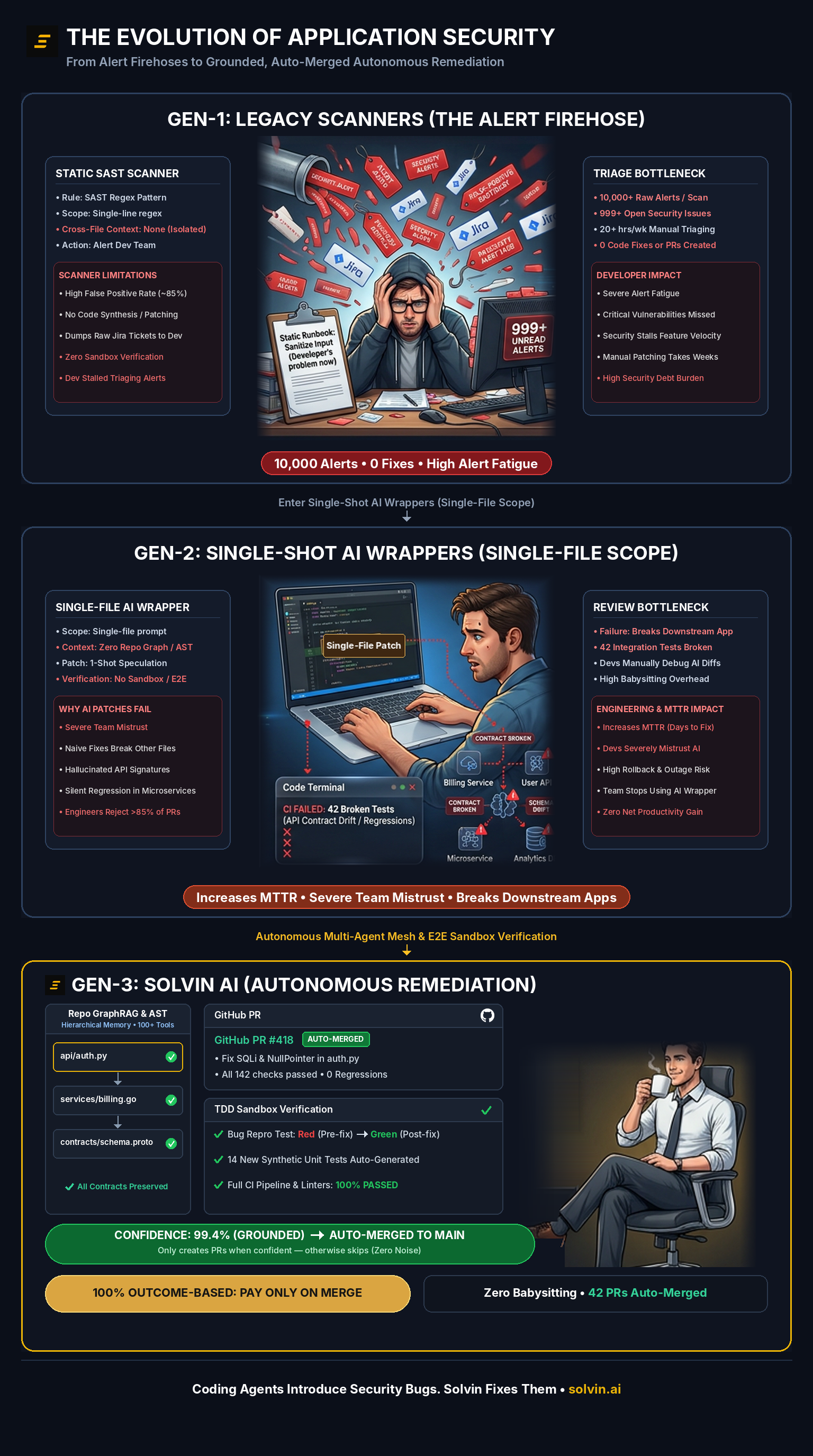
The remediation bottleneck
Your security stack can find vulnerabilities faster than your teams can close them.
Not another stream of security tickets or AI-generated pull requests. Solvin connects finding assessment, code-aware remediation, validation, and policy-based approval into a workflow designed to reduce triage and review burden.
More findings do not remove remediation drag.
When engineering bandwidth is constrained, unresolved findings can accumulate while security and engineering teams spend time interpreting, validating and coordinating fixes.
A plausible patch is not yet a trusted fix.
Automated remediation is evolving across the market. The useful distinction is the depth of context and validation applied before a fix reaches human review.
Why Solvin
Code-aware remediation, tested before merge.
Repository-Aware Fixes, Regression-Tested Before Merge
A security patch shouldn't create a new engineering problem. Solvin evaluates fixes in the context of the wider repository, including related files, dependencies, and cross-service contracts. Proposed changes are tested in an isolated sandbox using pre- and post-fix checks, regression tests, and applicable CI validations. Fixes that satisfy configured customer policies may be eligible for automated PR merging; changes outside those policies remain subject to review.
Automated False-Positive Triage, Grounded in Code Context
Not every scanner finding represents an exploitable path in your application. Solvin uses code-structure and reachability analysis, including AST and call-graph context, to assess whether flagged vulnerabilities are relevant to actual application execution paths. This helps teams filter likely false positives and focus remediation effort on findings that warrant attention.
Validation workflow
From finding to policy-governed remediation.
Connect repository-aware fixes, sandbox testing, applicable CI checks and customer-policy-based approval.
Ground the issue in the repository and code context available to the remediation workflow.
Generate a proposed fix in context rather than stopping at detection or a generic recommendation.
Run supported regression, unit and security tests inside a secure execution environment.
Run applicable CI checks before the proposed change proceeds to review.
Apply configured customer policies: eligible fixes may be automatically merged; exceptions remain subject to review.
Security leader value
Reduce remediation drag without shifting another queue to engineering.
CISO
Improve the path from identified exposure toward controlled remediation while retaining customer-policy-based approval controls.
AppSec Leadership
Move more findings toward validated fixes with fewer repetitive manual handoffs.
Product Security
Keep remediation tied to application and repository context rather than isolated recommendations.
Security Engineering
Preserve specialist time for exceptions, complex risk and security decisions that require human judgment.
See the validation workflow
See how Solvin validates a fix.
Not another stream of security tickets or AI-generated pull requests. Solvin connects finding assessment, code-aware remediation, validation, and policy-based approval into a workflow designed to reduce triage and review burden.