
Published by Intent Amplify, delivering research-driven insight for supply chain leaders, CIOs, COOs, planning executives, digital transformation teams, and enterprise decision-makers navigating AI, latency reduction, operational resilience, and adaptive planning.
Supply chain leaders today have access to more operational data than ever before. Yet many organizations still struggle to respond quickly when demand shifts, supplier conditions change, or financial assumptions move unexpectedly. The challenge is often not information availability but the speed at which organizations can convert information into action.
This challenge is becoming more significant as supply chains operate in increasingly dynamic environments where decisions often need to be evaluated much faster than traditional planning cycles allow. Financial assumptions move faster than planning calendars. Customer expectations do not wait for the next review cycle.
The result is decision latency: the gap between recognizing a change and acting on it effectively.
Supply Chain Now’s webinar, “AI That Moves at Velocity: Cut Through Latency with Agentic Workflows,” frames the issue directly: planning still runs in weekly or monthly cycles, and that delay becomes the bottleneck when demand, supply, and financials shift hourly.1
The session brings together Zero100 and OMP to explore how leading organizations are moving from periodic planning to continuous, adaptive planning through two high-impact workflows: Signal-to-Plan and Inventory-to-Service. 1
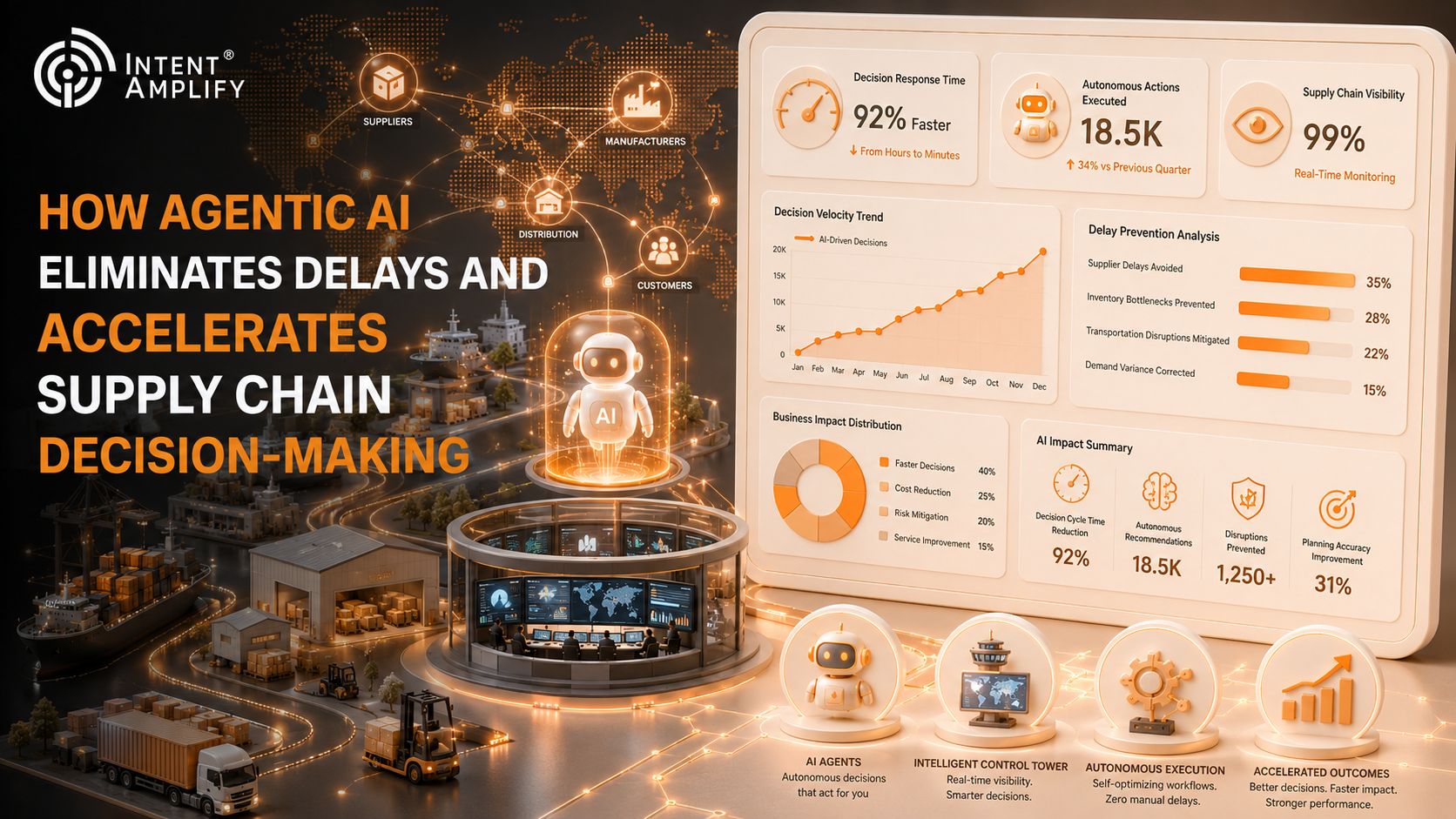
This is one reason agentic AI is attracting growing attention across supply chain organizations.
Agentic AI expands beyond traditional analytics by monitoring signals, evaluating context, generating scenarios, and supporting decision-making workflows.
View the Supply Chain Now webinar
Key Figures at a Glance
PwC’s 2026 Digital Trends in Operations Survey of 767 operations and supply chain leaders found 85% say they are ahead of competitors in digital transformation, yet 89% say technology investments have not fully delivered expected results. PwC also found 83% of leaders believe AI agents and automation will accelerate the breakdown of traditional functional silos. 2
Accenture’s Pulse of Change reports 82% of C-suite leaders expect higher change levels in 2026, while 86% plan to increase AI investment. 3
Microsoft describes an agentic supply chain architecture that helps move from intelligence to impact through AI agents, connected workflows, and real-time decision support. 4
Microsoft’s Supply Chain 2.0 research describes a global pharmaceutical company using agentic architecture to identify temperature-critical returns in real time and unlock multi-million euro annual productivity gains. 5
Google Cloud’s 2026 update highlights 1,302 real-world generative AI use cases from leading organizations. 6
Google Cloud reports that Domina manages 20 million+ annual shipments and uses Vertex AI and Gemini to predict package returns and automate delivery validation. 7
OMP’s UnisonIQ brings always-on agents, optimization, machine learning, and explainable AI into supply chain planning workflows.
Viewed collectively, these findings suggest that many organizations are reaching a similar conclusion: technology investments alone do not guarantee faster decisions. The ability to connect signals, planning processes, and execution activities may become a more important differentiator than data availability itself.
Figure: Where Decision Latency Hides
|
Latency Point |
What Happens Today |
Agentic Workflow Advantage |
|
Demand signals |
Teams wait for planning cycle updates |
Signals trigger faster scenario refresh |
|
Inventory deployment |
Stock decisions lag reality |
Inventory moves closer to service needs |
|
Exception handling |
Teams react after a disruption appears |
Agents identify and escalate earlier |
|
Financial trade-offs |
Cost impact is reviewed late |
Margin and service effects surface sooner |
|
Execution handoff |
Plans stall between functions |
Workflows connect planning to action |
Why Decision Latency Is Becoming a Leadership Issue
Decision latency is ultimately an organizational challenge. Technology can accelerate analysis, but delays often originate in fragmented workflows, unclear accountability, and planning processes that cannot adapt quickly enough to change.
The webinar takes a practical approach to agentic AI by focusing on two workflows where measurable impact is already emerging: Signal-to-Plan and Inventory-to-Service.1
Many leaders have moved beyond broad discussions about AI and are now focused on execution. They want to understand where to begin, how workflows will change, what new responsibilities will emerge, and which obstacles could slow adoption.
Supply Chain Now also emphasizes an important reality: scaling AI in planning requires more than technology. Success depends on the right operating model, cross-functional collaboration, workforce readiness, governance, and the ability to integrate new ways of working into existing planning processes.1
For OMP and Zero100, this is strong brand positioning. The conversation is not about replacing planners. It is about giving planning teams the operating model and technology backbone to move at the pace of reality.
Moving from Periodic Planning to Adaptive Planning
Zero100 describes Power Threads as end-to-end workflows that connect signals, plans, and execution so decisions update as reality changes. 1
That idea matters because supply chain work has historically been fragmented by function. Demand planning, inventory planning, logistics, finance, and execution often operate with separate timelines, tools, and assumptions.
This approach seeks to reduce those disconnects by linking planning activities more closely with execution realities.
Signal-to-Plan connects market, demand, supply, and operational signals within a planning loop that can adapt more quickly to change. Inventory-to-Service links demand signals, supply constraints, deployment, replenishment, and fulfillment into a connected workflow focused on product availability.
Technologies that combine optimization, machine learning, explainable AI, and workflow orchestration help organizations build more adaptive planning processes.
Decision Velocity Framework
|
Workflow |
Business Question |
Why Agentic AI Helps |
|
Signal-to-Plan |
What should change when signals shift? |
Agents interpret change and refresh planning scenarios |
|
Inventory-to-Service |
Where should inventory move to protect availability? |
Agents connect demand, constraints, replenishment, and fulfillment |
|
Exception-to-Action |
Which disruption needs attention first? |
Agents prioritize based on service, cost, and risk impact |
|
Scenario-to-Decision |
Which option is best now? |
Agents compare outcomes faster across functions |
|
Plan-to-Execution |
How does the decision move into action? |
Agents reduce handoff delays between teams |
Why Decision Speed Matters
Faster decisions create value only when they are supported by visibility, governance, and accountability. The objective is not speed for its own sake; it is the ability to respond more effectively while maintaining appropriate oversight.
Supply chain leaders need faster answers alongside confidence in how those answers are generated. A poor decision made quickly can still damage service, margins, and customer trust. Agentic workflows help reduce latency while preserving transparency and human judgment throughout the decision process.
For clients, the benefits are practical: faster responses to changing demand and supply conditions, stronger service protection, better cross-functional alignment, and planning processes that can scale as complexity grows.
More broadly, AI is increasingly being evaluated not only as a technology investment, but also as an operating capability that can reduce friction across planning and execution.
What Leaders Should Prioritize First
One common mistake in AI adoption is attempting to automate too many processes simultaneously. Many organizations achieve stronger outcomes by focusing on a limited number of high-impact workflows before expanding adoption.
|
Priority |
Why It Matters |
Business Outcome |
|
Pick the workflow |
Avoid broad AI pilots with unclear value |
Faster time to impact |
|
Define decision owners |
Agents need human accountability |
Stronger governance |
|
Connect signals |
Planning quality depends on live context |
Better responsiveness |
|
Build fusion teams |
AI adoption crosses supply chain, IT, and data science |
Faster scaling |
|
Measure latency reduction |
Track how much faster decisions move |
Visible business value |
The strongest starting point is not “deploy agentic AI everywhere.” It is selecting a workflow where latency is already expensive.
Signal-to-Plan and Inventory-to-Service are good candidates because they sit close to demand volatility, service performance, inventory productivity, and executive decision-making.
The Boardroom Takeaway
Executive teams are asking whether their planning processes can respond quickly enough to protect service levels, margins, and customer commitments during periods of uncertainty. As decision cycles compress, reducing the delay between signal detection, planning, and execution becomes a critical business capability.
In many organizations, decision delays can create operational and financial consequences comparable to traditional supply chain risks.
Supply Chain Now, Zero100, and OMP are focusing on the right challenge: workflows rather than technology hype. The value of AI will be determined not by isolated tools, but by connected operating processes that shorten the path from signal to action.
That focus makes the discussion especially relevant for organizations navigating increasing complexity and volatility.
Bottom Line
As supply chains become more dynamic, organizations increasingly need planning processes that can adapt at the same pace as changing business conditions. The long-term value of agentic AI may be less about automation itself and more about helping organizations shorten the time between recognizing change and responding effectively. Companies that improve decision velocity while maintaining governance and accountability are likely to be better positioned to navigate future uncertainty.
Competitive advantage may increasingly depend on how effectively organizations transform information into timely decisions.
Reserve your seat to explore Signal-to-Plan and Inventory-to-Service workflows
Be Ready for What’s Next
Subscribe to Intent Amplify for insightful analysis of the adoption of artificial intelligence and digital transformation powered by data.
References
- Supply Chain Now and IntentTechPub (2025) AI That Moves at Velocity. Supply Chain Now and IntentTechPub, 2025.
- PwC (2026) 2026 Digital Trends in Operations Survey. PricewaterhouseCoopers (PwC), 2026.
- Accenture (2025) Pulse of Change. Accenture, 2025.
- Microsoft (2025). From Intelligence to Impact. Microsoft Corporation, 2025.
- Microsoft (2024) Supply Chain 2.0. Microsoft Corporation, 2024.
- Google Cloud (2026) Google Cloud Next 2026. Google Cloud, 2026.
- Google Cloud (2024) Real-World Gen AI Use Cases. Google Cloud, 2024.