
logo
logo
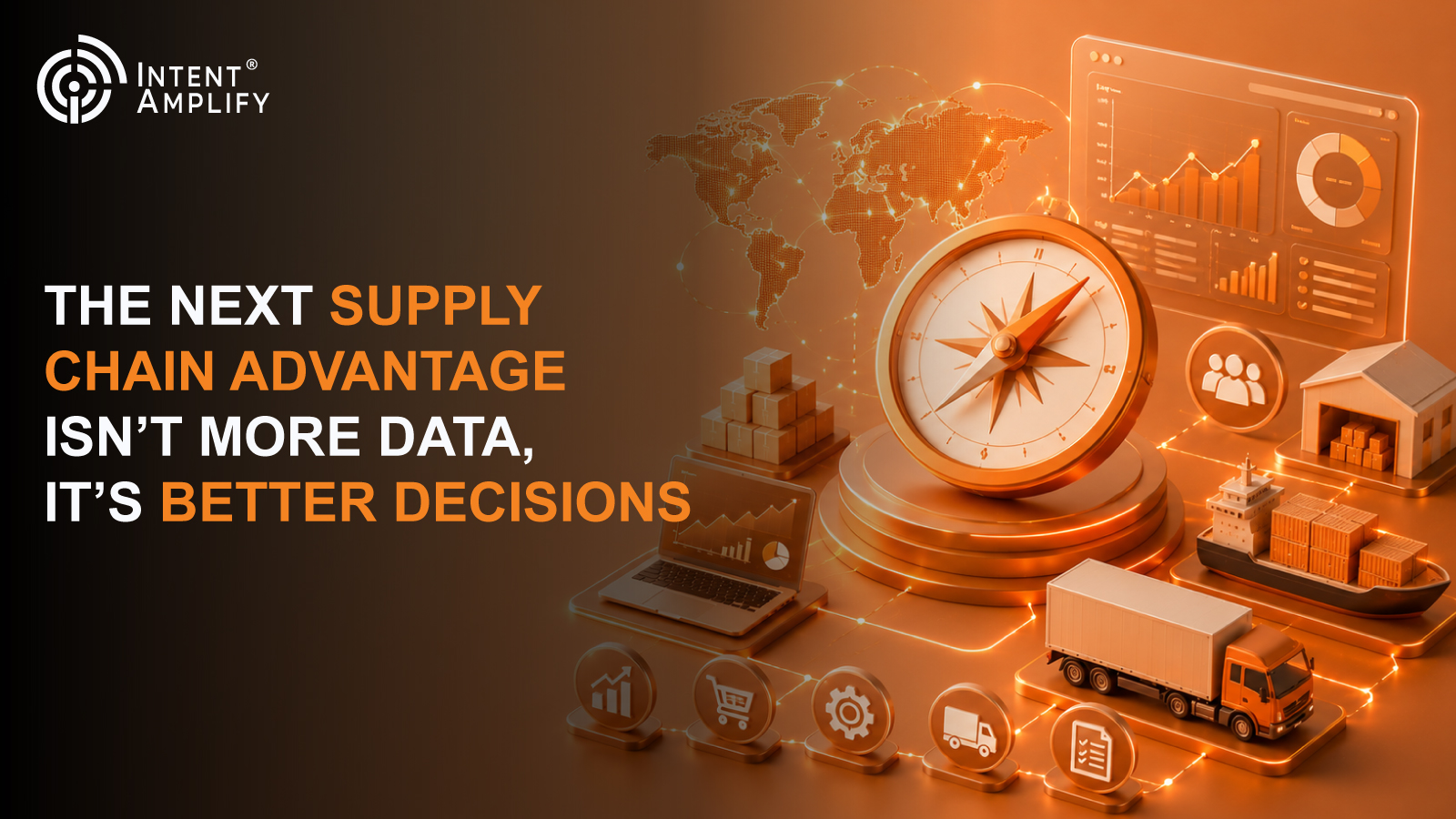
The Next Supply Chain Advantage Isn’t More Data, It’s Better Decisions

NEWSLETTER

The Next Supply Chain Advantage Isn’t More Data, It’s Better Decisions

Learn how supply chain decision intelligence helps manufacturers improve planning, optimize inventory, strengthen governance, and turn AI insights into better business decisions.

Executive Snapshot

Supply chain organizations across life sciences, pharmaceuticals, biotechnology, and consumer goods manufacturing generate vast volumes of operational data. Enterprise resource planning systems, supplier updates, demand plans, quality release information, inventory records, production schedules, and forecasting platforms already provide extensive operational visibility. Enterprise performance is constrained less by data availability than by fragmented information flows reaching planners after critical decision windows have narrowed.

Competitive advantage increasingly depends on decision architecture. Supply chain decision intelligence integrates planning data, operational constraints, governance policies, simulation models, and AI-assisted decision support into a coordinated planning environment. Inventory planning and inventory management functions retain human judgment while improving the consistency, transparency, and defensibility of operational decisions as supply conditions, demand patterns, quality status, and financial assumptions evolve.

Deloitte's 2026 Midyear Life Sciences Outlook reported that 62% of executives expressed greater confidence in their organization's outlook, while only 9% reported improved confidence in the global economy.¹ The divergence highlights an important enterprise reality. Competitive differentiation increasingly depends on execution quality rather than macroeconomic conditions. Supply chain planning remains one of the few enterprise capabilities with direct influence over resilience, service performance, inventory efficiency, and working capital. [1]

Key Industry Updates

AI Activity Is Outpacing Measurable Planning Value

Deloitte also reported that 71% of life sciences executives had made progress on AI deployment over the prior six months, yet only 45% had seen measurable performance gains. This is where many supply chain AI programs stall. The issue is not necessarily model capability. It is whether AI outputs are embedded in planning governance, master data management, compliance workflows, and daily decision routines. [1]

In pharmaceuticals and biotechnology, a forecast recommendation can achieve high accuracy at the product-family level while remaining operationally infeasible. Batch release schedules, constrained materials, shelf-life limitations, and market allocation policies frequently determine whether a planning recommendation can be executed. Predictive models identify emerging shortages; enterprise governance determines the operational response.

Decision support platforms create value by connecting analytical insight with operational execution. Effective implementations integrate planning data, governance policies, decision rights, evidence requirements, and escalation pathways before AI-assisted recommendations enter production planning and supply chain execution.

Persistent Shortages Make Decision Latency More Expensive

U.S. drug supply risk remains a material operating concern. ASHP's Q1 2026 national drug shortages report showed 223 active drug shortages, up for the second consecutive quarter, although still below the Q1 2024 high of 323. ASHP also noted that 77% of active shortages began in 2022 or later, which indicates that many shortages are persistent structural constraints rather than short-lived exceptions. [2]

Persistent shortages increase the cost of decision latency. Delayed visibility compresses response windows, driving expedited freight, inventory reallocation, production disruption, and service-level compromise. Competitive advantage depends on sensing supply constraints early, evaluating operational alternatives, and positioning inventory where it delivers the greatest enterprise value across the end-to-end supply network.

Quality release management remains a critical determinant of inventory availability in regulated manufacturing. Physical inventory does not automatically translate into commercial availability because batch release, documentation, regulatory review, and quality approval govern product disposition. Misalignment between quality release and supply planning distorts inventory visibility and understates shortage exposure. AI-assisted release forecasting strengthens planning by identifying potential delays and capacity constraints, while release authorization remains the responsibility of quality governance.

Trend Analysis

Limited business value from AI-enabled planning reflects a broader decision architecture challenge. Enterprise resource planning (ERP) platforms remain the transactional foundation of manufacturing supply chains, but cross-functional operational prioritization extends beyond transactional systems. Planning organizations continue to reconcile demand variability, supplier performance, lead-time volatility, quality status, manufacturing capacity, regulatory constraints, and working capital objectives before operational commitments can be executed.

Decision intelligence introduces a governance layer connecting analytical insight with operational execution. Rather than generating additional dashboards or predictive scores, it structures planning around decision rights, evidence requirements, operational assumptions, escalation pathways, and accountable ownership. Effective planning therefore evaluates a defined set of governance questions: Which operational decision requires immediate action? Which business assumptions materially influence the recommendation? What operational exposure emerges if those assumptions prove inaccurate? Which authority owns execution and accountability?

Enterprise value emerges when AI operates within governed planning processes. AI identifies planning assumptions that have diverged from operational reality, while predictive analytics quantifies shortage exposure, supplier disruption, inventory risk, and release variability before execution. Simulation capabilities supported by digital twin models evaluate alternative operating scenarios, quantify implications for service performance, inventory investment, manufacturing utilization, and working capital, and provide decision-makers with evidence before capacity, inventory, procurement, or capital commitments are approved.

Inventory Optimization Must Move Beyond Stock Reduction

Inventory optimization is often framed as inventory reduction. That is too narrow for life sciences and consumer goods manufacturing. The real objective is to hold the right inventory, in the right location, under the right assumptions, with a clear view of service and cash implications.

PwC's Working Capital Study 25/26 estimated that €1.84 trillion in excess working capital could be freed up for investment. It also found a 13.6% increase in days inventory outstanding across the most cash-intensive sectors in Western markets, which makes the inventory implication sharper than a broad working-capital figure alone. The figures reinforce a familiar but under-managed problem: inventory can become cash-trapped in outdated planning assumptions. In manufacturing supply chains, those assumptions often sit inside planning parameters such as lead times, safety stock rules, minimum order quantities, yield assumptions, and replenishment cycles. [3]

ERP planning parameter optimization deserves more attention. Improving planning accuracy with AI is difficult if the planning engine still uses stale inputs. AI inventory optimization for working capital should identify parameter drift, then support controlled updates through planning governance.

Expert Commentary

AI Decision Support Needs Governance Before Scale

Gartner's April 2026 survey found that 56% of chief supply chain officers identified integration with legacy systems and processes as a major barrier to scaling AI, while 50% cited limited internal expertise or talent. The finding points to a larger implementation reality: AI scale is an operating model problem, not only a model deployment problem. [4]

Supply chain governance must define how recommendations are generated, reviewed, approved, overridden, and measured. Without that discipline, AI planning platform investments can produce better analysis without better execution. Planners may distrust recommendations, finance may question assumptions, and quality teams may reject opaque release-risk signals.

A practical governance framework for supply chains should include explicit decision rights, explainable recommendation logic, and outcome measurement against planning accuracy, inventory reduction, service reliability, lead time optimization, and cash flow optimization.

Talent also matters. Gartner reported that demand for supply chain roles requiring AI skills increased 387% from Q1 2023 to Q1 2026, based on an analysis of more than 35 million job postings, including nearly 600,000 supply chain roles. Organizations cannot rely only on external hiring to build AI-enabled planning maturity. They need planners who understand AI outputs and AI specialists who understand planning constraints. [5]

Actionable Insights

1. Map Decisions Before Selecting the Platform

Start with the highest-value decisions, not the technology stack. In life sciences and pharmaceutical supply chains, these often include inventory positioning, constrained material allocation, quality release planning, supplier delay response, and production rescheduling. Each decision should have a defined trigger, owner, approval route, data requirement, and success metric.

2. Treat Master Data as a Decision Asset

Master data management is not administrative cleanup. It is the foundation of planning credibility. If lead times, batch attributes, supplier records, and planning parameters are unreliable, supply chain analytics will only describe the wrong operating picture more efficiently.

3. Use Digital Twins for Trade-Off Analysis

A digital twin for inventory optimization should help teams test real trade-offs: release delays, allocation risk, safety stock changes, service exposure, and cash impact. Its value is not scenario modeling without operational consequence. Its value is stronger decision discipline before execution.

4. Link Inventory Decisions to Working Capital and Service Risk

Working capital optimization extends beyond a finance objective. Inventory decisions influence service performance, shortage exposure, product expiry, manufacturing responsiveness, and enterprise liquidity. Effective performance frameworks evaluate inventory investment alongside service levels, inventory health, lead-time variability, demand volatility, and cash flow outcomes.

For manufacturers evaluating where AI can improve planning performance, the first task is distinguishing decision support from dashboard noise. Explore Beyond the Dashboard: Where AI Helps Enterprise Supply Chains and Where It Doesn't to assess where AI-powered supply chain optimization can support governed decisions, planning accuracy, and measurable operating outcomes.

Executive Decision Scorecard

Executive Decision Scorecard

Maturity Question

Decision governance

Are high-value supply chain decisions mapped with clear owners, triggers, approval routes, and escalation paths?

Master data maturity

Are planning inputs such as lead times, supplier records, batch attributes, inventory status, and planning parameters governed as decision assets?

Planning workflow integration

Are AI recommendations and planning insights embedded into daily workflows across planning, quality, procurement, finance, and operations?

Simulation capability

Can teams model service, inventory, quality, capacity, and cash implications before committing to execution?

AI explainability

Can planners and executives understand why a recommendation was generated, what assumptions shaped it, and what risks it carries?

Operational accountability

Is there clear ownership for the final business decision, not only for the dashboard, model, or planning output?

Decision execution maturity

Are decisions measured after execution against service performance, inventory health, working capital, resilience, and planning accuracy?

Intent Amplify Enterprise Decision Intelligence Framework

The Intent Amplify Enterprise Decision Intelligence Framework™ provides a practical structure for organizations moving from planning visibility to governed decision execution. It helps executive teams evaluate whether supply chain data, AI recommendations, simulation capabilities, and operational workflows are connected to measurable business decisions.

  1. Trusted Data
    Planning decisions depend on the quality of the inputs behind them. Lead times, batch attributes, supplier records, inventory status, planning parameters, quality release timelines, and demand signals should be treated as governed decision assets rather than passive system data.
  2. Decision Support
    AI and analytics should support decisions that have clear business impact, including inventory positioning, supplier delay response, allocation, production rescheduling, release-risk forecasting, lead time optimization, and working capital management. Decision support should clarify options, assumptions, risks, and trade-offs.
  3. Governance
    Decision intelligence requires defined ownership, approval thresholds, escalation routes, explainability standards, and outcome accountability. Governance determines when AI recommendations can be accepted, when planner review is required, and when cross-functional approval is needed.
  4. Simulation
    Digital twin and scenario-modeling capabilities should help teams evaluate the operational and financial implications of alternate decisions before execution. Simulation is most valuable when it connects service exposure, inventory investment, quality constraints, manufacturing capacity, and cash impact.
  5. Workflow Execution
    Decision intelligence becomes operational only when recommendations move through accountable workflows. Planning teams need clear execution paths that connect supply chain analytics with procurement, manufacturing, quality, finance, logistics, and commercial decisions.

Conclusion

The next phase of supply chain transformation will not be defined by how much data an organization collects. It will be defined by how well that organization converts data into governed, timely, and commercially sound decisions.

For biotech, pharmaceutical, life sciences manufacturing, and consumer goods leaders, the opportunity is practical: improve planning accuracy, reduce exceptions, optimize inventory, shorten decision latency, protect working capital, and strengthen resilience.

Supply chain decision intelligence provides the structure for that shift. It connects AI decision support, inventory optimization, supply chain planning, digital twin capabilities, quality release management, lead time optimization, and governance into a single decision discipline. The companies that benefit most will use AI to make planning expertise more scalable, traceable, and financially accountable.

Enterprise Decision Intelligence Readiness Assessment

As supply chain AI moves from visibility to governed decision execution, leaders need a clearer way to assess whether their planning operating model is ready for decision intelligence. The question is not only whether the organization has data, dashboards, planning systems, or AI pilots. It is whether those capabilities are connected to trusted inputs, explainable recommendations, simulation readiness, workflow integration, and accountable execution.

Intent Amplify's Enterprise Decision Intelligence Readiness Assessment helps evaluate:

  • Planning governance maturity
  • AI decision support readiness
  • Inventory optimization capability
  • Master data governance
  • Workflow integration
  • Simulation readiness
  • Operational decision maturity

Start your Enterprise Decision Intelligence Readiness Assessment

References

  1. Deloitte LLP (2026) Deloitte Survey: Life Sciences Confidence Rises at Company Level, Despite External Considerations. Available at: https://www.prnewswire.com/news-releases/deloitte-survey-life-sciences-confidence-rises-at-company-level-despite-external-considerations-302810645.html.
  2. American Society of Health-System Pharmacists (2026) National Drug Shortages: January 2001-March 2026. Available at: https://www.ashp.org/-/media/assets/drug-shortages/docs/2026-Drug-Shortages-Report-Q1.pdf.
  3. PwC (2025) Working Capital Study 25/26. Available at: https://www.pwc.co.uk/services/value-creation/insights/working-capital-study.html.
  4. Gartner (2026) Gartner Survey Finds Technology Integration and Talent Perceived as Key Roadblocks to Scaling AI in Supply Chain. Available at: https://www.gartner.com/en/newsroom/press-releases/2026-04-29-gartner-survey-finds-technology-integration-and-talent-perceived-as-key-roadblocks-to-scaling-ai-in-supply-chain.
  5. Gartner (2026) Gartner Says There Is an Outsized Need for AI Talent in Supply Chain. Available at: https://www.gartner.com/en/newsroom/press-releases/2026-06-15-gartner-says-there-is-an-outsized-need-for-ai-talent-in-supply-chain.
Prabhanshi   Singh

Prabhanshi Singh

Research Analyst

Contact Us

Supply Chain Decision Intelligence for Better Planning