
Published by Intent Amplify, delivering research-driven insight for supply chain leaders, CIOs, COOs, planning executives, digital transformation teams, and enterprise decision-makers navigating AI, latency reduction, adaptive planning, operational resilience, and decision velocity.
Supply chain organizations have invested heavily in planning, analytics, and visibility tools over the past decade. Yet many still struggle to respond quickly when market conditions change. Demand shifts, supplier constraints, transportation disruptions, and financial pressures often move faster than the processes designed to manage them.
The result is often slower decision-making at precisely the moment organizations need greater agility.
Modern supply chains move faster than the decision systems built to manage them. Demand shifts before the planning meeting happens. Inventory becomes misaligned before the next deployment review. Supplier issues appear before teams can model alternatives. Financial assumptions change before the scenario deck is ready.
This challenge helps explain why agentic AI is attracting growing interest across supply chain organizations.
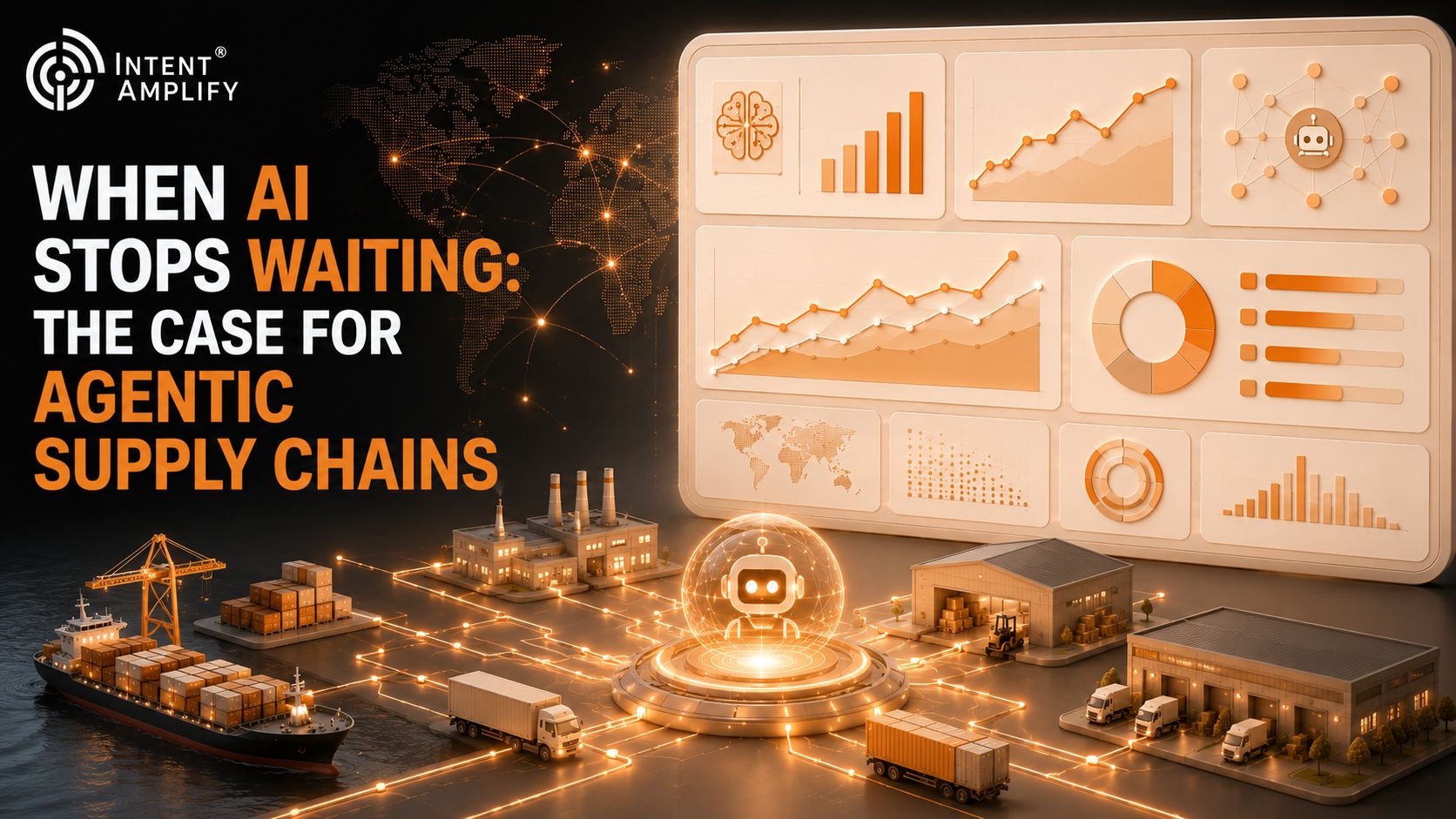
An agentic supply chain does not wait passively for humans to notice every signal. It continuously watches, interprets, prioritizes, recommends, and routes decisions into action. The objective is not to replace human judgment but to reduce the delays that prevent teams from acting on information quickly enough.
Supply Chain Now's webinar, "AI That Moves at Velocity: Cut Through Latency with Agentic Workflows," frames this shift clearly. Planning still often runs in weekly or monthly cycles, while demand, supply, and financial conditions can shift hourly. 1
The session brings together Zero100 and OMP to examine how organizations can move from periodic planning toward continuous, adaptive planning through two practical workflows: Signal-to-Plan and Inventory-to-Service. 1
The broader implication is that the gap between sensing change and acting on it is becoming a defining measure of supply chain performance.
View the Supply Chain Now webinar
Key Figures at a Glance
PwC's 2026 Digital Trends in Operations Survey of 767 operations and supply chain leaders found 85% say they are ahead of competitors in digital transformation, yet 89% say technology investments have not fully delivered expected results. PwC also found 83% of leaders believe AI agents and automation will accelerate the breakdown of traditional functional silos. 2
Accenture's Pulse of Change reports 82% of C-suite leaders expect higher change levels in 2026, while 86% plan to increase AI investment. 3
Microsoft describes agentic supply chain architecture as a model that connects data, decisions, and actions across the supply chain. 4
Microsoft's Supply Chain 2.0 research describes a global pharmaceutical company using agentic architecture to identify temperature-critical returns in real time and unlock multi-million euro annual productivity gains. 5
Google Cloud's 2026 update highlights 1,302 real-world generative AI use cases from leading organizations. 6
Google Cloud reports that Domina manages 20 million+ annual shipments and uses Vertex AI and Gemini to predict package returns and automate delivery validation. 7
OMP's UnisonIQ brings always-on agents, optimization, machine learning, and explainable AI into supply chain planning workflows. 8
Viewed collectively, these findings suggest that organizations are investing heavily in AI and digital transformation, yet many continue to struggle with execution speed. This highlights an emerging challenge: competitive advantage may depend less on generating additional insights and more on reducing the time required to act on them.
Figure: What Changes When AI Stops Waiting
Old Planning Pattern | Agentic Supply Chain Pattern | Business Impact |
Wait for planning cycles | Continuously monitor live signals | Faster response |
Escalate exceptions manually | Prioritize exceptions automatically | Less decision drag |
Build scenarios after the disruption | Refresh scenarios as conditions shift | Better readiness |
Handoff plans across silos | Connect planning, finance, and execution | Stronger alignment |
React after service pressure | Protect availability earlier | Better customer outcomes |
Why Decision Latency Is the Real Bottleneck
Many organizations already possess significant visibility into their operations. The challenge is often converting information into coordinated action across planning, finance, procurement, logistics, and execution teams.
A demand signal appears in one system. A constraint appears in another. Inventory is discussed in a separate meeting. Finance evaluates the impact later. Execution teams receive direction after the moment has already passed.
The delay between detecting change and taking informed action is commonly described as decision latency.
Agentic AI matters because it attacks the space between signal and action. It can monitor conditions, interpret changes, trigger scenario refreshes, highlight risks, and recommend decisions for human review. It moves planning from a calendar event to a continuous operating rhythm.
A useful distinction emerges when comparing different forms of AI adoption.
Generative AI is primarily used to improve information access and analysis, while agentic AI is designed to coordinate actions across connected workflows.
Why Decision Velocity Is Becoming a Leadership Priority
Decision velocity is ultimately a leadership challenge. Technology can accelerate analysis, but delays often arise from fragmented workflows, unclear accountability, and planning processes that cannot adapt quickly enough to change.
The webinar takes a practical approach to agentic AI, focusing on two high-value starting points: Signal-to-Plan and Inventory-to-Service. 1
These workflows are important because they are proximate to the areas that suffer from high latency. The Signal-to-Plan workflow links the dynamic signals from the market, demand, supply, and finance to planning decisions. The Inventory-to-Service workflow links inventory management directly to availability, fulfillment, and promises made to customers.
The discussion also highlights an important organizational reality: scaling AI requires changes to team structures, governance models, operating processes, and workforce capabilities. 1
That makes the conversation more useful for executives. It is not "buy AI and wait for transformation." It is "redesign the workflow so AI can help decisions move faster."
Moving Beyond Isolated AI Pilots
Zero100's Power Threads concept is valuable because it treats AI value as workflow value. Instead of scattering pilots across disconnected functions, Power Threads focuses on end-to-end operating flows where AI can compound value.
Inventory-to-Service is a clear example. Product availability is not determined only by inventory policy. It depends on demand signals, supply constraints, deployment logic, transportation, replenishment timing, fulfillment capacity, and commercial priorities.
When those decisions are disconnected, service suffers.
OMP brings the planning technology layer into that conversation. Its UnisonIQ approach positions agentic AI as a decision-support layer that combines always-on agents, optimization, machine learning, and explainable AI inside supply chain planning workflows. 8
For clients, the value is straightforward. Zero100 helps clarify where impact can be created, while OMP focuses on translating that potential into operational execution.
The broader shift is not technological but managerial. Organizations are increasingly judging AI by its ability to improve workflow outcomes rather than by the sophistication of the technology itself.
Decision Velocity Framework
Workflow | What AI Watches | What Teams Decide Faster |
Signal-to-Plan | Demand, supply, cost, market, and financial signals | What plan should change now |
Inventory-to-Service | Stock levels, availability, fulfillment, and constraints | Where inventory should move |
Exception-to-Action | Service risk, disruption signals, and cost exposure | Which issue gets priority |
Scenario-to-Decision | Trade-offs across cost, service, cash, and resilience | Which option to choose |
Plan-to-Execution | Ownership, timing, and downstream actions | How the decision moves |
Why Decision Speed Matters
The promise of agentic supply chains is not automation without oversight, but faster decisions supported by transparency, governance, and human accountability.
Speed alone is not enough. A poor decision made quickly can still damage service, margins, and customer trust. The value of agentic workflows lies in reducing the time spent gathering, validating, and sharing information while keeping human judgment at the center of critical decisions.
Planners gain faster access to relevant context, executives see trade-offs more clearly, and execution teams receive more actionable guidance. The result is a supply chain that can respond more quickly to change while maintaining control and alignment.
Organizations that adopt this approach can strengthen service performance, improve cross-functional coordination, and scale planning more effectively. At its core, the advantage comes from reducing the delay between recognizing change and acting on it.
Figure: Client Value from Agentic Workflows
Client Need | Agentic Workflow Value | Business Benefit |
Faster planning response | Always-on signal monitoring | Less delay between the event and the action |
Better availability | Inventory-to-Service coordination | Stronger customer reliability |
Lower operational drag | Automated exception prioritization | More planner capacity |
Clearer trade-offs | Scenario comparison across functions | Better executive confidence |
Scalable AI adoption | Workflow-first deployment | Faster time to value |
What Leaders Should Prioritize First
One of the most common mistakes in AI adoption is attempting to automate too many processes simultaneously. It is selecting the workflow where latency is already expensive.
Signal-to-Plan is a natural starting point when demand volatility, market signals, and financial assumptions change faster than planning cycles. Inventory-to-Service is a natural starting point when availability, stock positioning, fulfillment, and customer promises are under pressure.
Leaders should also define decision ownership early. Agents can recommend and route, but accountability must remain clear. They should connect the right signals, build fusion teams, measure latency reduction, and make governance part of the design rather than an afterthought.
The Boardroom Takeaway
Executive teams increasingly want to know whether planning processes can respond quickly enough to protect service levels, margins, customer commitments, and operational resilience during periods of uncertainty. As decision cycles continue to shorten, the ability to reduce delays between signal detection, planning, and execution may become a significant competitive differentiator.
Bottom Line
As supply chains become more dynamic, organizations increasingly need planning processes that can adapt at the same pace as changing business conditions. The long-term value of agentic AI may be less about automation itself and more about helping organizations shorten the time between recognizing change and responding effectively. Companies that improve decision velocity while maintaining governance and accountability are likely to be better positioned to navigate uncertainty and sustain growth.
Long-term competitive advantage may increasingly depend on how effectively organizations transform information into timely action.
Reserve your seat to explore Signal-to-Plan and Inventory-to-Service workflows
Be Ready for What's Next
Subscribe to Intent Amplify for insightful analysis of the adoption of artificial intelligence and digital transformation powered by data.
References
- Supply Chain Now and IntentTechPub (2025) AI That Moves at Velocity. Supply Chain Now and IntentTechPub, 2025.
- PwC (2026) 2026 Digital Trends in Operations Survey. PricewaterhouseCoopers (PwC), 2026.
- Accenture (2025) Pulse of Change. Accenture, 2025.
- Microsoft (2025). From Intelligence to Impact. Microsoft Corporation, 2025.
- Microsoft (2024) Supply Chain 2.0. Microsoft Corporation, 2024.
- Google Cloud (2026) Google Cloud Next 2026. Google Cloud, 2026.
- Google Cloud (2024) Real-World Gen AI Use Cases. Google Cloud, 2024.
- OMP (2025) UnisonIQ Agentic AI. OMP, 2025.