
logo
logo
The Velocity Index: Measuring the Business Impact of Agentic AI Across Modern Supply Chains

REPORT

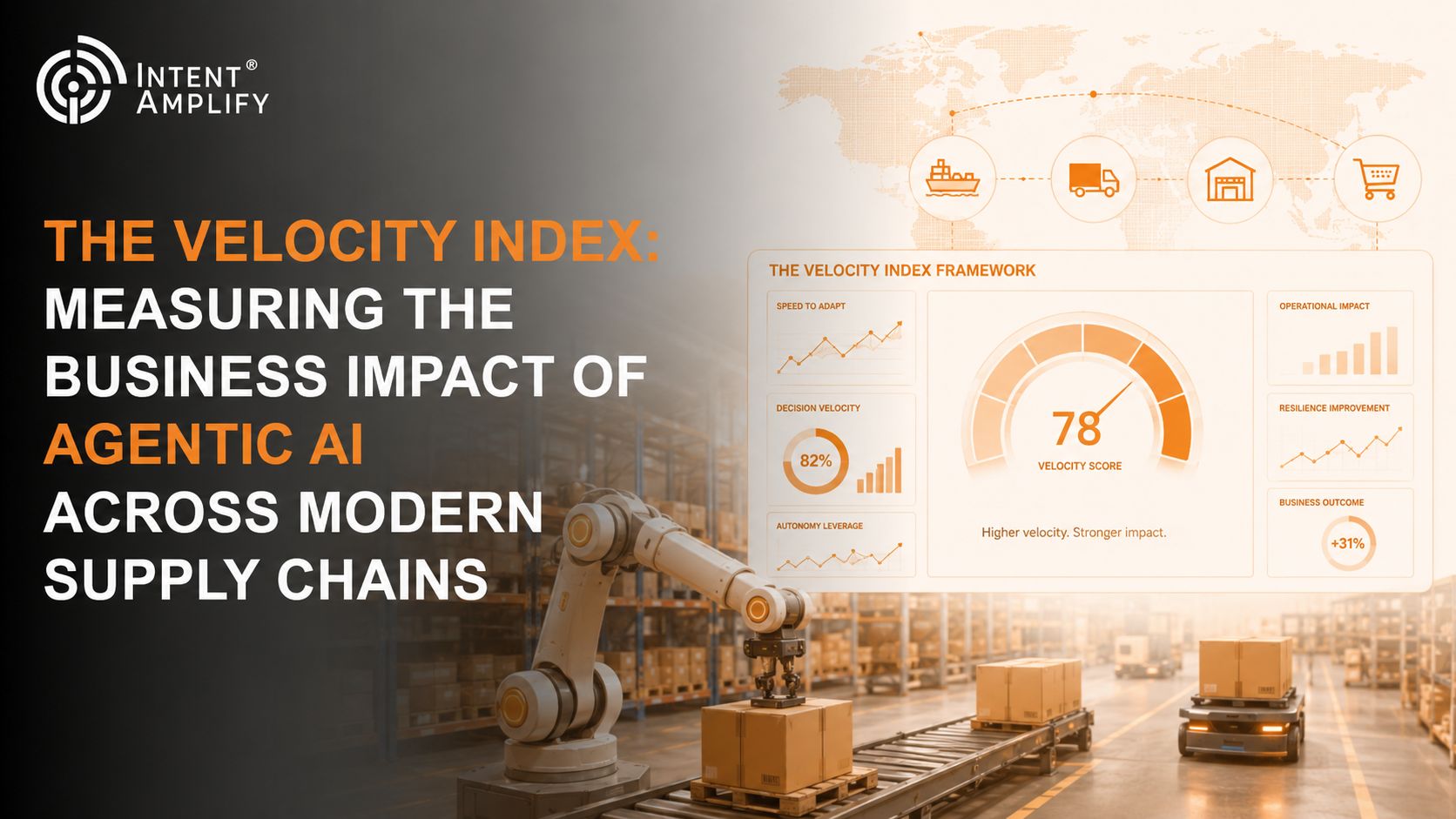
The Velocity Index: Measuring the Business Impact of Agentic AI Across Modern Supply Chains

Supply chain performance is no longer measured only by cost, forecast accuracy, or service levels. This report introduces the Velocity Index, a practical framework for measuring how agentic AI helps enterprises sense change, evaluate scenarios, align stakeholders, and act faster with governance, trust, and measurable business impact.

1. Executive Summary

Supply chain leadership is entering a new measurement era. For years, many organizations evaluated operational performance through familiar indicators: forecast accuracy, inventory turns, service levels, logistics costs, production utilization, and working capital. Those metrics still matter. Yet they do not fully answer a more urgent question facing U.S. enterprises: how quickly can the organization sense change, evaluate options, align stakeholders, and act before value is lost?

That question is becoming harder to ignore because disruption is no longer episodic. Tariffs, demand volatility, geopolitical risk, supplier fragility, transportation variability, labor constraints, and digital transformation pressure are now part of the operating baseline.

Artificial intelligence is arriving at precisely this moment. Yet the business impact of this technology will not be measured only by how many copilots, assistants, or agents an enterprise deploys. It will be measured by response velocity: the speed and quality with which organizations convert signals into action.

Gartner forecasts that supply chain management software with agentic AI capabilities will grow from less than $2 billion in spend in 2025 to $53 billion by 2030. Gartner also predicts that by 2030, 60% of enterprises using supply chain management software will have adopted agentic AI features, up from 5% in 2025. 2

This report introduces the Velocity Index as a practical executive framework for assessing the value of agentic AI across modern supply chains. The index does not treat speed as the only goal. Speed without governance can amplify mistakes. The stronger measure is balanced velocity: faster sensing, stronger scenario evaluation, clearer trade-off visibility, shorter response cycles, and measurable outcomes.

OMP's webinar, AI That Moves at Velocity: Cut Through Latency with Agentic Workflows, is timely because it focuses on the shift from periodic planning to continuous, adaptive planning. In the webinar, Supply Chain Now, Zero100, and OMP explore workflows where leading organizations are already moving away from static review cycles toward agentic ways of working.

The central argument is straightforward: agentic AI creates value when it reduces the delay between market change and coordinated response. For U.S. enterprises, that is no longer a technology conversation alone. It is a margin, resilience, service, and growth conversation.

2. Why Decision Velocity Has Become a Supply Chain Priority

Traditional planning rhythms were built for a slower world. Monthly cycles, weekly review meetings, static spreadsheets, and manually coordinated exception processes still provide structure. But when market conditions shift faster than the organization can interpret them, those same routines can become sources of delay.

A delayed decision can quietly become a financial event. A tariff shock can alter landed cost before sourcing teams have modeled alternatives. A demand swing can create excess inventory in one region and a shortage risk in another. A supplier issue can move from a minor exception to a service failure if no one can quantify the downstream effect quickly enough.

PwC's 2026 Digital Trends in Operations Survey of 767 U.S. operations and operations executives found that 85% say they are ahead of most competitors in digital transformation, yet 89% say their technology investments have not fully delivered expected results.3

That finding captures a difficult truth. Enterprises have invested heavily in digital capabilities, but many still struggle to convert visibility into coordinated action. They may detect an event quickly, yet still lose time evaluating options, reconciling assumptions, aligning functions, and moving decisions into execution.

Decision velocity, therefore, becomes a board-level operating metric. It connects the planning layer with enterprise value. Faster, better-informed choices can protect service, reduce expediting costs, improve inventory allocation, support margin discipline, and give leaders more confidence when conditions shift.

KPMG's 2026 supply chain outlook argues that leaders now face structural shifts requiring faster decisions and stronger operating models, including AI at scale, centralization, new performance metrics, and digital scenario modeling for tariff and trade disruption.4

The implication is clear. Enterprises do not need more fragmented automation. They need decision environments that reduce delay across the full decision journey.

3. The Latency Problem in Modern Planning

Latency is often discussed as a technology issue. In supply chain planning, it is much broader.

There is signal latency when the organization detects a change too late. There is analytical latency when teams cannot model scenarios fast enough. There is alignment latency when functions debate assumptions instead of acting from a shared view. There is execution latency when approved decisions do not move quickly into the operating network. There is learning latency when the enterprise fails to capture what worked and apply it to the next event.

McKinsey's 2025 risk pulse found that 20% to 40% of supply chain activity was affected in some way by tariffs among surveyed companies, with consumer goods reporting the highest exposure at 43% of activities.5

This kind of exposure creates an operating challenge that cannot be solved through periodic review alone. When landed cost, sourcing viability, demand, and service commitments shift at the same time, executives need rapid scenario comparison. What happens if production moves? What if inventory is repositioned? What if suppliers are rebalanced? What if the business absorbs costs temporarily to protect strategic accounts?

The issue is not that enterprises lack data. Many have more information than their teams can process. The problem is that signals often do not become decisions fast enough.

PwC found that 87% of U.S. operations and operations executives say poor data quality has affected their ability to achieve value from digital initiatives, while only 30% report significant improvement in data quality and reliability.3

That point is especially important for agentic models. Intelligent workflows depend on reliable inputs. If the underlying data is contradictory, stale, or poorly governed, agents can accelerate confusion instead of improving response quality. Speed has to be built on preparedness, transparency, and control.

4. The Velocity Index: A Practical Measurement Framework

The Velocity Index is a practical way to measure how effectively an enterprise turns changing conditions into coordinated business action. It is not a single dashboard metric. It is a multi-dimensional framework that connects AI-enabled analytical capabilities to measurable enterprise value.

The first dimension is signal-to-awareness time. This measures how quickly the organization detects a relevant change. Examples include supplier delays, demand variance, production constraints, transportation disruption, cost movement, and customer service risk.

The second dimension is awareness-to-scenario time. This evaluates how quickly teams can generate credible options. In a mature environment, planners should not wait days for a new model run every time conditions change. They should be able to evaluate alternatives through structured, reusable scenario logic.

The third dimension is scenario-to-decision time. This measures how quickly stakeholders align on trade-offs. A technically strong recommendation has limited value if finance, procurement, manufacturing, sales, and logistics cannot interpret the consequences in shared financial and operational language.

The fourth dimension is decision-to-execution time. This tracks whether approved actions move efficiently into planning, scheduling, procurement, production, transportation, or fulfillment workflows.

The fifth dimension is outcome realization. This connects velocity to value. Faster action should improve service, reduce cost leakage, protect margin, release working capital, support sustainability objectives, or strengthen resilience.

PwC found that 94% of companies with siloed or partially integrated operating structures expect to shift toward a more horizontal, networked model, yet only 41% operate that way today.3

The Velocity Index helps leaders identify where the operating model slows down. For some organizations, the bottleneck is poor data. For others, it is manual scenario analysis, unclear decision rights, disconnected functions, or limited confidence in system-generated recommendations.

The most useful index is not built to punish teams for delay. It is built to expose where the enterprise can remove friction.

5. Agentic AI and the Shift Toward Continuous Planning

Agentic AI changes the planning conversation because it moves beyond passive analytics. A traditional system may show a planner what happened. A dashboard may visualize risk. A forecasting tool may update a projection. Agent-driven workflows go further by sensing signals, initiating analysis, coordinating tasks, evaluating options, and supporting action within defined boundaries.

McKinsey's 2025 global AI survey found that 88% of respondents said their organizations use AI in at least one business function. It also found that 23% are scaling an agentic AI system somewhere in the enterprise, while another 39% have begun experimenting with intelligent agents.6

The relevance to supply chain planning is direct. Many planning activities involve repetitive but high-impact micro-decisions: exception handling, assumption validation, scenario comparison, stakeholder notification, constraint evaluation, and action recommendation. These are precisely the areas where agent-driven workflows can reduce manual drag and improve preparedness.

Still, agentic AI should not be framed as autonomy for its own sake. In high-stakes planning, the goal is not to remove experts from the loop. The goal is to place humans above the right loop: setting objectives, validating trade-offs, approving consequential moves, and reviewing exceptions that require judgment.

Gartner notes that human-in-the-loop levels are essential during early deployment of intelligent supply chain management software, particularly for management decisions where risk and accountability remain critical.2

Continuous planning is therefore not "set and forget." It is a governed model where intelligent agents accelerate work while human planners preserve accountability.

6. From Functional Automation to End-to-End Orchestration

Many enterprises have automated isolated planning tasks. Demand teams have forecasting tools. Procurement has supplier analytics. Logistics has transportation platforms. Manufacturing has scheduling systems. Finance has scenario models. These tools are valuable, but local optimization can create enterprise friction.

The next stage is orchestration. Instead of optimizing one function at a time, organizations need connected workflows that understand how one choice affects another. A sourcing shift changes cost and lead time. A production decision alters capacity and inventory. A transportation change influences service and emissions. A promotion affects demand, allocation, and replenishment.

PwC found that 83% of surveyed U.S. operations and operations executives believe intelligent agents and automation will accelerate the breakdown of traditional functional silos, yet only 27% have fully embedded an intelligent automation strategy across operating units.3

This is where the Velocity Index becomes useful. It measures not only whether one function can move faster, but whether the enterprise can compress the full decision journey.

For example, an agent-enabled planning process could detect supplier disruption, analyze material exposure, identify at-risk customers, compare sourcing scenarios, estimate margin impact, and launch a review workflow. The value does not come from automating one isolated step. It comes from compressing the path from signal to coordinated decision.

MHI and Deloitte's 2026 Annual Industry Report is based on responses from more than 500 manufacturing and operations executives, with 61% of respondents holding executive-level roles. The report identifies AI as a major disruptor shaping how organizations reassess operations, workforce investment, and advanced digital technology adoption.7

Executives are now looking for AI that changes outcomes, not only activity. Orchestration is the bridge between digital capability and measurable value.

7. Governance, Trust, and Human Validation

Velocity without trust is dangerous. If intelligent agent-based systems make the wrong recommendation, the organization may move faster toward a poor outcome. That is why governance must be embedded into the operating architecture, not added after deployment.

Trust has several layers. The first is data reliability. The second is explainability: users must understand why a recommendation was generated. The third is accountability: decision rights must be clear. The fourth is control: agents should operate within defined policy, permission, and escalation boundaries.

Bain's Supply Chain Resiliency Index reports that 63% of surveyed companies rank resiliency as very important compared with other business objectives, and 85% expect resiliency-related investments to increase over the next three to five years.8

Resilience investment will not deliver full value if decision systems cannot be trusted during stress. When disruption hits, users need confidence that scenario outputs reflect current data, approved assumptions, and real constraints. They also need to know which decisions can be automated, which require review, and which must be escalated.

OMP's decision-centric planning messaging reflects this balance. OMP describes Unison Decision-Centric Planning as combining advanced AI, autonomous agents, real-time scenario modeling, and human validation to help organizations anticipate disruption, evaluate trade-offs, and act with confidence.9

The broader lesson is vendor-neutral: successful agent-enabled planning must combine speed with governance. The best systems will not merely automate tasks. They will make trade-offs visible, preserve human judgment, and create an audit trail for consequential choices.

8. OMP Webinar Spotlight: AI That Moves at Velocity

OMP's webinar, AI That Moves at Velocity: Cut Through Latency with Agentic Workflows, directly fits the business problem described in this report. It is not just about adding AI to planning. It focuses on how organizations can move from periodic planning toward continuous, adaptive workflows.

According to OMP's event page, the Supply Chain Now webinar features Zero100 and OMP exploring two workflows where leading organizations are already moving from periodic planning to continuous, adaptive planning. The webinar is scheduled for June 25 and invites viewers to register for AI That Moves at Velocity: Cut Through Latency with Agentic Workflows, Webinar

The value of the webinar is that it treats latency as an operating issue. Modern supply chains are not slowed only by technology gaps. They are slowed by fragmented functions, delayed interpretation, manual coordination, weak scenario throughput, and uncertainty around decision ownership.

OMP's broader positioning around Unison Decision-Centric Planning and UnisonIQ reinforces the webinar's theme. OMP states that Unison Decision-Centric Planning helps organizations move from reactive, process-driven planning to proactive, event-driven decision-making, while UnisonIQ orchestrates intelligent agents, generative AI assistants, and advanced optimization engines.9

The benefits for enterprise executives are practical. Agent-driven workflows can help planners detect signals earlier, generate scenarios faster, understand trade-offs more clearly, and focus human attention where judgment matters most. These processes may also support stronger cross-functional alignment by giving finance, operations, procurement, manufacturing, logistics, and commercial teams a more consistent view of consequences.

The webinar should not be read as a product pitch. Its broader relevance is that it frames intelligent agent-based systems as an operating model shift. For U.S. enterprises navigating cost pressure, volatility, service risk, and digital transformation fatigue, that framing is valuable.

This webinar helps operations executives understand how agentic workflows can reduce response delay, support continuous adaptation, and improve the measurable enterprise impact of intelligent planning.

Register for the webinar

9. Strategic Recommendations for U.S. Enterprise Leaders

Enterprise leaders should begin by defining response speed as a measurable capability. The goal is not simply to make people work faster. It is to reduce avoidable delay between signal, scenario, alignment, execution, and learning.

The priority is to identify high-value choices where delay creates measurable exposure. These may include shortage response, demand shifts, production rebalancing, supplier disruption, inventory repositioning, transportation rerouting, promotion planning, or tariff-sensitive sourcing.

The second priority is to map the current response cycle. Leaders should ask how long it takes to detect a change, generate options, validate data, align stakeholders, approve action, and measure impact. This baseline becomes the starting point for the Velocity Index.

The third priority is to improve information readiness. Agentic workflows require trustworthy inputs. Organizations should strengthen master data, operating assumptions, constraint visibility, access controls, and integration between operational systems.

The fourth priority is to embed human validation deliberately. Not every recommendation requires the same review level. Low-risk actions may be automated within policy. High-impact decisions should remain subject to expert oversight.

The fifth priority is to measure value beyond productivity. Useful indicators include decision cycle compression, avoided expedite cost, service recovery speed, scenario volume, user adoption, inventory productivity, margin protection, sustainability gains, and executive alignment.

The sixth priority is to redesign roles around orchestration. Planners should not spend most of their time moving data between systems. Their value should increasingly come from guiding objectives, interpreting trade-offs, managing exceptions, and shaping cross-functional choices.

PwC's finding that only 27% of U.S. operations and operations executives have fully embedded an intelligent automation strategy across operating units shows why the operating model matters as much as the technology.3

Intelligent agent-based systems will not create enterprise value automatically. They must be connected to the decisions that matter most.

10. Future Outlook

The next phase of intelligent supply chain transformation will be measured less by experimentation and more by responsiveness, trust, and measurable impact.

The first shift will be from periodic planning to continuous orchestration. Annual or monthly cycles will not disappear, but they will be supplemented by always-on sensing and scenario generation.

The second shift will be from dashboards to decision intelligence systems. Leaders will expect systems to explain trade-offs, recommend options, and clarify financial consequences.

The third shift will be from isolated automation to agentic workflow design. Instead of deploying AI inside narrow tasks, companies will build multi-step workflows that coordinate across functions.

The fourth shift will be from adoption metrics to outcome metrics. The number of agents deployed will matter less than whether response delay is reduced and outcomes improve.

The fifth shift will be from human-in-the-loop as a safety phrase to human validation as an operating discipline. Leaders will need to define where human judgment is required, where policy-based automation is acceptable, and how exceptions are audited.

Together, these signals point to a new executive agenda. Intelligent transformation success will not be defined by implementation alone. It will be defined by whether the enterprise can decide faster, act smarter, and learn continuously.

11. Conclusion

The Velocity Index gives operations executives a practical way to evaluate intelligent agent-based systems through an enterprise lens. It shifts the conversation from "What AI tools have we deployed" to "How much faster and better do we turn change into action"

That distinction matters. Modern supply chains are exposed to tariff movement, demand volatility, transportation disruption, supplier risk, cost pressure, and service expectations that can move faster than traditional review cycles allow. The organizations that win will not simply have more information or more automation. They will have stronger decision systems.

Intelligent agent-based systems can help by reducing signal delay, accelerating scenario development, improving cross-functional alignment, and helping planners focus on high-value judgment. Yet their impact depends on trust. Data quality, governance, human validation, explainability, and measurable value capture remain essential.

OMP's webinar is relevant because it addresses this inflection point directly. It frames agent-driven workflows as a way to cut through response delay and support continuous, adaptive decision-making. That is the right discussion for U.S. enterprises now.

The future of supply chain performance will not be measured only by efficiency. It will be measured by velocity with discipline: the ability to sense earlier, model faster, decide with confidence, execute consistently, and improve after every event.

Register for the webinar

About Intent Amplify

Intent Amplify is an intelligence-led pipeline activation company helping B2B technology brands identify in-market buyers, understand buying group behavior, and turn real-time intent signals into meaningful revenue opportunities. Through demand intelligence, go-to-market strategy, sponsored research, executive roundtables, webinars, targeted content, and strategic consulting, Intent Amplify helps organizations engage the right decision-makers with the right message at the right stage of the buying journey.

Contact Us

12. References

  1. McKinsey & Company, Operations Insights, 2025

  2. Gartner, Gartner Forecasts Supply Chain Management Software with Agentic AI Will Grow to $53 Billion in Spend by 2030, April 7, 2026

  3. PwC, Digital Trends in Operations Survey, 2026

  4. KPMG, Key Supply Chain Trends Shaping 2026, 2026

  5. McKinsey & Company, Supply Chain Risk Survey, 2025

  6. McKinsey & Company, The State of AI, 2025

  7. MHI and Deloitte, New MHI and Deloitte Report Finds AI Is Biggest Disruptor of Supply Chains Over the Next Decade, 2026

  8. Bain & Company, Supply Chain Resiliency Index, 2026

  9. OMP, OMP Unveils Decision-Centric Planning to Accelerate Supply Chain Decision Velocity, 2026

Yash Lad

Yash Lad

Research Analyst

Contact us for Report