
logo
logo
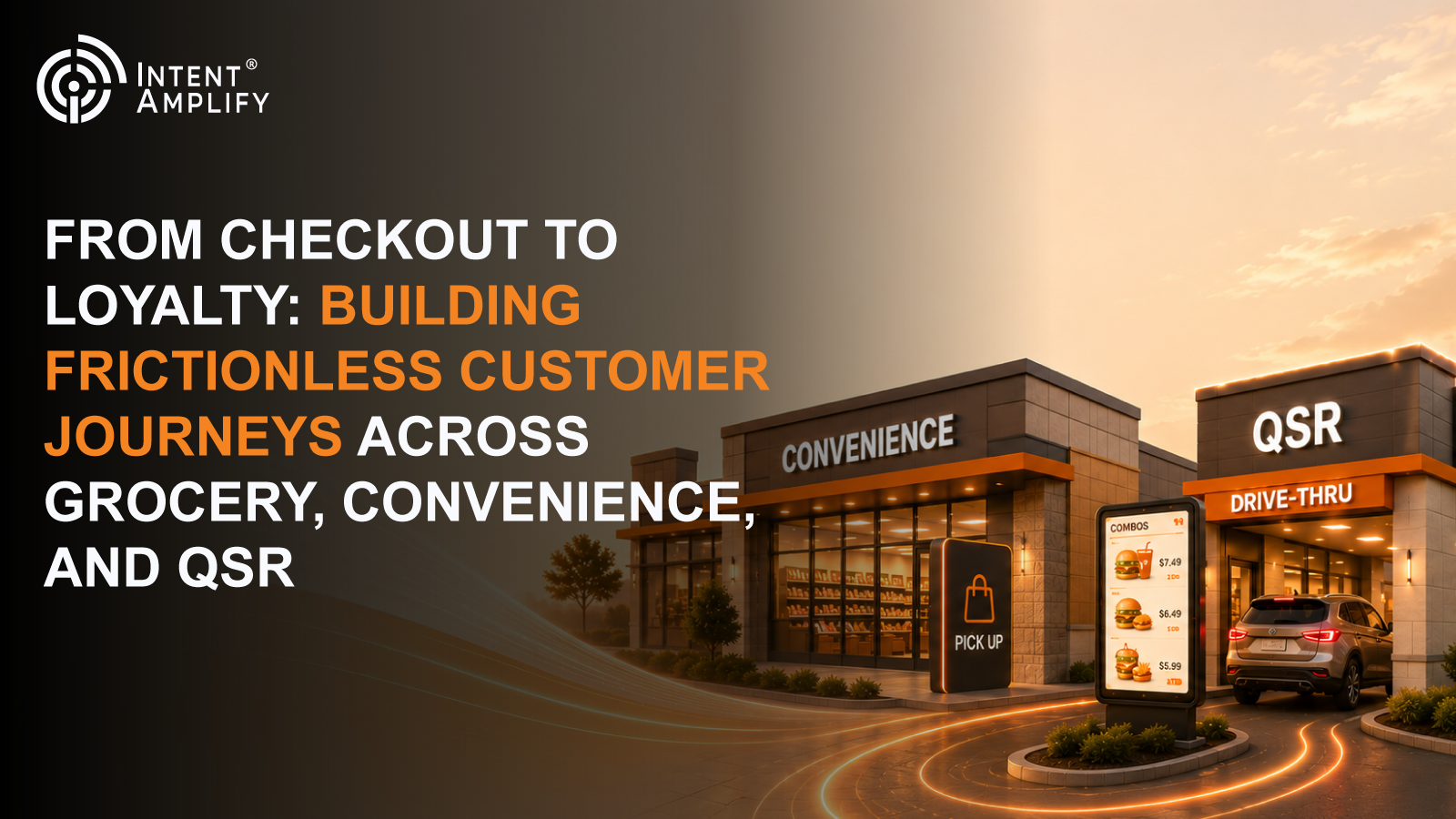
From Checkout to Loyalty: Building Frictionless Customer Journeys Across Grocery, Convenience, and QSR

WHITEPAPER

From Checkout to Loyalty: Building Frictionless Customer Journeys Across Grocery, Convenience, and QSR

A practical executive guide exploring how grocery, convenience, and QSR operators can reduce customer effort, improve loyalty, and connect checkout, fulfillment, payments, and digital experiences into one frictionless journey.

Executive Summary

Retailers have spent years improving the visible parts of customer experience: faster checkout lanes, cleaner mobile apps, better loyalty programs, stronger digital menus, self-service kiosk deployments, and more convenient pickup options. These investments helped modernize grocery, convenience, and quick-service restaurant environments. Yet the next competitive frontier is not simply faster service. It is lower customer effort across the entire journey.

The journey from checkout to loyalty now depends on how well retailers connect ordering, payment, fulfillment, promotions, inventory visibility, age verification, store operations, self-checkout security, and post-purchase engagement. A customer may enter the journey through a grocery app, a forecourt pump, a self-ordering kiosk, a drive-thru lane, a loyalty offer, or a mobile pickup order. They do not see separate systems. They see one brand.

Today, frictionless retail has evolved into an operating-model challenge spanning technology, operations, fulfillment, payments, and customer experience. Every delay, failed promotion, missed substitution, payment interruption, age-check exception, or pickup error becomes a signal that the business is asking the customer to work too hard.

The opportunity is significant. The National Retail Federation forecasts that U.S. retail sales will grow between 2.7% and 3.7% in 2025, reaching between $5.42 trillion and $5.48 trillion, despite economic uncertainty.1

For grocery, convenience, and QSR leaders, this scale makes friction expensive. Even small improvements in transaction speed, basket completion, retail throughput, loyalty engagement, and workforce efficiency can create measurable business impact. RETHINK Retail's report, The Frictionless Frontier: Why Grocery, Convenience, and QSR Need a Reset, underscores that 84% of consumers prefer self-service kiosks, kiosk deployments can drive 30% higher ticket sizes, and AI age estimation can reduce human intervention by 75%.

Loyalty no longer begins after a purchase. It is built, or weakened, in every low-effort moment before, during, and after checkout.

Why Frictionless Journeys Now Matter

The old customer journey was relatively linear. A shopper entered a store, selected products, paid, and left. A restaurant guest ordered, waited, collected food, and returned later if the experience was good. A convenience-store customer completed a fuel or food mission quickly and judged the location by speed, price, and habit.

That world has changed.

Today's grocery, convenience, and QSR journeys are layered. A customer may browse online, compare prices, activate a loyalty offer, check inventory, order ahead, pay digitally, collect curbside, use a self-service kiosk, enter a drive-thru, or redeem a personalized promotion. Each interaction adds potential value. Each handoff also creates the possibility of friction.

Deloitte's commerce research found that 80% of business-to-consumer leaders believed they were delivering impressive online shopping experiences, while fewer than half of consumers agreed. The same research found that consumers spend 37% more with brands that deliver consistent and positive commerce experiences.2

The gap between retailer perception and customer experience creates measurable commercial risk. Retailers may believe they have invested enough in digital capability, yet customers judge the experience by whether the journey works when it matters. A mobile app is not valuable if the store inventory is wrong. A loyalty program is not persuasive if offers fail at checkout. A kiosk is not convenient if it creates new exceptions. A pickup promise is not credible if the order is incomplete.

Frictionless commerce is therefore not about removing every human interaction. It is about removing unnecessary effort. The best retail technology platform gives customers choice without complexity and gives associates tools that reduce preventable work.

The New Customer Journey: From Checkout to Loyalty

Checkout is used to mark the end of the customer journey. Increasingly, it is the hinge between purchase and loyalty.

A smooth checkout reinforces confidence. A failed checkout creates doubt. A relevant loyalty offer increases return intent. An irrelevant one feels like noise. A fast pickup experience builds a habit. A delayed pickup forces the shopper to reconsider whether the brand is worth the time.

Customer journey mapping is essential for identifying friction across connected touchpoints. Retail leaders need to see the journey not as isolated touchpoints but as a connected chain of effort. The friction may begin before checkout, surface during payment, and damage loyalty after the transaction is complete.

Consider a grocery customer ordering online. The journey starts with search and selection, then moves through availability, substitution logic, payment, fulfillment, pickup timing, and loyalty recognition. If the product data is weak, the journey suffers. If store operations are not aligned with digital demand, the promise breaks. If the loyalty offer cannot be applied, the customer experiences the brand as inconsistent.

The same pattern appears in convenience stores. A fuel-to-food visit may involve a pump, app, loyalty ID, hot food order, restricted product, checkout automation, and digital receipt. If those systems are disconnected, the shopper feels the burden.

In QSR, the journey may begin through mobile ordering and end with pickup, delivery, or drive-thru handoff. National Restaurant Association research shows that nearly 75% of restaurant traffic now happens off-premises, meaning almost three out of four orders are taken to go.3

This is why omnichannel retail cannot remain a strategy deck phrase. It must become an operating discipline.

Grocery: Reliability Is the New Convenience

For grocery retailers, friction often feels like uncertainty.

Is the item really available? Will the promotion work? Will the pickup order be ready? Will substitutions reflect the customer's needs? Will fresh items arrive in acceptable condition? Will the digital price match the shelf? These are not minor details. They are the practical moments that determine whether a grocery brand earns repeat behavior.

McKinsey's State of Grocery Retail research shows how grocery leaders are navigating margin pressure, changing consumer behavior, online fragmentation, foodservice adjacency, and AI adoption. In its 2026 grocery analysis, McKinsey reported that European grocery sales grew 3.4% in 2025, while consumer prices rose 2.9% and volume increased only 0.6%, indicating that growth remained constrained and operational productivity mattered more.4

Although that data reflects European markets, the lesson is relevant for U.S. grocery executives: when volume growth is difficult, the cost of friction rises. A poor substitution can lose a customer. An inaccurate item signal can weaken trust. A delayed pickup can push a shopper toward a competitor.

Predictive analytics retail capabilities can help grocers anticipate demand and improve replenishment. Computer vision retail systems can support shelf awareness and reduce product availability gaps. Retail intelligence can help identify where shoppers abandon digital baskets or reject substitutions. Unified commerce can connect inventory, loyalty, pricing, fulfillment, and checkout into a more reliable experience.

Reliability may not feel dramatic, but it is powerful. Customers often return to grocers that make ordinary shopping feel predictable.

Convenience Stores: The Triple-Threat Site Needs One Journey

Convenience stores have become more complex than their name suggests.

A single location may now operate as a fuel site, foodservice destination, beverage stop, quick-trip grocery store, loyalty platform, restricted-product environment, and QSR-adjacent ordering point. The customer may arrive for fuel, buy coffee, add prepared food, redeem a promotion, verify age, and pay digitally during one short visit.

That journey can feel seamless only if the underlying systems behave as one.

RETHINK Retail's asset identifies the "triple-threat site" as a key challenge: fuel, convenience, and QSR are converging, and the seams between forecourt, counter, kiosk, checkout, and compliance workflows are where friction breaks the experience.

Platform unification is central here. Connected POS systems, loyalty engines, food ordering flows, payment tools, inventory signals, and age verification software need to share context. Without that connection, the associate becomes the human integration layer, and the customer feels the wait.

Retail automation software can improve flow, but only when it supports the real mission. AI checkout can reduce unnecessary steps. Self-service kiosk workflows can support ordering control. AI loss prevention can help reduce retail shrinkage without making every shopper feel watched. Self-checkout security can be more precise when supported by data, not blunt interruption.

The convenience-store promise has always been speed. The new promise is coordinated ease.

QSR: Speed Must Become Flow

QSR operators have long optimized speed. The modern challenge is that speed alone is no longer enough.

The customer expects accuracy, value, personalization, loyalty recognition, and reliable handoff across multiple ordering channels. A restaurant may receive demand from the counter, drive-thru, mobile app, delivery marketplace, curbside lane, and self-ordering kiosk during the same peak period. If those channels are not orchestrated, transaction speed at one touchpoint can create congestion elsewhere.

The National Restaurant Association expects the U.S. restaurant industry to reach $1.5 trillion in sales in 2025, employ 15.9 million people by year-end, and add more than 200,000 net new jobs.5

That scale makes QSR experience performance a national retail issue. The same source also reports that more than 8 in 10 operators expect 2025 sales to be either higher than or about the same as 2024, even as competition and operating pressures remain intense.5

Off-premises behavior raises the bar further. National Restaurant Association research reports that 57% of adults recently used mobile ordering, including 74% of millennials and 65% of Gen Z adults. It also found that 94% of consumers say speed is critical and that more than 9 in 10 cite customer service as a top priority. 3

For QSR leaders, this means checkout efficiency cannot be separated from kitchen throughput, customer flow management, loyalty visibility, and order accuracy. A self-ordering kiosk that speeds ordering but overwhelms production does not create a seamless customer journey. A mobile app that increases demand but creates pickup confusion has shifted friction, not removed it.

Operational flow across ordering, production, fulfillment, and loyalty interactions has become the primary performance objective.

The Technology Layer Behind Effortless Journeys

Frictionless journeys depend on more than customer-facing tools. They require a technology architecture connecting transactions, inventory, loyalty, fulfillment, payments, and operational workflows across the enterprise.

POS integration forms the foundation. Pricing, loyalty, inventory, payments, and order-routing systems must exchange information seamlessly within the point-of-sale environment. Unified commerce extends connectivity across physical and digital channels, allowing customers to experience a single brand rather than a collection of disconnected systems.

Retail technology platforms support several critical operating capabilities: accurate product and pricing data, reliable order routing, cross-channel loyalty recognition, checkout automation with effective exception management, and analytics identifying operational bottlenecks. The objective is measurable operational improvement, not additional complexity.

McKinsey's 2026 grocery research reported 47% of grocery chief executives identified AI and automation adoption as a top-three priority. At the same time, 70% reported no measurable EBIT impact from AI or indicated it was too early to assess results, while only 3% reported an EBIT increase greater than 5%.⁴

The findings reinforce a practical reality: AI investments require clear operational use cases and measurable performance outcomes. Smart checkout, predictive analytics, retail intelligence, and computer vision deliver value when they reduce customer effort, improve labor productivity, strengthen inventory accuracy, and enhance loyalty effectiveness.

Technology performs best when operational complexity remains behind the scenes and customer interactions become easier, faster, and more reliable.

Trust, Security, and Compliance in Frictionless Retail

Frictionless retail depends on data, and data creates responsibility.

Grocery, convenience, and QSR operators increasingly manage payment credentials, loyalty profiles, mobile-order histories, location patterns, preference data, delivery information, and identity signals. These inputs allow personalization and operational intelligence, but they also make trust part of the experience architecture.

IBM's Cost of a Data Breach Report 2025 reported that the global average cost of a data breach reached USD 4.44 million in 2025, while the U.S. average reached USD 10.22 million.6

For U.S. operators, this matters because loyalty cannot grow if customers do not trust how their data is handled. A retailer can offer strong promotions, fast checkout, and personalized ordering, but a weak security posture can undo confidence quickly.

Security must also be balanced with convenience. Retail shrinkage is a real operating challenge, and self-checkout security cannot be ignored. Yet heavy-handed monitoring can damage the customer experience. AI loss prevention and checkout monitoring should reduce theft and errors while minimizing unnecessary interventions for honest shoppers.

Age verification is another test case. RETHINK Retail's report states that AI age estimation can reduce human intervention by 75%, helping operators maintain compliance while reducing the repeated associate interruptions that slow store flow.

The best frictionless strategy protects both speed and trust.

The Frictionless Journey Framework

Retail leaders need a practical framework for moving from isolated improvements to connected journeys.

The first step is a friction audit. Operators should map high-frequency journeys across checkout, pickup, drive-thru, fuel-to-food, loyalty redemption, self-checkout, mobile ordering, substitutions, and age-restricted purchases. The goal is to identify where customers wait, repeat information, abandon orders, reject substitutions, seek associate help, or experience inconsistent offers.

The second step is root-cause mapping. A visible delay is rarely the true cause. A checkout line may point to payment system design. A kiosk abandonment pattern may reveal poor menu logic. A pickup delay may expose inventory visibility gaps. A loyalty failure may reflect disconnected promotion rules. A retail shrinkage issue may require stronger AI loss prevention rather than more visible monitoring.

The third step is platform unification. Grocery, convenience, and QSR operators should prioritize systems that share context across POS, kiosks, loyalty, payments, inventory, workforce management, compliance, and fulfillment. More tools do not automatically produce better experiences. Better integration does.

The fourth step is metric redesign. Retail leaders should measure effort removed, not only transactions completed. Useful measures include kiosk completion rate, checkout exception frequency, transaction speed, loyalty redemption success, substitution acceptance, mobile order abandonment, pickup readiness, age-verification interventions, associate overrides, and repeat purchase behavior.

The fifth step is loyalty linkage. Every operational improvement should be connected to retention. The question is not only whether the customer completed the transaction. The more important question is whether the experience made the next visit more likely.

Where RETHINK Retail's Report Fits

The Frictionless Frontier: Why Grocery, Convenience, and QSR Need a Reset is relevant because it frames friction as a platform-level and operating-model issue rather than a surface-level customer experience problem.

The report focuses on where friction hides: in checkout flows, kiosk exceptions, age-check moments, forecourt-to-counter transitions, labor constraints, and disconnected retail systems. For executives evaluating unified commerce, self-service kiosk strategy, AI checkout, retail automation, POS integration, platform unification, and customer journey mapping, that framing is practical.

The report is valuable because it identifies where friction originates and how organizations can address it systematically. Most leaders already know that. The value is in showing where friction is built into existing architecture and how leaders can begin removing it before it reaches revenue, labor, loyalty, and margin.

Access the full report here:
The Frictionless Frontier: Why Grocery, Convenience, and QSR Need a Reset

What Leaders Should Do Next

Retail leaders should begin by treating customer effort as an executive metric. This requires more than asking whether customers are satisfied. It requires understanding where they are forced to compensate for operational weakness.

Grocery teams should prioritize inventory accuracy, substitution intelligence, app usability, loyalty reliability, and pickup readiness. Convenience-store operators should examine the full forecourt-to-counter journey, especially where fuel, foodservice, loyalty, payment, and compliance overlap. QSR leaders should focus on channel orchestration, kitchen flow, pickup accuracy, and loyalty integration across off-premises journeys.

Technology investment should follow the friction audit. A retailer should not deploy checkout automation simply because the tool is available. It should deploy automation where customer effort, associate workload, and revenue leakage are visible.

Leaders should also involve store teams early. Associates know where friction lives because they resolve it every day. Their feedback can reveal where retail operations management, workforce optimization, system integration, and customer flow management need improvement.

Finally, loyalty teams should move beyond points and discounts. Loyalty grows when the journey feels reliable. It weakens when customers must work too hard to receive the value they were promised.

About Intent Amplify

Intent Amplify helps B2B revenue teams turn buyer intent into a qualified pipeline through GTM strategy, demand intelligence, pipeline activation, roundtables, research-led content, webinars, panels, vendor intelligence, and strategic consulting.

We help technology, SaaS, cybersecurity, AI, manufacturing, agency, and business services teams move beyond lead volume by identifying high-intent accounts, mapping buying-group signals, and building narrative-led campaigns that engage the right decision-makers at the right stage.

Contact us to learn how Intent Amplify can help your organization convert audience intent into qualified demand and stronger go-to-market outcomes.

Conclusion

The future of retail will be shaped by brands that remove effort before customers notice it.

For grocery, convenience, and QSR operators, the path from checkout to loyalty is no longer linear. It moves through digital intent, store execution, self-service, payment, fulfillment, security, compliance, and post-purchase engagement. Every handoff can either strengthen trust or create friction.

The strongest retailers will not win by adding more visible technology to every interaction. They will win by building systems that make ordinary missions easier. Checkout will feel faster. Pickup will feel more reliable. Loyalty will feel more relevant. Security will feel less intrusive. Associates will spend less time fixing preventable problems and more time improving the moments that still need human judgment.

Frictionless commerce combines lower customer effort, stronger trust, operational discipline, and effective use of automation. It means a business designed around lower effort, stronger trust, cleaner execution, and more durable loyalty.

References

  1. National Retail Federation, NRF Forecasts 2025 Retail Sales to Hit $5.42 Trillion, Despite Economic Uncertainty, April 2, 2025
    https://nrf.com/media-center/press-releases/nrf-forecasts-2025-retail-sales-to-hit-5-42-trillion-despite-economic-uncertainty

  2. Deloitte, What Do Consumers Really Think About Commerce Experiences?, April 2024
    https://deloitte.wsj.com/cmo/what-do-consumers-really-think-about-commerce-experiences-b492c8f7

  3. National Restaurant Association, From Trend to Transformation: Off-Premises Dining Now Essential for Restaurant Consumers, Operators, April 16, 2025
    https://restaurant.org/research-and-media/media/press-releases/from-trend-to-transformation-off-premises-dining-now-essential-for-restaurant-consumers,-operators/

  4. McKinsey & Company, The State of Grocery Retail, 2026
    https://www.mckinsey.com/industries/retail/our-insights/state-of-grocery-retail-global

  5. National Restaurant Association, Restaurant Industry Poised for Growth in 2025: Industry Expected to Employ 15.9 Million People and Reach $1.5 Trillion in Sales, February 6, 2025
    https://restaurant.org/research-and-media/media/press-releases/restaurant-industry-poised-for-growth-in-2025-industry-expected-to-employ-15-9-million-people-and-r/

  6. IBM, Cost of a Data Breach Report 2025, 2025
    https://www.ibm.com/reports/data-breach

Yash Lad

Yash Lad

Research Analyst

Let connect with us