
logo
logo
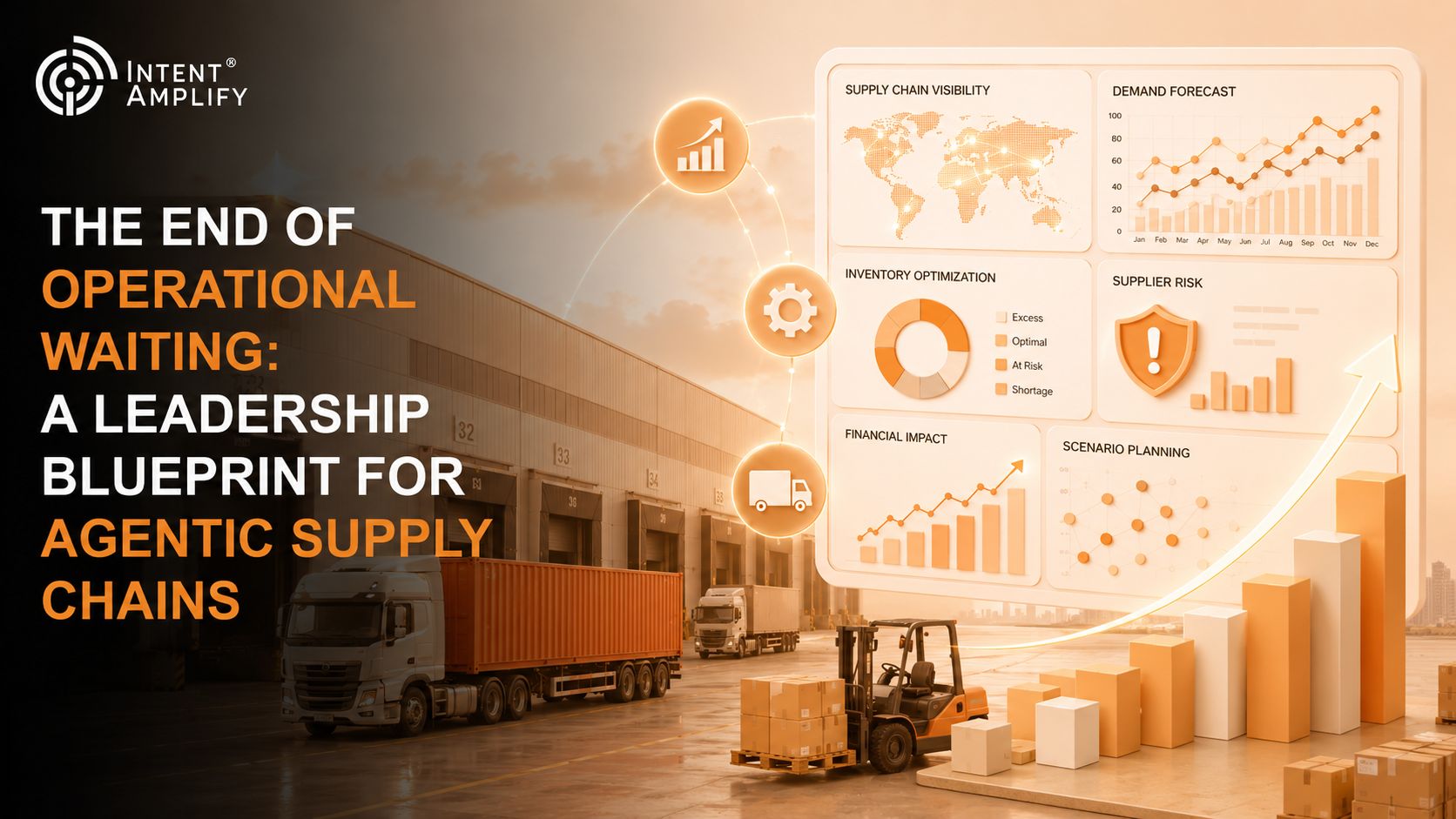
The End of Operational Waiting: A Leadership Blueprint for Agentic Supply Chains

WHITEPAPER

The End of Operational Waiting: A Leadership Blueprint for Agentic Supply Chains

Operational waiting is one of the hidden costs in supply chain performance. This whitepaper explores how agentic workflows, AI-based forecasting, and decision-centric planning help enterprises reduce latency, accelerate response, improve resilience, and move from periodic reviews to continuous orchestration.

Executive Summary

Operational waiting has become one of the least visible but most expensive constraints in modern supply chain performance. Enterprises often know when demand changes, capacity tightens, inventory falls out of balance, or transportation conditions shift. The harder challenge is acting before that signal becomes a service failure, margin event, or executive escalation.

The problem is rarely a lack of information. Many organizations already use forecasts, dashboards, exception alerts, scenario tools, and analytics teams. Yet action still waits for manual review, fragmented handoffs, meeting cycles, and cross-functional alignment. In a volatile market, that pause can erase the advantage created by better visibility.

Gartner predicts that 70% of large organizations will adopt artificial intelligence-based forecasting to predict future demand by 2030.1

Investment momentum is also rising. The 2025 MHI Annual Industry Report, produced with Deloitte, found that 55% of supply chain leaders are increasing technology and innovation spending, 60% plan to invest more than $1 million, and 19% expect to spend more than $10 million.2

Those figures show intent, but they do not guarantee speed. A new tool does not remove latency if the surrounding operating model still depends on manual sequencing. The next performance frontier is decision velocity: the ability to sense change, evaluate options, route accountability, and move into execution within trusted guardrails.

This whitepaper presents a leadership blueprint for agentic supply chains. The term describes planning environments where intelligent agents monitor signals, prepare scenarios, coordinate tasks, recommend next actions, and escalate consequential choices to humans. The aim is not unchecked autonomy. It is faster orchestration with clear accountability.

Accenture estimates that autonomous supply chain capabilities can reduce order lead times by 27%, improve productivity by 25%, lower carbon emissions by 16%, and shorten disruption recovery time by around 60%.3

This whitepaper references OMP's webinar, AI that moves at velocity: Cut through latency with agentic workflows, as a practical resource for executives exploring how planning organizations can shift from periodic reviews to continuous, adaptive response.

The Latency Problem Hiding in Plain Sight

Delay often hides inside ordinary routines. Demand exceptions wait for review. Allocation conflicts wait for consensus. Material shortages await scenario preparation. Logistics issues wait for manual comparison of alternatives. By the time an answer reaches the right owner, market conditions may have moved again.

McKinsey's 2025 Supply Chain Risk Pulse found that 82% of surveyed companies reported that new tariffs affected their supply chains, with 20% to 40% of their activity affected in some way. Thirty-nine percent reported higher supplier and material costs, while 30% saw reduced customer demand.4

The same research found that affected companies were responding through multiple levers: 45% were increasing inventories, 39% were pursuing dual sourcing, and 33% were developing nearshoring or onshoring plans.4

Each move carries consequences. More stock may protect service but consume cash. Dual sourcing may improve resilience but add complexity. Nearshoring can reduce exposure while changing cost, capacity, and manufacturing assumptions. Leaders need rapid trade-off analysis, not a delayed report that arrives after the decision window closes.

This is why latency now belongs in senior leadership conversations. It affects revenue protection, working capital, customer trust, planner productivity, and resilience. A slow response can turn a manageable exception into a costly disruption.

The deeper issue is design. Data often sits inside functional systems. Scenario modeling lives with specialized experts. Approvals travel through scheduled forums. Execution depends on manual coordination. Even strong analytics can underperform when the operating model around them is slow.

Agentic routines challenge that pattern. They can detect events, trigger analysis, prepare options, and alert accountable teams before the next review forum. The leadership opportunity is not replacing people. It is giving them better-prepared choices, sooner.

From Scheduled Reviews to Event-Driven Response

Traditional planning depends on cycles. Sales and operations planning, integrated business planning, supply reviews, demand reviews, and executive forums create discipline. These structures remain important. In high-volatility conditions, however, calendar-based coordination can also create friction.

Agentic operating models introduce a different rhythm. They do not wait for the next meeting. They monitor signals, detect variance, initiate approved routines, compare options, and prepare recommendations. Humans remain accountable for material choices, while agents support the work that happens before judgment is exercised.

Deloitte's 2026 analysis of agentic supply chains argues that organizations should redesign workflows around the complementary strengths of humans and agents rather than simply adding AI agents to existing operating models. It describes agentic approaches that can monitor conditions, compare options, coordinate tasks, and take bounded action in real time.5

This distinction matters. A dashboard tells a planner that something changed. An intelligent routine can identify affected items, assess available stock, check capacity, estimate service impact, draft mitigation paths, and notify the responsible owner. The work becomes more prepared before the human conversation begins.

IBM's Institute for Business Value found that 74% of supply chain leaders say generative AI enables better visibility, insights, and decision-making across ecosystems.6

Visibility is useful, but it is not enough. If a team sees a disruption and still waits for reconciliation, meetings, approvals, or manual scenario work, the organization has information without momentum. The strategic move is from awareness to action.

Design Rules for Agentic Planning

Agentic planning cannot be built around speed alone. Faster routines create value only when leaders trust the inputs, understand the recommendation, and know where human oversight remains required.

Context must come before autonomy. Agents need reliable demand signals, inventory positions, production constraints, supplier details, service policies, cost assumptions, and customer priorities. Without that foundation, automation can accelerate confusion instead of improving response quality.

Workflow fit matters more than novelty. Agent-enabled processes should live inside actual business routines, not beside them. Recommendations need to connect with demand management, inventory balancing, production scheduling, logistics execution, and sales and operations coordination. If they sit outside the way choices are made, adoption will remain limited.

Human judgment needs clear boundaries. Routine monitoring, exception routing, data checks, and scenario preparation are practical candidates for agent support. Choices involving financial exposure, customer commitments, strategic allocation, regulatory implications, or major trade-offs should remain governed by accountable leaders.

Explainability determines trust. Executives need to know why an action is suggested, which assumptions shaped it, what alternatives were compared, and where uncertainty remains. A fast answer that cannot be challenged will not earn confidence in a high-stakes operating environment.

Value must be measured in business terms. Useful measures include shorter response cycles, better service, reduced expediting, improved planner productivity, lower working capital, faster recovery, stronger forecast adoption, and fewer manual handoffs.

The 2025 MHI and Deloitte report shows that adoption expectations for inventory and network optimization reach 92% over five years, while predictive analytics reach 87%, and artificial intelligence reaches 82%.7

Those figures show that digital planning will keep expanding. The harder question is whether new capabilities will be orchestrated into coherent work patterns or added as another layer of complexity.

Turning Decision Velocity into Operating Practice

The best starting point is not a broad declaration about artificial intelligence. It is a practical question: where does waiting create measurable cost, service exposure, or lost margin?

Demand exception management is one candidate. When demand shifts materially, an intelligent routine can identify affected products, compare historical patterns, review service commitments, and prepare options before the next review session.

Allocation is another. When constrained supply must be distributed across customers, channels, or regions, an agent-supported process can examine margin, priority, substitution options, stock levels, and policy rules. The final call may remain human, but the decision package arrives faster.

Disruption response offers similar value. If a vendor, site, lane, or region is affected, an orchestrated routine can gather relevant signals, test alternatives, estimate cost and service impact, and recommend escalation paths.

Transportation planning is also a strong use case. Deloitte describes a logistics-agent example in which an agentic supply chain can detect demand and capacity gaps, solicit carrier bids, validate contractual and policy compliance, book carriers, and update logistics systems within defined guardrails.5

Inventory balancing may be the most visible area. Excess stock ties up capital. Shortages damage service. Manual reviews slow response. Intelligent systems can monitor policies, demand changes, availability, and constraints continuously, then prepare recommendations when conditions move outside tolerance.

The leadership lesson is straightforward. Agentic value comes from carefully selected moments where latency is visible, decisions repeat, and oversight can be designed into the process.

Webinar Spotlight: AI That Moves at Velocity

OMP's webinar, "AI that moves at velocity: Cut through latency with agentic workflows," addresses a practical question: how can organizations move from periodic decision cycles to continuous, adaptive planning without losing control?

The webinar is relevant because it focuses on latency. Many enterprises already have forecasting tools, data platforms, analytics teams, and planning applications. What they still lack is the ability to turn signals into action at business speed. OMP's public webinar page states that Zero100 and OMP explore workflows where leading organizations are moving from periodic to continuous, adaptive planning.

This framing avoids treating agentic AI as a novelty. The important issue is operational design. Can the enterprise detect an event, interpret impact, prepare options, route accountability, and act within guardrails? Can planners shift from manual coordination to higher-value judgment? Can executives reduce waiting without surrendering control?

For U.S. organizations, the webinar offers a timely lens. Planning teams are under pressure to respond faster while preserving service, margin, and resilience. Agentic workflows can help, but only when embedded into real processes rather than deployed as disconnected pilots.

The takeaway is direct. The future of planning will not be defined by how many AI tools an enterprise deploys. It will be shaped by how effectively intelligent systems reduce delay in the moments that matter most.

Where OMP Supports the Blueprint

OMP is relevant to this blueprint because its work centers on complex planning environments where response speed, scenario modeling, cross-functional alignment, and human-AI collaboration matter. OMP's Unison Planning platform supports network design, demand management, sales and operations planning, operational planning, scheduling, cloud deployment, and data integration.

OMP's decision-centric planning page states that Unison Decision-Centric Planning is built on Unison Planning and orchestrated by UnisonIQ, bringing decision-centric principles into daily operations across complex global supply chains.

The benefit is not simply that a company can use artificial intelligence. Many already can. The larger value is helping planning organizations move toward decision-centric work, where signals are interpreted earlier, scenarios are prepared sooner, trade-offs are clearer, and humans remain accountable for consequential choices.

OMP's public resource page describes the webinar as a discussion with Zero100 on cutting through latency through agentic workflows, with examples of leading organizations moving from periodic to continuous, adaptive planning.

The point is not that OMP alone defines the future. No single provider does. The broader value is that planning leaders can use the webinar as a practical starting point for identifying where waiting exists today and how agent-enabled processes may reduce it.

To explore the discussion behind this framework, access the webinar, "AI that moves at velocity: Cut through latency with agentic workflows."

Leadership Moves for Ending Operational Waiting

Locate latency before investing in more automation.
Leaders should identify where work slows today: demand changes, supply interruptions, allocation conflicts, transportation constraints, or inventory exceptions waiting for analysis, meetings, approvals, or cross-functional clarification. These moments reveal where agentic workflows can create measurable value.

Focus on repeatable choices with visible business impact.
Not every process needs orchestration at once. Strong starting points include recurring situations where faster action can improve service, reduce expediting, protect margin, lower working capital, or compress cycle times.

Strengthen the operational context agents depend on.
Trusted demand signals, stock positions, capacity rules, cost assumptions, vendor constraints, customer priorities, and policy guardrails must be accurate enough for intelligent routines to interpret events and prepare credible options.

Define where human judgment remains essential.
Monitoring, exception routing, and scenario preparation may be automated or agent-supported. Choices involving customer commitments, financial exposure, strategic trade-offs, or major service implications should remain governed by human leaders.

Measure velocity as a business outcome.
Track recovery speed, service impact, planner productivity, inventory performance, margin protection, cycle compression, and execution accuracy. Time saved matters, but business performance matters more.

Redesign rhythms around continuous response.
Agentic workflows should not simply accelerate old processes. They should help organizations move from periodic planning to continuous orchestration, where events are sensed earlier, scenarios are prepared faster, and accountable owners receive clearer options.

Prepare teams to work with intelligent routines.
Adoption depends on trust. Planners, supply leaders, finance stakeholders, and commercial teams need to understand how recommendations are generated, where they can fail, how assumptions should be challenged, and when escalation is required.

Conclusion: From Delay to Orchestration

Operational waiting is a hidden cost. It appears in manual handoffs, delayed scenario analysis, slow approvals, disconnected data, and review cycles that cannot keep pace with volatility. For leaders, the challenge is not simply seeing disruption earlier. It is responding with speed, discipline, and confidence.

Agentic workflows offer a path forward. They can monitor signals continuously, prepare options faster, coordinate tasks, and escalate the right choices to human decision-makers. The value lies in orchestration, not unchecked autonomy.

The evidence points in the same direction. Gartner expects 70% of large organizations to adopt AI-based forecasting by 2030. 8 MHI and Deloitte report that 55% of leaders are increasing technology investment, with 19% planning more than $10 million.2 Accenture estimates that autonomous approaches could reduce order lead times by 27% and shorten disruption recovery by about 60%. 3 IBM reports that 74% of supply chain leaders see generative AI improving visibility, insights, and decision-making. 6

OMP's webinar captures the leadership question behind those numbers: how can enterprises cut through latency and move toward continuous, adaptive planning? The answer begins with workflow design, trusted context, human oversight, and decision velocity.

For U.S. organizations, the strategic message is direct. The end of operational waiting will not come from AI adoption alone. It will come from redesigning the way planning work moves across people, systems, and intelligent agents.

To explore the webinar behind this framework, access OMP's "AI that moves at velocity: Cut through latency with agentic workflows."

Register Now

About Intent Amplify

Intent Amplify helps businesses turn complex ideas into market-ready content experiences that educate buyers, build category authority, and support demand generation. Through analyst-led research, editorial strategy, sponsored content programs, and targeted technology publishing, Intent Amplify connects enterprise audiences with the insights they need to make confident decisions.

For technology leaders exploring how agentic workflows, artificial intelligence, and decision-centric planning can reshape supply chain operations, this whitepaper offers a starting point. The next step is a practical conversation about audience priorities, webinar strategy, and how to position complex enterprise technology solutions for decision-makers who need clarity before commitment.

To discuss research-led content programs, sponsored assets, or technology publishing opportunities, contact Intent Amplify.

References

  1. Gartner, Gartner Predicts 70% of Large Organizations Will Adopt AI-Based Supply Chain Forecasting to Predict Future Demand by 2030, September 2025

  2. MHI and Deloitte, The Digital Supply Chain Ecosystem: Orchestrating End-to-End Solutions, 2025

  3. Accenture, Making Autonomous Supply Chains Real, 2026

  4. McKinsey & Company, Supply Chain Risk Pulse 2025: Tariffs Reshuffle Global Trade Priorities, December 2025

  5. Deloitte, Resilient by Design: The Agentic Supply Chain, March 31, 2026

  6. IBM Institute for Business Value, Scaling Supply Chain Resilience: Agentic AI for Autonomous Operations, April 2025

  7. MHI and Deloitte, New MHI and Deloitte Report Focuses on Orchestrating End-to-End Digital Supply Chain Solutions, March 2025

  8. Gartner, Gartner Predicts 70% of Large Organizations Will Adopt AI-Based Supply Chain Forecasting to Predict Future Demand by 2030, September 2025

Yash Lad

Yash Lad

Research Analyst

Let connect with us

The End of Operational Waiting in Agentic Supply Chains