Why DIY RAG Looks Simple Until Production Begins
For many enterprise AI, data science, and machine learning teams, the build-versus-buy decision begins only after the first Retrieval-Augmented Generation, or RAG, prototype succeeds. The proof of concept may look simple: connect a few documents, generate embeddings, add a search layer, and show leadership a working assistant.
Production changes the equation. Real deployments require governed ingestion, deterministic retrieval, source attribution, role-based access, hybrid search, built-in evaluation, observability, re-indexing, maintenance, and security controls that can perform reliably across departments, data sources, and business use cases.
This is the decision. Progress Software’s whitepaper, Build vs. Buy: The Reality of Production-Grade RAG, is designed to help AI and engineering leaders evaluate. The question is no longer whether a team can build a RAG prototype. Many can. The harder question is whether building and maintaining production-grade RAG infrastructure is the best use of scarce engineering, security, and governance capacity.
Worldwide spending on artificial intelligence is already estimated at nearly $235 billion, with IDC projecting the market to exceed $631 billion by 2028. The issue is not whether enterprises are investing. They are. The harder question is whether those investments can move from pilot theater to governed, measurable operations.1
McKinsey’s 2025 global research found that 88% of organizations use AI regularly in at least one business area, up from 78% the previous year. Yet only about one-third have expanded their AI programs across the enterprise. This gap between usage and scaled operating maturity is becoming expensive, especially as leaders decide whether to build RAG infrastructure internally, buy a managed platform, or choose a hybrid path. 2
Gartner has issued a clear warning: at least 30% of generative AI projects will likely be abandoned after proof of concept by the end of 2025 because of poor data quality, inadequate risk controls, escalating costs, or unclear business value. 3
For Progress Software’s target buyers, RAG is not just a model wrapper. It is a governed knowledge layer that determines which enterprise source is retrieved, which permission applies, how evidence is attributed, how an answer is evaluated, and whether users can trust the system in real workflows. That is why the build-versus-buy decision must account for more than prototype cost. It must account for operational ownership.
That is why the build-versus-buy decision deserves more rigor than a prototype budget review.
Why Production-Grade RAG Requires More Than a DIY Stack
A prototype may only need documents, embeddings, a search layer, and a large language model. Production-grade RAG needs a governed operating layer. It requires source permissions, audit trails, content freshness rules, ranking controls, chunking strategy, hybrid retrieval, source attribution, evaluation, observability, and incident response when an answer sounds confident but the supporting evidence is weak.
Progress Software’s whitepaper, Build vs. Buy: The Reality of Production-Grade RAG, frames this challenge around a practical enterprise reality: do-it-yourself RAG can work in the early stages, but production exposes the operational burden of scaling ingestion, retrieval, access control, evaluation, and observability. The whitepaper helps leaders compare DIY development with a governed RAG-as-a-Service approach built around deterministic retrieval, source attribution, governed access, hybrid retrieval, built-in evaluation, and full observability.
That is not only a technical concern. It is a governance issue.
IBM’s Cost of a Data Breach Report 2025 found that the global average cost of a data breach reached $4.4 million. IBM also reported that 97% of organizations with AI-related security incidents lacked proper AI access controls, while 63% lacked governance policies to manage AI or prevent shadow AI.4
A weak RAG implementation can expose sensitive information, retrieve stale files, ignore source hierarchy, or provide unverifiable answers. In a low-risk internal pilot, that may be frustrating. In legal, financial, healthcare, cybersecurity, procurement, customer support, or regulated workflows, it can become a material business problem.
The lesson is straightforward: production RAG is not simply about giving employees faster answers. It is about deciding whether the organization should build and maintain this governed knowledge layer internally, use a managed RAG-as-a-Service model, or combine both approaches where business differentiation justifies custom ownership.
The Build Case: When Custom Control Is Worth It
Building can still make sense. Some organizations have genuine strategic reasons to own the full stack.
A bank may need domain-specific ranking logic. A defense contractor may require sovereign deployment. A pharmaceutical company may need specialized scientific retrieval. A global manufacturer may require multilingual search across technical documents, drawings, field reports, warranty data, and supplier files.
In these scenarios, control is not vanity. It is differentiation.
Custom RAG, however, should not be treated as a weekend engineering project. Even organizations with strong technology teams often struggle to scale AI across departments, security models, governance requirements, and business workflows.
Cisco’s AI Readiness Research shows that only 13% of companies are “Pacesetters,” meaning they have the infrastructure, skills, data discipline, and operating processes needed to execute AI initiatives consistently.5
That finding reflects what many enterprise AI teams already know. A RAG concept is comparatively easy to demonstrate. Making it reliable across business units is the hard part.
The pressure appears quickly. A team can build a first version with open-source libraries and cloud services. Then real users arrive. They ask vague questions. They expect answers from dozens of repositories. They need citations. They require role-based access. They want predictable performance under load. They expect the tool to work every Monday morning, not only during a demo.
The build path requires funding for ingestion pipelines, parsing, metadata enrichment, vector storage, hybrid retrieval, reranking, evaluation sets, security reviews, observability, cost controls, model changes, re-indexing, and ongoing maintenance.
Without that commitment, the organization is not building a platform. It is accumulating technical debt.
The RAG-as-a-Service Case: When Speed, Trust, and Reuse Matter More Than Infrastructure Ownership
Buying becomes attractive when the hard work is reusable rather than differentiating.
Most enterprise teams do not win because they created another PDF parser. They win because employees find the right policy in seconds, customer service agents resolve issues faster, legal teams locate precedents with confidence, and product teams reuse institutional knowledge without digging through disconnected systems.
Cisco’s 2025 AI Readiness Index showed that just 13% of organizations are “Pacesetters.” These top performers are 4x more likely to move pilot projects into full production and 50% more likely to measure actual value. The takeaway is clear: advantage depends less on experimentation and more on readiness.6
Cisco research also shows why infrastructure matters. 83% of companies plan to use AI agents, with nearly 40% expecting them to work alongside staff within a year. Yet 54% say their networks cannot handle the complexity or data volume, and only 15% believe their networks are flexible or adaptable enough. 5
A governed RAG-as-a-Service approach can reduce this burden by centralizing ingestion, retrieval, access control, evaluation, observability, and deployment patterns. It gives AI, data, and engineering teams a reusable foundation instead of forcing every business unit to assemble, secure, test, monitor, and maintain its own RAG stack. k.
The Progress-specific buy case is strongest when the organization needs a production-ready foundation for trusted RAG: governed ingestion, deterministic retrieval, source attribution, role-based access, hybrid search, built-in evaluation, and full observability. In those situations, the question is not whether a capable team could build the components. It is whether rebuilding and maintaining those components is the best use of scarce engineering, security, and AI governance capacity.
A Practical Build-Buy-Hybrid Framework for Production-Grade RAG
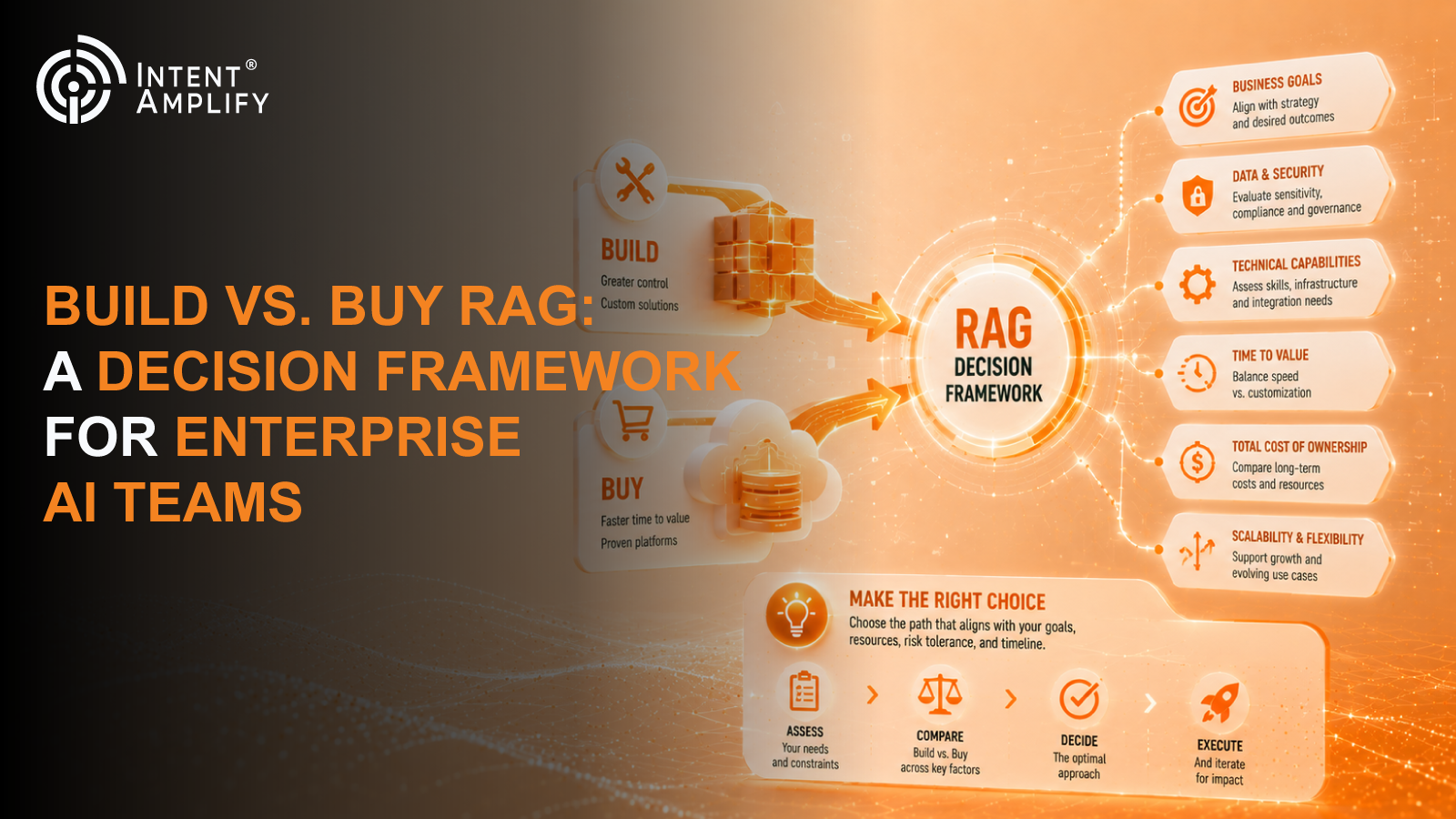
Enterprise AI leaders should assess production-grade RAG decisions across five dimensions: differentiation, knowledge complexity, governance exposure, quality measurement, and total cost of ownership.
First, identify the source of differentiation. If proprietary retrieval logic, specialized taxonomies, domain-specific ranking, or regulated deployment control creates a business advantage, custom development may be justified. If the main challenge is reusable complexity, a managed route may be more rational.
Second, map knowledge complexity. Count repositories, formats, languages, user roles, update frequency, document ownership, retention rules, and conflicting versions. A clean demo corpus hides the real work. A live enterprise environment reveals it.
Third, assess governance exposure. RAG systems must respect permissions, protect sensitive data, provide defensible citations, and show how answers were produced. This becomes especially important for legal, finance, healthcare, cybersecurity, procurement, customer support, and regulated operations.
Fourth, measure quality continuously. Gartner’s 2025 AI maturity research found that 45% of high-maturity organizations keep AI initiatives operational for at least three years, compared with only 20% of low-maturity organizations. It also found that 63% of high-maturity organizations use financial analysis, ROI analysis, and customer-impact metrics to measure success. 7
Fifth, calculate total ownership cost. Include engineering time, model changes, re-indexing, storage, monitoring, incident response, security review, user support, and roadmap delay. The cheapest proof of concept may become the most expensive operating model.
This framework gives leaders a more disciplined way to evaluate the real decision. The choice is rarely “build everything” or “buy everything.” More often, it is a question of which layers should be owned, which should be standardized, and which can be accelerated through mature tooling.
Where Progress Software Fits in the Build-Versus-Buy Decision
Progress Software’s relevance in this decision comes from the gap between what a RAG prototype proves and what a production system must sustain. A prototype may show that enterprise content can improve AI responses. A production system must prove that content can be ingested, retrieved, permissioned, attributed, evaluated, monitored, and maintained at scale.
Build vs. Buy: The Reality of Production-Grade RAG helps technology leaders evaluate that gap with greater discipline. The whitepaper examines where DIY RAG creates a hidden operational burden, where a governed RAG-as-a-Service model can reduce repeated infrastructure work, and where a hybrid approach may allow teams to retain custom business logic while standardizing the layers that do not create differentiation.
Enterprise AI, data, and engineering leaders can use the whitepaper to evaluate which path best fits their goals, resources, risk profile, and long-term roadmap. The value is not only in choosing whether to build or buy. It is in identifying which RAG layers should be owned, which should be standardized, and which can be accelerated through a governed service model.
Download Build vs. Buy: The Reality of Production-Grade RAG to evaluate whether your organization should build, buy, or take a hybrid path to production-grade RAG.
What Leaders Should Do Next
Start by auditing current RAG pilots. List connected repositories, document types, permission models, refresh cycles, evaluation methods, failure patterns, and support owners. Then ask a sharper question: which parts of the current system create business advantage, and which parts mainly consume engineering effort?
Next, test under real conditions. Use restricted content, stale documents, duplicate files, multilingual sources, contradictory guidance, and ambiguous user queries. Production readiness is determined by how a system behaves under enterprise messiness, not by how it performs in a curated demonstration.
Adoption also needs to be evaluated from the user’s side. BCG’s 2025 AI at Work survey, based on more than 10,600 respondents across 11 countries and regions, found that more than 75% of leaders and managers use generative AI several times a week, while frontline usage has stalled at 51%. The same research found that strong leadership support raises positive employee sentiment toward generative AI from 15% to 55%. 8
That finding matters. RAG adoption is not only an architecture problem. It is also a workflow, trust, and change-management problem.
When comparing build, buy, and hybrid options, use the same standards: time to launch, security, retrieval quality, source coverage, evaluation depth, integration effort, operational ownership, and future scalability. Choose the path that makes the next 10 use cases easier, not harder.
Conclusion: Own What Differentiates. Standardize What Slows Production.
The RAG conversation is maturing quickly. The question is no longer whether enterprises can connect language models to internal content. Many can. The real question is whether they should own every layer required to make RAG governed, measurable, secure, observable, and scalable across real business workflows.
PwC’s 2025 Global AI Jobs Barometer shows why the pressure is rising. It found that productivity growth in industries most exposed to AI nearly quadrupled, rising from 7% in the 2018–2022 period to 27% between 2018 and 2024. It also found that the most AI-exposed industries saw 3x higher growth in revenue per employee than the least exposed industries. 9
That upside will not come from fragile pilots. It will come from systems that combine trusted data, strong governance, usable workflows, and measurable outcomes.
Build where internal ownership creates a durable advantage. Buy or adopt managed approaches where repeatable infrastructure, evaluation, security, and maintenance can be handled more efficiently. For many enterprise AI teams, the smartest path may be hybrid: own the business logic that matters and avoid rebuilding operational layers that do not.
Progress Software’s whitepaper, Build vs. Buy: The Reality of Production-Grade RAG, gives technology leaders a practical next step for weighing DIY development, governed RAG-as-a-Service, and hybrid approaches. It helps teams evaluate the operational, financial, and governance realities that determine whether RAG remains a promising prototype or becomes a trusted production capability.
As enterprises adopt RAG more quickly, the winners will not simply be the teams with the most sophisticated prototypes. They will be the organizations that make disciplined decisions about where to customize, where to standardize, and how to scale responsibly.
Download the whitepaper: Build vs. Buy: The Reality of Production-Grade RAG
From Insight to Influence
As technology markets become increasingly complex, success depends not only on generating valuable insights but also on ensuring those insights reach the stakeholders shaping strategic decisions.
Cyber Tech Intelligence enables technology organizations to extend the reach of thought leadership, engage buying groups with precision, and convert market intelligence into meaningful business opportunities through intelligence-led demand generation and pipeline activation programs.
To learn more: Contact us.
References
-
IDC, IDC’s Worldwide AI and Generative AI Spending Industry Outlook, 2025
-
McKinsey & Company, The State of AI, 2025
-
Gartner, Gartner Predicts 30% of Generative AI Projects Will Be Abandoned After Proof of Concept by End of 2025, July 29, 2024
-
IBM, Cost of a Data Breach Report 2025, 2025
-
Cisco, Cisco AI Research: The Most AI-Ready Companies Outpace Peers in the Race to Value, 2025
-
Cisco, AI Readiness Index, 2025
-
Gartner, Newsroom, 2025
-
Boston Consulting Group, AI at Work 2025: Momentum Builds, but Gaps Remain, 2025
-
PwC, Global AI Jobs Barometer, 2025