
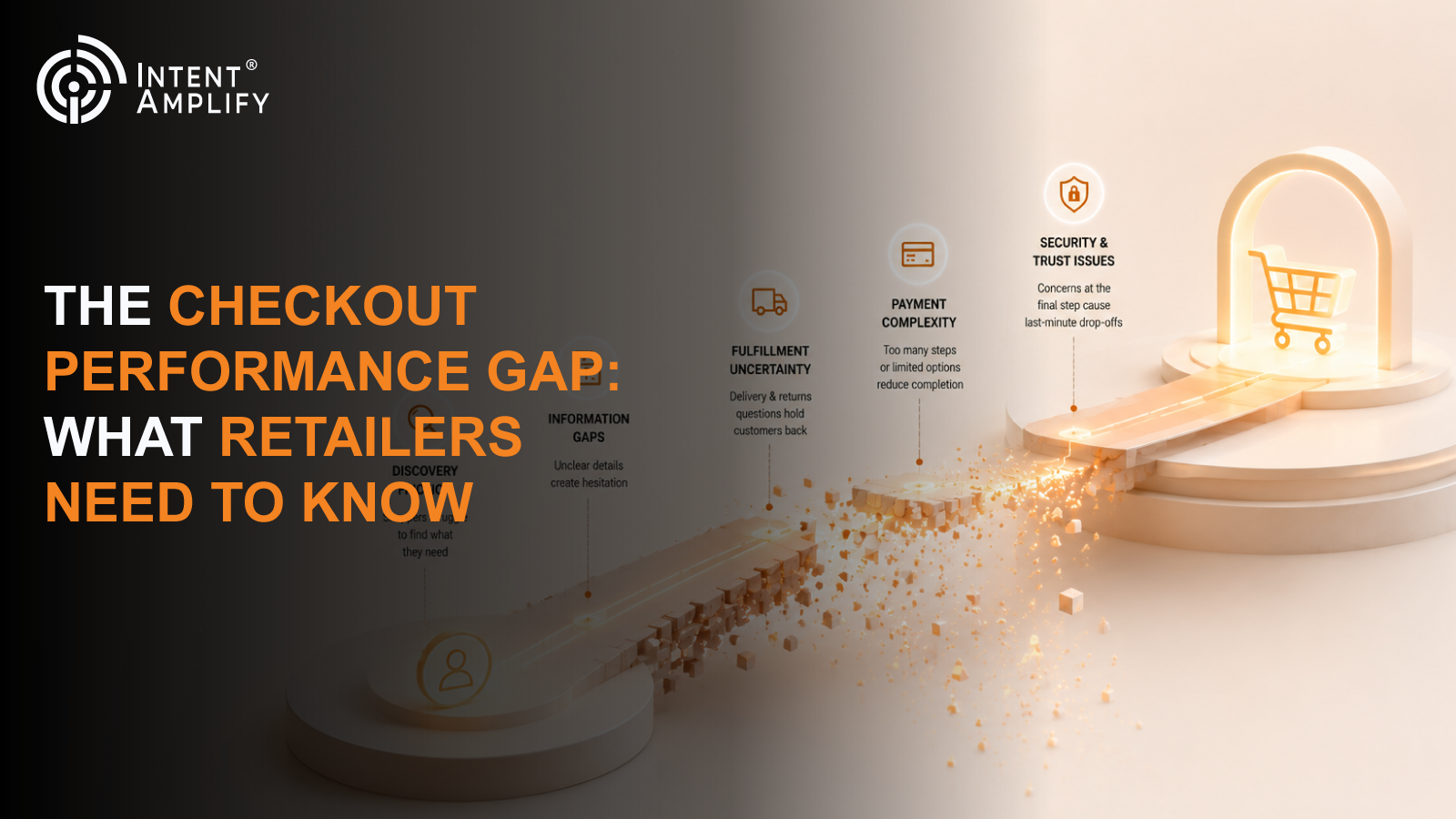
Retailers rarely lose customers because shoppers suddenly forget they wanted to buy something. In most cases, the customer has already done the harder work: finding the product, accepting the price, choosing the channel, and moving toward payment. Then checkout creates friction at exactly the wrong moment, turning purchase intent into cart abandonment, failed transactions, or quiet frustration.
That is the checkout performance gap: the distance between a customer’s willingness to buy and a retailer’s ability to complete the transaction smoothly across ecommerce, mobile, POS, self-checkout, kiosk, app-based, curbside, and omnichannel payment flows.
For Director+ leaders in IT, Operations, Security, and Strategy, this is no longer a narrow payment issue. It affects conversion optimization, payment performance, revenue recovery, operational resilience, and the customer’s willingness to trust the brand again. Checkout is where retail strategy becomes measurable, which is inconvenient for anyone hoping the problem could stay hidden inside a dashboard.
The Expensive Problem of “Almost Bought”
Retailers spend heavily to attract traffic through advertising, personalization, loyalty programs, merchandising, and unified commerce initiatives. But demand only becomes revenue when checkout works. Baymard Institute’s 2025 benchmark places the average documented online cart abandonment rate at 70.22%, showing that most digital carts still fail before checkout completion. That makes the issue far more than a UX inconvenience.1
Most retailers can measure completed sales. Far fewer can identify where customer intent disappears before transaction completion. Purchase abandonment often stems from missing payment options, late-stage shipping costs, weak trust signals, slow mobile performance, or payment authorization failures after purchase intent has already formed.
At scale, these sources of friction contribute to revenue leakage, lower conversion rates, and weaker customer retention. Customers evaluate the experience, not the systems behind it.
Checkout Friction Is Not One Thing
Checkout friction rarely stems from a single failure. More often, it emerges from a series of decisions that appear reasonable in isolation but collectively create an experience that feels slow, unclear, or unnecessarily demanding.
Baymard’s 2025 Checkout UX benchmark found that 64% of leading desktop e-commerce sites and 63% of mobile sites deliver "mediocre" or worse checkout experiences.¹
Even retailers with strong traffic and brand recognition can lose conversion when friction appears at the final stage of the purchase journey.
Payment Choice Is Now Customer Experience
Payment methods have evolved beyond back-office infrastructure. They now shape the customer experience directly. Worldpay’s Global Payments Report 2025 found that digital payment methods accounted for 66% of global e-commerce transaction value and 38% of global in-person shopping value in 2024. Digital wallets, mobile wallets, BNPL, account-to-account payments, and alternative payment methods have become central to how customers expect to complete purchases.²
Payment choice directly influences conversion. Customers who prefer digital wallets or buy now, pay later options often view the absence of those methods as a reason to abandon the transaction rather than a minor inconvenience. Many will move to a marketplace, competitor, or retail application that supports their preferred payment experience.
Speed Protects Revenue
Payment processing speed matters because slow authorization, payment latency, POS lag, app delays, frozen terminals, and long queues create hesitation when retailers need momentum. In e-commerce, hesitation becomes checkout abandonment. In stores, it becomes associated with pressure, lower throughput, and customers reconsidering purchases while everyone pretends the line is moving.
Modern POS systems, mobile POS, smart terminals, and cloud-based POS solutions are increasingly part of checkout optimization because speed is no longer just a convenience metric. For grocery, convenience, QSR, apparel, and specialty retailers, faster checkout supports conversion, store flow, and operational consistency across locations.
Trust Breaks Fast at Checkout
Trust should be strongest at checkout. Instead, many retailers weaken it with surprise fees, unfamiliar redirects, unclear return policies, weak security cues, or payment screens that feel disconnected from the branded experience.
Deloitte’s 2025 retail cybersecurity research found that 64% of shoppers are hesitant to shop with retailers that have experienced a data breach, while 70% worry about sharing personal information with retailers because of breaches, misuse, or unclear data practices. That makes checkout security directly connected to conversion because customers are not only evaluating whether a transaction is protected. They are deciding whether the retailer deserves their payment information in the first place.3
Digital identity verification, identity authentication, age verification software, and fraud prevention tools can reduce risk, but poorly designed controls can slow legitimate buyers. NICE Actimize’s 2025 Fraud Insights Report found that scams represented 57% of attempted fraud transactions by value and 52% by volume in 2024, which shows why retailers cannot treat security as decorative compliance theater.4
Why Director+ Leaders Should Care
Checkout performance depends on a complex technology and operations stack that includes e-commerce platforms, payment gateways, payment orchestration, fraud tools, digital identity systems, loyalty platforms, inventory data, store networks, POS software, and customer data infrastructure. A single transaction requires these systems to operate consistently across multiple handoffs before a customer reaches a confirmation screen. Performance failures anywhere in the chain can disrupt conversion, trust, and revenue capture.
IT leaders are responsible for the reliability layer through uptime, integrations, routing, monitoring, transaction speed, and recovery paths. Operations leaders manage the experience layer through store execution, queue management, associate readiness, self-checkout performance, customer flow, and location-level consistency. Security leaders protect the trust layer through fraud prevention, payment security, identity verification, and risk management.
Checkout performance should be measured beyond approval rates. Approval rate remains an important indicator, but it does not reveal where purchase intent is lost or where friction enters the transaction journey. A more complete performance framework includes checkout completion rate, failed transaction rate, average checkout time, mobile checkout abandonment, POS downtime, queue abandonment, fraud review friction, and repeat purchase behavior following checkout failure.
Retail leaders need visibility into where customer intent is being lost across digital and physical commerce channels. Without that visibility, conversion issues often remain hidden until they appear as lower revenue, weaker customer retention, or declining operational performance.
Explore the full report on The Checkout Performance Gap to understand the data behind conversion, payment choice, and trust.
Closing the Gap Without Overengineering It
Retailers do not need to turn checkout into a science project. They need to remove obvious friction, support relevant payment methods, improve mobile checkout optimization, strengthen secure identity checks, and modernize payment infrastructure where legacy systems slow the business down.
A better strategy should reduce unnecessary fields, prevent surprise costs, support digital wallet adoption, improve transaction speed, and connect physical and digital commerce through unified commerce platforms. Some retailers may also need payment orchestration, better POS software, smarter queue management systems, or cleaner mobile checkout flows, depending on where the breakdown occurs.
The checkout performance gap is where customer intent, payment choice, security, and operational execution collide. Retailers that close it do more than reduce cart abandonment. They recover lost revenue, improve trust, and capture more of the demand they already paid to create. Put less politely: retailers should stop losing customers at the exact moment those customers are trying to give them money.
Connect with Intent Amplify to support your next content syndication campaign.
References
-
Baymard Institute (2025) Current State of Checkout UX. Available at: https://baymard.com/blog/current-state-of-checkout-ux
-
Worldpay (2025) Global Payments Report 2025. Available at: https://worldpay.com/en/insights/articles/gpr-2025-released
-
Deloitte (2025) Retail Reimagined: Cybersecurity in Retail. Available at: https://www.deloitte.com/ca/en/Industries/consumer/perspectives/retail-reimagined-cybersecurity-in-retail.html
-
NICE Actimize (2025) 2025 Fraud Insights Report. Available at: https://www.niceactimize.com/press-releases/nice-actimize-2025-fraud-insights-report-482