
For years, associations have invested in content as a core member benefit. They publish research, host webinars, build certification programs, produce event sessions, maintain policy libraries, and preserve years of institutional expertise. On paper, this should make them indispensable.
In practice, much of that value is harder to reach than it should be.
A member may know the answer exists somewhere, but not where. A staff team may have already created the resource, but still receives the same question repeatedly. A new professional may join for guidance, only to face a maze of portals, PDFs, recordings, forum threads, and outdated search results. The organization has the expertise. The user has the need. The connection between the two is often where the experience breaks down.
Artificial intelligence is changing how people discover, evaluate, and consume information. Microsoft's Global Artificial Intelligence Diffusion Report found that global AI usage rose from 16.3% to 17.8% of the world's working-age population in the first quarter of 2026, with 26 economies now exceeding 30% adoption among working-age users. 1
The shift reflects changing user behavior as much as technology adoption. People are growing accustomed to asking direct questions and receiving contextual answers. They no longer want to search through archives. They want guidance.
Associations now face greater pressure to make expertise easier to discover and apply.
The Expertise Problem Hiding in Plain Sight
Most associations are not short on knowledge. They are often overwhelmed by it.
A professional body may have years of conference recordings, legislative briefings, certification guides, technical standards, training modules, committee documents, research reports, and member discussions. Each asset may be valuable on its own. Collectively, however, these resources can become difficult to navigate when they sit across disconnected systems.
The challenge is not content volume but the ability to connect members with relevant information when they need it.
This is where many digital experiences fall short. A keyword search box can locate documents, but it cannot always understand intent. It can return pages, but not necessarily answers. It can show results, but not confidence. For a member trying to make a compliance decision, prepare for certification, or solve a professional challenge, that distinction matters.
Salesforce's State of Data and Analytics research found that 84% of data and analytics leaders say their data strategies need a complete overhaul before Artificial Intelligence ambitions can succeed. 2
AI initiatives depend on information environments that are connected, current, and accessible.
Why Traditional Search Is No Longer Enough
Traditional search was built for retrieval. Modern users expect interpretation.
That is the essential difference.
A member searching for "cybersecurity certification renewal" may not use the same words found in the official renewal guide. Another may ask about "board governance for AI use" when the relevant material lives inside an ethics policy webinar. A third may need regulatory insight that appears across several documents, none of which provides a complete answer alone.
Keyword-based search focuses on matching terms, while intelligent systems evaluate meaning, context, and intent.
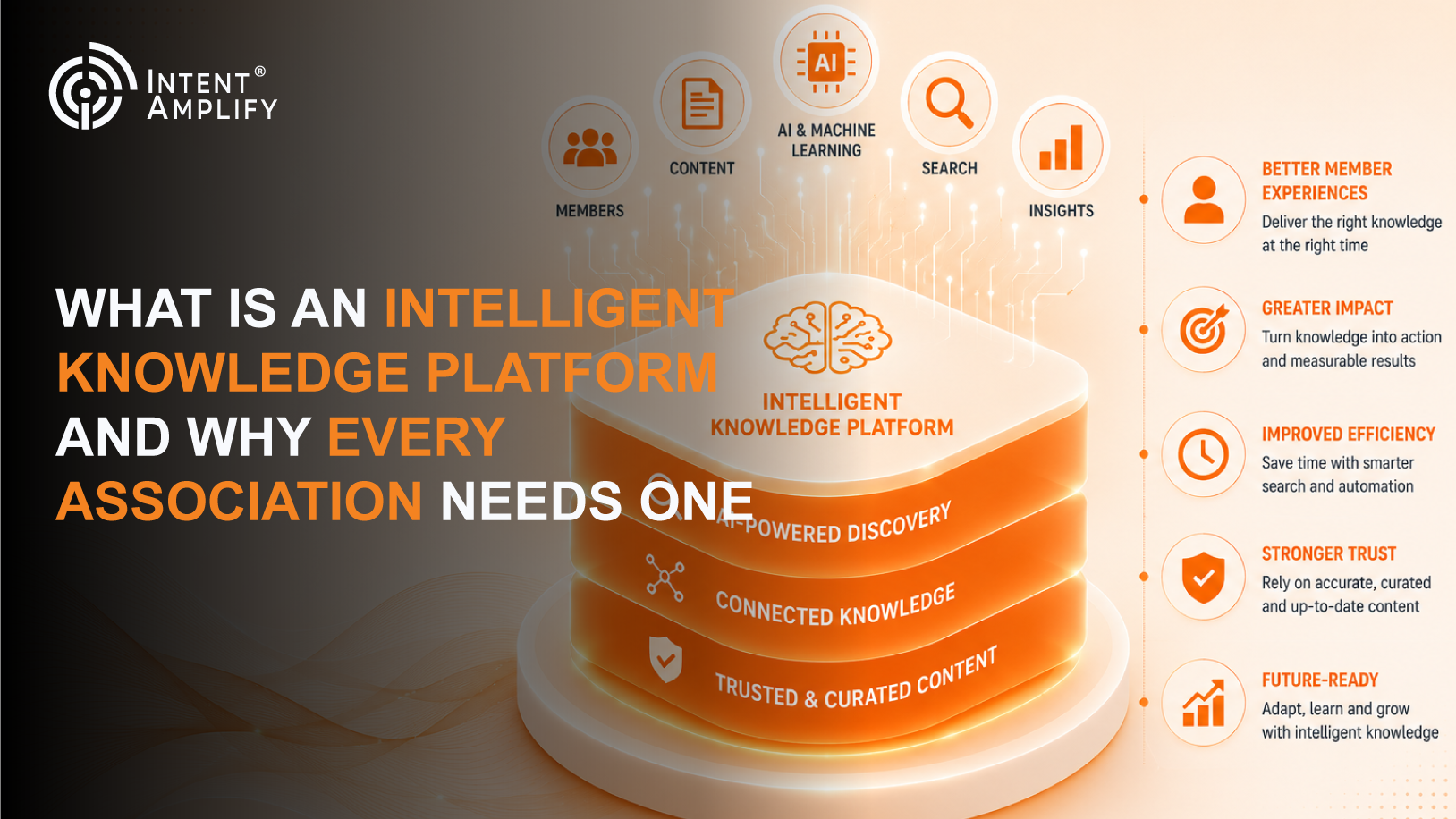
An Intelligent Knowledge Platform is the layer that connects people with organizational expertise through semantic search, natural language interaction, source-grounded answers, and governed access to approved content. It helps users discover, understand, and apply information in context.
That makes it different from a repository, intranet, or chatbot. Unlike repositories and standalone chat interfaces, Intelligent Knowledge Platforms combine retrieval, contextual reasoning, and governed access to trusted information.
For associations, that difference can reshape the member experience.
What an Intelligent Knowledge Platform Actually Does
An Intelligent Knowledge Platform brings together scattered resources and makes them usable through a more intuitive interface. Instead of asking members to understand where documents live, it allows them to ask questions in natural language.
One may ask, "What continuing education requirements do I have to meet before my next certification renewal?" And the system would be able to pull up the most recent guidelines for certification, provide a synopsis of the requirement, and provide you with the source. One may ask, "What has the organization published on the topic of AI governance this year?"
The value is not only faster access. It is better confidence.
In associations, trust is the product. Members rely on official guidance for decisions that affect compliance, professional development, operations, and strategy. If an Artificial Intelligence system gives an answer without showing where it came from, it may create more risk than value.
That is why retrieval-augmented generation, or RAG, has become important. RAG connects generative Artificial Intelligence systems to approved organizational content so answers can be grounded in trusted sources rather than generated from a model alone.
The Business Case for Better Knowledge Access
The return on an Intelligent Knowledge Platform starts with member experience, but it does not end there.
If expertise is readily available, then the lifespan of educational material increases. Webinars that have been archived become accessible once again. Research findings reach other people. Guidelines on certification become more apparent. Time is saved from answering redundant questions, as employees no longer need to do it. Recruits get up to speed without needing any help.
This is especially important as data volumes grow. Salesforce's State of Data and Analytics research reports that data and analytics leaders estimate organizational data volumes are increasing by 25% annually, while 54% of business leaders are not fully confident that the data they need is accessible. 3
Associations face a similar pattern. Content keeps growing, but access does not automatically improve. Without an intelligent layer, each new report, event, and resource can add value and complexity at the same time.
An Intelligent Knowledge Platform helps reverse that pattern. It turns accumulated content into a living resource that can support learning, engagement, research discovery, and member services.
AI Raises the Stakes for Governance
The rise of AI agents makes this conversation more urgent.
Salesforce's 2026 Connectivity Report found that organizations currently use an average of 12 AI agents, with that number projected to climb 67% within two years. The same report states that 96% of IT leaders say AI agent success depends on integration across systems.4
Future member experiences will extend across websites, learning environments, event applications, AI assistants, and support channels. They may involve Artificial Intelligence assistants, learning portals, event apps, support workflows, and personalized recommendation engines. Each touchpoint will depend on accurate, connected, governed information.
If the underlying content layer is weak, every Artificial Intelligence experience built on top of it becomes fragile.
Cisco's AI Readiness Index highlights the same concern from a governance perspective, noting that only 24% of organizations can control agent actions with proper guardrails and live monitoring. 5
Governance remains a critical requirement for any member-facing AI experience.
A smart interface without governance can quickly become a liability. Members do not just need fast responses. They need official, current, permission-aware, and explainable answers.
Why Associations Need More Than a Chatbot
A chatbot can answer questions. That does not mean it can manage knowledge.
Many organizations begin their AI journey by experimenting with conversational interfaces. Early demos can look impressive. A user asks a question, and the system responds in seconds. But production environments require much more than a polished front end.
They need secure access controls so member-only content stays protected. They need source attribution so users can verify guidance. They need monitoring, so teams understand what people are asking. They need evaluation processes so that inaccurate answers can be corrected. They need integrations across content systems, learning environments, customer relationship management platforms, and document repositories.
Google Cloud's 2026 AI Agent Trends research is based on a survey of 3,466 global executives and frames the current enterprise shift as an "agent leap," where AI moves from one-off prompts toward systems that orchestrate complex workflows. 6
That evolution reinforces a simple point: the future is not about isolated AI tools. It is about connected intelligence.
Associations that want to deliver modern digital experiences need a foundation capable of supporting that shift.
From Information Repositories to Intelligent Experiences
Many associations have spent years building impressive digital libraries. They have invested in research centers, learning portals, certification resources, webinar archives, discussion communities, and member-only content hubs.
The challenge is that adding more content does not automatically create more value.
A growing collection of resources can become increasingly difficult to navigate unless users can quickly find the information most relevant to their needs. In many organizations, valuable insights remain buried inside reports, event recordings, policy documents, and educational materials that few people discover after their initial publication.
This is where the conversation around Intelligent Knowledge Platforms becomes increasingly important.
Rather than treating content as a collection of isolated assets, these environments transform information into a connected, searchable, and actionable resource. They help professionals move beyond traditional search experiences and toward direct, context-rich answers grounded in trusted organizational expertise.
For membership-driven organizations, that shift represents more than a technology upgrade. It creates an opportunity to extend the value of existing intellectual property, improve member engagement, accelerate learning, and strengthen the overall digital experience.
Where Progress Software Fits
As associations explore new ways to unlock value from their institutional expertise, Progress Software is helping organizations rethink how information is accessed and applied.
Through Progress Agentic RAG, organizations can connect fragmented content sources, improve discoverability, surface trusted answers, and create more intuitive knowledge experiences. Rather than requiring users to navigate multiple systems, the approach focuses on delivering relevant information when and where it is needed.
The objective is simple: transform decades of accumulated expertise into a strategic asset that supports education, engagement, retention, and long-term growth.
Because ultimately, members do not judge an organization by the size of its content library. They judge it by how effectively that expertise helps them solve problems, make decisions, and advance their professional goals.
The Next Era of Association Value
Associations have always been built around expertise. What is changing is how that expertise must be delivered.
Professionals increasingly expect conversational experiences. Digital interactions are becoming more personalized. Educational journeys are growing more complex. At the same time, content ecosystems continue to expand, creating new challenges around discovery, accessibility, and relevance.
In this environment, success will not be determined by how much information an organization publishes. It will be determined by how effectively that expertise can be activated.
An Intelligent Knowledge Platform represents a new way of thinking about member value. Instead of treating knowledge as something that is stored, it treats knowledge as something that is continuously accessible, discoverable, and actionable.
For leadership teams, the question is no longer whether better access to expertise matters. The real question is whether their organization is prepared to transform years of accumulated insights into an experience that meets the expectations of today's professionals.
Download the Whitepaper
Associations are entering a new era where members expect immediate access to trusted guidance, personalized learning pathways, and context-rich answers.
To learn how leading organizations are transforming static content repositories into dynamic knowledge experiences, download Progress Software's whitepaper:
From Archives to Answers: The Future of Association Knowledge
The whitepaper explores how associations can unlock greater value from existing expertise, improve discoverability, enhance member engagement, and prepare their knowledge ecosystems for the next generation of AI-powered experiences.
As organizations navigate AI adoption, digital transformation, cybersecurity, and evolving customer expectations, access to trusted market intelligence has never been more important.
Explore additional industry insights and expert perspectives at Intent Amplify
Interested in discussing your marketing or content strategy goals? Connect with the team here: Contact Us.
References
-
Microsoft, AI Diffusion Report 2026 (Q1), May 2026
-
Salesforce, Data & Analytics Trends 2026, 2026
-
Salesforce, State of Data and Analytics, 2026
-
Salesforce, Connectivity Report 2026, 2026
-
Cisco, AI Readiness Index, 2026
-
Google Cloud, AI Agent Trends 2026, 2026