
Published by Intent Amplify, delivering research-driven insights for legal knowledge leaders, AI leaders, risk leaders, architecture teams, legal operations leaders, innovation teams, and professional services decision-makers navigating trusted AI adoption, traceable search, governance, client trust, regulatory expectations, and digital transformation.
Generative AI can scale fast, but legal trust cannot.
A law firm can pilot a chatbot, summarize contracts, automate intake, and draft client updates in weeks. But if the search layer is not traceable, governed, and permission-aware, every scaled workflow inherits the same weakness: the answer may sound right before anyone can prove where it came from, whether the source was current, and whether the user was authorized to access it.
Thomson Reuters found that 40% of professional services organizations now use GenAI, up from 22% the prior year, while 87% expect it to become central to workflow within five years. Agentic AI is gaining momentum too, with 15% of organizations already using it, 53% planning or considering it, and 77% expecting it to become central by 2030.¹
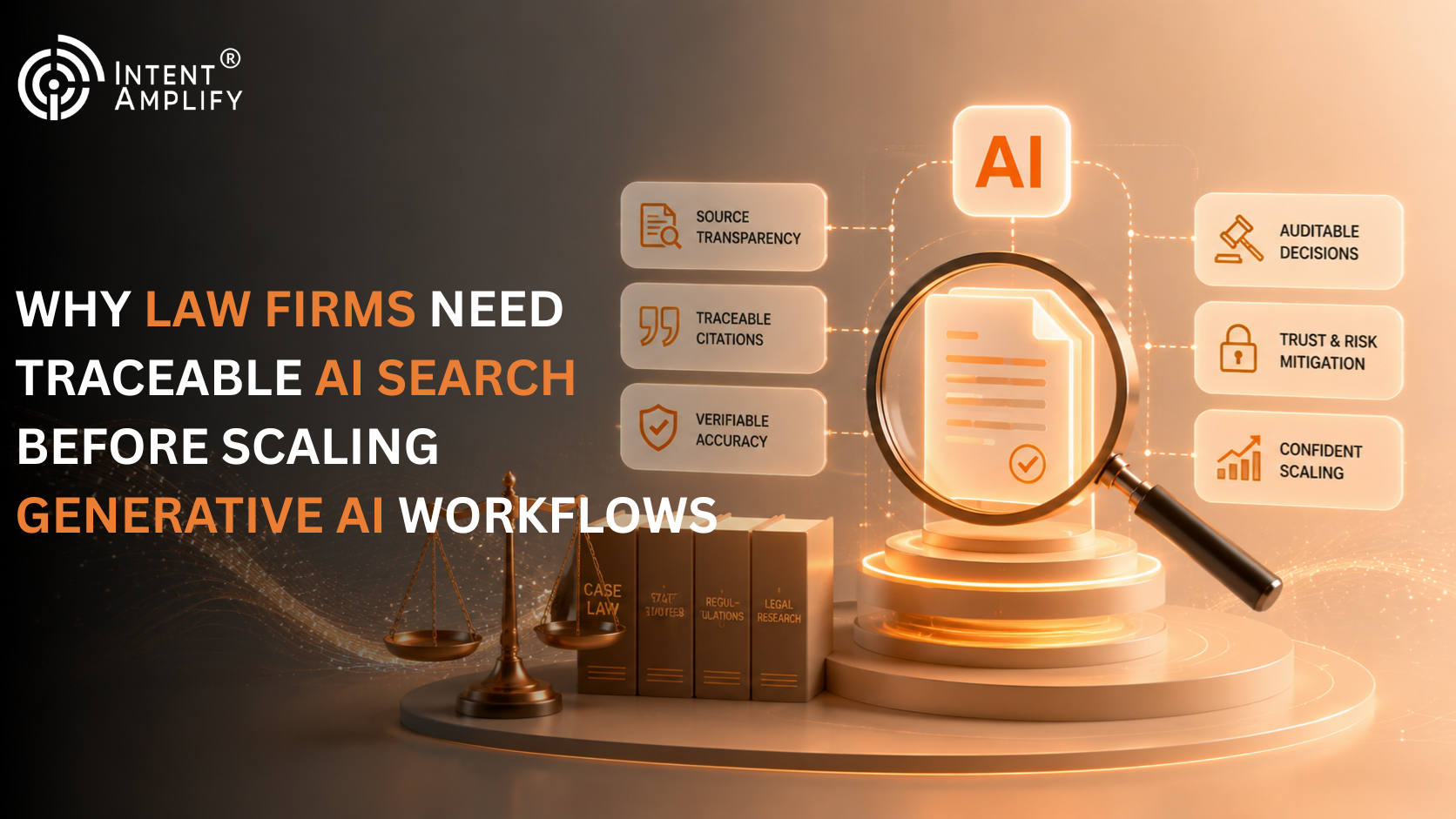
For law firms, the message is simple: scale traceability, governance, and source trust before scaling generative AI workflows.
Progress Agentic RAG provides the right model. Its case study with a leading European law firm shows an AI assistant delivering trusted, traceable answers grounded in legal and accounting knowledge.
View the Progress Agentic RAG case study
Key Figures for Legal Knowledge, AI, Risk, and Architecture Leaders
Progress reports up to 95% faster AI-readiness and more than 80% cost savings compared with building similar RAG capabilities internally.²
Traditional enterprise search can require employees to open 8–12 documents to answer one question.³
The Progress case study supports approximately 300 legal and accounting professionals, a firm serving more than 20,000 clients, and thousands of questions per month.⁴
Only 18% of professional services organizations collect AI ROI metrics, while 40% do not know whether AI ROI is measured.¹
Legal professionals expect AI to free nearly 240 hours per year, creating about $19,000 in annual value per professional.⁵
Microsoft analyzed 31,000 workers across 31 countries and found 81% of leaders expect AI agents to be integrated into AI strategy within 12–18 months.⁶
IBM reports AI-enabled workflows are expected to expand from 3% in 2024 to 25% by 2026, an 8x increase.⁷
Google Cloud’s grounding framework supports a score from 0 to 1, up to 200 facts, and 10,000 characters per fact for grounding checks.⁸
McKinsey estimates agent-enabled process reinvention can reduce time to resolution by 60–90% in selected workflows.⁹
PwC analyzed nearly one billion job ads and found that industries more exposed to AI saw 3x higher growth in revenue per worker.¹⁰
Why Traceable, Governed Search Must Come Before AI Workflow Scale
Generative AI workflows depend on the reliability of the knowledge sources they access. If a system retrieves outdated information, overlooks a policy exception, or combines current legal guidance with superseded content, the workflow may appear efficient while producing outputs that are difficult to validate or defend.
Traceable AI search provides a stronger foundation for legal research and advisory work. It connects outputs to authoritative source documents, provides citations, supports lawyer review, enforces retrieval controls, and helps firms govern what the system can access, retrieve, and present.
In legal and professional-services environments, answer quality depends on more than generation. Outputs must be grounded in authorized sources, supported by evidence, reviewable by professionals, and defensible within established governance frameworks.
Progress Agentic RAG: Scaling Legal AI With Traceability and Control
The Progress case study shows why traceability should come first.
The law firm needed faster answers for complex legal and accounting questions, but it could not compromise accuracy, confidentiality, or professional oversight. Progress Agentic RAG helped the firm create an assistant that grounds answers in approved legal and accounting knowledge, uses tailored retrieval strategies, supports source traceability, and links answers back to authoritative documents for professional review.
For clients, that means faster guidance with visible source support and professional oversight. For the firm, it means a stronger trust position: modern, accountable, governed, and client-centered.
Bottom Line
Law firms should not scale generative AI workflows on top of ungoverned, untraceable search. They should first build a legal-grade AI search foundation that supports source grounding, permission-aware retrieval, retrieval control, quality evaluation, auditability, and human validation.
Progress Agentic RAG gives firms a practical path to modernize research, protect trust, govern retrieval, and create a traceable client-service advantage.
Download the full Progress case study PDF to see how a leading law firm used Progress Agentic RAG to build a trusted, traceable AI search with governed retrieval, source grounding, and professional review.
Want to explore more research like this?
Intent Amplify delivers research-driven insights, market intelligence, and industry analysis to help technology leaders make informed business decisions. Learn More
References
-
Thomson Reuters (2026) AI in Professional Services Report 2026. Thomson Reuters, 2026.
-
Progress (n.d.) RAG-as-a-Service Solution. Progress Software Corporation.
-
Progress (n.d.) From Search to Answers with Agentic RAG. Progress Software Corporation.
-
Progress (n.d.) Leading Law Firm Agentic RAG Success Story. Progress Software Corporation.
-
Thomson Reuters (2025) Future of Professionals Report 2025. Thomson Reuters, 2025.
-
Microsoft (2025) 2025 Work Trend Index Annual Report. Microsoft Corporation, 2025.
-
IBM (2025). From AI Projects to Profits. IBM Corporation, 2025.
-
Google Cloud (n.d.) Check Grounding with RAG. Google Cloud.
-
McKinsey & Company (2025) Seizing the Agentic AI Advantage. McKinsey & Company, 2025.
-
PwC (2025) 2025 Global AI Jobs Barometer. PricewaterhouseCoopers (PwC), 2025.