

STRUCTURED ANALYSIS FOR COMPLEX GTM QUESTIONS.
Go beyond opinion with explicit evidence, assumptions, operating implications and what remains unknown.
Market Analysis
What changed and why it matters to GTM.
Buyer Analysis
How buying behavior may be changing.
Account Analysis
How current evidence changes account priority.
Program Analysis
What program evidence supports—and what it does not.
Resource engagement can support account prioritization, buying-context interpretation and evidence-rich handoff. It must not automatically create an SQL. Sales qualification requires the approved lifecycle definition and authoritative CRM evidence.
Expert Analysis resources
30 published resources matching this section.
Inventory Accuracy as a Fulfillment Reliability Lever
Explore how inventory accuracy strengthens fulfillment reliability by improving product availability, reducing phantom inventory, and creating more dependable customer p…
The Hidden Economics of Peak Experience: Why Staff Friction Becomes Customer Cost
Explore how staff friction during peak retail periods consumes operating capacity, increases decision time, and can become a customer-facing cost across service, fulfill…
The Hidden Cost of Indirect Labor: A Decision Framework for Finding Paid Time That Never Reaches Throughput
A practical framework for distribution leaders to classify indirect labor, uncover unproductive paid time, trace process friction, and connect labor variance to cost, th…
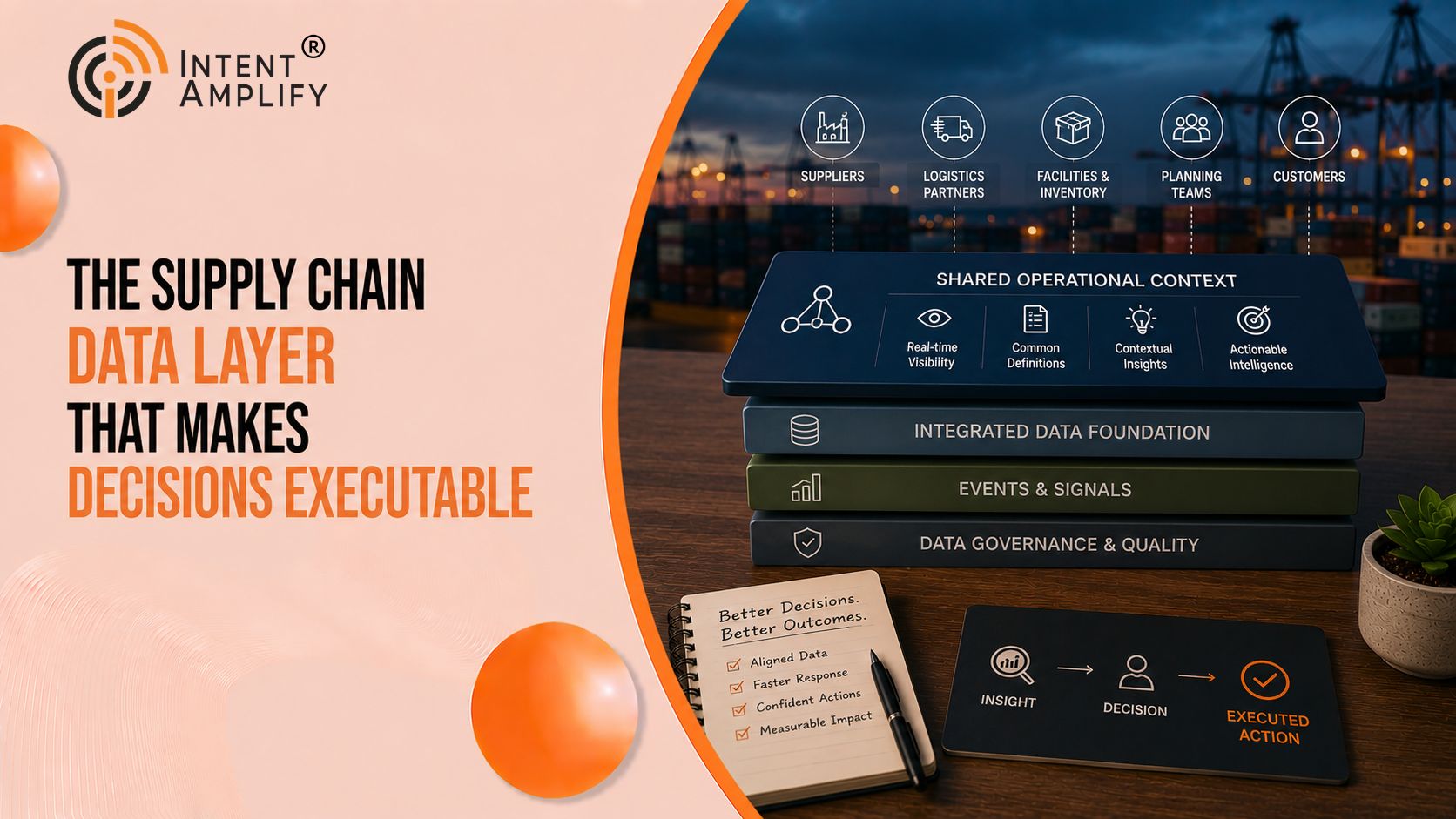
The Supply Chain Data Layer That Makes Decisions Executable: Why Shared Operational Context Matters More Than Another Dashboard
Learn how a decision-ready supply chain data layer connects trusted operational context, improves data quality, reduces decision latency, and turns supply chain signals …
SAP Joule for Supply Chain: From Conversational AI to Orchestrated Execution
SAP Joule is moving supply-chain AI beyond conversational access toward assistants, specialized agents, and governed execution. This analysis explains the decision layer…
The Missing Architecture Between Your Rate Engine and Shipping Label
Discover the missing "decision layer" between your rate engine and shipping label. Learn how shipment-level AI allocation cuts costs and improves delivery.
What Makes an Amazon Quick Initiative Ready for a Serious Evaluation?
Learn what makes an Amazon Quick initiative ready for serious evaluation, from workflow specificity and sponsor access to AWS fit, evidence readiness, and decision timin…
Why Profitable Same-Day Grocery Must Be Designed Backward from Order Economics
Discover why profitable same-day online grocery must be designed backward from order economics. Learn to align customer promise, fulfillment, routing, and capacity for s…
What Boards Should Ask About Contract Intelligence and AI
Board-level questions for testing contract exposure, AI governance, data authority, obligations, renewals, value, resilience, and accountable executive oversight.
The Retail Media Growth Constraint Is Decision Friction
An executive analysis of the handoffs, definition gaps, workflow complexity, and evidence ambiguity that weaken otherwise strong media propositions.
Why Retail Media Networks Must Compete on Partnership, Not Inventory Alone
Retail media networks must compete on more than audience access and inventory. Learn how stronger partnerships, transparent measurement, clear data value, and accountabl…
From Market-by-Market Complexity to a Unified Global Ecommerce Operating Model
A practical analysis of how enterprises can move from fragmented market-by-market ecommerce operations to a unified, governed global operating model.
Move from resource insight to an executable GTM decision.
Bring the market, account, buying-group or measurement problem you are solving.