
The quiet mistake in a successful content campaign
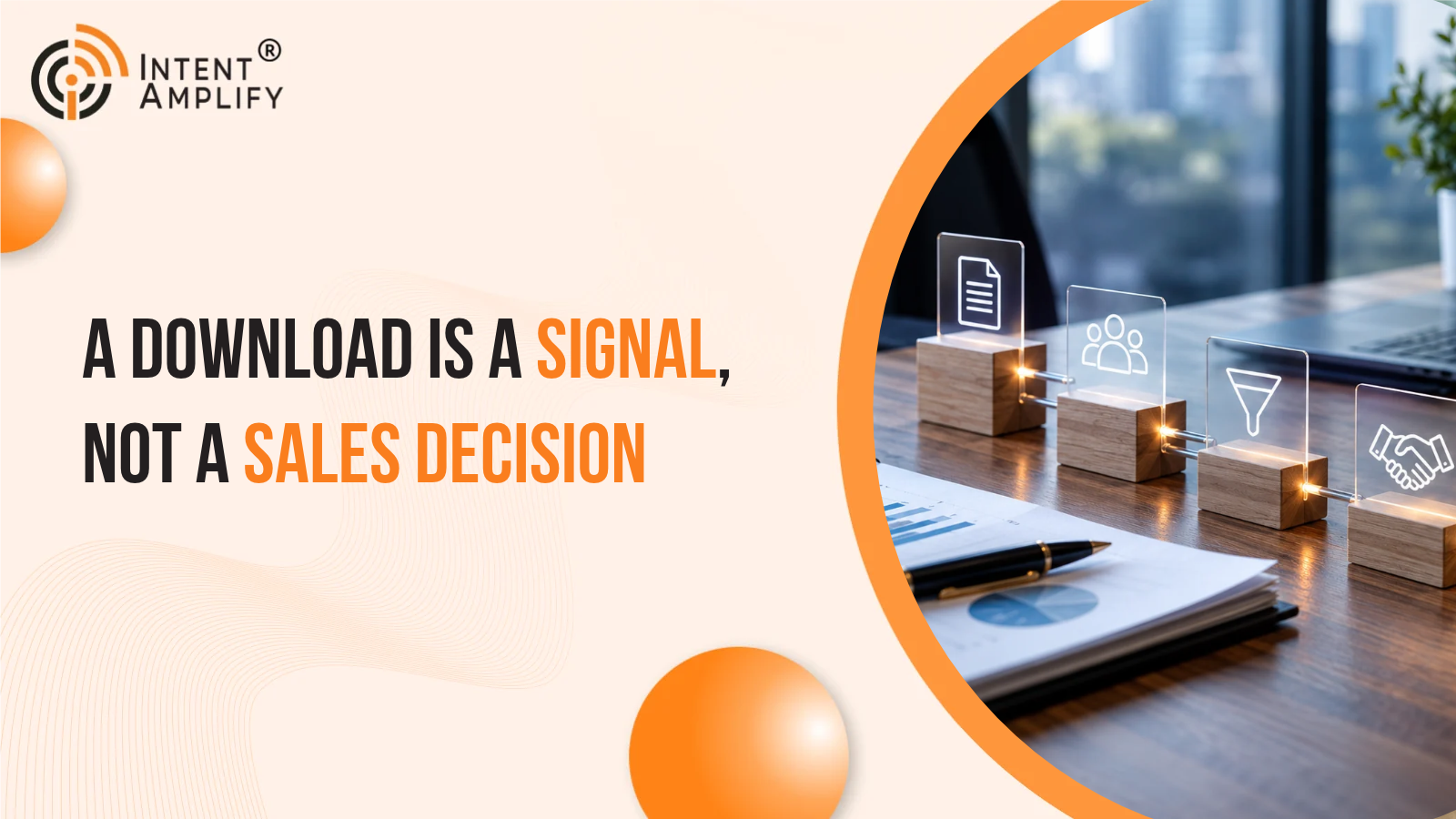
A B2B SaaS team distributes a practical guide and receives a healthy stream of downloads. The dashboard shows activity, the delivery partner provides a file of respondents, and a weekly presentation calls the results qualified demand. Yet the file may not establish who fits the intended audience, whether each interaction can be traced to an actual person, or whether anyone is working on a purchase. None of those questions is answered by a download count alone.
This distinction is not hostile to content syndication. It makes the activity more useful. Google Analytics lists generate_lead for form submissions and qualify_lead for a lead that has subsequently met qualification criteria [1]. Those are different events, and that difference offers a sensible starting point for campaign design.
Check 1: Name the event before judging its value
Call a form submission a form submission. Call a verified resource request a verified resource request. If an email was delivered, say delivered; do not call it read. A click to a partner page is not evidence that the asset was consumed in full. Where platform-level analytics cannot connect an interaction to a person, keep it as an anonymous or account-level event.
Before launch, write an event dictionary. Include content view, form submit, accepted respondent, permission-eligible follow-up, marketing qualification, Sales acceptance, and Sales-qualified conversation as separate entries. Each event needs its own timestamp, source, identifier, and owner. A report that maintains those distinctions can explain where the journey stops without inflating the later stages.
Check 2: Decide who should see the content
Syndication should begin with an audience definition rather than a purchased volume target. Specify the SaaS product category, intended industries, company sizes, geographies, excluded accounts, and functions with a credible connection to the subject. Use role and account fit as selection criteria, not as evidence that a selected person has an active project.
Intent Amplify describes Buyer Intelligence as defining target accounts, buying roles, and validation rules before activation [3]. In a program brief, this might become an account-fit checklist with a separate role-relevance note. A Vice President of Engineering may be a useful reader for a deployment guide, but the title does not establish budget authority or purchasing timing.
Check 3: Explain what an accepted form-fill means
LinkedIn's Lead Gen Forms specifications set concrete field and character limits and recommend a small number of fields as a form-design practice [2]. Platform validation, however, is not a campaign's business-acceptance contract. An accepted response should satisfy explicit rules for required fields, target eligibility, identity checks, duplicates, source evidence, exclusions, and permissible use.
An incorrect company, a student response to an enterprise-only offer, or a duplicate event can each require a different disposition. Preserve those reasons. The goal is not to reject participation unnecessarily; it is to keep the denominator honest. Count submitted forms, accepted unique respondents, and rejected or replaced records independently.
Check 4: Make content useful before asking for a meeting
People request B2B SaaS content for many legitimate reasons. They may be learning a concept, preparing a comparison for colleagues, checking implementation requirements, or exploring a problem without approval to buy. A useful follow-up responds to the question suggested by the asset, not to an imagined procurement deadline.
A buyer of analytics software who opens a measurement guide may appreciate an example reporting dictionary. A product marketer who requests an audience worksheet may want a short segmentation example. Neither deserves a message announcing that their company has entered a buying cycle. Relevance can be polite, specific, and genuinely helpful without asserting urgency that the evidence does not show.
Check 5: Keep campaign tracking and contact permission separate
Campaign URLs can carry utm_source, utm_medium, utm_campaign, and other parameters that identify the referring program in Google Analytics [7]. These parameters support campaign attribution within the captured context; they are not proof of individual identity, consent, or revenue causation. Keep the actual landing destination, form version, and asset identifier alongside the campaign label.
For US commercial email, the FTC explains that CAN-SPAM also applies to business-to-business messages and requires, among other controls, truthful headers and a valid opt-out mechanism [6]. A relevant professional contact can still be ineligible for a given channel. The approved outreach decision therefore belongs beside, not inside, the account-fit field.
Check 6: Let Sales qualify the commercial step
Intent Amplify's Managed Demand Generation service describes coordinated audience, content, validation, and reporting within agreed program rules [4]. Its Pipeline Activation service describes carrying validated contact and campaign context to a receiving Sales owner [5]. Neither description supports turning an accepted content response directly into an opportunity or booked revenue.
For an actionable handoff, include the relevant SaaS offer, actual interaction, date, target-fit rationale, source record, channel eligibility, next-step suggestion, and receiving owner. Sales should then confirm business relevance, meaningful need, and an accepted next step before marking a genuinely qualified conversation. If Sales declines the handoff, capture the reason rather than silently counting it as pipeline.
A five-minute audit for the next campaign review
Choose one recent batch of ten form submissions. Ask the marketing owner to show the original event, relevant audience rule, duplicate check, permitted-use record, and later Sales disposition for each one. It is reasonable for some records to stop at educational engagement. The point is to know which ones, why, and what information would change the next action.
The same short review can reveal whether a content topic is too general, a form asks too much, or a campaign's acceptance definition is poorly understood. These are testable operating questions. They do not require an invented lead-quality percentage or a claim that every downloaded document creates demand.
The Intent Amplify perspective
Buyer Intelligence can help frame an explainable audience. Managed Demand Generation can connect approved content, distribution, and acceptance checks. Pipeline Activation can preserve context for an accountable Sales review [3], [4], [5]. These are program capabilities described by Intent Amplify, not a guarantee of commercial results for a particular SaaS vendor.
FAQ: Does a verified download count as an MQL?
Not automatically. A verified content response establishes the documented event, and an accepted response establishes compliance with the agreed delivery rules. Marketing qualification requires an additional, explicit assessment of account and contact fit, relevance, and the receiving organization's definition of meaningful interest. An MQL should be recorded only when that separate test is met.
FAQ: Should every content request trigger an SDR call?
No. The appropriate action depends on the reader's request, channel eligibility, asset type, and confirmed business context. Some interactions merit a helpful resource or a question about what the reader is researching. Others may become a legitimate conversation after the person expresses a specific need. Outreach should never be framed as a compulsory consequence of a download.
Try a simple evidence-label exercise
Before your next weekly review, take ten responses and label each as submitted, accepted, marketing-qualified, or Sales-qualified only where the record supports that state. Compare the reasons with your team, then explore how Intent Amplify frames audience evidence: https://www.intentamplify.com/solutions/buyer-intelligence.
Evidence notes and references
Bracketed citations identify the public source supporting the adjoining factual claim. Process models, examples, and recommendations are original editorial analysis, not measured customer outcomes. Service delivery varies by approved program scope. Sources reviewed October 29, 2026.
- Google Analytics Help, Recommended Events (Official product documentation). https://support.google.com/analytics/answer/9267735?hl=en
- LinkedIn Marketing Solutions, Lead Gen Forms Specifications (Official form specifications). https://business.linkedin.com/advertise/ads/sponsored-content/lead-gen-ads/specs
- Intent Amplify, Buyer Intelligence (Official service description). https://www.intentamplify.com/solutions/buyer-intelligence
- Intent Amplify, Managed Demand Generation (Official service description). https://www.intentamplify.com/solutions/managed-demand-generation
- Intent Amplify, Pipeline Activation (Official service description). https://www.intentamplify.com/solutions/pipeline-activation
- Federal Trade Commission, CAN-SPAM Act: A Compliance Guide for Business (US federal regulatory guidance). https://www.ftc.gov/business-guidance/resources/can-spam-act-compliance-guide-business
- Google Analytics Help, URL Builders: Collect Campaign Data with Custom URLs (Official product documentation). https://support.google.com/analytics/answer/10917952?hl=en