
Why a Name in the CRM Is Not Enough
A B2B technology company can run a relevant campaign, validate a business email, and pass the resulting contact to Sales without explaining why the person engaged. The seller sees a name, job title, and perhaps a score. The campaign team sees a form fill, a content download, or an event response. Both views may be accurate, yet neither tells the complete story. The gap matters because a responsible first conversation must reflect what the person actually did, not what a dashboard suggests they might buy.
Intent Amplify describes Pipeline Activation as a way to bring validated account and contact details together with campaign, content, and qualification evidence for an accountable CRM handoff [3]. That is a description of service scope, not a guarantee of meetings or revenue. A useful SDR handoff preserves the evidence, the limits of that evidence, and a clear next action. These six checks offer a practical standard for making such records more useful without exaggerating purchase readiness.
Check 1: Confirm the Account and Buyer Role
Start with account fit, not the highest engagement score. Record the organization, relevant business unit where known, target market, approved industry criteria, and the person's verified role. A lead can be reachable without being appropriate for a campaign. A company can be a plausible commercial fit without having shown any recent interest. Those are separate judgments and should be labeled separately.
Intent Amplify's Buyer Intelligence service describes defining account criteria, buying roles, validation fields, and source limitations before activation [1]. An SDR should therefore be able to see what was checked, when it was checked, and which information remains uncertain. A job title copied months earlier may need confirmation; an account match based only on an email domain may need review. The objective is credible context, not an appearance of certainty.
Check 2: Name the Actual Engagement
A form submission means a form was submitted. A document request means the resource was requested. An email click may document a link interaction, subject to the tracking method. None of these events independently establishes an approved project, a budget, or a decision date. The handoff should carry the specific asset, action, date, and source so the seller can understand the topic rather than repeat a generic pitch.
Google Analytics describes different recommended events for generating a lead and marking a lead as qualified [6]. That distinction is an instrumentation example, not an instruction to classify every form respondent as an MQL. Write the actual interaction in ordinary language: The contact requested a guide about reducing handoff friction. Do not silently rewrite that observation into: The buyer needs a new sales platform. The first statement is an event description; the second would require the buyer's own confirmation.
Check 3: Preserve the Source and Its Limitations
Each accepted handoff should retain a campaign identifier, original source, recorded timestamp, content or event identity, contact validation result, and applicable communication preferences. Include the version of any acceptance rule. If a source only supports account-level activity, say so. Do not attribute that activity to an individual employee without additional evidence.
Salesforce's 2026 State of Sales report, based on a 2025 survey of sales professionals, discusses the friction of disconnected data and data-cleaning work [4]. Its findings describe that survey population; they do not measure the results of an Intent Amplify engagement. The operational lesson is to make the supporting evidence easy to inspect. If Sales has to rebuild the contact's history across disconnected systems, the program has transferred effort instead of transferable context.
Check 4: Separate Marketing Qualification From Sales Acceptance
Marketing can validate account fit, role relevance, engagement context, and the published campaign acceptance rules. Sales determines whether a record merits direct follow-up and whether a business need has emerged. HubSpot's official lifecycle guidance distinguishes a Marketing Qualified Lead from a Sales Qualified Lead according to which function has qualified the contact [5]. Every organization should still document its own acceptance criteria.
For a practical handoff, record an MQL decision with its rule and evidence, followed by an explicit Sales acceptance or decline and a reason. An SQL should require a business issue expressed directly by the buyer and a mutually agreed next action under the receiving team's policy. A seller who declines a record because the request was educational has not disproved the campaign's value; the disposition helps Marketing make the next interaction more relevant.
Review One Handoff Before the Next Campaign
Choose a recent contact and compare the original engagement record with the summary Sales received. Identify one missing evidence field and one sentence that assumes more than the contact stated. Intent Amplify's Buyer Intelligence approach offers a useful reference for audience and role validation.
Explore Buyer Intelligence
Check 5: Name the Receiving Owner and Response Path
A complete record needs a named owner or agreed queue, route date, suggested next action, and a way to return feedback. Salesforce documents lead assignment rules that connect record conditions to a specified user or queue [8]. Those are CRM capabilities, not proof that any organization has activated a particular workflow. The operational decision remains local: Who is accountable for the first appropriate response?
Give the SDR a plain-language reason to reach out, such as an offer to clarify a requested guide or share the next educational resource. Avoid telling the recipient that their company is actively evaluating a purchase unless that conclusion comes from the recipient. Record whether the seller made contact, received a response, scheduled a mutually agreed discussion, or returned the contact to nurture. A route without an eventual disposition is a transfer, not a completed decision.
Check 6: Measure the Next Action Honestly
Distinguish delivered records, reviewed records, Sales-accepted records, direct conversations, meetings held, and opportunities created under approved definitions. One person can generate multiple interactions without becoming multiple unique leads. Sales acceptance is not a scheduled meeting; a meeting request is not a held meeting; an opportunity is not closed revenue. Use consistent denominators and disclose the reporting period.
Intent Amplify's Managed Demand Generation service describes coordinated activation, validation, and delivery reconciliation [2]. Its Pipeline Activation service describes an evidence-backed receiving context [3]. These capabilities can be scoped together to help a B2B technology vendor connect campaign execution to more appropriate follow-up. They do not convert activity into an automatic commercial result. For outbound messages, the Federal Trade Commission explains that US commercial-email rules apply to B2B messages and include truthful message and opt-out obligations [7]. A record's relevance cannot override those controls.
The Intent Amplify Perspective
Buyer Intelligence can help B2B technology vendors define which accounts and buying roles belong in a campaign, while retaining the basis for validation [1]. Managed Demand Generation can coordinate approved content activation, response handling, and acceptance reconciliation [2]. Pipeline Activation can carry the verified account, engagement, and qualification context into a documented Sales decision [3]. The three capabilities fit together when the contract specifies actual deliverables and Sales retains authority over its own qualification stages.
The practical goal is a first conversation that would make sense to the person receiving it. A relevant follow-up can recognize a specific requested resource without implying urgency, procurement authority, or intent that nobody stated. An evidence-rich handoff helps the seller act with care, and gives Marketing an inspectable record of what its program delivered.
Two Common Questions
Does Every Content Download Belong With an SDR?
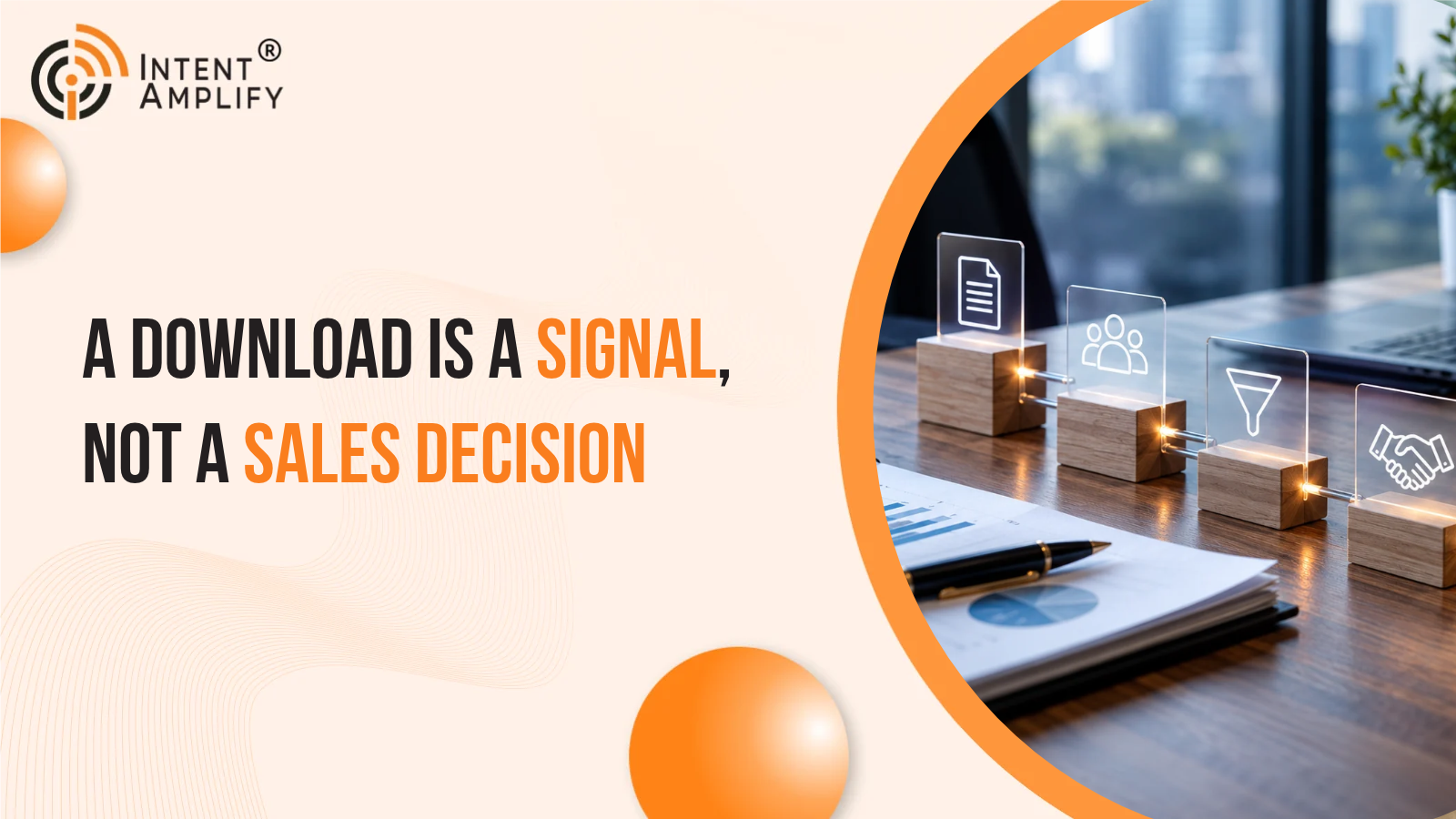
No. A download can establish a content interaction, subject to the source record, but it does not prove a current business requirement. The next step depends on account and role fit, communication eligibility, the resource requested, and the agreed qualification rule. Educational nurture can be the right outcome when direct Sales interest has not been expressed.
What If the Contact Has Not Requested a Meeting?
Do not describe the record as meeting-ready. A seller may offer a relevant resource or ask whether a short conversation would be useful where the channel is permitted. Record the buyer's response and honor a decline. The distinction between an offer of help and a confirmed appointment protects both the relationship and the accuracy of the campaign report.
Evidence Notes and References
Numbered citations identify supporting source material. Official documentation establishes what its publisher describes, not a measured Intent Amplify client result. Proposed operating methods and illustrative examples are editorial synthesis rather than observed performance. Sources reviewed November 5, 2026.
- Intent Amplify, Buyer Intelligence (Official service description). https://www.intentamplify.com/solutions/buyer-intelligence
- Intent Amplify, Managed Demand Generation (Official service description). https://www.intentamplify.com/solutions/managed-demand-generation
- Intent Amplify, Pipeline Activation (Official service description). https://www.intentamplify.com/solutions/pipeline-activation
- Salesforce, State of Sales Report Announcement (2026 survey of 4,050 sales professionals; survey conducted in 2025). https://www.salesforce.com/news/stories/state-of-sales-report-announcement-2026/
- HubSpot Knowledge Base, Use Contact and Company Lifecycle Stages (Official lifecycle definitions). https://knowledge.hubspot.com/records/use-lifecycle-stages
- Google Analytics Help, Recommended Events (Official lead-generation event specifications). https://support.google.com/analytics/answer/9267735?hl=en
- Federal Trade Commission, CAN-SPAM Act: A Compliance Guide for Business (Official US guidance). https://www.ftc.gov/business-guidance/resources/can-spam-act-compliance-guide-business
- Salesforce Help, Set Up Assignment Rules (Official CRM routing documentation). https://help.salesforce.com/s/articleView?id=sf.creating_assignment_rules.htm&language=en_US&type=5