
logo
logo
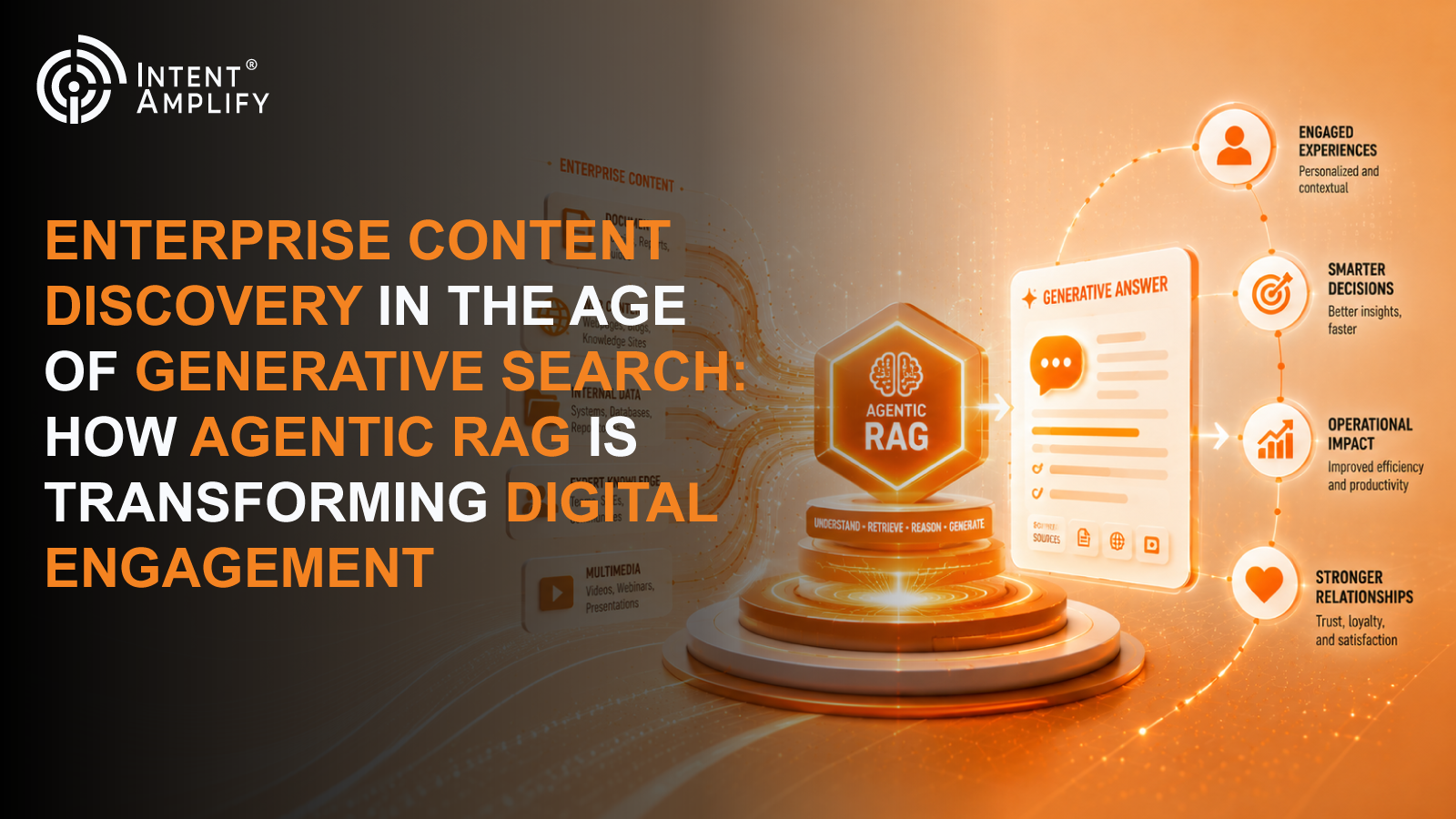
Enterprise Content Discovery in the Age of Generative Search: How Agentic RAG Is Transforming Digital Engagement

REPORT

Enterprise Content Discovery in the Age of Generative Search: How Agentic RAG Is Transforming Digital Engagement

Discover how agentic RAG and generative search are transforming enterprise content discovery with AI-powered answers, governed retrieval, and intelligent digital experiences.

The Website Is No Longer Just a Website

For years, enterprise websites and portals behaved like well-funded filing cabinets. They stored product pages, whitepapers, documentation, case studies, support articles, event pages, webinar transcripts, compliance notes, resource libraries, knowledge base entries, and enough PDFs to make a content manager question several life choices. The assumption was simple: if the content exists, the navigation is sensible enough, and the search bar is present, users will find what they need.

That assumption is beginning to fall apart.

Buyers, customers, partners, and technical evaluators no longer approach enterprise websites with the patience of librarians. They arrive with questions. Specific questions. Messy questions. Questions like: Which deployment model fits a regulated environment? What are the tradeoffs of building RAG internally? How does this product support governance, retrieval quality, or integration with existing systems?

A traditional search box can return pages. It cannot always resolve intent. That gap is where generative search, and more specifically agentic RAG, starts to matter.

This shift aligns closely with Progress Software Corporation's Build vs. Buy: The Reality of Production-Grade RAG, produced through Intent Amplify, because production-grade discovery is no longer just a search problem. It is a digital experience, content operations, governance, architecture, and answer-quality problem.

The Quiet Failure of "Find It Yourself"

Most enterprises are not short on content. They are buried in it.

A typical enterprise digital estate contains CMS pages, PDFs, technical documentation, developer resources, customer support articles, product explainers, webinar transcripts, pricing information, industry reports, and gated assets. The answer a user needs often exists somewhere. The problem is that the user does not know where, and the website often cannot figure out what the user means.

Keyword search was built for exactness. It rewards matching language. It struggles with ambiguity, context, comparison, and intent. A product architect researching enterprise AI search may not use the same terms as the content team that tagged the asset. A healthcare buyer may ask about compliant knowledge discovery, while the relevant content is filed under digital experience modernization. A financial services executive may search for "AI search governance," while the best answer sits inside a whitepaper about production-grade RAG.

The result is a strange form of digital waste. Enterprises invest heavily in content, then force users to excavate it manually. That waste shows up in measurable ways: users abandon searches, submit repeat questions, ignore valuable resources, rely on support or sales teams, and move through digital journeys with less confidence than the business intended.

McKinsey reported in 2025 that 88% of organizations now use AI regularly in at least one business function, up from 78% the year before, with knowledge management among the most common areas of use. That matters because enterprise content discovery is knowledge management in public clothing: the same problem, just wearing a website theme and carrying a conversion target.1

Once users become accustomed to AI-assisted work, a static resource library starts to feel like a locked drawer with a search icon painted on it.

Generative Search Has Made Users Less Forgiving

Generative search has changed the shape of digital expectations. Users increasingly want synthesized answers, not just ranked lists. They want a response that understands context, summarizes relevant material, and points back to credible sources. For CX and digital experience leaders, that means the search experience now affects trust, satisfaction, support deflection, and journey completion. For product and content leaders, it means existing assets need to work harder across evaluation, education, onboarding, and support. For AI, data, engineering, and IT teams, it means the answer layer needs governed retrieval, permissions, observability, and evaluation from the start.

This is not just a consumer search trend. It is becoming an enterprise website problem. Digital buyers, CX leaders, product teams, technical buyers, engineering leaders, AI teams, architects, data leaders, content teams, and platform owners now spend their workdays around copilots, assistants, conversational interfaces, and answer-first experiences. When they land on a corporate site and get ten blue links plus a filter menu, the experience feels behind the curve.

Bain reported in 2025 that about 80% of search users rely on AI-written results for at least 40% of their searches, while roughly 60% of traditional searches end without a click to another site. Discovery is increasingly happening through answers before a visitor reaches the brand's own digital property. That raises the bar for what the website must do when the visitor finally arrives. The brand experience can no longer depend on users browsing patiently through a content library. It has to help them ask, compare, validate, refine, and act. .2

The website, then, becomes less of a destination and more of a response environment. It must interpret intent, retrieve the right material, respect permissions, generate useful answers, and help the user move forward. That is a much bigger job than "search the blog."

Why 2025 Became the Pressure Point

The move toward answer-led enterprise experiences is not driven by one isolated trend. It is the collision of agent experimentation, proprietary data pressure, and uneven enterprise readiness.

In 2025, 23% of organizations were already scaling an agentic AI system somewhere in the enterprise, while another 39% were experimenting with AI agents. That signals a shift from isolated AI pilots toward more operational agentic workflows, even if many deployments are still early, uneven, and surrounded by the usual enterprise fog machine of ambition.1

72% of surveyed CEOs view proprietary data as key to unlocking generative AI value, while 68% say integrated enterprise-wide data architecture is critical for collaboration. This is directly relevant to discovery because high-performing answer systems depend less on generic model cleverness and more on trusted enterprise content being connected, classified, and accessible.3

Then comes the less glamorous part. Cisco's 2025 AI Readiness Index found that 83% of organizations plan to deploy AI agents, yet 64% struggle to centralize data, and only 26% have robust GPU capacity. The ambition is there. The infrastructure, as usual, is arriving late with a badge that says "strategic dependency.4

This is why agentic RAG cannot be treated as a surface-level feature.It also cannot be treated as a one-off chatbot project. If the architecture is not reusable, observable, permission-aware, and connected to governed content, every new answer experience becomes another custom system waiting to annoy its future owners. It depends on the boring things enterprises like to postpone: content structure, metadata, access rules, retrieval quality, evaluation, and systems integration.

What Makes RAG "Agentic" Instead of Merely Useful?

Traditional RAG retrieves information and uses a language model to produce an answer grounded in that retrieved material. It is valuable, especially when the content set is controlled. But enterprise discovery often requires more than one retrieval pass.

A user may ask a question that touches product documentation, support policy, pricing logic, implementation guidance, and compliance constraints. The system may need to clarify intent, retrieve from multiple sources, compare evidence, check permissions, reject weak sources, and format the answer differently depending on whether the user is a buyer, customer, developer, or internal stakeholder.

Agentic RAG adds orchestration to that process. It can plan the path. It can choose whether to use semantic search, keyword search, metadata filtering, structured lookup, graph retrieval, or a combination. It can break a broad question into smaller tasks. It can inspect whether the retrieved evidence is strong enough before generating a response.

This distinction matters because enterprise websites, portals, and knowledge experiences are not dealing with simple FAQ lookups anymore. They are being asked to support guided evaluation, product education, technical education, customer self-service, support deflection, regulated discovery, buyer enablement, and internal knowledge reuse.

A basic RAG system might answer, "Here is what this page says."
An agentic RAG system can move closer to, "Here is the best answer across approved sources, here is where it came from, here is what applies to your context, and here is what you should look at next."

That is a different kind of digital engagement.

The CMS Was Built to Publish. Now It Has to Participate.

A CMS manages content through publishing, organization, governance, and lifecycle management. Generative discovery requires broader capabilities from the content stack. CMS platforms, knowledge bases, asset libraries, documentation systems, and structured data sources must operate as components of a connected knowledge environment.

Production-grade RAG depends on accuracy, governance, scalability, and long-term maintainability within enterprise environments.

Answer-ready content environments depend on multiple capabilities operating in coordination. Core requirements include content ingestion across CMS pages, documents, videos, support content, technical resources, and structured repositories. Consistent metadata supports retrieval quality, governance, and discoverability. Retrieval architectures should combine lexical precision with semantic understanding while supporting source citations, permission-aware access, freshness validation, analytics, and feedback loops.

Effective answer systems support users while providing visibility into audience needs, content performance, and unanswered questions. These insights can improve search effectiveness, content engagement, support deflection, product education, conversion performance, onboarding experiences, and self-service outcomes

Digital Engagement Becomes Less Linear

The old digital journey looked like a funnel because marketers enjoy pretending human behavior is geometrically obedient. A user entered the site, browsed content, clicked a CTA, downloaded an asset, and eventually became a lead.

Real journeys are messier. A technical buyer may begin with a search engine summary, land on a product page, ask a deployment question, compare build-versus-buy tradeoffs, inspect documentation, read a customer story, and leave without filling out anything. Another user may return days later through an AI-generated answer, looking for governance details.

Adobe's 2025 AI traffic research found that AI-driven traffic to technology and software sites produced 35% higher engagement and 46% more time spent than non-AI referrals. For financial services sites, AI-driven visits grew 266% year over year, with users spending 21% more time per visit. The message is not that AI traffic automatically converts. It is possible that AI-influenced users may arrive with clearer intent, and websites need better answer experiences to capture that intent.5

Agentic RAG supports non-linear exploration by allowing users to navigate through questions, intent, and context rather than site structure alone. That is especially useful for VP and director-level leaders in engineering, AI, data, MLOps, platform engineering, enterprise architecture, solutions architecture, and data science. These readers are not looking for fluffy claims about transformation. They want implementation logic, risks, tradeoffs, and proof.

Agentic RAG supports non-linear exploration by allowing users to navigate through questions, intent, and context rather than site structure alone. Effective answer experiences should improve understanding, surface relevant assets, strengthen trust, support decision-making, and reveal content gaps that require attention.

These measures provide a more meaningful assessment of digital engagement than page-view metrics alone.

The Governance Problem Everyone Meets Eventually

Agentic RAG introduces new opportunities for enterprise knowledge delivery, but production deployment requires organizations to address a broad set of operational, security, and governance requirements. Enterprise answer systems must manage hallucination risk, prompt injection, permissions, content freshness, sensitive-data exposure, regulatory compliance, and auditability.

Deloitte's 2025 State of Generative AI in the Enterprise found that more than two-thirds of respondents expected 30% or fewer of their generative AI experiments to reach full scale within the next three to six months.6 The findings highlight the challenges organizations encounter when moving from experimentation to production deployment.

Deloitte also reported that regulatory compliance concerns increased from 28% in Wave 1 to 38% in Wave 4 as a barrier to developing and deploying generative AI applications.6 For organizations operating in highly regulated sectors such as financial services, healthcare, insurance, legal services, and life sciences, governance requirements directly influence deployment decisions.

Production-grade answer systems require more than retrieval pipelines. They depend on policy controls, role-based access management, redaction capabilities, source allowlists, evaluation frameworks, human escalation paths, logging, and answer-quality monitoring. When responses fail to meet expectations, teams should be able to determine whether the root cause originates from content gaps, metadata quality, retrieval performance, source freshness, model behavior, or user intent.

Observability enables organizations to identify, diagnose, and remediate these issues systematically rather than relying on broad assumptions about AI performance.

Where the Architecture Creates Value

The same answer-led architecture can support different enterprise contexts.

In SaaS and enterprise software, it can improve product discovery, documentation search, migration research, integration guidance, and solution comparison. A buyer should not need to open seven tabs to understand whether a platform supports their deployment and governance needs.

In financial services and insurance, it can guide users through policy language, disclosures, claims resources, product explainers, and regulated educational content. Speed matters, but provenance matters more.

In healthcare and life sciences, controlled discovery can support patient education, provider resources, research navigation, and compliance-sensitive documentation. The system must know when to answer, when to cite, and when to stop.

In legal and document-heavy workflows, the value lies in finding, comparing, and grounding information across dense material. Here, citations are not decorative. They are the basis of trust.

The economic and workforce signals point in the same direction. Stanford HAI's 2025 AI Index reported that private investment in generative AI reached $33.9 billion in 2024, up 18.7% from 2023 and more than 8.5 times higher than 2022 levels. The investment wave will keep expanding the tooling ecosystem around retrieval, agents, evaluation, and enterprise AI infrastructure.7

Build, Buy, or Pretend the Search Bar Is Fine?

The build-versus-buy decision around production-grade RAG is no longer theoretical. Building can provide greater control, customization, and integration flexibility, but it also requires sustained investment in retrieval architecture, evaluation, security, observability, infrastructure, and governance.

Platform-led approaches can accelerate time to value and reduce implementation complexity, particularly for organizations managing large content estates and limited capacity for maintaining bespoke AI infrastructure.

Build-versus-buy decisions should be evaluated through ownership models, governance requirements, operational complexity, long-term maintenance obligations, and organizational readiness. Enterprises with mature platform engineering capabilities, strong data architecture, and specialized retrieval expertise may be well positioned to build. Organizations prioritizing governed deployment within existing digital experience environments may benefit from a platform approach.

Success ultimately depends on content readiness, permission management, measurement, governance, and the ability to maintain answer quality over time.

Agentic RAG represents an operating model for enterprise knowledge that combines retrieval, orchestration, governance, and digital experience delivery. Teams evaluating internal development versus production-ready platforms should focus on how retrieval systems perform under enterprise conditions, including scale, content complexity, security requirements, governance controls, and ongoing operational demands.

Progress Software's whitepaper, Build vs. Buy: The Reality of Production-Grade RAG, explores the practical tradeoffs around ingestion, retrieval, evaluation, security, source attribution, and governed access. That positioning matters because the conversation should not be reduced to "add AI to search." The stronger message is that enterprises need a governed way to connect CMS assets, knowledge sources, semantic retrieval, agentic workflows, and digital experience delivery without forcing every team to maintain a custom AI stack.

From More Content to Better Answers

The future of enterprise content discovery will not be won by publishing more pages. Most enterprises already have enough content to confuse a determined professional before lunch. The advantage will come from making that content connected, governed, retrievable, trusted, and useful in the moment a user needs it.

Generative search has changed what users expect. Agentic RAG changes what enterprise websites can deliver. Together, they move digital engagement away from passive browsing and toward contextual answers.

For Progress Software Corporation, the opportunity is to help enterprises think beyond static content management and toward governed answer experiences. For Intent Amplify's campaign, the message is clear: production-grade RAG is not just an AI architecture conversation. It is a website strategy conversation, a content operations conversation, a trust conversation, and increasingly, a competitive one.

The enterprise website is no longer just a place where content lives. It is becoming a place where knowledge has to work.

For B2B teams looking to turn technical content, buyer intent, and campaign strategy into measurable pipeline conversations, Intent Amplify helps connect market insight with demand activation. Its work across sponsored research, targeted content, buying-group intelligence, and pipeline activation makes it a natural partner for campaigns built around complex enterprise technology narratives. To discuss how intelligence-led content can support your next demand program, contact Intent Amplify.

References

  1. McKinsey & Company -- The State of AI -- 2025
  2. Bain & Company -- Consumer Reliance on AI Search Results Signals New Era of Marketing -- 2025
  3. IBM -- IBM Study: CEOs Double Down on AI While Navigating Enterprise Hurdles -- 6 May 2025
  4. Cisco -- Cisco AI Research: The Most AI-Ready Companies Outpace Peers in the Race to Value -- 2025
  5. Deloitte -- State of Generative AI in the Enterprise -- 2025
  6. Stanford Institute for Human-Centered Artificial Intelligence (HAI) -- AI Index Report 2025: Economy -- 2025
  7. Stanford Institute for Human-Centered Artificial Intelligence (HAI) -- AI Index Report 2025 -- 2025
Prabhanshi   Singh

Prabhanshi Singh

Research Analyst

Contact us for Report

Enterprise Content Discovery with Agentic RAG & AI