
logo
logo

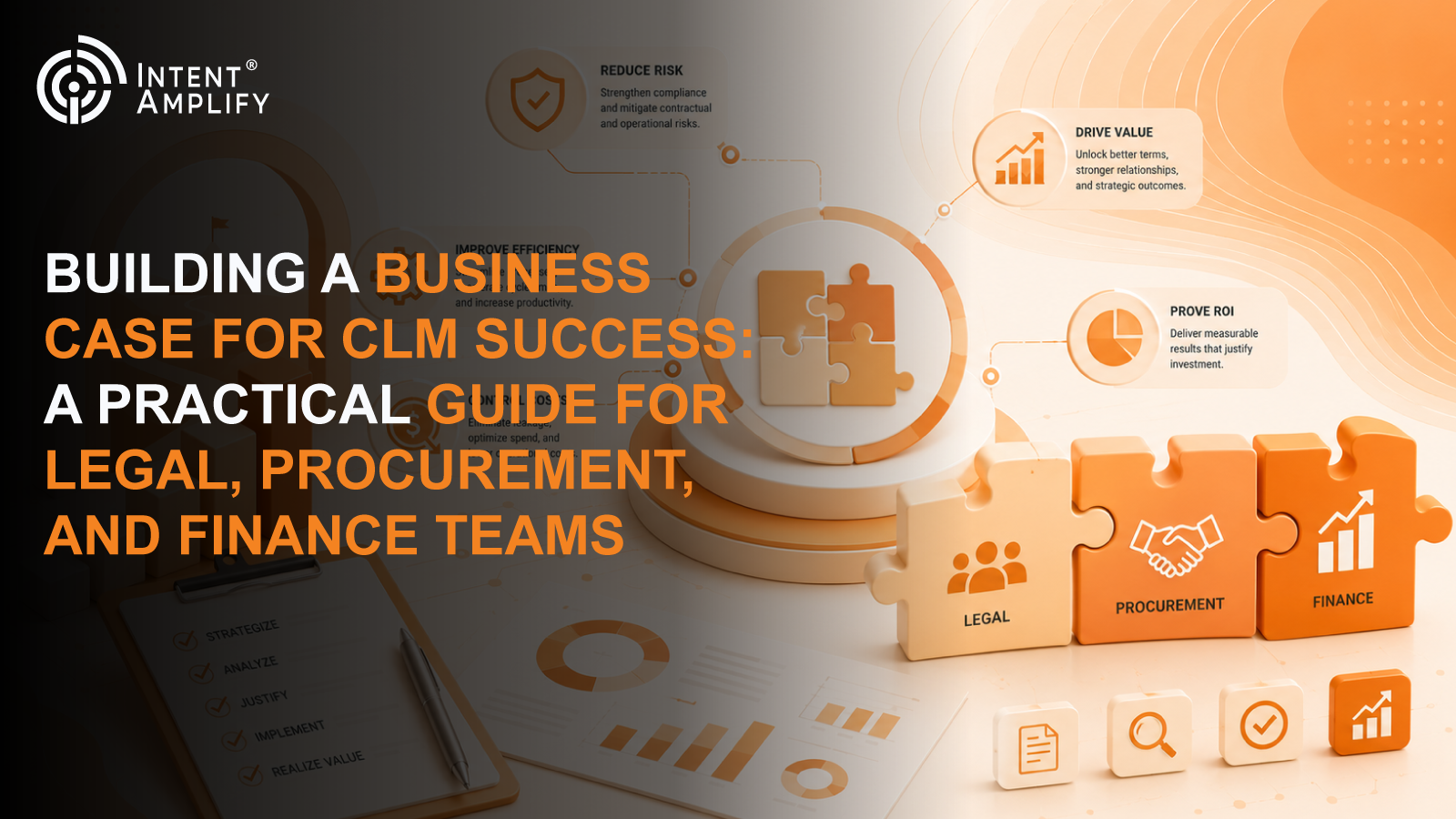
Building a Business Case for CLM Success: A Practical Guide for Legal, Procurement, and Finance Teams

Learn how legal, procurement, and finance leaders can build a compelling CLM business case by quantifying risk, ROI, cost control, and contract intelligence outcomes.

Building a Business Case for CLM Success: A Practical Guide for Legal, Procurement, and Finance Teams

Executive Summary

Contract lifecycle management (CLM) has become a business-critical capability for organizations that need stronger control over risk, cost, revenue execution, supplier performance, and regulatory accountability. 

CLM is no longer limited to replacing shared drives, email-based approvals, or manual contract repositories. 

Legal teams need better clause governance, faster review cycles, and stronger auditability. Procurement teams need supplier contract management, renewal visibility, pricing discipline, and obligation tracking. Finance teams need reliable contract analytics, contract reporting, payment-term visibility, and stronger control over commercial exposure. Executives need contract intelligence that shows where risk, cost, and value are concentrated.

Gartner reported in October 2025 that artificial intelligence and contract analytics had become urgent strategic priorities for general counsel. In a July 2025 survey of 104 general counsel, 36% said they were focused on AI adoption, AI skills, or AI risk management, while 9% identified advanced contract analytics and technology tools as priorities for managing contract risk and reducing costs. 1

Organizations are not investing in CLM only to digitize contracting. They are investing to build a more governable contract operating model. A strong CLM business case should explain how the platform will reduce risk, improve efficiency, control cost, accelerate revenue processes, and generate measurable return on investment (ROI).

This ebook provides a practical guide for building a defensible CLM business case across legal, procurement, and finance. It covers how to identify current-state contracting pain points, quantify risk and cost exposure, define stakeholder priorities, calculate CLM ROI, assess total cost of ownership, document CLM requirements, plan implementation, and build an executive narrative that supports budget approval.

For teams preparing internal approval, this Toolkit by Agiloft provides a practical framework for defining current-state challenges, aligning stakeholders, estimating CLM ROI, evaluating CLM cost, and preparing an executive-ready justification for investment.

Chapter 1: Why CLM Business Cases Need Cross-Functional Ownership

A CLM initiative cannot be justified by legal efficiency alone. Legal may own contract language, but contracts affect procurement savings, sales execution, finance visibility, compliance obligations, supplier performance, and enterprise risk. 

This is why a contract management business case should be developed collaboratively across legal, procurement, finance, sales operations, information technology, and risk functions.

The first step is to define the business problem. Some organizations struggle with slow contract approval workflows. Others lack contract visibility, making it difficult to locate renewals, obligations, termination rights, or pricing terms. 

A credible business case for CLM should translate these pain points into measurable business impact. Instead of stating that “contracting is inefficient,” the case should identify where inefficiency appears: average cycle time, number of manual handoffs, approval delays, missed renewal windows, outside counsel spend, contract search time, template deviations, and untracked obligations.

Executives rarely approve technology investments because a team wants a better system. They approve investments when the business case shows how the system reduces exposure, improves operating performance, controls cost, or supports growth.

Chapter 2: Legal Teams Building the Risk and Governance Case

For legal teams, the strongest CLM value drivers are governance, standardization, review efficiency, and risk visibility. Manual contracting often creates inconsistent clause usage, unclear approval trails, limited visibility into negotiated deviations, and weak post-signature obligation management.

A legal-led CLM business case should focus on four outcomes.

First, CLM can improve clause governance. Approved templates, clause libraries, fallback language, and escalation rules help legal teams control contractual risk without manually reviewing every agreement from the same starting point.

Second, CLM can reduce repetitive review work. Routine non-disclosure agreements, order forms, amendments, and low-risk supplier contracts can often move through standardized workflows, allowing legal teams to focus on higher-risk negotiation and advisory work.

Third, CLM improves auditability. A secure CLM platform should maintain version history, approval records, execution status, user activity, and contract metadata. This matters during disputes, audits, compliance reviews, and internal control assessments.

Fourth, CLM enables contract analytics. Legal leaders can identify frequently negotiated clauses, non-standard terms, recurring fallback positions, and business units that generate higher exception volume.

Microsoft’s 2026 Dynamics 365 Supply Chain Management documentation describes CLM integration as connecting external CLM systems with workflows for purchase agreements, non-disclosure agreements, amendments, negotiation, signing, and termination. 2

For legal teams, this shows why CLM should not operate as a stand-alone document system. Contract governance becomes more valuable when contract workflows connect to the broader enterprise systems that drive procurement, finance, and operations.

Chapter 3: Procurement Teams Building the Cost Control and Supplier Value Case

Procurement teams should view CLM as a mechanism for supplier control, cost discipline, and operational visibility. Supplier contracts contain pricing terms, renewal provisions, service levels, rebates, volume commitments, termination rights, indemnities, data protection terms, and performance obligations. If these terms are not searchable, tracked, or connected to procurement operations, negotiated value can leak after signature.

A procurement contract management business case should quantify the cost of fragmented supplier agreements. Common value leakage points include missed renewal deadlines, unwanted auto-renewals, inconsistent supplier terms, unclaimed discounts, unmanaged service-level commitments, and limited visibility into contract obligations.

CLM helps procurement teams by creating a centralized contract repository, standardizing supplier agreement workflows, improving contract search, and supporting obligation tracking. It also strengthens collaboration with legal and finance by making negotiated terms visible beyond the original contracting team.

The strongest procurement case links CLM to measurable outcomes: lower contract cycle time, fewer missed renewals, improved supplier term enforcement, stronger sourcing visibility, better contract data migration, and more reliable contract reporting.

Procurement leaders should also assess CLM ERP integration. When contract data connects with enterprise resource planning systems, organizations can align purchasing activity with approved contractual terms. This is important for pricing compliance, supplier governance, and financial control. Microsoft’s CLM integration documentation supports this point by positioning CLM within source-to-pay workflows and integrated purchase agreement processes. 2

Chapter 4: Finance Teams Building the ROI and Visibility Case

Finance teams should be involved early in the CLM business case because they are responsible for validating cost, ROI, and financial exposure. A CLM proposal that lacks finance input may overstate savings, understate implementation cost, or fail to define measurable outcomes.

Finance contract management priorities typically include payment terms, renewal obligations, revenue recognition dependencies, supplier commitments, rebates, liabilities, termination rights, and contract-related forecasting. When contract data is fragmented, finance teams may struggle to answer basic questions: which agreements renew this quarter, which contracts include price escalators, which supplier terms are enforceable, and which customer contracts contain non-standard commercial commitments?

A mature CLM ROI model should include direct and indirect value. Direct value may include reduced manual work, lower administrative effort, reduced outside counsel dependency for routine agreements, and faster contract processing. Indirect value may include avoided renewal leakage, improved supplier pricing enforcement, stronger revenue execution, better risk visibility, and more reliable contract analytics.

Deloitte’s 2025 AI ROI research, based on a survey of 1,854 senior executives across Europe and the Middle East, found that 85% of organizations had increased AI investment in the previous 12 months and 91% expected to increase investment further, while many still faced difficulty measuring returns. 3

The implication for CLM is practical. As CLM platforms add AI-enabled contract analytics, extraction, summarization, and reporting, buyers should avoid assuming that AI features automatically create business value. Finance teams should require a clear ROI model that includes adoption assumptions, baseline metrics, implementation cost, migration cost, integration cost, training requirements, and post-go-live measurement.

Chapter 5: Defining CLM Requirements Before Vendor Selection

A strong business case should include a clear view of CLM requirements. Without this discipline, vendor evaluation becomes a feature comparison exercise rather than a fit assessment.

CLM requirements should cover contract types, workflows, approval rules, templates, clause libraries, metadata fields, reporting needs, security controls, integrations, data migration, user roles, and adoption support. These requirements should be prioritized by business impact.

A practical CLM software requirements checklist should include:

  1. Contract types and business units in scope.

  2. Intake, drafting, approval, negotiation, execution, storage, renewal, and obligation workflows.

  3. Clause library and fallback language requirements.

  4. Contract metadata and reporting requirements.

  5. CLM security, role-based access, audit trails, and privacy controls.

  6. CLM CRM integration, CLM ERP integration, Microsoft 365 integration, and e-signature integration.

  7. Contract data migration and repository cleanup.

  8. User training, change management, and adoption measurement.

  9. Contract dashboard and executive reporting requirements.

  10. Success metrics for ROI tracking.

Vendor evaluation should focus on alignment with the organization's contract operating model, integration environment, risk profile, and business objectives.

Chapter 6: Calculating CLM Cost and Total Cost of Ownership

CLM cost should be assessed beyond subscription pricing. Total cost of ownership for CLM software includes licensing, implementation services, workflow configuration, data migration, integration development, security review, training, change management, support, and future expansion.

A CLM implementation cost analysis should also account for internal resource time. Legal, procurement, finance, IT, security, and business operations teams will need to participate in requirements workshops, process design, template development, testing, user training, and post-launch optimization.

Finance leaders should evaluate costs against both measurable savings and strategic value. ROI evaluation should account for contract intelligence, reporting, renewal control, obligation tracking, and visibility improvements in addition to cycle-time reduction. A platform that supports contract intelligence, reporting, renewal control, and obligation tracking may create broader business value.

A practical CLM ROI calculator should include:

  • Current annual contract volume

  • Average contract cycle time

  • Manual review hours by contract type

  • Average legal, procurement, and finance labor cost

  • Missed renewal or leakage estimates

  • Outside counsel spends on routine contract work

  • Expected reduction in cycle time

  • Expected reduction in manual effort

  • Expected improvement in renewal visibility

  • Implementation and operating cost

The model should be conservative enough to be credible. Overstated ROI can weaken stakeholder trust and create unrealistic implementation expectations.

Chapter 7: Planning CLM Implementation and Adoption

CLM implementation is where the business case becomes an operational reality. A good plan should include governance, process redesign, system configuration, migration, integration, testing, training, and adoption measurement.

McKinsey’s 2025 State of AI research found that workflow redesign had the biggest effect among tested attributes on an organization’s ability to see EBIT impact from generative AI. McKinsey also reported that 21% of respondents using generative AI said their organizations had fundamentally redesigned at least some workflows. 4

The same principle applies to CLM implementation. Contract management software deployment should not automate broken workflows. It should redesign how contracts move across intake, review, approval, negotiation, signing, storage, renewal, and obligation management.

A CLM implementation checklist should include:

  1. Executive sponsor and governance team.

  2. Phase-one contract types.

  3. Workflow redesign.

  4. Template and clause library development.

  5. Metadata and reporting model.

  6. Contract data migration plan.

  7. Integration testing.

  8. Security and access review.

  9. Role-based training.

  10. Go-live support and adoption metrics.

CLM user adoption should be measured after launch. Useful indicators include contracts initiated in the system, template usage, approval completion, average cycle time, search activity, renewal tracking, and exception rates. 

If users continue to work around the system through email or local storage, the organization has an adoption problem, not just a technology problem.

Chapter 8: Building the Executive Narrative

The executive narrative should connect CLM to business control. Each stakeholder needs a specific reason to support the investment.

The proposed CLM initiative is expected to reduce manual contract routing, improve renewal visibility, standardize clause governance, and provide finance with contract reporting needed to monitor commercial obligations.”

The Toolkit can help teams structure this executive narrative. It provides a practical way to organize stakeholder priorities, current-state gaps, ROI assumptions, CLM cost considerations, and approval requirements before vendor selection or implementation planning begins.

Chapter 9: Practical CLM Business Case Framework

A practical CLM business case should include the following structure:

1. Current-state assessment
Document contract volume, process delays, manual effort, missed renewals, contract visibility gaps, clause variance, and reporting limitations.

2. Stakeholder impact
Identify how legal, procurement, finance, sales, IT, security, and executives are affected by current contract processes.

3. Business outcomes
Define expected improvements in risk reduction, efficiency, cost control, revenue acceleration, compliance, and contract intelligence.

4. Requirements model
List CLM requirements across workflows, templates, analytics, integrations, security, migration, reporting, and adoption.

5. Cost and ROI model
Estimate CLM cost, implementation cost, total cost of ownership, measurable savings, and strategic value.

6. Implementation roadmap
Define phases for discovery, vendor selection, configuration, migration, integration, training, launch, and optimization.

7. Governance plan
Assign ownership for templates, workflows, clause libraries, metadata quality, reporting, security, and ongoing improvement.

This structure helps prevent a common failure: treating CLM as a software purchase rather than an operating model change.

Where We Help

For organizations and CLM solution providers, the challenge is not simply explaining what CLM software does. The challenge is helping buyers understand why the investment matters, how to justify it internally, what outcomes should be measured, and how legal, procurement, finance, and executive stakeholders should align.

Our research-led approach helps translate CLM complexity into executive-ready content, business case narratives, buyer education assets, ROI frameworks, vendor evaluation guides, implementation planning resources, and contract intelligence thought leadership. 

We help position CLM around the outcomes that matter most: risk management, efficiency, cost control, revenue acceleration, compliance readiness, and measurable ROI.

Access the toolkit here.

Conclusion

Strong CLM business cases connect technology investment directly to business performance. Requirements are defined before vendor selection. ROI is modeled realistically. Implementation is planned deliberately. Success is measured after go-live. In this operating model, CLM functions as an enterprise capability for managing contractual value, obligations, risk, and business performance.

References

[1] Gartner (2025) Gartner Survey Shows AI and Contract Analytics Are Urgent Priorities for General Counsel. Available at: https://www.gartner.com/en/newsroom/press-releases/2025-10-01-gartner-survey-shows-ai-and-contract-analytics-ar-urgent-priorities-for-general-counsel

[2] Microsoft (2026) Contract Lifecycle Management Integration Overview. Available at: https://learn.microsoft.com/en-us/dynamics365/supply-chain/procurement/contract-lifecycle-management/clm-overview

[3] Deloitte (2025) AI ROI: The Paradox of Rising Investment and Elusive Returns. Available at: https://www.deloitte.com/global/en/issues/ai/ai-roi-the-paradox-of-rising-investment-and-elusive-returns.html

[4] McKinsey & Company (2025) The State of AI: How Organizations Are Rewiring to Capture Value. Available at: https://www.mckinsey.com/~/media/mckinsey/business%20functions/quantumblack/our%20insights/the%20state%20of%20ai/march%202025/the-state-of-ai-how-organizations-are-rewiring-to-capture-value_final.pdf


Download E-Book

Building a Business Case for CLM Success: A Practical Guide for Legal, Procurement, and Finance Teams