
Enterprise AI success is becoming less dependent on access to advanced models and more dependent on the discipline used to move ideas into measurable production value. Most organizations can now explore generative AI, evaluate Amazon Q Business, test AI assistants, build a proof of concept, or identify promising agentic AI use cases. The harder challenge is turning those early signals into secure, governed, and adopted capabilities that improve productivity, accelerate decisions, and support business transformation at scale.
Quantiphi’s Live in 45 with Amazon Quick Business: First Value Fast campaign is relevant because it speaks to the delivery gap many enterprises face. The brochure is positioned around faster first value, practical generative AI implementation, and structured deployment with Amazon Q Business, especially for leaders who want to move beyond theoretical AI enthusiasm and show progress through a focused, time-bound adoption path.¹
For executives, CIOs, CTOs, data leaders, enterprise architects, AI project sponsors, and teams involved in agentic AI programs, the central issue is no longer whether AI can create value in theory. The central issue is whether the organization can select the right opportunities, prepare the data, govern the risks, align stakeholders, launch usable workflows, and measure the return on AI investment with enough clarity to justify further scale.
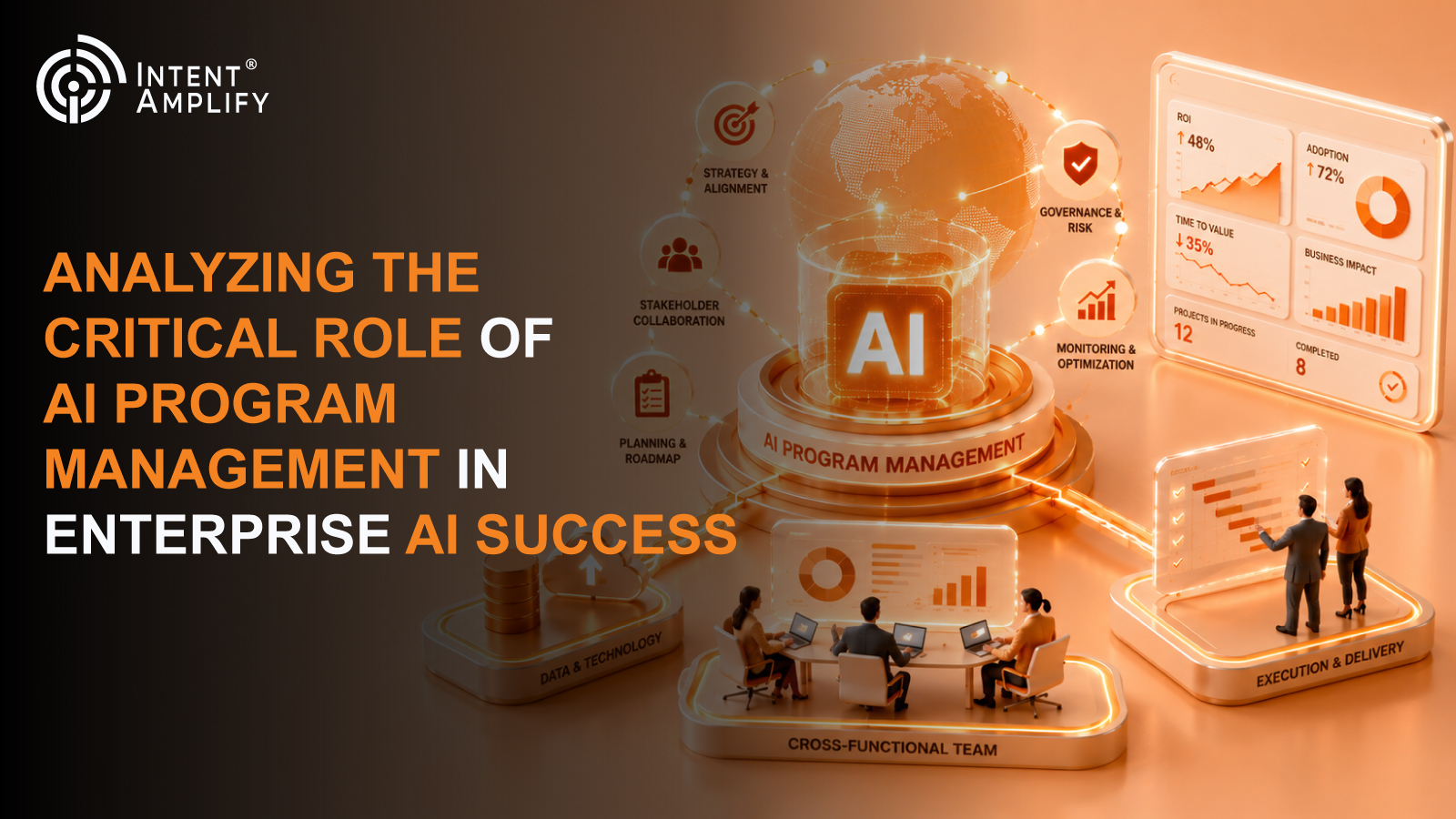
AI program management is becoming a core discipline in enterprise AI transformation. It provides the operating structure that connects AI business strategy with delivery execution, funding decisions, governance, adoption planning, AWS generative AI architecture, and measurable business outcomes.
Why AI Program Management Has Become Mission Critical
Generative AI implementation now touches too many parts of the enterprise to be managed as a narrow technology project. A business sponsor may care about speed to value, while IT leaders care about architecture, security, and integration. Data teams focus on quality and permissions, finance wants a credible AI business case, and end users need tools that fit the way work actually happens. When those needs are handled separately, AI initiatives can move quickly at first and then slow down when they reach production decisions.
A structured AI program prevents that fragmentation. It creates a common view of priorities, dependencies, risks, ownership, and success metrics before the organization begins scaling AI adoption across business units. It also helps leaders decide which projects should move first, which should wait for stronger data readiness, and which should be redesigned because the business case is not yet clear.
McKinsey’s 2025 State of AI research shows why this discipline matters. 88% of organizations report regular AI use in at least one business function, 62% are experimenting with AI agents, only about one-third have begun scaling AI across the enterprise, and 39% report enterprise-level EBIT impact from AI.²
These figures point to a widening gap between AI activity and AI value, which is precisely where program management becomes essential.
Program Management Converts AI Strategy into Delivery
AI strategy often begins with broad executive ambition, but production success depends on how well that ambition is translated into sequenced work. Without a program layer, teams may launch disconnected pilots, compete for the same data resources, duplicate similar use cases, or measure value inconsistently. The result is AI activity that looks busy but does not become a repeatable operating capability.
AI program management gives the enterprise a portfolio view. It defines the use case pipeline, clarifies which business problems matter most, and establishes decision rules for funding, prioritization, and scale. It also ensures that AI implementation services, AI deployment services, and internal technology teams are aligned around a shared roadmap rather than separate experiments.
For agentic AI project teams, this becomes even more important because agents may retrieve knowledge, interpret intent, trigger actions, update systems, and interact with users across business processes. That level of autonomy requires orchestration across data sources, permissions, application workflows, human review, and monitoring. A program management function makes sure those moving parts are coordinated before the organization asks AI to act on behalf of users.
Readiness Assessment Prevents Costly False Starts
An AI readiness assessment is not a bureaucratic checkpoint. It is a practical way to determine whether a promising idea can become a production-ready AI deployment. A use case may sound compelling in a workshop yet still fail if the data is scattered, ownership is unclear, security requirements are unresolved, or business users are not prepared to change how they work.
A strong AI readiness framework evaluates business alignment, data availability, integration complexity, governance requirements, user adoption risk, funding readiness, and expected ROI. It also identifies the difference between a high-value use case and a use case that is merely exciting because it demonstrates new technology.
Early projects should be selected based on measurable value, workflow clarity, trusted data, and manageable implementation complexity. Leaders should not choose early projects only because they are technically impressive. They should choose projects where the first value can be demonstrated, where the workflow is understood, where the data can be trusted, and where the outcome can be measured without excessive complexity.
Quantiphi’s “first value fast” positioning fits this point because speed is most useful when it is focused. A compressed delivery path can work when the team has a clear business goal, a defined audience, validated knowledge sources, measurable success criteria, and a realistic plan for moving from pilot users to broader adoption.¹
AWS Architecture Helps Close the Production Gap
Moving from an AI pilot to production requires more than a model endpoint and a successful demo. The enterprise needs an architecture that can support secure access, data grounding, identity controls, monitoring, cost visibility, model selection, and responsible AI practices. AWS generative AI services are relevant because they give organizations a cloud-native foundation for building and scaling enterprise AI solutions.
AWS describes Amazon Bedrock as a platform for building generative AI applications and agents at a production scale, with access to foundation models, customization tools, agent capabilities, guardrails, monitoring, and cost optimization features.³
This matters for teams that need flexibility across use cases because one model or one design pattern will not fit every business problem.
Amazon Q Business supports another important category of enterprise AI adoption: secure productivity and knowledge work. AWS positions it as a generative AI-powered assistant that can help employees find information, gain insight, and take action using enterprise data, while respecting existing identities, roles, and permissions.⁴
For program managers, this creates a practical pathway for faster first value because many organizations can begin with knowledge access, employee productivity, and guided workflow use cases before moving into more complex agentic AI deployments.
The program management task is to match the business problem to the right AWS AI architecture. Some use cases may be best served by Amazon Q implementation for enterprise knowledge discovery, while others may require Amazon Bedrock for custom agents, domain-specific applications, or deeper workflow automation.
Governance Builds Confidence Before Scale
AI governance should not be treated as a brake on innovation. In well-run programs, governance makes adoption easier because business users, security teams, and executives can see how AI outputs are controlled, reviewed, and improved. Without that confidence, even useful generative AI solutions may face resistance when they reach sensitive workflows or larger user populations.
NIST’s AI Risk Management Framework emphasizes trustworthy AI across design, development, use, and evaluation.⁵
In enterprise AI program management, that guidance should become operational through approved data sources, role-based permissions, human review thresholds, model evaluation, privacy controls, audit trails, and escalation paths for uncertain or high-impact outputs.
This is especially important for agentic AI because the system may not only answer a question but also recommend or initiate an action. The governance model must therefore define where automation is acceptable, where human approval is required, and how the organization will monitor performance over time.
Good governance also protects ROI. If users receive inconsistent or untrusted outputs, adoption drops. If security teams discover unclear controls late in the process, deployment slows. If leaders cannot explain how AI decisions are supervised, confidence weakens. Governance reduces those risks by making trust part of the implementation design instead of an afterthought.
ROI Requires Measurement Before the Build Begins
AI ROI becomes difficult to prove when measurement is added after launch. Program managers should define value indicators before the solution is built because those indicators influence use case design, workflow integration, and adoption planning. A team that cannot describe how value will be measured before deployment is unlikely to produce a strong return on AI investment after deployment.
Different use cases require different ROI models. A knowledge assistant may measure time saved, search reduction, answer usefulness, and repeat adoption. A sales enablement workflow may measure faster account preparation, better follow-up consistency, and reduced manual research. An operations use case may track cycle-time improvement, lower exception volume, and fewer handoffs. A service desk automation project may measure resolution speed, ticket deflection, user satisfaction, and escalation accuracy.
The AI business case should also connect short-term value with the longer AI operating model. First value matters because it builds confidence, but enterprise AI success depends on whether early wins can be repeated across departments, workflows, and use cases. Program management creates that bridge by capturing lessons, standardizing delivery patterns, and giving leaders a clearer view of where the next investment should go.
Adoption Is a Change Management Challenge
Enterprise AI deployment often underperforms when leaders assume the tool will create adoption on its own. Users may be curious during the pilot, but sustained adoption requires training, workflow fit, managerial support, and clarity about how AI should be used. If employees do not trust the answer, understand the source, or know when to escalate, they may return to older ways of working even when the AI tool is available.
Microsoft’s 2026 Work Trend Index reinforces the organizational nature of AI adoption by reporting that organizational factors account for 67% of AI impact, compared with 32% for individual mindset and behavior.⁶
Early projects should be selected based on measurable value, workflow clarity, trusted data, and manageable implementation complexity.
This is where AI enablement becomes central. Users need guidance on prompt quality, output review, responsible usage, workflow selection, and expected behavior when AI is uncertain. Managers need adoption dashboards and feedback loops. Executives need reporting that shows whether AI is changing work in ways that matter.
Program Cadence Keeps AI Work from Fragmenting
A successful AI program needs a delivery rhythm that is visible enough for executives and practical enough for project teams. Without cadence, AI initiatives can drift, duplicate effort, or continue long after the value case has weakened. With cadence, the organization can maintain momentum while still making disciplined decisions.
A useful cadence includes use case intake, prioritization review, readiness assessment, architecture design, governance approval, build sprints, user validation, launch measurement, and post-deployment improvement. It should also create a mechanism to pause, redesign, or retire initiatives that do not meet business or readiness thresholds.
This operating rhythm helps enterprises avoid one of the most common AI transformation problems: too many pilots with too little learning between them. A program view ensures that each project contributes reusable assets, whether those assets are governance patterns, data connectors, prompt libraries, evaluation methods, user enablement materials, or architecture templates.
What Quantiphi Brings to the Conversation
Quantiphi is positioned for this conversation because enterprise AI success requires both implementation skill and program discipline. Organizations need a partner that can help define high-value AI use cases, align AWS generative AI capabilities with enterprise architecture, assess readiness gaps, design responsible AI controls, and guide teams toward measurable first value.
For executives, Quantiphi’s value is a sharper path from AI strategy to business outcomes. For CIOs, CTOs, and enterprise architects, the value is an AWS-native delivery discipline that can support secure and scalable AI growth. For data and AI leaders, the value is stronger coordination between data readiness, governance, use case design, and adoption. For agentic AI project teams, the value is a structured implementation model that connects Amazon Q Business, Amazon Bedrock, enterprise knowledge, and human oversight into a practical route to production.
The strongest approach does not treat speed and control as opposing forces. It uses program structure to accelerate the right work and governance to make that work scalable.
Quantiphi’s brochure helps enterprise AI and technology leaders understand how Amazon Q Business and AWS generative AI capabilities can accelerate first value, support practical adoption, and create a stronger path from AI idea to production readiness.
Live in 45 with Amazon Quick
Business First Value Fast
About Intent Amplify
Intent Amplify helps organizations move from market insight to measurable growth through GTM strategy, demand intelligence, pipeline activation, executive roundtables, sponsored research, targeted content, webinars and panels, vendor intelligence, and strategic consulting. For teams that need sharper positioning, stronger executive engagement, and more effective activation, Intent Amplify connects strategy, content, and market intelligence into a practical growth engine. Contact Us
Executive Takeaway
AI program management has become critical to enterprise AI success because the hardest work is not launching a proof of concept. The harder work is selecting the right opportunities, preparing the organization, governing AI outputs, measuring value, and building a repeatable path from early adoption to production scale.
Enterprises that succeed will not be defined only by how quickly they test generative AI. They will be defined by how consistently they turn experimentation into governed, measurable, and adopted business capability. In that environment, AI program management becomes the discipline that turns enterprise AI ambition into production-ready value.
References
- Quantiphi and IntentTech Insight (2026) Live in 45 with Amazon Quick Business: First Value Fast. Available at: https://intenttechpub.com/brochure/live-in-45-with-amazon-quick-business-first-value-fast/
- McKinsey and Company (2025). The State of AI in 2025: Agents, Innovation and Transformation. Available at: https://www.mckinsey.com/capabilities/quantumblack/our-insights/the-state-of-ai
- Amazon Web Services (2026). Amazon Bedrock: Build Generative AI Applications and Agents at Production Scale. Available at: https://aws.amazon.com/bedrock/
- Amazon Web Services (2026) Amazon Q Business. Available at: https://aws.amazon.com/q/business/
- National Institute of Standards and Technology (2026) AI Risk Management Framework. Available at: https://www.nist.gov/itl/ai-risk-management-framework
- Microsoft (2026). 2026 Work Trend Index: Agents, Human Agency, and the Opportunity for Every Organization. Available at: https://www.microsoft.com/en-us/worklab/work-trend-index/agents-human-agency-and-the-opportunity-for-every-organization