
logo
logo
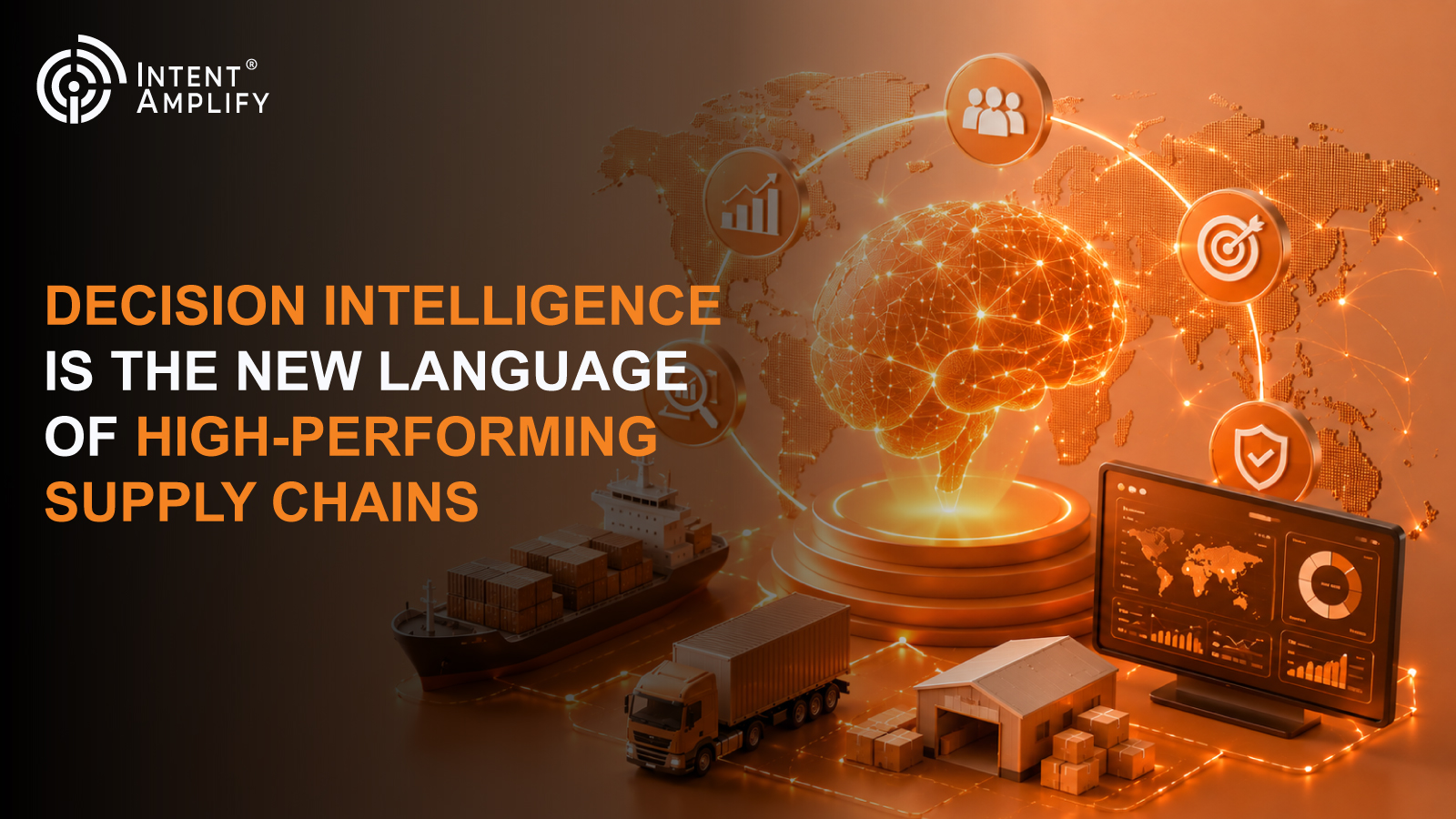
Decision Intelligence Is the New Language of High-Performing Supply Chains

EXPERT INSIGHT

Decision Intelligence Is the New Language of High-Performing Supply Chains

Discover how decision intelligence helps supply chain leaders improve planning, inventory optimization, AI governance, and operational resilience with better enterprise decision-making.

Industry Context: The Planning Problem Has Moved Beyond Visibility

High-performing supply chains are distinguished by the quality of operational decisions rather than the volume of available data. Competitive advantage increasingly depends on translating uncertainty into disciplined, evidence-based, and auditable execution.

For life sciences, pharmaceuticals, biotechnology, and consumer goods manufacturers, operational discipline carries direct commercial consequences. Capacity constraints, quality release dependencies, supplier variability, working capital objectives, regulatory obligations, and customer service commitments leave little tolerance for inconsistent execution. Delayed batch release, inaccurate lead-time assumptions, ineffective inventory positioning, or fragmented governance can rapidly affect financial performance, product availability, regulatory compliance, and customer commitments.

Supply chain decision intelligence has matured into an enterprise operating capability. Planning, procurement, manufacturing, quality, finance, logistics, and commercial functions benefit from a common governance framework for evaluating operational alternatives, assigning decision rights, managing escalation, and determining which activities are appropriate for automation, human review, or executive intervention. Sustainable business value depends on disciplined execution supported by accountable governance, transparent decision rights, and measurable operational outcomes.

BCG's 2026 Supply Chain Planning research reported that more than 90% of surveyed executives rely on supply chain planning to navigate operational complexity, optimize business performance, and manage enterprise uncertainty.¹

The findings reflect a broader shift in enterprise operations. Supply chain planning increasingly functions as a strategic governance capability for allocating resources, balancing competing priorities, and managing business volatility. Decision quality has become a defining enterprise capability with direct influence over resilience, operational performance, capital efficiency, and long-term competitiveness. [1]

Emerging Trend: From Planning Systems to Decision Systems

The previous phase of supply chain transformation focused heavily on visibility. Companies wanted to see demand shifts earlier, monitor supplier risk, improve planning accuracy, and track inventory across the network. That work still matters. But visibility alone does not answer the question that planners face every day: what should the organization do next?

A decision support platform must go further than reporting variance. It should evaluate options, expose trade-offs, simulate alternatives, capture rationale, and route actions through accountable workflows. In regulated manufacturing, this distinction is critical. A recommendation to increase safety stock, shift production, prioritize a batch, or reallocate constrained inventory must be explainable and auditable. The "best" plan is not always the lowest-cost plan when quality release management, compliance workflows, and service obligations are part of the same decision.

BCG also reported that more than 70% of surveyed companies have invested in advanced planning systems (APS), yet many still struggle to extract full value because adoption, data quality, exception management, and governance remain uneven. That gap is familiar to supply chain leaders. Technology deployment often moves faster than operating-model change, so a platform may generate better recommendations while teams still fall back on spreadsheets and meeting-based escalation. [1]

Expert Perspective: AI Is Useful Only When the Decision Model Is Clear

AI decision support has real potential in supply chain planning, but it performs best when the organization has already defined the decision boundary. Demand sensing, lead time prediction, inventory rebalancing, supplier risk scoring, quality release forecasting, and planning accuracy improvement are credible use cases. None of them should operate as unmanaged black boxes.

McKinsey's 2025 global AI survey found that 88% of respondents report regular AI use in at least one business function, while only about one-third say their companies are scaling AI across the enterprise. The pattern matters because it separates adoption from institutionalization. Using AI in isolated workflows is relatively easy. Embedding AI into supply chain governance, planning cadence, performance management, and exception resolution is much harder. [2]

The value gap is equally instructive. McKinsey found that 39% of respondents report enterprise-level EBIT impact from AI, even as many organizations continue to report localized productivity gains. For supply chain teams, the lesson is not that AI lacks value. The lesson is that value appears when recommendations change decisions that influence service, cost, inventory, capacity, or cash flow. A model that improves forecast accuracy but does not change production, procurement, allocation, or inventory policy remains an analytical improvement rather than an operating advantage. [2]

The mature approach is not "AI everywhere." It is targeted AI for supply chain decision-making, governed by thresholds, ownership, confidence scoring, and escalation logic. AI pattern recognition can flag abnormal demand behavior. Predictive analytics can estimate lead time variability. AI modeling can recommend parameter changes. The organization still needs to decide which recommendations can be automated, which require planner review, and which need cross-functional approval because the business risk is material.

Market Implications: Inventory, Quality, and Cash Are Converging

The pressure is especially visible in pharmaceuticals and biotech. Supply chain planning decisions can affect drug availability, batch release timing, and inventory posture across constrained networks. ASHP reported 216 active drug shortages at the end of 2025, while 89 new shortages were identified during 2025, the lowest annual number since 2006. The decline in new shortages is encouraging, but the active shortage count shows why pharmaceutical planning teams cannot treat inventory optimization as a simple working-capital exercise. Availability risk remains part of the planning equation. [3]

Consumer goods manufacturers face a different but related problem. Demand volatility, channel mix changes, promotional distortion, and margin pressure make it difficult to separate strategic buffers from unmanaged excess. Reducing excess inventory with AI is valuable only when models account for service requirements, supply chain lead times, replenishment constraints, and demand uncertainty. Inventory reduction that damages availability is not optimization. It is risk transfer.

PwC's Working Capital Study 25/26 identified €1.84 trillion in excess working capital globally that could be freed up for investment, based on its analysis of more than 17,000 listed companies worldwide. The same study found that days inventory outstanding has risen 13.6% in the most cash-intensive sectors across Western markets, pushing inventory into a sharper cash and resilience issue. For manufacturers, the implication is not to cut stock indiscriminately. It is to identify where inventory protects service and where it masks planning defects, supplier variability, poor parameter governance, or delayed quality release. [4]

Decision Governance Is Where AI Becomes Operationally Useful

The next phase of supply chain transformation will be less about adding another intelligence layer and more about governing the decision layer already forming across planning, quality, finance, and operations. This is where a digital twin supply chain becomes useful. A digital twin for inventory optimization can simulate demand shifts, lead time variability, quality release delays, and capacity constraints before teams commit to action. But simulation creates enterprise value only when it is connected to ownership, approval thresholds, and measurable outcomes.

For leaders trying to separate practical AI value from overextended automation claims, Bluecrux's whitepaper offers a useful next step. It examines where AI can materially improve enterprise supply chains and where leadership teams should remain cautious, particularly across planning platforms, decision support models, digital twins, and inventory optimization using AI.

Download the Whitepaper: Beyond the Dashboard: Where AI Helps Enterprise Supply Chains and Where It Doesn't

Enterprise Decision Intelligence Framework

Here are the recommendations from Intent Amplify for enterprises looking to turn supply chain decision intelligence from a planning concept into an operational discipline.

1. Map the Decisions Before Expanding the Technology

Start with the decisions that determine performance: safety stock changes, production prioritization, allocation during constraint, supplier substitution, expedited approval, quality release planning, and planning parameter updates. Each decision should have a named owner across planning, quality, finance, procurement, or operations, along with required data inputs, business impact logic, escalation rules, and approval thresholds. This is the practical foundation of supply chain governance best practices.

2. Treat Planning Parameters as Governed Data

Planning parameters are often treated as system settings rather than governed enterprise data. That is a mistake. Lead times, minimum order quantities, yields, safety stock rules, batch sizes, shelf-life assumptions, and release timelines directly shape planning recommendations. ERP planning parameter optimization should include ownership, refresh cadence, statistical review, and exception workflows.

3. Use AI Where Outcomes Can Be Measured

AI-powered planning recommendations should begin in areas with clear feedback loops. Lead time optimization, inventory rebalancing, demand anomaly detection, quality release delay prediction, and planning accuracy improvement are strong candidates because the organization can compare prediction with outcome. That makes model performance easier to govern and easier to improve.

4. Connect Inventory Decisions to Finance, Quality, and Service

AI inventory optimization for working capital should not be separated from quality release management or service risk. A credible decision support platform should show the cash flow benefit of reducing inventory alongside the exposure created by supplier variability, batch delay, release hold, or constrained replenishment. In life sciences, this balance is nonnegotiable.

5. Build Human Oversight Into the Workflow

Human oversight should be designed, not improvised. Deloitte's 2026 State of AI in the Enterprise research found that only one in five companies has a mature model for governance of autonomous AI agents. Supply chain leaders should treat this as an early warning. As AI decision support becomes more autonomous, planning governance must specify when recommendations can execute automatically, when planners must review them, and when cross-functional approval is required. [5]

Executive Decision Intelligence Scorecard

Executive Decision Intelligence Scorecard

Maturity Question

Decision governance maturity

Are critical planning decisions mapped with owners, thresholds, escalation rules, and approval paths?

Planning workflow ownership

Are planning recommendations routed through accountable workflows across planning, quality, finance, procurement, and operations?

AI explainability

Can teams explain why an AI-supported recommendation was generated and what assumptions shaped it?

Inventory governance

Are inventory decisions evaluated against service risk, working capital impact, quality release dependencies, and replenishment constraints?

Human oversight

Are review requirements clearly defined for automated, planner-reviewed, and executive-level decisions?

Outcome measurement

Are decisions measured against operational, financial, service, and resilience outcomes after execution?

Operational accountability

Is there clear ownership for the final decision, not just the analytics or recommendation behind it?

Conclusion: The Advantage Is Better-Governed Judgment

Decision intelligence is emerging as the operating framework for high-performing supply chains because it reflects how enterprise planning decisions are executed. Analytical insight, AI capabilities, and operational execution become part of a unified governance model instead of existing as disconnected analytics, isolated AI initiatives, or dashboards that identify operational issues without guiding enterprise action.

For life sciences, pharmaceuticals, biotechnology, and consumer goods manufacturers, competitive advantage increasingly depends on integrating supply chain analytics, predictive analytics, master data management, planning governance, supply chain simulation, digital twin capabilities, and financial decision intelligence within a coordinated operating model. Human judgment remains central to enterprise planning, supported by consistent evidence, transparent governance, and AI-assisted decision orchestration that improves execution quality, operational resilience, and business performance.

Build Stronger Demand Around Supply Chain Decision Intelligence

Enterprise Decision Intelligence Readiness Assessment

As supply chain AI moves from planning visibility to governed decision execution, enterprise leaders need a clearer way to evaluate whether their operating model is ready for decision intelligence. The challenge is not only whether the organization has advanced planning systems, AI models, dashboards, or digital twin capabilities. The real question is whether those capabilities are connected to trusted data, accountable workflows, explainable recommendations, and measurable business outcomes.

Intent Amplify's Enterprise Decision Intelligence Readiness Assessment helps organizations evaluate planning governance maturity, workflow ownership, AI decision support readiness, inventory governance, explainability, operational accountability, and decision execution maturity. The assessment is designed to help leadership teams identify where decision intelligence can improve supply chain performance, where governance gaps may limit AI value, and where operating-model redesign is needed before automation scales.

For technology providers, consulting firms, and supply chain solution leaders, this creates a stronger bridge between executive education and advisory engagement. It positions decision intelligence not as another AI trend, but as a practical enterprise capability for improving planning discipline, inventory decisions, quality-aligned execution, and operational resilience.

Start your Enterprise Decision Intelligence Readiness Assessment

References

  1. Boston Consulting Group (2026) Supply Chain Planning 2026 Report. Available at: https://web-assets.bcg.com/86/2d/bc2246f04e3ab0f7631727e3fff8/supply-chain-planning-2026-report-feb-2026-edit.pdf.
  2. McKinsey & Company (2025) The State of AI: Global Survey 2025. Available at: https://www.mckinsey.com/capabilities/quantumblack/our-insights/the-state-of-ai.
  3. American Society of Health-System Pharmacists (2025) National Drug Shortages: January 2001-December 2025. Available at: https://www.ashp.org/-/media/assets/drug-shortages/docs/2025-Drug-Shortages-Report-Q4.pdf.
  4. PwC (2025) Working Capital Study 25/26: Managing in an Uncertain & Unreliable World. Available at: https://www.pwc.co.uk/services/value-creation/insights/working-capital-study.html.
  5. Deloitte (2026) The State of AI in the Enterprise. Available at: https://www.deloitte.com/us/en/what-we-do/capabilities/applied-artificial-intelligence/content/state-of-ai-in-the-enterprise.html.
Prabhanshi   Singh

Prabhanshi Singh

Research Analyst

Let us connect for more

Decision Intelligence for High-Performing Supply Chains