
logo
logo
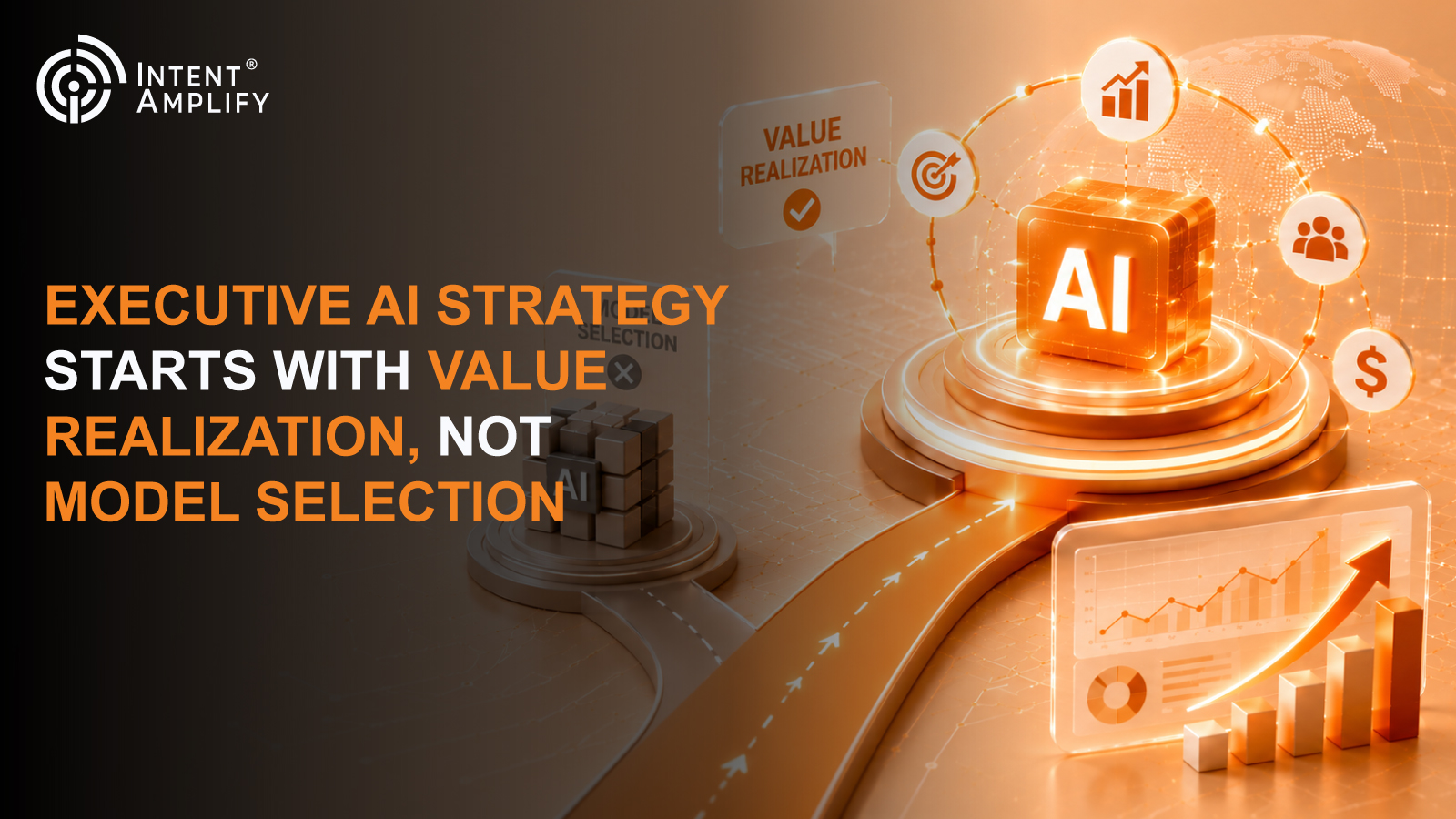
Executive AI Strategy Starts With Value Realization, Not Model Selection

EXPERT INSIGHT

Executive AI Strategy Starts With Value Realization, Not Model Selection

Learn why successful enterprise AI strategies begin with measurable business value rather than model selection, and how Amazon Q Business and AWS generative AI support production-ready AI adoption.

Enterprise AI strategy is entering a more disciplined phase. For the past several years, much of the executive conversation has centered on model capability, generative AI experimentation, agentic AI potential, and platform choice. Those questions still matter, but they are no longer the best starting point for business leaders who need measurable outcomes from AI investments. Executive AI strategy should begin with value realization: where AI improves work, accelerates decisions, reduces friction, strengthens productivity, or creates measurable business impact.

Quantiphi's Live in 45 with Amazon Quick Business: First Value Fast campaign speaks directly to this shift. The asset is designed for enterprise leaders who want to move from AI interest to practical adoption through Amazon Q Business and AWS generative AI capabilities, with an emphasis on reaching first value through focused implementation rather than extended experimentation.¹

For executives and teams involved in agentic AI projects, the central question should not be which model looks most impressive in a demo. The better question is which business process, user group, or decision workflow can benefit from AI in a way that is secure, measurable, trusted, and ready to scale. When leaders begin with that value lens, model selection becomes an architectural decision inside a broader AI business strategy rather than the strategy itself.

Why Model-First Thinking Creates Strategic Drift

Model-first AI planning often begins with technical excitement. Teams compare foundation models, explore benchmarks, test prompts, and evaluate new capabilities before clearly defining the business outcome. This can produce energy, but it can also create strategic drift because the organization becomes focused on what the technology can do instead of what the business needs to improve.

Strategic drift becomes costly when pilots multiply without a common implementation roadmap, governance model, ROI framework, or production-readiness standard. One team may test an internal knowledge assistant, another may explore a customer-facing chatbot, a third may build a workflow agent, and none of them may share the same governance framework, ROI model, or production readiness standard. The result is AI activity without a strong enterprise AI operating model.

A value-first strategy changes the sequence. Leaders begin by identifying the outcome, the user, the workflow, the data source, the adoption path, and the metric that will prove progress. Only then should the organization decide whether Amazon Q Business, Amazon Bedrock, a custom generative AI application, or another AWS AI service is the right technical fit.

KEY FIGURES AT A GLANCE

McKinsey's 2025 State of AI research shows that 88% of organizations report regular AI use in at least one business function, yet only about one-third have begun scaling AI across the enterprise, and 39% report enterprise-level EBIT impact from AI.²

AWS states that Amazon Bedrock supports generative AI application and agent development at a production scale for more than 100,000 organizations worldwide, while Amazon Q Business is positioned as a generative AI assistant that helps employees find information, gain insights, and take action using enterprise data.³

Microsoft's 2026 Work Trend Index surveyed 20,000 AI-using workers across 10 countries and found that organizational design is becoming a decisive factor in AI impact, which reinforces the need for executive alignment, user enablement, and workflow redesign before broad deployment.⁵

NIST's AI Risk Management Framework provides a governance foundation for trustworthy AI across design, development, use, and evaluation, which is essential when AI systems influence enterprise workflows, employee decisions, and business operations.⁶

Value Realization Should Shape the AI Portfolio

An executive AI strategy should organize work around value pools rather than isolated technology experiments. A value pool may include faster knowledge discovery, improved sales preparation, reduced service desk effort, better policy access, accelerated operations support, stronger decision intelligence, or more efficient internal reporting. Each value pool should have a business owner, a target user group, a measurable outcome, and a delivery path.

This approach helps executives distinguish between high-interest AI ideas and high-impact AI use cases. A use case may be innovative, but that does not automatically make it the right first deployment. The best early opportunities are usually narrow enough to deliver quickly, important enough to matter to the business, and structured enough to measure without complex assumptions.

AI ROI also becomes easier to discuss when value is defined before deployment. Instead of asking whether generative AI is broadly valuable, leaders can ask whether a specific workflow is saving time, reducing manual effort, improving decision speed, lowering support volume, or helping employees complete work with better context.

Amazon Q Business Fits the First-Value Mandate

Amazon Q Business is relevant to a value-first AI strategy because many enterprises need a practical way to improve knowledge access and workplace productivity before they pursue more advanced agentic AI programs. AWS describes Amazon Q Business as a generative AI-powered assistant that can help employees find information, gain insight, and take action using enterprise data, while respecting existing identities, roles, and permissions.⁴

This matters because knowledge fragmentation is one of the most common barriers to productivity. Employees often spend time searching across documents, systems, messages, policies, dashboards, and application records before they can answer a question or complete a task. An Amazon Q implementation can create early value by reducing search friction and helping users interact with trusted enterprise information through a more natural interface.

For executives, that early value is important because it builds confidence. A focused deployment can show how AI fits into real work, how employees respond, where data quality needs improvement, and which governance controls must be strengthened before the organization expands into more complex AI business cases.

AWS Architecture Turns Adoption into a Scalable Capability

Value realization should not ignore architecture. It should guide it. Once leaders identify the right business outcome, AWS's generative AI capabilities can be matched to the use case with greater clarity. Some initiatives may require Amazon Q Business for secure enterprise productivity, while others may need Amazon Bedrock for custom applications, AI agents, retrieval-augmented generation, model selection, guardrails, or deeper workflow integration.³

The architectural decision should reflect the nature of the value being pursued. A knowledge discovery use case may depend on connectors, permissions, and answer transparency. A process automation use case may require agent orchestration, integration with business applications, and human approval steps. A decision-support use case may need domain-specific data grounding, evaluation methods, and auditability.

This is why AI production deployment should be planned from the start. If the enterprise waits until after the pilot to address identity, governance, data access, monitoring, and cost controls, the project may appear successful in a controlled setting and then slow down when it reaches real users. A value-first approach avoids that delay by treating production readiness as part of the business case.

Governance Protects Value, Not Just Compliance

AI governance is sometimes framed as a constraint, but executives should view it as a value protection mechanism. If users do not trust AI outputs, adoption weakens. If security teams cannot verify permissions, deployment slows. If leaders cannot explain how high-impact outputs are reviewed, risk confidence declines. Governance, therefore, determines whether AI can move from pilot enthusiasm to enterprise acceptance.

NIST's AI Risk Management Framework is useful because it frames trustworthy AI as a lifecycle issue rather than a one-time review.⁶

In enterprise AI programs, that means leaders should define approved data sources, role-based access, human review thresholds, output evaluation, privacy controls, audit trails, and escalation paths before scaling use cases.

This is especially important for agentic AI project involvement because agents may do more than answer questions. They may recommend actions, trigger workflows, update systems, or coordinate steps across applications. The more action-oriented AI becomes, the more important it is to clarify where automation is allowed, where human approval is required, and how performance will be monitored.

Executive Alignment Should Come Before Funding Expansion

Enterprise AI funding models are stronger when leadership alignment comes before budget expansion. A large AI investment can still underperform if executives do not agree on priority use cases, adoption goals, governance expectations, and measurement standards. A smaller first-value initiative can create a more useful foundation when it is connected to a clear scale path.

An executive AI strategy workshop should therefore focus on value pools, readiness gaps, business ownership, and ROI assumptions before debating the full technology roadmap. Leaders need to agree on where AI should create near-term impact, what risk tolerance is acceptable, which teams will own adoption, and what evidence will justify further funding.

This alignment also helps prevent AI programs from becoming fragmented across departments. When the enterprise has a shared value realization framework, business units can still move quickly while using common standards for governance, measurement, and production readiness.

What Quantiphi Brings to the Conversation

Quantiphi is positioned for this conversation because enterprises need more than access to AWS AI services. They need structured guidance that connects AI business strategy, use case discovery, readiness assessment, Amazon Q implementation, AWS generative AI architecture, governance, and measurable outcomes into one practical adoption path.

For executives, Quantiphi's value is helping AI strategy begin with business impact rather than technical novelty. For CIOs, CTOs, and enterprise architects, the value is implementation discipline that supports secure and scalable AI adoption. For data and AI leaders, the value is stronger coordination between data readiness, responsible AI, user enablement, and ROI measurement. For teams involved in agentic AI projects, the value is a clearer way to move from the first use case to production-ready capability without losing focus on the business outcome.

Strong AI strategies treat model selection as one architectural decision within a broader value-realization system.

Quantiphi's brochure helps enterprise AI and technology leaders understand how Amazon Q Business and AWS generative AI capabilities can accelerate first value, support practical adoption, and create a stronger path from AI idea to production readiness.

Live in 45 with Amazon Quick

Business First Value Fast

Download Now

About Intent Amplify

Intent Amplify helps organizations move from market insight to measurable growth through GTM strategy, demand intelligence, pipeline activation, executive roundtables, sponsored research, targeted content, webinars and panels, vendor intelligence, and strategic consulting. For teams that need sharper positioning, stronger executive engagement, and more effective activation, Intent Amplify connects strategy, content, and market intelligence into a practical growth engine.

Contact Us

Executive Takeaway

Executive AI strategy starts with value realization because the real measure of success is not whether the enterprise selected an advanced model. The measure is whether AI improved a meaningful workflow, created trusted adoption, reduced friction, supported faster decisions, and generated evidence that leaders can use to fund the next stage of growth.

Enterprises that begin with value will make better decisions about AI use cases, architecture, governance, Amazon Q Business, Amazon Bedrock, and production deployment. They will also avoid the common trap of confusing experimentation with transformation. In the next phase of enterprise AI adoption, model selection will remain important, but value realization will decide whether AI becomes a business capability or another promising pilot.

References

  1. Quantiphi and IntentTech Insights (2026) Live in 45 with Amazon Quick Business: First Value Fast. Available at: https://intenttechpub.com/brochure/live-in-45-with-amazon-quick-business-first-value-fast/
  2. McKinsey and Company (2025). The State of AI in 2025: Agents, Innovation and Transformation. Available at: https://www.mckinsey.com/capabilities/quantumblack/our-insights/the-state-of-ai
  3. Amazon Web Services (2026). Amazon Bedrock: Build Generative AI Applications and Agents at Production Scale. Available at: https://aws.amazon.com/bedrock/
  4. Amazon Web Services (2026) Amazon Q Business. Available at: https://aws.amazon.com/q/business/
  5. Microsoft (2026). 2026 Work Trend Index: Agents, Human Agency, and the Opportunity for Every Organization. Available at: https://www.microsoft.com/en-us/worklab/work-trend-index/agents-human-agency-and-the-opportunity-for-every-organization
  6. National Institute of Standards and Technology (2026) AI Risk Management Framework. Available at: https://www.nist.gov/itl/ai-risk-management-framework
Omkar Waghmare

Omkar Waghmare

Research Analyst

Let us connect for more

Executive AI Strategy Begins With Business Value