
logo
logo
The Shift to Cloud-Based Physical Security for Modern Enterprises

NEWSLETTER

The Shift to Cloud-Based Physical Security for Modern Enterprises

Discover why modern enterprises are adopting cloud-based physical security to strengthen cyber-physical resilience, centralize governance, improve identity integration, and accelerate incident response across distributed environments.

Modern enterprises operate across distributed offices, hybrid work models, warehouses, data centers, branch sites, healthcare facilities, educational campuses, retail locations, and regulated environments, where physical events can quickly become digital risk events. A compromised credential can open a cloud application.

A stolen badge can enable on-site access. A vulnerable camera or unmanaged network video recorder can become a foothold into the enterprise network. A delayed investigation can turn a local incident into an enterprise-wide exposure.

This is why chief information security officers (CISOs), chief security officers (CSOs), risk leaders, and infrastructure teams are re-evaluating traditional physical security architectures. The question is no longer whether cameras record footage. The better question is: can the organization detect, investigate, govern, and respond to cyber-physical risk at enterprise speed?

Gartner stated in July 2025 that cyber-physical systems continue to proliferate across industries due to digital transformation, and that security and risk management leaders are increasingly tasked with securing them. 1

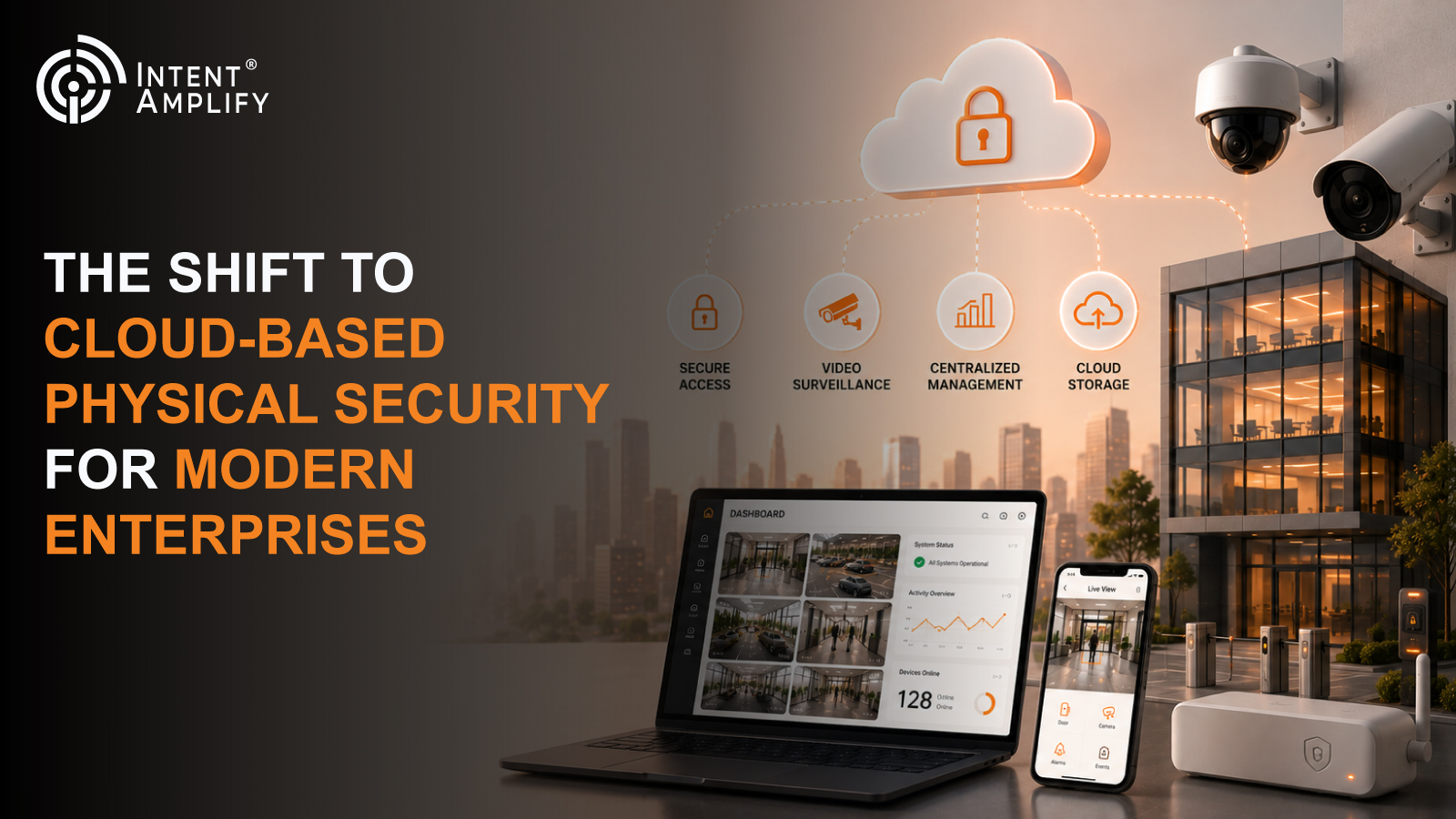
In this model, video security, access control, environmental sensors, visitor management, and incident workflows can be managed through a unified platform. For enterprises with multiple locations, that shift changes both the economics and the risk posture.

How the Cloud Shift Is Accelerating Now

The move toward cloud-based physical security is not happening in isolation. It is part of a wider enterprise pattern: security programs are moving away from isolated tools and toward platforms that support visibility, automation, resilience, identity governance, and faster response.

Microsoft's 2025 Digital Defense Report shows the scale of modern security operations. Microsoft processes more than 100 trillion security signals daily across endpoints, cloud services, identity systems, and other sources. 2

That datapoint matters for physical security because enterprise defense is becoming signal-driven. The more distributed an organization becomes, the less effective manual review becomes. A security team cannot afford to search video footage manually across 80 sites while also correlating badge activity, identity alerts, visitor logs, and endpoint events.

The future of physical security has to look more like modern cybersecurity: searchable, integrated, policy-driven, and capable of producing rapid investigative context.

1. Legacy Architecture Cannot Keep Pace with Distributed Risk

Traditional physical security systems were built for local control. That made sense when most employees worked onsite, assets were concentrated in a few locations, and investigations were handled locally. But modern enterprises need centralized governance without losing local responsiveness.

A cloud-based model allows security teams to standardize policies, monitor device health, manage access rights, retrieve footage, and support investigations across geographies. For U.S. enterprises with multiple offices, manufacturing sites, retail branches, or sensitive operational environments, this is a measurable advantage.

It also reduces the dependence on site-specific servers, manual patching cycles, and inconsistent configurations. In analyst terms, cloud-based physical security converts physical infrastructure into an operational security platform.

Gartner forecasted worldwide end-user spending on information security to reach $213.025 billion in 2025 and $239.759 billion in 2026, with security software growing from $105.940 billion in 2025 to $121.154 billion in 2026. Gartner linked this growth partly to the shift from on-premises to cloud-based systems and the security risks that follow. 3

For buyers, the implication is clear. As budgets move toward cloud security, identity, analytics, and software-led controls, physical security modernization should not be treated as a facilities-only upgrade. It should be part of the broader cyber resilience roadmap.

2. Cyber-Physical Convergence Is Becoming a Board-Level Risk

Cybersecurity leaders have spent years improving endpoint detection, identity controls, cloud posture management, and incident response. Yet physical security infrastructure often remains under-governed. This gap is becoming harder to justify.

Accenture's 2025 State of Cybersecurity Resilience report found that only 10% of organizations occupy what it calls the "Reinvention-Ready Zone," meaning they demonstrate both robust security capabilities and an integrated cyber strategy. The report also identifies cyber-physical security as part of the mature security capability set. 4

This finding should concern CISOs and CSOs. Most organizations are not failing because they lack tools. They are struggling because strategy, execution, and resilience are misaligned. Physical security is one of the areas where that misalignment becomes visible.

Consider a common enterprise scenario. A terminated employee's cloud access is revoked, but badge access remains active at one regional office. Or a contractor enters a restricted area, but the video system is not integrated with visitor records. Or an incident at a branch location requires footage retrieval, but local hardware is offline, or the recording window has expired. Each of these is a governance problem, not just a physical security problem.

Cloud-based physical security can support stronger governance by connecting access, video, alerts, and investigation workflows into a common operating model. That does not eliminate the need for strong local procedures, but it gives leaders a better foundation for control.

CyberTech Intelligence Perspective

CyberTech Intelligence views cloud-based physical security as a governance shift, not only an infrastructure upgrade. As video security, access control, visitor management, device health, and incident workflows move into cloud-managed environments, physical security becomes part of the enterprise control plane for cyber-physical risk.

For CISOs, CSOs, and infrastructure leaders, the value is no longer limited to replacing local servers or simplifying camera management. The strategic value is the ability to apply consistent policies, centralize visibility, strengthen identity alignment, accelerate investigations, and govern physical security data across distributed sites. In this model, cloud-based physical security becomes an enterprise governance platform that supports resilience, auditability, and operational control.

3. AI Is Raising the Bar for Detection and Investigation

Artificial intelligence is becoming a central feature of both attack and defense. In physical security, AI can support faster search, anomaly detection, object recognition, license plate recognition, people analytics, and alert prioritization. Used responsibly, these capabilities can reduce investigation time and help security teams focus on high-risk events.

However, AI also changes the risk equation. A poorly governed AI-enabled physical security system can introduce privacy concerns, biased workflows, excessive data collection, and weak auditability. That is why buyers should evaluate AI capabilities through the same governance lens they apply to cybersecurity tools: transparency, access control, retention, logging, policy enforcement, and integration with enterprise risk processes.

Accenture reported in 2025 that only 28% of companies embed security controls in all transformation initiatives from the start, while just 42% are balancing AI development with the security investments needed to protect those systems. 4

For physical security buyers, this is a warning. AI-enabled cameras, cloud video analytics, and smart access platforms should not be deployed as isolated innovation projects. They should be assessed as enterprise security systems with cyber, privacy, operational, and compliance implications.

4. Identity Is Becoming the Bridge Between Cyber and Physical Access

Identity has become the security control plane for cloud applications. It is now becoming equally important in physical security. The convergence of physical and digital identity allows organizations to apply consistent access policies, reduce manual provisioning, and improve auditability.

For example, when human resources updates an employee's status, that change should flow into digital identity and physical access systems. When a privileged user enters a restricted facility, that event may be relevant to a security operations center. When a visitor is granted temporary access, the organization should know who approved it, where the visitor went, and whether the access expired.

This is where cloud-based physical security becomes strategically relevant. It can help CISOs and CSOs align access control with identity governance, compliance reporting, and incident response.

McKinsey noted in October 2025 that autonomous AI agents introduce new risks because they can act without human oversight, and organizations should update identity and access management, third-party risk management, and governance processes to cover new AI capabilities.5

Although this McKinsey research focuses on agentic AI, the principle applies directly to physical security modernization: access must be governed continuously, not reviewed occasionally.

CyberTech Intelligence Enterprise Cloud Physical Security Framework

CyberTech Intelligence recommends that enterprises evaluate cloud-based physical security through a governance and resilience framework rather than a hardware modernization checklist. The CyberTech Intelligence Enterprise Cloud Physical Security Framework™ helps security leaders assess whether their physical security environment can support unified visibility, cyber-physical integration, identity governance, operational resilience, and continuous control across distributed sites.

Current Priority

Branded Framework Pillar

Unify Visibility Across Sites

Pillar 1: Unified Visibility

Integrate Physical Security with Cybersecurity Workflows

Pillar 2: Cyber-Physical Integration

Treat Physical Security Modernization as a Business Resilience Investment

Pillar 3: Operational Resilience

Identity Is Becoming the Bridge Between Cyber and Physical Access

Pillar 4: Identity Governance

Governance across cloud, access, video, AI, and incident workflows

Pillar 5: Continuous Governance

Readers who want a practical introduction can access the demo deck here.

CyberTech Intelligence Research Desk Observation

The convergence of cloud infrastructure, identity, physical access, video intelligence, and operational resilience is changing the role of physical security in the enterprise. Organizations that continue to manage cameras, access systems, visitor workflows, and incident response as separate functions are likely to face slower investigations, weaker auditability, and greater cyber-physical exposure.

The next maturity stage will belong to enterprises that treat cloud-based physical security as a unified governance layer. This means aligning access with identity, connecting physical events to security workflows, measuring operational resilience, and managing physical security data with the same discipline applied to cybersecurity platforms.

Executive Readiness Scorecard

Assessment Area

1 = Low Readiness

2 = Developing Readiness

3 = High Readiness

Cloud Readiness

Systems rely on local servers and manual administration.

Some sites use cloud tools, but coverage is uneven.

Cloud management is standardized across key sites.

Identity Integration

Physical access is separate from identity workflows.

Some identity alignment exists, but updates are inconsistent.

Access rights sync with user status, role, and location.

Multi-Site Governance

Sites operate with separate policies and limited oversight.

Central visibility exists for priority locations.

Policies, users, devices, and logs are governed centrally.

Incident Response Maturity

Investigations depend on local teams and manual evidence retrieval.

Response workflows exist, but integration is partial.

Alerts, footage, access events, and evidence are connected.

Operational Resilience

Physical security supports recording but not resilience planning.

Systems improve response, but value tracking is limited.

Physical security supports continuity, auditability, and risk reduction.

Platform Integration

Video, access, sensors, and workflows are siloed.

Some integrations exist across critical systems.

Platform data connects with identity, cyber, and response workflows.

Turn Cloud Physical Security Into an Enterprise Governance Platform

Cloud-based physical security is no longer only about replacing local servers, aging cameras, or fragmented access systems. It is becoming a strategic control layer for visibility, identity governance, incident response, operational resilience, and cyber-physical risk management.

CyberTech Intelligence's Enterprise Cloud Physical Security Readiness Assessment helps organizations evaluate cloud migration readiness, infrastructure lifecycle risk, identity governance, operational resilience, cyber-physical integration, and AI readiness. The assessment is designed for CISOs, CSOs, infrastructure leaders, facilities stakeholders, and enterprise buyers who need a clearer view of where physical security modernization can reduce risk and improve resilience.

Request an Enterprise Cloud Physical Security Readiness Assessment

References

[1] Gartner. "Hype Cycle for Cyber-Physical Systems Security, 2025." Published July 15, 2025. https://www.gartner.com/en/documents/6723934

[2] Microsoft. "Microsoft Digital Defense Report 2025: Safeguarding Trust in the AI Era." Published 2025. https://cdn-dynmedia-1.microsoft.com/is/content/microsoftcorp/microsoft/bade/documents/products-and-services/en-us/security/Microsoft-Digital-Defense-Report-2025-v5-21Nov25.pdf

[3] Gartner. "Gartner Forecasts Worldwide End-User Spending on Information Security to Total $213 Billion in 2025." Published July 29, 2025. https://www.gartner.com/en/newsroom/press-releases/2025-07-29-gartner-forecasts-worldwide-end-user-spending-on-information-security-to-total-213-billion-us-dollars-in-2025

[4] Accenture. "State of Cybersecurity Resilience 2025." Published June 25, 2025. https://www.accenture.com/content/dam/accenture/final/accenture-com/document-3/State-of-Cybersecurity-report.pdf

[5] McKinsey & Company. "Deploying Agentic AI with Safety and Security: A Playbook for Technology Leaders." Published October 16, 2025. https://www.mckinsey.com/capabilities/risk-and-resilience/our-insights/deploying-agentic-ai-with-safety-and-security-a-playbook-for-technology-leaders

Prabhanshi   Singh

Prabhanshi Singh

Research Analyst

Contact Us