
Most enterprise websites are full of valuable information. Product pages, policy documents, technical guides, support articles, compliance resources, videos, PDFs, and thought leadership assets often exist in abundance. Users often navigate multiple sources before locating, validating, and applying relevant information.
Keyword search depends on exact terms, clean metadata, and well-maintained content structures. In large organizations, those conditions rarely hold consistently. Content sits across systems. Naming conventions vary. Older documents remain discoverable long after they stop being useful. The result is friction: slower decisions, inconsistent answers, and rising pressure on support, sales, and security teams.
Microsoft’s 2025 Digital Defense Report states that Microsoft processes more than 100 trillion security signals daily, blocks 4.5 million net-new malware files each day, and analyzes 38 million identity risk detections on an average day. Competitive advantage increasingly depends on the ability to interpret and apply information quickly and accurately. [1]
Enterprise search increasingly functions as part of the organization's trust infrastructure. When official content cannot answer clearly, users turn elsewhere: public AI tools, outdated decks, internal messages, or unofficial summaries. That creates risk. Inaccurate answers can affect buying decisions, compliance posture, customer confidence, and brand credibility.
Agentic RAG Changes the Role of Enterprise Search
Retrieval-augmented generation, or RAG, has become a practical answer to a common AI problem: large language models can generate fluent responses, but they need enterprise context to be useful and trustworthy. RAG helps by retrieving relevant source content first, then grounding the generated response in that material.
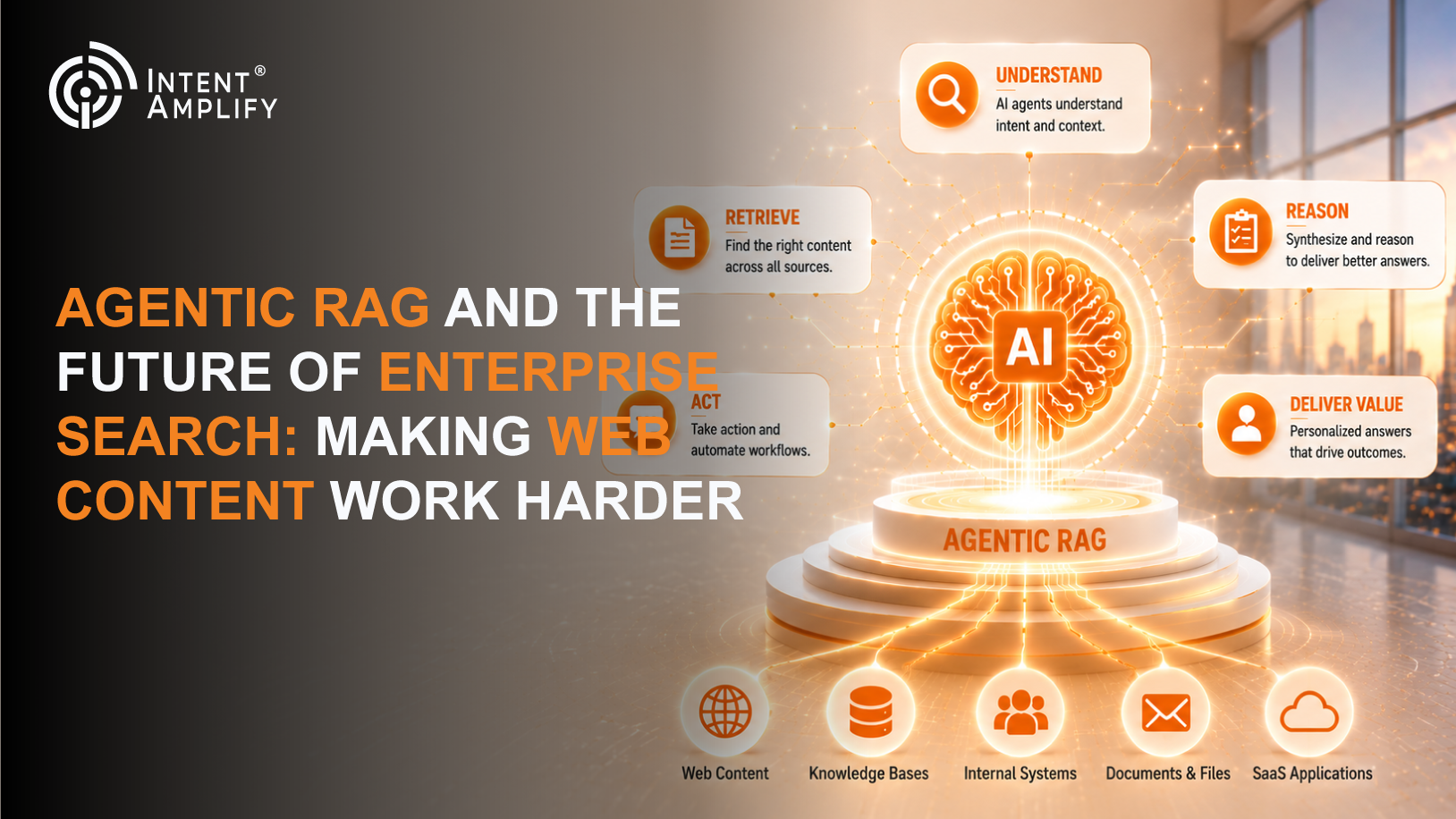
Agentic RAG takes this further. Instead of passively retrieving documents, agentic systems can reason through a user’s request, select retrieval strategies, work across formats, and produce more contextual answers. Agentic RAG supports intent resolution by combining retrieval, reasoning, and contextual response generation.
A single website visit may include product comparison, risk assessment, implementation feasibility, pricing research, security review, and stakeholder education. Search needs to support that complexity.
McKinsey’s 2025 Global Survey on AI found that 88% of respondents report regular AI use in at least one business function. It also found that 23% of respondents are scaling agentic AI somewhere in the enterprise, while another 39% have started experimenting with AI agents. [3]
Gartner’s 2025 research points in the same direction. The firm predicts that 40% of enterprise applications will be integrated with task-specific AI agents by the end of 2026, up from less than 5% at the time of publication. Gartner also projects that agentic AI could account for approximately 30% of enterprise application software revenue by 2035. [4]
Enterprise search is evolving into an intelligent interface between users and organizational knowledge.
Progress Software Corp’s asset, Websites Supercharged: Content Storage Transformed into an Answer Engine, fits directly into this shift. The eBook frames generative search, powered by agentic RAG, as a way to turn existing website and content management system content into a trusted, contextual answer engine that accelerates customer journeys and unlocks the value of unstructured content. [8]
Gartner’s September 2025 survey found that only 15% of IT application leaders were considering, piloting, or deploying fully autonomous AI agents. It also reported that 75% were piloting, deploying, or had deployed some form of AI agent, while only 19% had high or complete trust in vendor hallucination protection. [5]
Enterprise search modernization spans content governance, AI trust, and digital experience management rather than chatbot deployment alone.
Turn Web Content into a Governed Answer Engine
The opportunity lies in increasing the value generated by existing website and content investments.
A governed answer engine should retrieve from approved sources, generate clear responses, cite where answers came from, and guide users to the next relevant action. That could mean a product comparison, a support article, a compliance resource, a demo request, or a deeper technical guide.
Progress Agentic RAG is positioned for this use case. Progress describes its generative search capability as replacing link-based results with precise, context-rich answers, allowing users to ask natural-language questions and get the exact passage, timestamp, or snippet they need from across the content ecosystem. It also supports documents, text, video, audio, images, multilingual answers, modular pipelines, and LLM-agnostic deployment. [9]
Enterprise evaluations should focus on five areas: content readiness, retrieval quality, access control, source traceability, and measurable business impact. A mature implementation should help customers find answers faster, help sales teams reduce repeated explanations, help support teams deflect common questions, and help security teams maintain oversight of how enterprise knowledge is used.
Deloitte’s October 2025 cyber threat analysis adds an important caution. It reports that threat actors are using artificial intelligence for more sophisticated attacks, including deepfake videos, modular toolkits, and generative AI-powered scams. It also notes that AI-powered tools are lowering skill barriers and automating phishing and social engineering. [6]
The threat landscape increases the importance of governed, auditable answer-generation systems. Enterprises need AI experiences that are transparent, auditable, and grounded in verified content. Accenture’s June 2025 report found that only 42% of organizations are balancing AI development with security investment, and just 28% embed security into transformation initiatives from the outset. [2]
Progress Software Corp’s Websites Supercharged eBook is a practical next step. It outlines how agentic RAG can help transform static website and CMS content into a trusted answer engine for customers, employees, and business teams.
From Interest to Qualified Enterprise Engagement
Intent Amplify helps B2B teams identify in-market buying groups, map decision-maker signals, and activate narratives that convert research interest into pipeline conversations. [10]
For Progress Software Corp, the campaign opportunity is clear: position agentic RAG as the bridge between enterprise content, trusted answers, and measurable digital engagement.
To engage enterprise buyers around agentic RAG, generative search, and AI-powered content discovery, connect with Intent Amplify for demand intelligence, persona mapping, and narrative-to-pipeline activation.
At Intent Amplify, our role is to connect enterprise technology narratives to real buying intent. The shift from keyword search to generative discovery is not a niche website optimization topic. It sits at the intersection of customer experience, enterprise AI, content operations, digital commerce, service transformation, and revenue acceleration.
References
[1] Microsoft (2025), Microsoft Digital Defense Report 2025.
[2] Accenture (2025), State of Cybersecurity Resilience 2025, published June 25, 2025.
[3] McKinsey & Company (2025), The State of AI in 2025: Agents, Innovation, and Transformation.
[4] Gartner (2025), Gartner Predicts 40% of Enterprise Apps Will Feature Task-Specific AI Agents by 2026, published August 26, 2025.
[5] Gartner (2025), Gartner Survey Finds Just 15% of IT Application Leaders Are Considering, Piloting, or Deploying Fully Autonomous AI Agents, published September 30, 2025.
[6] Deloitte (2025), Midyear Cyber Threat Trends for 2025, published October 21, 2025.
[7] Gartner (2025), Gartner Predicts Over 40% of Agentic AI Projects Will Be Canceled by End of 2027, published June 25, 2025.
[8] Progress Software Corp, Websites Supercharged: Content Storage Transformed into an Answer Engine.
[9] Progress Software Corp, Generative Search – AI Is Changing the Search.
[10] Intent Amplify, Buying Group Intelligence & Pipeline Activation.