
Book a Demo
Home Platform Audience Accounts Intent Evidence Activation Solutions Industries Programs Research Pricing About Careers Press Contact Brands Trust Privacy Accessibility Demo ABM Advertising Content Demand Intent Data Sales Blog Infographics Events Product Sheets Videos Webinars White Papers E-books Customer Stories Corporate Presentation Newsletters Expert Insights Expert Analysis Research Reports
Blog

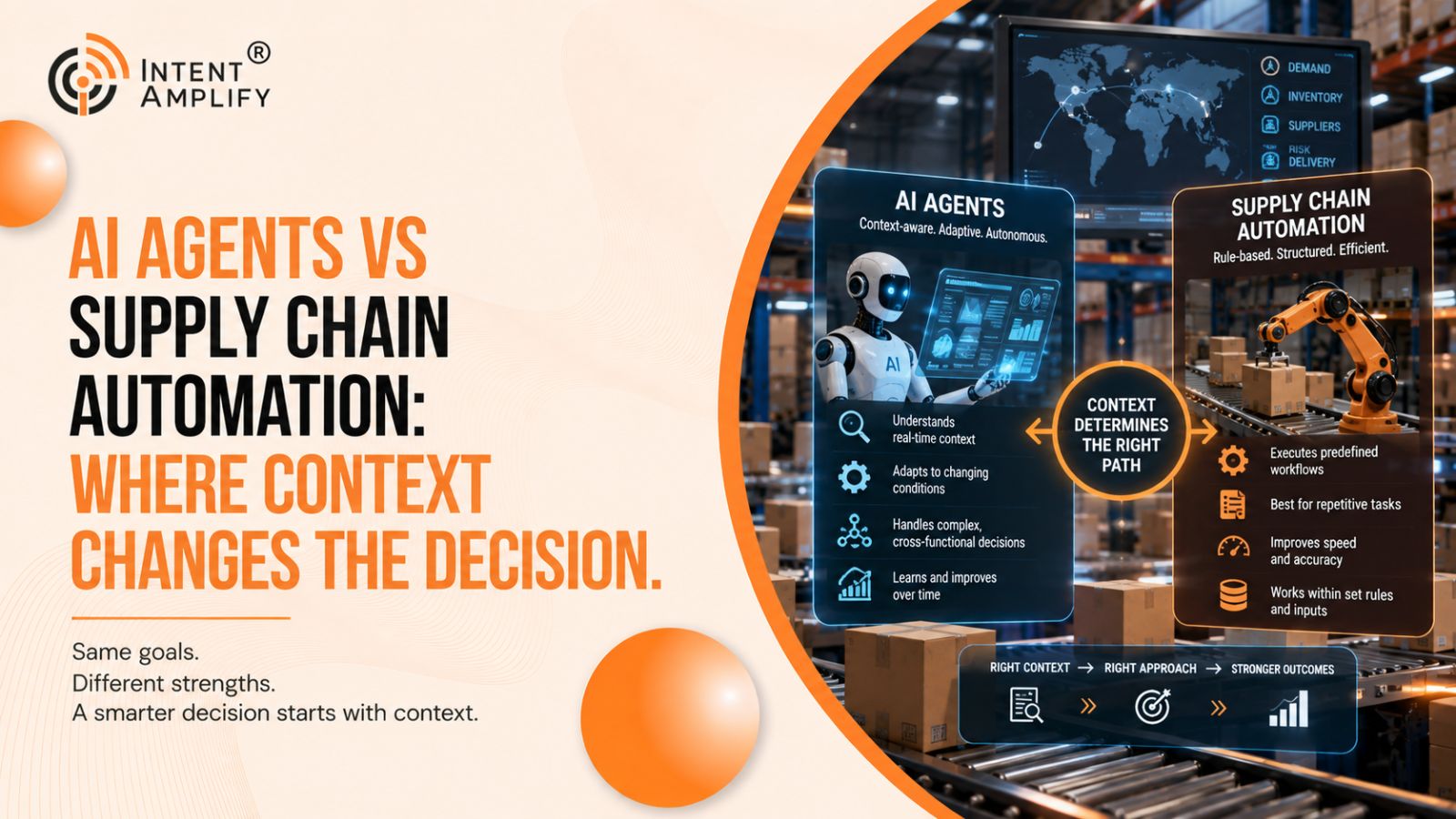
AI Agents vs Supply Chain Automation: Where Context Changes the Decision

AI Agents vs Supply Chain Automation: Where Context Changes the Decision
September 10, 2026 12 min read

Quick Answer

Explore where AI agents add value beyond traditional supply chain automation, how operational context shapes decisions, and when human oversight, recommendation, or bounded execution is the right model.

Supply-chain automation and AI agents are often discussed as though they are points on the same technology spectrum. They are related, but the operational difference is important.

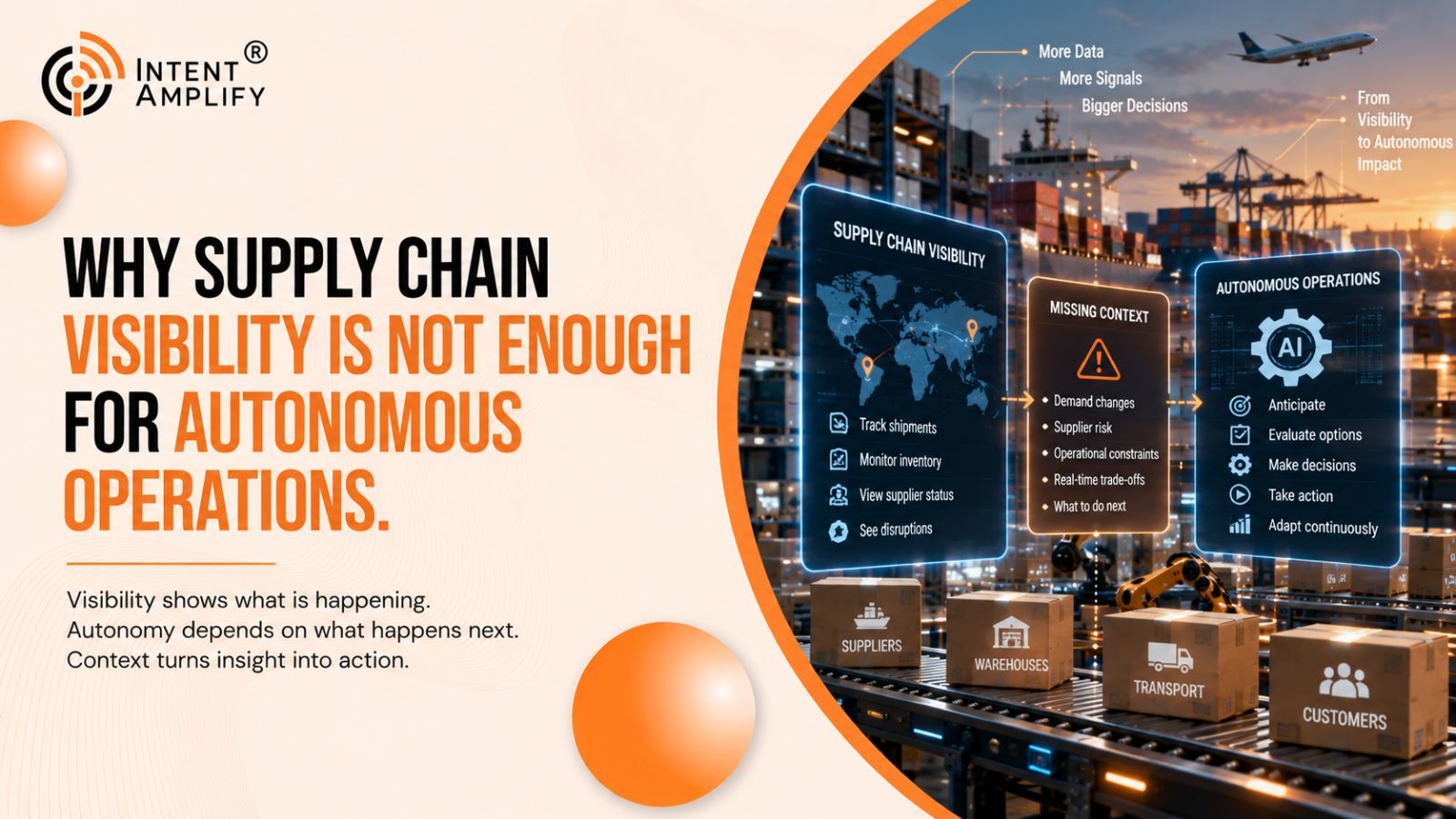
Automation is strongest when the organization already knows what should happen. A rule detects a condition and triggers a predefined response. AI agents become more relevant when the organization needs the system to interpret changing conditions, assemble context, evaluate options, and decide what to recommend or do next.

That shift makes context the dividing line.

AUTOMATION EXECUTES RULES; AGENTS INTERPRET SITUATIONS

A traditional workflow might create an alert when inventory drops below a threshold. An AI agent can potentially go further: determine which production orders are exposed, check inbound supply, identify alternate inventory, evaluate supplier commitments, assess customer priorities, and recommend a response.

The agent is not valuable because it is “more automated.” It is valuable because it can reason across a broader operational situation.

But that advantage only exists when the context is trustworthy. If the agent sees the inventory level but not the production dependency, its recommendation can be incomplete. If it sees the transport delay but not the customer commitment, it may optimize cost while creating service risk. If it sees supplier performance but not contractual or qualification constraints, it may suggest an option the business cannot use.

This is why operational AI requires a different design discipline from conventional automation.

WHERE AUTOMATION REMAINS THE RIGHT CHOICE

Not every workflow needs an agent. Deterministic automation remains highly effective for stable, repeatable tasks with clear rules and limited ambiguity.

Examples can include status updates, data synchronization, routine notifications, predefined approvals, standard routing, and other actions where the desired response is already known.

Adding AI to a deterministic workflow can increase complexity without creating additional business value. Leaders should therefore begin with the operating problem, not the technology category.

Ask: Does the workflow require interpretation? Does the correct response change with context? Are there multiple valid options? Do exceptions require reasoning across several systems or process stages? Does the organization need the system to explain why one action is preferable to another?

When the answer is no, automation may be enough. When the answer is yes, an agentic approach may be worth evaluating.

THE FOUR-LEVEL AUTHORITY MODEL

The most useful way to distinguish agentic participation is by authority.

OBSERVE — The AI monitors, retrieves, summarizes, classifies, or detects. It changes understanding, not the workflow.

RECOMMEND — The AI proposes an action, prioritization, or response. A person decides whether to proceed.

EXECUTE — The AI performs an approved action when defined conditions are satisfied.

ESCALATE — The AI recognizes that uncertainty, material impact, conflicting evidence, or policy requires human judgment.

This model prevents a common mistake: treating technical capability as permission. An agent may be capable of changing an order, reallocating inventory, or initiating an expedite without being authorized to do so.

Authority should be assigned at the workflow step. The same agent can observe in one situation, recommend in another, execute a low-risk action, and escalate a high-impact exception.

CONTEXT CHANGES THE AUTHORITY DECISION

The amount of authority an agent can reasonably receive depends partly on the context available to it.

Imagine a logistics delay. If the agent knows only that a shipment is late, the safest role may be observation or escalation. If it also understands inventory coverage, production dependency, customer commitments, alternative routes, cost thresholds, and service priorities, it can support a more useful recommendation.

Even then, context does not automatically justify autonomous execution. The action may still require human approval because of financial impact, strategic importance, contractual obligations, or another business consideration.

The design principle is therefore: stronger context can support better decisions, but authority must still be explicit.

PROCESS INTELLIGENCE IS THE BRIDGE

Supply-chain data lives across multiple systems. Process intelligence helps connect those records into an operating view of what actually happened, where the process deviated, and how events relate across the workflow.

That process view gives AI a stronger foundation for reasoning. Instead of analyzing isolated fields, the agent can interpret the sequence and dependencies that created the current situation.

It also improves human oversight. A planner or operations leader should be able to see the evidence behind a recommendation: the event, relevant process history, constraints, options, and expected consequences.

This creates a shared context for human and machine decision-making.

THREE DECISIONS TO TEST FIRST

SHORTAGE RESPONSE

Automation can detect that inventory is below a threshold. An agent can assemble affected demand, inbound supply, production priorities, alternate materials, supplier commitments, and response options. The decision becomes less about detecting the shortage and more about selecting the appropriate operational response.

LOGISTICS RECOVERY

Automation can flag a delayed shipment. An agent can connect that delay to service commitments, inventory, production dependency, alternative routes, and cost trade-offs. It can help prioritize which disruptions require intervention.

SUPPLIER EXCEPTION TRIAGE

Automation can identify a late purchase order. An agent can evaluate whether the delay has material downstream consequences and distinguish routine variance from an exception that threatens production or customer commitments.

In each case, context turns a signal into a decision problem.

HUMANS REMAIN PART OF THE OPERATING MODEL

Agentic AI should not be framed as the removal of people from supply-chain decisions. The more useful model is deliberate orchestration.

AI can continuously monitor, assemble information, recognize patterns, summarize, prioritize, and recommend. Humans contribute commercial judgment, supplier relationships, negotiation, accountability, and the ability to resolve ambiguity.

The handoff should be designed. When an agent escalates, the human should receive the relevant context, actions already taken, options considered, and reason for escalation. A handoff that loses context simply moves the research burden back to the person.

MEASURE DECISION QUALITY, NOT JUST AUTOMATION

A successful agentic workflow should not be judged only by how many tasks were automated.

Measure the process outcome, the quality of the decision, and the behavior of the control model. Did the workflow become faster or more consistent? Were the right exceptions prioritized? How often did humans override recommendations? Did the agent stay inside its authority? Could the organization reconstruct why an action occurred?

These measures help distinguish useful autonomy from automation for its own sake.

THE EXECUTIVE TEST

Before choosing between automation and an AI agent, ask five questions:

1. Is the desired response deterministic or context-dependent?

2. What operational context changes the decision?

3. What level of AI authority is appropriate?

4. Which exceptions require human judgment?

5. What evidence will show whether the workflow improved?

If those questions are clear, the technology decision becomes easier.

A DECISION TREE FOR AUTOMATION VS AGENTS

A practical selection process can begin with the response itself. If the desired response is known in advance, the inputs are reliable, and the workflow has limited ambiguity, deterministic automation is usually the cleaner choice.

If the response changes according to context, ask whether the system primarily needs to help a person understand the situation or whether it needs to participate in the workflow. A copilot or recommendation model can support interpretation while preserving human execution. An agent becomes relevant when the workflow benefits from continuous monitoring, context assembly, coordination, or bounded action.

Next, evaluate consequence. A context-dependent decision can still remain human-owned when the action is high-impact, difficult to reverse, commercially sensitive, or strategically important. The presence of an agent does not require autonomous execution.

This decision tree keeps technology proportional to the operating problem.

WHEN AUTOMATION IS BETTER THAN AN AGENT

Automation has several advantages when the workflow is deterministic. It is easier to specify, test, observe, and explain. The expected action is known. Exceptions can be explicitly routed. The organization does not need a reasoning layer to select among several valid options.

This makes automation particularly useful for routine process steps such as notifications, data synchronization, standard routing, or predefined status changes. These actions can be important without requiring AI interpretation.

Leaders should resist the assumption that replacing a rule with an agent automatically modernizes the process. If the business already knows the correct action, additional reasoning can create unnecessary complexity.

The strongest architecture can combine deterministic automation with agentic reasoning where each is appropriate.

WHEN AN AGENT ADDS DISTINCT VALUE

An agent adds more value when the workflow contains ambiguity that cannot be captured efficiently through a simple rule set. The system may need to assemble information from several process stages, interpret the significance of an exception, compare options, or coordinate steps according to changing conditions.

Shortage response is one example. The right action can depend on production priority, inbound supply, inventory coverage, alternative materials, supplier commitments, logistics options, and customer consequences. The response is not simply “inventory below threshold, therefore expedite.”

An agent can help synthesize the situation and recommend a response. The organization can then decide whether any part of the action should be executed automatically or remain subject to human approval.

The value is contextual reasoning, not automation volume.

THE ROLE OF REVERSIBILITY

Reversibility should influence whether an agent receives execution authority. An action that can be detected and reversed quickly creates a different risk from one that becomes consequential after a supplier, carrier, plant, system, or customer responds.

A change can be reversible in software but difficult to reverse operationally. A purchase-order update can trigger supplier action. A routing instruction can commit transport capacity. An inventory movement can begin physically before the digital record is changed again.

Leaders should therefore ask when the action becomes difficult to unwind, what downstream effects it creates, and how an incorrect action would be detected. High reversibility can support bounded execution. Low reversibility generally strengthens the case for approval or escalation.

CONTEXT QUALITY DETERMINES RECOMMENDATION QUALITY

An agent can reason only from the context it receives. More data is not necessarily better context. The workflow needs trusted information with clear operational meaning.

For a logistics decision, shipment status may be insufficient without inventory coverage, production dependency, customer commitment, route alternatives, and cost thresholds. For a supplier decision, performance history may be insufficient without order criticality, alternate supply, qualification rules, and commercial constraints.

Teams should identify the minimum trusted context for the decision and define what happens when that context is missing or contradictory. An agent should not silently convert uncertainty into confident execution.

This is one of the clearest differences between designing a conventional automated rule and designing an agentic workflow.

AUTOMATION AND AGENTS CAN WORK TOGETHER

The choice is not always automation or agent. Many effective workflows can use both.

Automation can handle deterministic steps such as event ingestion, data movement, notifications, standard approvals, and execution of predefined actions. An agent can interpret the situation, assemble context, prioritize exceptions, and recommend which predefined path should be used.

The agent does not need to replace the existing automation layer. It can provide reasoning around it. This reduces the need to rebuild stable process steps while adding contextual intelligence where it creates value.

The architecture should make the boundary visible. Teams should know which actions are deterministic, which depend on AI reasoning, and where human judgment remains decisive.

DESIGNING THE ESCALATION PATH

An agentic workflow should be designed to stop well. Escalation is not a fallback added after deployment. It is a core operating capability.

The agent should escalate when required context is missing, evidence conflicts, the action exceeds a threshold, the situation falls outside the permitted scope, or the decision requires human judgment. The trigger should be specific enough to test.

When escalation occurs, the human should receive the work already completed: event summary, process history, material constraints, options considered, actions already taken, and reason for escalation. This preserves the speed benefit of AI while keeping accountability with the correct owner.

A generic “send to human” step is not sufficient if the person must rebuild the case.

WHAT TO DO WITH HUMAN OVERRIDES

Overrides are useful operating evidence. If humans repeatedly reject the same class of recommendation, the organization should investigate why.

The issue may be missing context, poor data, an incomplete business rule, a changed process, or a difference between the authority model and actual business practice. The answer is not automatically to retrain the AI or remove the human check.

Where practical, capture a lightweight reason for the override and review patterns. Repeated human decisions can reveal where the workflow needs better context or a different division of responsibility.

This creates a learning loop between people and the agentic system.

A PORTFOLIO OF OPERATING MODELS

A supply chain does not need one answer to the automation-versus-agent question. Different workflows can use different operating models.

A routine status process can be fully automated. A high-volume exception queue can use AI prioritization. A logistics recovery workflow can use agent recommendations with human approval. A low-impact reversible update can support bounded execution. A strategic supplier decision can remain human-owned while AI assembles the evidence.

This mixed portfolio is a strength when the operating model matches the decision. It prevents the organization from forcing every workflow toward the same autonomy target.

HOW TO PILOT AN AGENT WITHOUT OVERCOMMITTING

Select one bounded decision where context-dependent reasoning creates clear operational friction. Map the current process and establish the minimum trusted context. Define the initial AI role and human owner.

Start with monitoring, context assembly, prioritization, or recommendation where appropriate. Instrument the workflow so teams can review process outcomes, recommendation acceptance, overrides, escalations, and context gaps.

Only consider execution for a specific action when the evidence shows that the process is stable, required context is dependable, exceptions can be detected, and the consequence is controlled.

This approach creates learning without making full autonomy a prerequisite for value.

THE AUTOMATION-TO-AGENT MATURITY PATH

A workflow can evolve without following a rigid maturity model. One useful sequence is deterministic automation for known steps, AI assistance for information synthesis, agent recommendation for context-dependent decisions, and bounded execution for specific actions supported by evidence.

The sequence can stop at any stage. A high-impact decision may remain recommendation-only indefinitely. A deterministic process may never need an agent. A workflow can also move backward if operating conditions change.

The objective is not progression for its own sake. It is the operating model that produces dependable decisions with clear accountability.

THE FINAL EXECUTIVE CHECK

Before approving an agentic approach, leaders should be able to explain why deterministic automation is insufficient, what context the agent will use, which action it may take, what remains human-owned, how exceptions are escalated, how outcomes are observed, and what evidence would justify any increase in authority.

If those answers are unclear, the organization has not yet defined the operating problem precisely enough to choose the technology.

CONCLUSION

AI agents are not simply more powerful automation. They represent a different operating model in which software can interpret context and participate in decisions.

That makes context, authority, human orchestration, and evidence essential design requirements.

Use automation where rules are stable and the correct action is known. Use agentic AI where the business needs interpretation across a changing operational situation. And in both cases, keep the decision tied to a real process outcome.

Join the September 17 webinar, “Operational AI in the Supply Chain: How Context Empowers Agents and Humans to Operate Side by Side,” to explore how operational context changes what AI agents can responsibly contribute across supply-chain workflows.

Register Now

REFERENCES 

1. Celonis — Supply Chain Transformation: https://www.celonis.com/solutions/supply-chain-transformation/ 

2. Celonis — Context Model: https://www.celonis.com/platform/context-model 

3. Celonis — Enterprise AI: https://www.celonis.com/solutions/ai 

4. NIST — Artificial Intelligence Risk Management Framework (AI RMF 1.0): https://www.nist.gov/publications/artificial-intelligence-risk-management-framework-ai-rmf-10 

5. NIST — Generative AI Profile (NIST AI 600-1): https://www.nist.gov/publications/artificial-intelligence-risk-management-framework-generative-artificial-intelligence 

Contact
Sales