
Blog

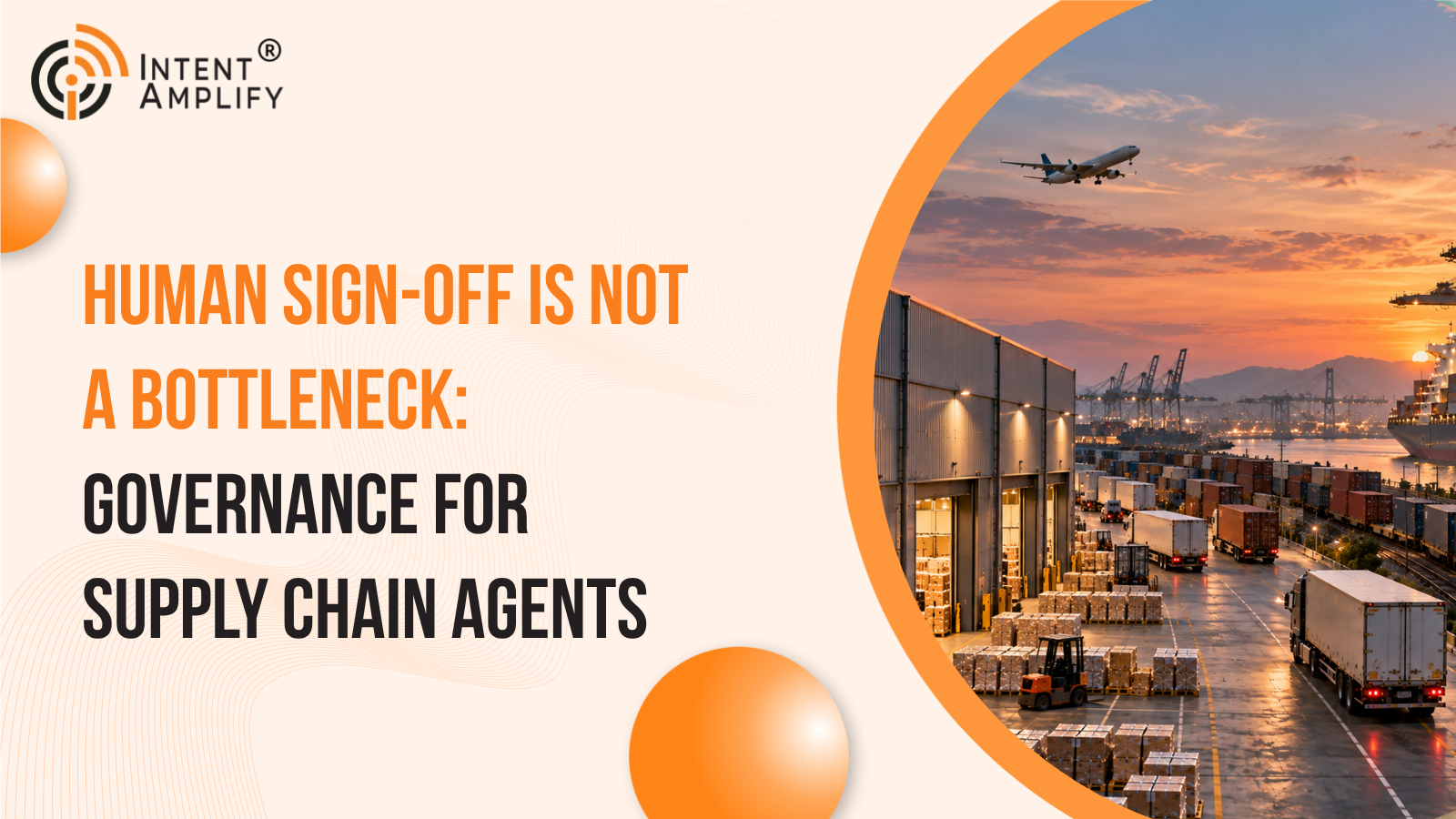
Human Sign-Off Is Not a Bottleneck: Governance for Supply Chain Agents

September 30, 2026 6 min read

Quick Answer

Explore how supply chain leaders can govern agentic AI with human sign-off, bounded authority, decision rights, audit trails, and measurable controls without creating unnecessary operational friction.

Agentic AI changes the supply-chain governance question because an intelligent system may do more than analyze. It can investigate signals, call approved tools, compare scenarios, prepare recommendations, route work, and potentially execute permitted actions.

That expanded capability makes human oversight more important, not less.

The DataRobot and Supply Chain Now on-demand webinar, $2.5B in 72 Hours: What Agentic AI Looks Like When It Actually Works, presents production-oriented examples across supplier risk, plant operations, and aftermarket service. The session includes a tariff scenario involving $2.5 billion in revenue risk addressed in 72 hours rather than weeks, while retaining human sign-off at every step.¹

The operating lesson is not that every decision should remain manual. It is that decision rights should be designed deliberately. Human approval can be a control architecture that allows agentic workflows to move faster inside clear boundaries.

Governance Begins with Decision Classes

Not every supply-chain action carries the same consequence.

Reading a supplier record is different from changing a purchase order. Recommending an alternative source is different from committing spend. Flagging a plant bottleneck is different from resequencing production. Identifying a warranty pattern is different from authorizing a field-service action.

A practical governance model separates permissions to read, analyze, recommend, approve, execute, and verify.

This prevents two common design errors. The first is excessive autonomy, where a system receives authority before the organization has established evidence standards and escalation rules. The second is excessive friction, where every action is routed through the same approval queue regardless of consequence.

The goal is bounded authority: enough permission to remove avoidable delay without allowing accountability to disappear.

Human Oversight Can Increase Decision Speed

Human approval is often treated as the opposite of automation. In a well-designed workflow, the two can reinforce each other.

If the system has already assembled the relevant evidence, checked freshness, compared permitted options, exposed assumptions, and identified the required approver, the human decision can happen with less investigation.

The webinar's 72-hour example is useful precisely because human sign-off remained part of the process.¹ The agentic workflow is not positioned as replacing accountable leadership. It is positioned as compressing the work required to reach an informed decision.

For executives, the design question becomes: where does human judgment materially improve the decision, and where can policy safely govern progression?

Use Consequence and Reversibility to Set Boundaries

A simple governance framework can begin with two questions: how consequential is the action, and how difficult is it to reverse?

Low-consequence, easily reversible actions may operate with lighter approval requirements. Higher-impact actions affecting supplier commitments, production schedules, customer promises, financial exposure, regulated records, or safety-relevant operations deserve stronger review.

Evidence quality should also influence authority. If the workflow is operating on incomplete, stale, or conflicting information, escalation should increase rather than decrease.

DataRobot's manufacturing positioning emphasizes the ability to rank sourcing, inventory, and production responses and execute approved actions in enterprise systems.² The word approved is important. Production value depends on connecting intelligence to authority, not simply connecting intelligence to an API.

Build the Audit Trail into the Workflow

Governance should not be reconstructed after an incident. The workflow should create its own evidence trail.

For every material case, preserve the trigger, sources consulted, freshness checks, assumptions, recommendation, policy checks, approval, executed action, and verified result.

That record serves several purposes. It allows business owners to understand why a recommendation was made. It helps technical teams diagnose failed actions. It shows where approvals create delay. It reveals which recommendations are routinely rejected. It also creates evidence for deciding whether a particular workflow is ready for broader autonomy.

DataRobot's 2026 Unmet AI Needs Survey reports widespread Day 2 operational issues after organizations deploy agentic AI, reinforcing why post-deployment governance and operational control matter.³

Design for Failure Before Expanding Autonomy

A production agent should be tested against the conditions most likely to break the normal path.

What happens when supplier data is stale? What if two systems disagree? What if an approver is unavailable? What if an API call fails after approval? What if the same event arrives twice? What if the downstream system accepts the request but the expected operational result does not occur?

The workflow should fail visibly and safely. It should preserve the case, expose the exception, prevent unauthorized progression, and route the issue to the appropriate owner.

This is especially important when AI-supported decisions approach physical operations. DataRobot's collaboration with Chevron on agentic AI for autonomous inspections illustrates the broader move toward agentic systems operating in environments where operational standards and real-world consequences matter.⁴

Governance Requires Named Ownership

An agent should never become the place where accountability disappears.

Every production workflow should identify the business owner responsible for the outcome, the policy owner responsible for decision rules, the technical owner responsible for integrations and access, and the operational owner responsible for exceptions.

Those roles may sit in different functions. That is normal. Supply-chain decisions often cross procurement, planning, manufacturing, logistics, finance, IT, and service.

The governance model should therefore make ownership visible at each stage rather than assuming the technology team owns the entire process.

Measure Whether Governance Is Working

A governance program should be measurable.

Track approval cycle time, escalation frequency, rejected recommendations, failed executions, reopened cases, stale-data exceptions, policy violations, and human overrides. These measures can show where the workflow is too permissive, too restrictive, or dependent on weak evidence.

The purpose is not to minimize human involvement at all costs. A high override rate may indicate poor recommendations, but a low override rate does not automatically prove the workflow is safe. Measures need to be interpreted alongside consequence, evidence quality, and business outcomes.

Supply Chain Now's discussion of scaling agentic AI from pilots to performance emphasizes the need to connect AI adoption to operational discipline and enterprise execution.⁵

Conclusion

Human sign-off is not inherently a bottleneck. Poorly designed approval processes are.

Agentic AI can reduce the investigative burden that makes approvals slow while preserving accountable authority for decisions with material consequences. The strongest operating model separates permissions, sets boundaries according to consequence and reversibility, exposes weak evidence, records the full decision trail, and verifies what happened after execution.

For supply-chain leaders, governed autonomy is not a compromise between speed and control. It is the discipline required to pursue both.

Watch the on-demand webinar: $2.5B in 72 Hours: What Agentic AI Looks Like When It Actually Works.

Connecting Agentic AI Innovation with Enterprise Decision Makers

For organizations bringing agentic AI, supply-chain intelligence, or decision-orchestration solutions to market, Intent Amplify helps translate technical capability into executive-ready demand generation.

Our work supports B2B technology brands with content strategy, audience intelligence, executive messaging, account-based engagement, and pipeline activation designed for complex enterprise buying cycles.

References

1. Supply Chain Now, $2.5B in 72 Hours: What Agentic AI Looks Like When It Actually Works, September 3, 2026

https://supplychainnow.com/2-5b-in-72-hours-what-agentic-ai-looks-like-when-it-actually-works/ 

2. DataRobot, AI for Manufacturing, 2026

https://www.datarobot.com/solutions/manufacturing/ 

3. DataRobot, The Unmet AI Needs Survey 2026, 2026

https://www.datarobot.com/resources/unmet-ai-needs-survey-2026/ 

4. DataRobot, DataRobot and Chevron Collaborate to Advance Agentic AI for Autonomous Inspections, June 2, 2026

https://www.datarobot.com/newsroom/press/datarobot-and-chevron-collaborate-to-advance-agentic-ai-for-autonomous-inspections/ 

5. Supply Chain Now, From AI Pilots to Performance: How Supply Chain Leaders Are Scaling Agentic AI, June 11, 2026

https://supplychainnow.com/ai-pilots-to-performance-how-supply-chain-leaders-scaling-agentic-ai/