
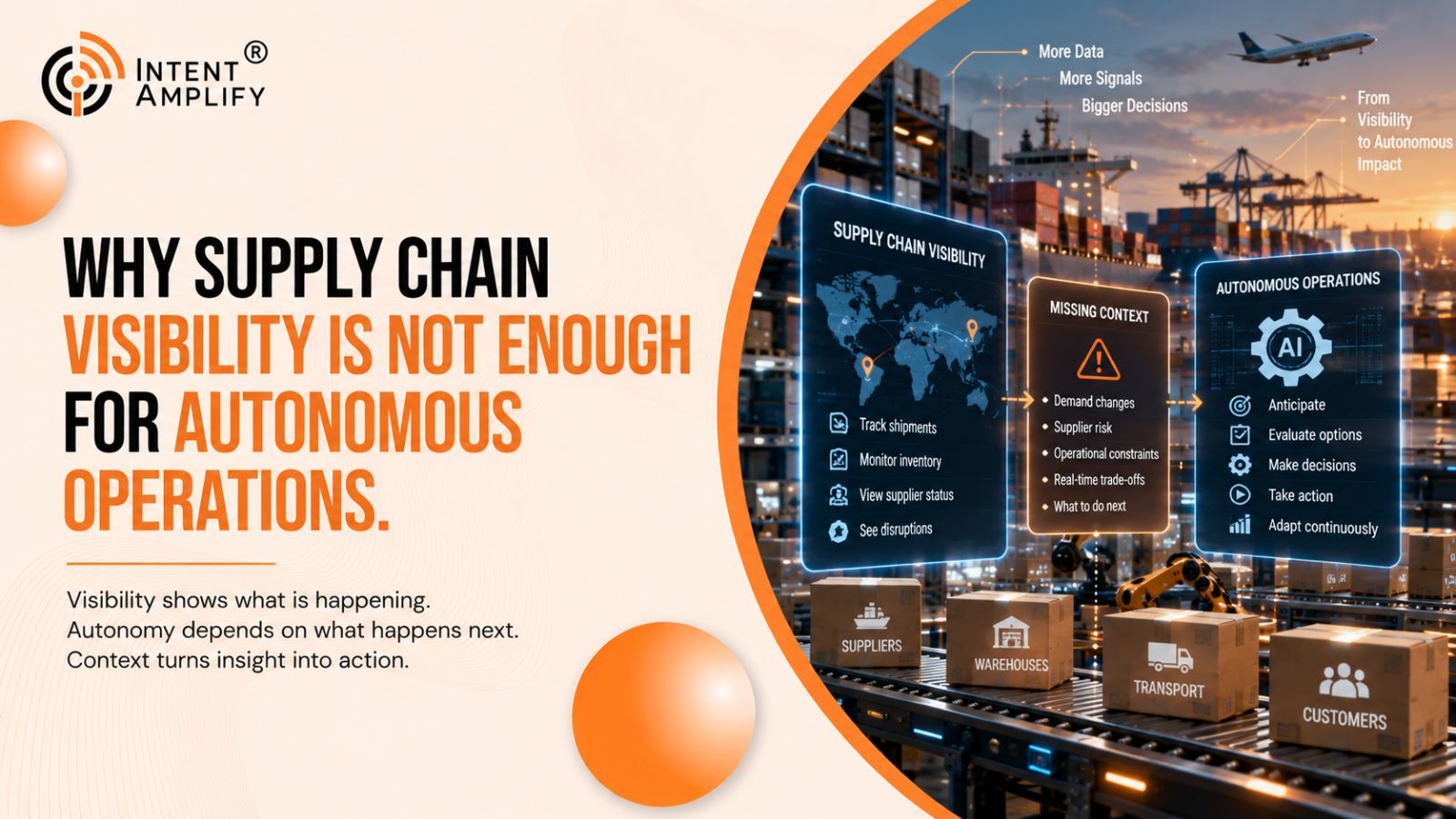
Supply-chain visibility has become a foundational capability. Leaders want earlier awareness of delays, shortages, inventory exposure, supplier issues, and execution risk. But seeing an event and knowing what to do about it are different problems.
That gap becomes critical as organizations explore autonomous supply chain operations.
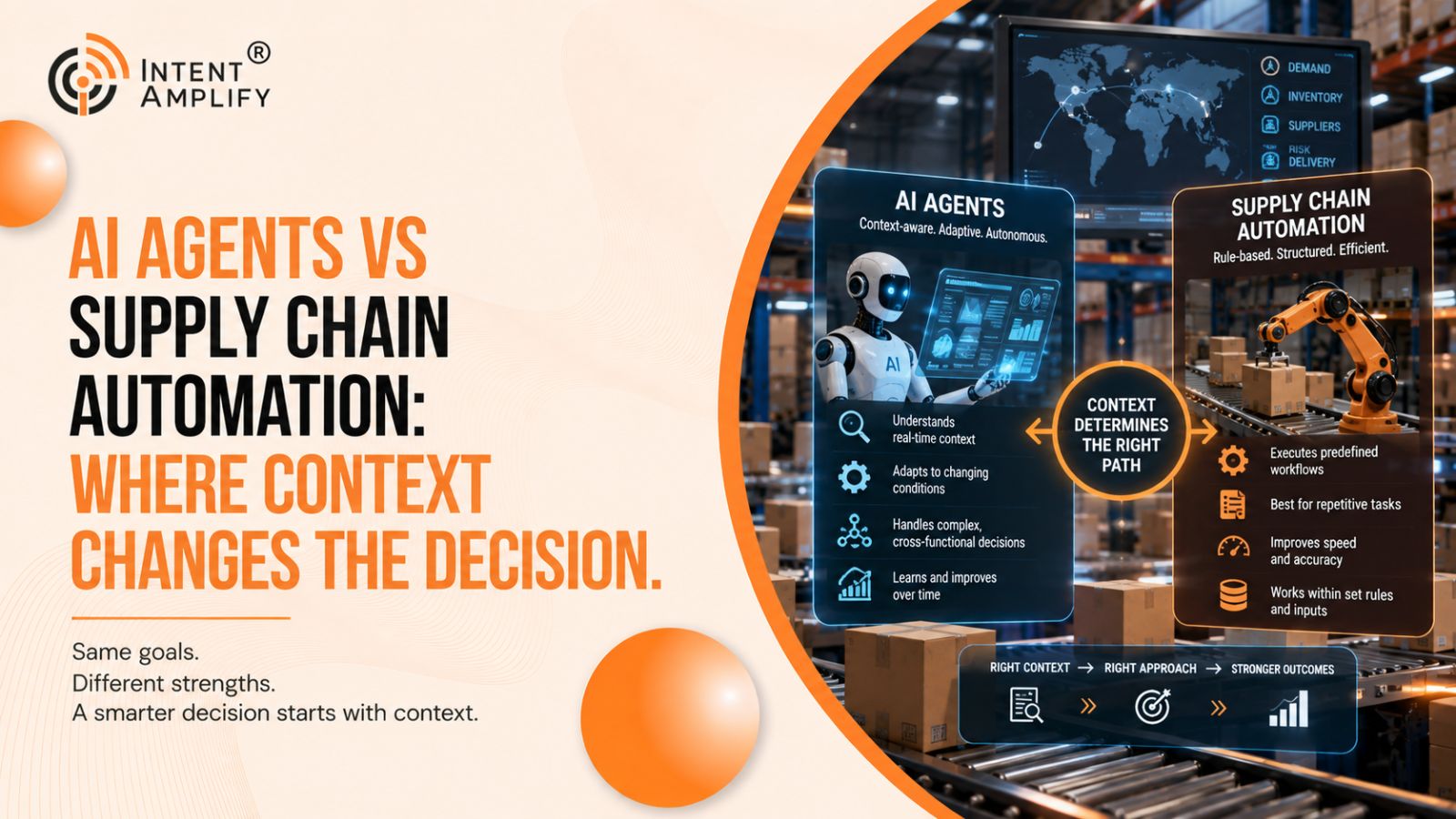
A visibility platform can tell a team that a shipment is delayed. An autonomous or agentic workflow must determine whether the delay matters, what other processes are affected, which options are available, what action is permitted, and when a human needs to intervene.
The difference is operational context.
VISIBILITY ANSWERS “WHAT?” CONTEXT ANSWERS “SO WHAT?”
A late shipment is data. Its operational meaning depends on the surrounding situation.
Is the material required for a constrained production order? Is alternate inventory available? Is the customer commitment flexible? Can the route be changed? Is expediting permitted within the cost threshold? Is the supplier already managing another exception? Does the decision affect a strategic account or critical production line?
Visibility exposes the signal. Context explains the consequence.
Autonomous operations require the second layer because an AI agent cannot make a dependable decision from an alert alone.
WHY MORE DATA DOES NOT SOLVE THE PROBLEM
The instinctive response to missing context is often to connect more data. That can help, but quantity is not the same as decision quality.
Supply-chain information is distributed across ERP, planning, procurement, manufacturing, warehouse, transportation, supplier, and analytics systems. These sources can conflict, update at different speeds, and use different business definitions.
An agent needs to know not only what data exists, but which source is authoritative for the decision, how current it is, what process state it represents, and what to do when the evidence is incomplete.
The operating requirement is therefore decision-grade context: the minimum trusted information and relationships required to interpret the situation correctly.
PROCESS INTELLIGENCE CONNECTS EVENTS TO THE REAL WORKFLOW
Process intelligence helps organizations understand how work actually flows across systems and where deviations occur. Instead of treating each event as isolated, it connects the sequence of activities that produced the current state.
That matters for autonomous operations because many supply-chain decisions are path-dependent. The right response depends on what has already happened, which exceptions are open, which commitments were made, and how upstream and downstream processes are connected.
For people, this context reduces the time spent reconstructing the situation. For AI, it provides a stronger basis for reasoning.
AUTONOMY REQUIRES AN AUTHORITY MODEL
Even with excellent context, an AI agent should not automatically be allowed to take every technically possible action.
A practical authority model distinguishes four roles:
Observe — monitor, retrieve, summarize, classify, detect.
Recommend — propose an action for human review.
Execute — perform an approved action within defined conditions.
Escalate — transfer responsibility when uncertainty, impact, or policy requires judgment.
This model makes autonomy specific. A workflow can be highly autonomous for routine, reversible actions while retaining human approval for high-impact exceptions.
The key principle is that technical capability does not equal business permission.
THREE EXAMPLES OF THE VISIBILITY-TO-ACTION GAP
INVENTORY EXPOSURE
Visibility can show inventory below target. Context determines whether the shortage is material by connecting demand, inbound supply, production priorities, substitute materials, service commitments, and replenishment options. An agent can then prioritize the issue and recommend a response rather than simply generate another alert.
LOGISTICS DISRUPTION
Visibility can show a delayed shipment. Context connects that delay to inventory coverage, production dependency, customer impact, route alternatives, and cost thresholds. The operating decision may be to monitor, reroute, expedite, communicate, or escalate.
SUPPLIER PERFORMANCE
Visibility can show late deliveries or quality variance. Context determines whether the exception threatens production, whether alternatives exist, whether contractual or qualification constraints apply, and which team owns the next action.
In each case, the signal is only the beginning.
HUMAN JUDGMENT IS PART OF AUTONOMOUS OPERATIONS
Autonomous operations should not be interpreted as operations without people. A more practical objective is to automate what can be reliably bounded while improving the quality and speed of human judgment where ambiguity remains.
AI can continuously monitor, assemble context, detect patterns, prioritize, and recommend. Humans can handle negotiation, commercial trade-offs, novel exceptions, strategic relationships, and decisions where accountability must remain explicit.
A strong human handoff preserves the work already done by the AI. The person should receive the relevant event history, process context, constraints, options, and reason for escalation.
If the human must start from zero, the workflow is not truly orchestrated.
OBSERVABILITY MAKES AUTONOMY GOVERNABLE
Autonomous actions should leave evidence.
An authorized reviewer should be able to understand what triggered the workflow, which context was used, what the agent recommended or executed, whether a human intervened, and what outcome followed.
This does not mean retaining unlimited information. Evidence should be appropriate to the use case and governed by the organization’s data, security, and retention requirements.
The goal is operational reconstructability: enough visibility into the decision path to improve the process and investigate material exceptions.
MEASURE THE OUTCOME, NOT THE NUMBER OF AGENTS
Agent count is not a business outcome. Automation volume is not a business outcome.
Measure whether the workflow improves the operating result. Depending on the use case, that may involve cycle time, exception backlog, delay, rework, throughput, service exposure, inventory impact, recommendation acceptance, override patterns, or escalation quality.
Control evidence should also show whether the agent remained within its permissions and escalated appropriately.
A faster workflow that produces worse downstream decisions is not progress.
HOW TO MOVE FROM SUPPLY CHAIN VISIBILITY TO CONTROLLED ACTION
- Step 1 — Select one bounded operational decision.
- Step 2 — Map the end-to-end process and exception paths.
- Step 3 — Define the minimum trusted context.
- Step 4 — Identify authoritative sources and data gaps.
- Step 5 — Set AI authority at each workflow step.
- Step 6 — Design human escalation and context transfer.
- Step 7 — Define process, decision, and control evidence.
- Step 8 — Pilot assisted execution.
- Step 9 — Review exceptions and overrides.
- Step 10 — Expand scope or authority only from evidence.
This sequence moves the organization from visibility to controlled action without assuming that every workflow should become fully autonomous.
FROM SUPPLY CHAIN VISIBILITY TO DECISION ORCHESTRATION
The next stage beyond supply chain visibility is not simply faster alerting. It is decision orchestration: connecting the signal to the process, assembling the relevant context, identifying the accountable owner, determining the permitted response, and observing the outcome.
This distinction matters because many visibility investments stop at detection. They surface a shortage, delay, deviation, or supplier issue and then hand the problem to a person. The person must open multiple applications, reconstruct the sequence of events, validate the current state, identify affected commitments, and decide what can be done. The alert may arrive quickly while the decision remains slow.
A context-aware operating model changes that sequence. The workflow can detect the event, connect it to the process path that produced it, assemble the minimum trusted evidence, and prepare the decision before human attention is required. For lower-impact cases, the same workflow may support recommendation or bounded execution when authority is explicit.
The objective is not to remove people from the process. It is to reduce the amount of manual reconstruction required before a person or agent can make a useful decision.
DECISION-GRADE CONTEXT HAS TO BE DESIGNED
Operational context should not be treated as an accidental by-product of integration. It has to be designed around the decision.
For each priority workflow, leaders should identify the triggering event, the business decision that follows, the minimum information required to interpret the situation, the relationships that can change the answer, and the constraints that limit the response. They should also identify which system or business source is authoritative for each material input.
This approach prevents a common mistake: giving an AI system broad access to enterprise data without defining what information actually matters. More records can increase retrieval volume without increasing decision quality. The agent may have access to many facts while still lacking the specific process relationship that determines whether an exception is important.
Decision-grade context is therefore selective. It is not a complete replica of the enterprise. It is the smallest reliable operating picture that allows the workflow to understand what happened, why it matters, what options exist, and where responsibility sits.
For a production shortage, that picture may include current and inbound inventory, demand priority, production sequence, supplier commitments, substitutes, qualification rules, transport options, and customer obligations. For a logistics disruption, it may include inventory coverage, downstream production dependency, service commitments, route alternatives, carrier constraints, and approved cost thresholds.
The exact context is workflow-specific. The design principle is consistent: connect only what materially changes the decision, but connect it well enough that the decision can be defended.
AUTONOMY SHOULD FOLLOW REVERSIBILITY AND CONSEQUENCE
Not all executable actions carry the same operational risk. One of the most practical ways to distinguish them is to evaluate consequence and reversibility.
A low-impact action that can be detected and reversed quickly creates a different authority requirement from an action that commits inventory, changes a supplier instruction, affects production, incurs premium freight, or changes a customer promise. Even when the reasoning is simple, the consequence may justify human approval.
Reversibility must be evaluated across the full process, not only inside the originating application. A transaction may be technically editable while becoming difficult to unwind after another system, supplier, carrier, plant, or customer acts on it. That is why authority design should consider what happens downstream after the action leaves the agent’s immediate control.
For each executable step, leaders should ask: When does this action become difficult to reverse? How would an incorrect action be detected? Who can stop or correct it? Which downstream commitments may already have changed by the time the error is discovered?
These questions create a stronger basis for deciding whether an agent should execute, recommend, or escalate. They also allow organizations to expand autonomy selectively instead of assigning one autonomy level to an entire process.
THE HUMAN HANDOFF SHOULD BE DECISION-READY
Human escalation is often described as a safety mechanism, but its quality also determines operating speed. A poorly designed handoff can preserve accountability while recreating the same delays that automation was intended to reduce.
A decision-ready handoff should transfer the work already completed. The receiving person should see the triggering event, relevant process history, affected orders or commitments, material constraints, authoritative evidence, actions already taken, options considered, and the reason the agent stopped.
The handoff should also make ownership explicit. A supplier-commercial exception may belong with procurement. A production consequence may require planning or operations. A customer-impacting decision may require a commercial or service owner. A data conflict may require a different path from a policy exception.
Generic escalation queues can preserve oversight, but they can also obscure responsibility. Routing should reflect the type of decision that remains open.
The reverse handoff matters as well. When a human approves, rejects, or changes an AI recommendation, that decision can become operating evidence. Repeated overrides may reveal missing context, an incomplete rule, a new process variant, or an authority boundary that is too broad or too narrow.
This creates a learning loop in which human judgment improves the design of the process rather than sitting outside it.
A PRACTICAL MATURITY PATH FOR AUTONOMOUS SUPPLY CHAIN OPERATIONS
Organizations do not need to jump from visibility to full execution. A more defensible maturity path moves through increasingly demanding operating roles.
The first stage is visibility: detect and surface material events. The second is context assembly: connect the event to process history, dependencies, constraints, and ownership. The third is recommendation: evaluate permitted options and prepare a decision for human review. The fourth is bounded execution: allow specific low-impact actions when explicit conditions are satisfied. The fifth is adaptive orchestration: coordinate human and agent roles across a workflow while continuously reviewing evidence, exceptions, and authority.
Progress should not be measured by whether the organization reaches the final stage everywhere. Some workflows may remain at recommendation because the consequences are high or judgment is strategic. Others may support execution because the decision is stable, the context is dependable, the action is reversible, and outcomes are observable.
A mixed portfolio is a sign of disciplined operating design. Inventory status updates, supplier negotiations, production reallocations, transport recovery decisions, and customer commitments do not need the same autonomy model.
The strongest autonomy strategy is therefore decision-specific. It expands responsibility only where process evidence supports the change and keeps human ownership where consequence, ambiguity, or accountability requires it.
CONCLUSION
Supply-chain visibility is necessary, but it is not the destination. Autonomous operations require the ability to interpret events inside the process context that gives them meaning.
That means connecting data to workflow history, dependencies, constraints, authority, human ownership, and measurable outcomes.
The organizations that succeed with operational AI will not simply see more. They will create a disciplined path from seeing to understanding, from understanding to deciding, and from deciding to acting.
Join the September 17 webinar, “Operational AI in the Supply Chain: How Context Empowers Agents and Humans to Operate Side by Side,” to explore how operational context can help organizations move beyond visibility toward dependable human-and-agent execution.
REFERENCES
1. Celonis — Supply Chain Transformation: https://www.celonis.com/solutions/supply-chain-transformation/
2. Celonis — Context Model: https://www.celonis.com/platform/context-model
3. Celonis — Enterprise AI: https://www.celonis.com/solutions/ai
4. NIST — Artificial Intelligence Risk Management Framework (AI RMF 1.0): https://www.nist.gov/publications/artificial-intelligence-risk-management-framework-ai-rmf-10
5. NIST — Generative AI Profile (NIST AI 600-1): https://www.nist.gov/publications/artificial-intelligence-risk-management-framework-generative-artificial-intelligence