
logo
logo
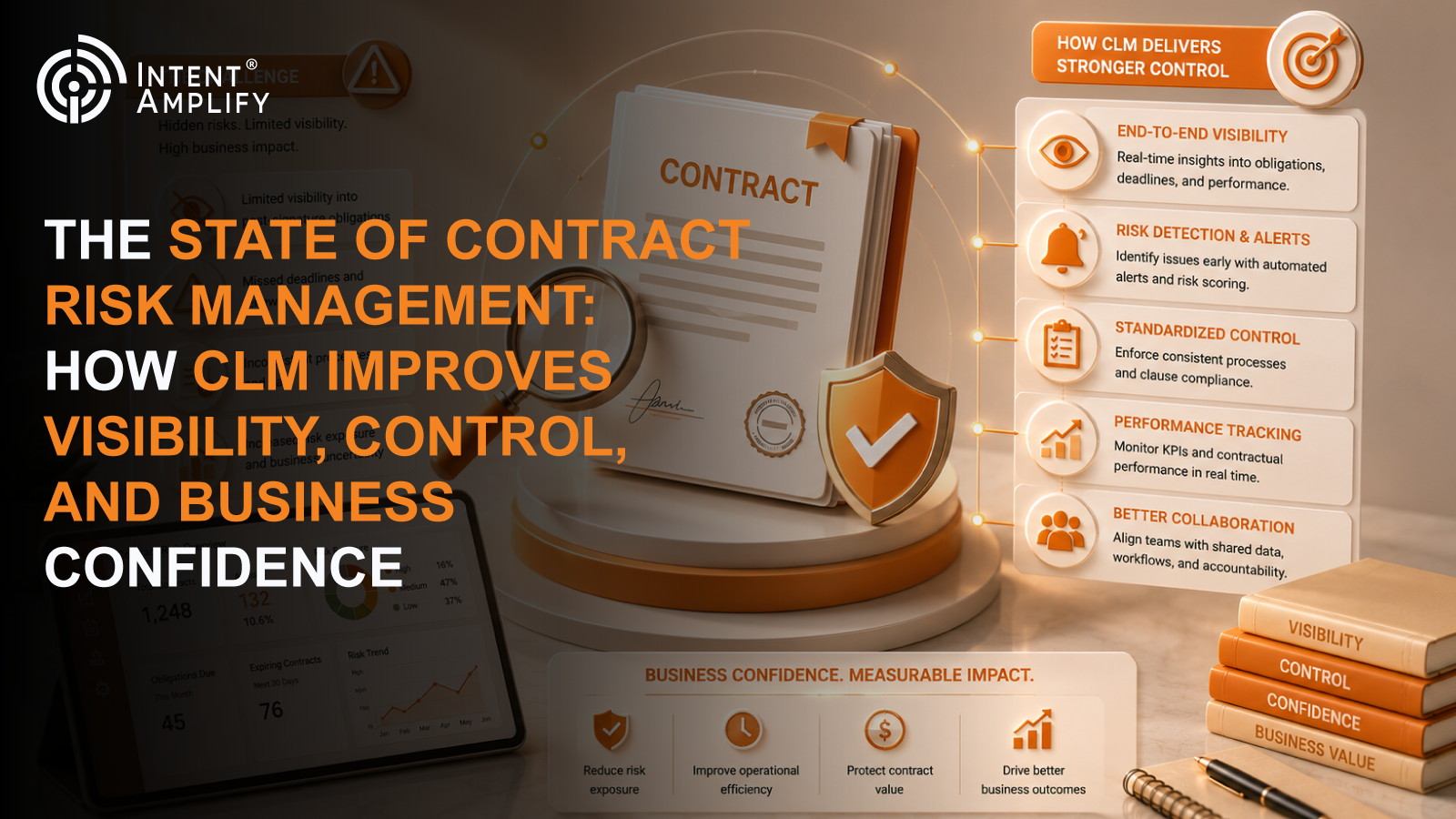
The State of Contract Risk Management: How CLM Improves Visibility, Control, and Business Confidence

REPORT

The State of Contract Risk Management: How CLM Improves Visibility, Control, and Business Confidence

Modern contract risk management requires more than document storage. Discover how CLM improves contract visibility, governance, compliance, risk control, and business confidence through contract intelligence and AI-enabled insights.

Executive Overview: Contract Risk Has Outgrown the Filing Cabinet

Contracts once followed a predictable lifecycle: drafted, negotiated, signed, stored, and revisited only when a dispute, audit, renewal, or compliance issue required attention. That operating model now creates material risk for enterprises that depend on agreements to govern supplier relationships, pricing protections, compliance obligations, renewal rights, liability exposure, service commitments, audit provisions, data requirements, and performance expectations.

Contract risk management has evolved into an enterprise discipline because agreements increasingly shape decisions far beyond the legal function. Across procurement, finance, supply chain, healthcare, technology, energy, manufacturing, financial services, education, and other regulated sectors, contractual obligations influence how organizations assess exposure, manage commitments, protect value, and respond to disruption. Agreements function as operational control mechanisms as much as legal records.

World Commerce & Contracting's 2025 Benchmark Report found that 87% of organizations are operating in conditions of elevated uncertainty and characterized that environment as the new normal. The same report found that 88% of executives recognize the importance of commercial and contract management excellence. The challenge lies in execution. Many enterprises still lack the visibility, automation, and intelligence required to manage risk effectively across the agreement lifecycle.1

This is where contract lifecycle management becomes strategically important because modern CLM software is not just a faster path to signature. At its best, it gives leaders a governed contract repository, searchable contract data, AI-supported contract analytics, obligation tracking, contract dashboards, and the confidence to act before risk becomes damage.

Why Contract Risk Looks Different in 2025

The current state of contract risk management is being shaped by volatility because procurement teams are managing supplier disruption, while legal teams are reviewing risk in a faster and more regulated environment, and finance leaders are monitoring value leakage because every missed term ultimately affects financial performance. Executives also want visibility across enterprise commitments. They expect accurate data, timely answers, and minimal additional burden on already stretched teams.

Deloitte's 2025 Global Chief Procurement Officer Survey, now in its 12th year, gathered insights from more than 250 CPOs across 40 countries and highlighted procurement's role in managing risk while guiding the C-suite through market turbulence and adopting generative AI and agentic AI. This matters because procurement risk does not stay inside sourcing decisions as it flows into vendor contract management, supplier performance management, pricing terms, renewal clauses, and third-party obligations that must be tracked and controlled through better contract lifecycle management.2

Trade volatility makes the shift even clearer because Agiloft's 2025 tariff impact research found that 92% of companies now include tariff-related clauses in contracts, which shows how quickly external disruption becomes a contract data management issue. Tariff clauses affect pricing, supplier relationships, renegotiation rights, pass-through costs, compliance exposure, and termination strategies, so teams need more than a folder of signed agreements if they want to understand which contracts are exposed.3

The same Agiloft research reported that nearly 49% of U.S. organizations and more than 52% of U.K. organizations exited existing supplier relationships due to tariff impacts. Supplier exits are not just procurement events because they create contract renewals, amendments, termination reviews, data transfer concerns, service continuity risks, and compliance questions that can spread across departments before anyone has a clean answer.4

Agiloft also found that 51% of U.S. respondents and nearly 57% of U.K. respondents entered new supplier relationships in unfamiliar markets or regions because of tariff pressures. That expands exposure across new jurisdictions, vendor obligations, commercial terms, and supplier performance requirements, which makes enterprise contract search and contract data extraction far more valuable because leaders need to identify affected agreements quickly rather than waiting for three departments to produce three conflicting spreadsheets.4

The Enterprise Problem: Contract Risk Is Fragmented

Most organizations do not have a contract shortage because what they really have is a contract intelligence shortage. Agreements may live in shared drives, ERP systems, procurement tools, email inboxes, local folders, legacy databases, and business-unit repositories, while legal owns the negotiation history, procurement owns supplier performance, finance tracks savings, compliance monitors obligations, and operations manages delivery. No single team has the full picture, and somehow this has been allowed to pass as governance.

Zefort's 2025 State of Contract Management report found that 71% of companies cannot locate at least 10% of their active contracts, which creates hidden costs, compliance risks, and missed opportunities. That statistic is especially damaging because it shows contract risk often begins before analysis even starts, since an agreement that cannot be found cannot be governed, searched, renewed, enforced, optimized, or trusted.5

Repository maturity plays an important role in effective contract management. Storage alone provides limited value. The greater benefit comes from supporting visibility, search, clause governance, renewal management, compliance monitoring, obligation tracking, and risk reporting across the agreement lifecycle.

Forrester's 2025 CLM commentary notes that post-signature management carries the same importance as pre-signature activity because agreements establish accountability and define recourse. The observation highlights a persistent weakness in enterprise contracting. Signature often marks the end of organizational attention, even though many governance, compliance, operational, and commercial responsibilities begin after execution.6

Visibility: The First Layer of Control

Contract risk management starts with visibility because leaders need to know what contracts exist, where they sit, which agreements are active, what terms they contain, which obligations are due, which suppliers are exposed, and which renewals are approaching. A contract that cannot be found or interpreted is not an asset. It is a future incident with a file name.

CLM software improves contract visibility by centralizing agreements, extracting key terms, indexing clauses, structuring metadata, and enabling enterprise contract search. It allows legal and procurement teams to move from manual contract querying to portfolio-level insight so leaders can use contract dashboards to identify agreements by vendor, business unit, renewal date, contract value, risk category, jurisdiction, clause type, or obligation owner.

Visibility Area

Risk Without CLM

CLM Improvement

Contract location

Agreements scattered across teams and systems

Centralized contract repository

Clause visibility

Risk terms hidden in unstructured files

Searchable clauses and deviation tracking

Obligation visibility

Missed deadlines and unclear ownership

Assigned owners, alerts, and dashboards

Renewal visibility

Accidental renewals or missed negotiations

Automated contract renewals workflow

Supplier visibility

Limited vendor-level exposure insight

Vendor contract management intelligence

Executive visibility

Decisions based on partial data

Contract dashboards and analytics

Visibility also strengthens contract compliance because when teams can search obligations, identify missing clauses, and connect contract data to business owners, compliance becomes less dependent on memory and more dependent on process. A shocking innovation, apparently.

Control: From Contract Awareness to Contract Governance

Visibility identifies exposure. Control determines whether the organization can manage it effectively. Governance begins with standardized workflows for requests, reviews, approvals, negotiations, amendments, renewals, and exceptions. It extends through clause governance, approved fallback language, playbooks, risk-based routing, and escalation procedures for material agreements.

Automation strengthens control by reducing process variability and improving consistency. Low-risk nondisclosure agreements and high-value supplier contracts with tariff exposure, uncapped liability, or performance penalties warrant different review paths, approval requirements, and oversight mechanisms. Risk-based governance aligns scrutiny with business impact.

CLM platforms support control by routing agreements according to risk classification, contract value, counterparty, jurisdiction, clause deviation, and business unit. They can identify non-standard terms, assign review responsibilities, trigger renewal notifications, and surface risk indicators before issues affect operations, procurement, compliance, or finance.

Post-signature governance is equally important. Delivery commitments, reporting requirements, renewal notices, audit rights, service-level obligations, rebate provisions, and compliance activities require clear ownership and accountability. Organizations that fail to assign and monitor those responsibilities often struggle to realize negotiated value, maintain compliance, and manage exposure throughout the agreement lifecycle.

Business Confidence: The Strategic Outcome

Business confidence comes from trusted contract data because executives do not simply need more contracts completed. They need to know whether the business can trust what those contracts say and whether teams can connect contractual commitments to actual business outcomes.

Icertis' 2025 State of Contracting Report includes insights from more than 10 million contracts managed by Icertis, along with third-party research and industry spotlights. The report frames contracts as performance assets rather than simple legal records, which aligns with the broader shift from paperwork to contract intelligence.7

Icertis also reported that 90% of CEOs and 82% of CFOs believe their companies are leaving money on the table during contract negotiations. That is not only a negotiation problem because it is also a contract performance problem since savings, rebates, pricing protections, service commitments, and renewal opportunities can disappear after signature when terms are not actively tracked.7

The financial risk continues after execution because Icertis' executive insights survey found that businesses lose an average of 9% of an agreement's overall value after signature. That figure makes the post-signature visibility issue painfully concrete because poor contract lifecycle management does not just create legal exposure. It can drain value from agreements that the business has already worked hard to negotiate.8

For executive leaders across legal, procurement, finance, compliance, and operations, business confidence depends on timely access to reliable information.

Which agreements carry elevated risk?

Which obligations are overdue? Which suppliers require attention?

Which renewals are approaching? Which terms affect revenue, cost, or compliance exposure?

Which agreements warrant review because business conditions have changed?

Contract and legal analytics help transform those questions into actionable decisions. Structured agreement data enables organizations to assess exposure, prioritize reviews, allocate resources, and protect business outcomes with greater speed and confidence.

Organizations seeking to strengthen contract visibility, risk management, and AI-enabled contracting should begin by evaluating the quality, accessibility, and governance of their agreement data.

Access the full guide here.

AI for Contracts: Helpful, But Not a Magic Wand

AI for contracts is becoming more relevant because contract portfolios are too large, too complex, and too fragmented for manual review alone. AI contract review can help summarize agreements, identify risky clauses, extract obligations, compare language to playbooks, support contract summarization, and accelerate contract data extraction.

Gartner reported in 2025 that AI and contract analytics had become urgent priorities for general counsel. In a July 2025 survey of 104 general counsel, 36% said they were focused on adopting AI, building AI skills, or improving AI risk management. This shows that contract analytics is moving into the legal leadership agenda rather than sitting quietly on the legal operations wish list.9

Still, AI-enabled CLM only works well when built on reliable contract data management because if the underlying data is scattered, outdated, duplicated, or incomplete, AI simply helps the organization be wrong faster. A thrilling advancement if the goal is automated confusion.

2025 Contract Risk Statistics Snapshot

Statistic

Why It Matters

87% of organizations face high uncertainty

Contract risk management must adapt to volatility rather than wait for stability.

88% of executives recognize CCM excellence matters

Leadership sees the issue, although execution maturity still lags.

71% of companies cannot locate at least 10% of active contracts

Visibility remains a basic but serious risk gap.

92% of companies include tariff-related clauses

External volatility is rewriting contract strategy.

Nearly 49% of U.S. and 52%+ of U.K. organizations exited suppliers due to tariffs

Supplier risk is now deeply contractual.

51% of U.S. and nearly 57% of U.K. organizations entered unfamiliar supplier markets

New supplier relationships create new contract exposure.

250+ CPOs across 40 countries contributed to Deloitte's 2025 survey

Procurement risk is a global executive concern.

Icertis analyzed insights from 10M+ contracts

Contract performance is being studied at enterprise scale.

90% of CEOs and 82% of CFOs see value left on the table

The contract risk is directly tied to financial performance.

9% of agreement value is lost after signature on average

Post-signature governance is a value-protection issue.

36% of GCs are focused on AI adoption, skills, or AI risk management

Legal leaders are prioritizing technology-enabled risk management.

Sources: As per references shown above, Intent Amplify Analysis

What Mature Contract Risk Management Looks Like

Maturity does not mean buying CLM software and declaring victory in a slide deck because it means changing how the organization governs contract data and risk.

Maturity Stage

Description

Business Impact

Reactive

Contracts are stored but not actively governed

Risk appears during disputes, audits, missed renewals, or supplier issues

Visible

Contracts are centralized and searchable

Teams can find agreements, clauses, obligations, and renewal dates

Controlled

Workflows, clauses, approvals, and obligations are governed

Risk is managed consistently across legal, procurement, finance, and operations

Intelligent

Contract data supports analytics, AI, predictive contracting, and business decisions

Leaders use contract intelligence to reduce risk and protect value

The most mature organizations treat contracts as living business assets because they connect contract data to workflows, dashboards, compliance requirements, supplier performance, procurement analytics, and executive decision-making. They also begin to explore predictive contracting and autonomous contract management carefully, not as buzzwords, but as future extensions of governed contract intelligence.

Strategic Implications for Legal, Procurement, Finance, and Leadership

For legal and legal operations teams, CLM improves control over clause management, legal AI use cases, contract compliance, exceptions, approvals, and post-signature obligations. It helps legal shift from reactive review to proactive risk governance.

For procurement and supply chain leaders, CLM strengthens vendor contract management, supplier performance management, renewal control, tariff exposure analysis, and procurement analytics. In unstable markets, supplier terms are not administrative details because they are operating levers.

For finance, CLM improves visibility into negotiated value, renewal exposure, pricing obligations, rebate terms, and revenue or cost leakage. It supports better forecasting because leaders are not relying on partial contract data and optimistic folklore.

For executives, CLM creates a shared contract intelligence layer. It gives leadership a clearer view of commitments, exposure, performance, and risk across the enterprise.

Conclusion: From Contract Risk to Contract Intelligence

The state of contract risk management in 2025 is defined by a visibility and control gap because organizations depend on contracts to govern supplier relationships, revenue commitments, pricing protections, compliance obligations, liability exposure, and operational accountability, while many still lack the contract visibility, contract analytics, and governance workflows needed to manage risk across the full lifecycle.

CLM helps close that gap by centralizing contract data, enabling enterprise contract search, supporting contract automation, tracking obligations, surfacing risk signals, managing renewals, and giving leaders contract dashboards they can actually use.

The larger shift is from contract administration to contract intelligence. Visibility shows where risk lives. Control helps manage it. Business confidence emerges when leaders trust the data behind their decisions.

Contracts will always carry risk because risk allocation is one of their core functions. The critical question is whether organizations identify that risk early enough to manage it or discover it after a dispute, audit, supplier failure, missed renewal, or unexpected cost has already occurred.

If your organization is looking to engage legal, procurement, finance, and executive audiences with research-led content around CLM, contract intelligence, and enterprise risk, connect with Intent Amplify to build a campaign strategy aligned with high-intent decision-makers.

References

  1. World Commerce & Contracting (2025) Benchmark Report 2025. Available at: https://info.worldcc.com/benchmark-2025.

  2. Deloitte (2025) 2025 Chief Procurement Officer Survey. Available at: https://www.deloitte.com/us/en/about/press-room/2025-chief-procurement-officer-survey.html.

  3. Agiloft (2025) Global Trade Chaos. Available at: https://www.agiloft.com/news/global-trade-chaos/.

  4. Agiloft (2025) Global Trade Chaos Forces 92% of Organizations to Rewrite Contracts, Agiloft Report Reveals. Available at: https://www.prnewswire.com/news-releases/global-trade-chaos-forces-92-of-organizations-to-rewrite-contracts-agiloft-report-reveals-302557495.html.

  5. Zefort (2025) The State of Contract Management in 2025: Key Insights and Statistics Every Business Leader Should Know. Available at: https://zefort.com/blog/the-state-of-contract-management-in-2025-key-insights-and-statistics-every-business-leader-should-know/.

  6. Forrester (2025) Contract Lifecycle Management Is the Bridge Between Strategy and Reality: Choose Wisely to Thrive in Uncertainty. Available at: https://www.forrester.com/blogs/contract-lifecycle-management-is-the-bridge-between-strategy-and-reality-choose-wisely-to-thrive-in-uncertainty/.

  7. Icertis (2025) 2025 State of Contracting Report Spotlights Contract Performance. Available at: https://www.icertis.com/company/news/features/2025-state-of-contracting-report-spotlights-contract-performance/.

  8. Icertis (2024) 90 Percent of CEOs Are Losing Money in Contract Negotiations, According to Icertis Survey. Available at: https://www.businesswire.com/news/home/20241113212986/en/90-Percent-of-CEOs-are-Losing-Money-in-Contract-Negotiations-According-to-Icertis-Survey/.

  9. Gartner (2025) Gartner Survey Shows AI and Contract Analytics Are Urgent Priorities for General Counsel. Available at: https://www.gartner.com/en/newsroom/press-releases/2025-10-01-gartner-survey-shows-ai-and-contract-analytics-ar-urgent-priorities-for-general-counsel.

Prabhanshi   Singh

Prabhanshi Singh

Research Analyst

Contact us for Report

Contract Risk Management: Visibility, Control & Confidence