
Executive Summary
Agentic service is redefining how enterprises think about customer support, service automation, and measurable customer experience outcomes. For United States enterprise executives, the question is no longer whether artificial intelligence can summarize tickets, recommend responses, or support basic customer service automation. The more strategic question is whether the organization is ready for AI support agents that can understand customer intent, retain context, execute approved workflows, escalate intelligently, and improve service quality management without creating new operational, compliance, or trust risks.
The urgency is rising because customer expectations have already outpaced many enterprise service models. Zendesk's CX Trends 2026 report finds that 74% of consumers now expect customer service to be available 24/7 due to AI. 1
This expectation shift changes the enterprise service mandate. Customers are not evaluating AI customer service by whether the technology feels novel. They are evaluating whether the business respects their time, remembers their history, solves problems consistently, and explains decisions clearly when automation is involved. Zendesk also reports that 83% of customer experience leaders say memory-rich AI agents are key to truly personalized journeys, while 74% of customers are frustrated when they have to repeat their story to different agents.1
The enterprise opportunity is significant, but it is not automatic. Salesforce's 2026 research found that agentic AI adoption in customer service organizations increased from 39% in 2025 to 66% in 2026, a 1.7x increase. The same research found that 70% of organizations using AI service agents observed measurable value within 60 days of deployment.2
At the same time, enterprise readiness remains uneven. IBM's June 2026 Institute for Business Value research found that only 11% of surveyed technology executives believe they are completely prepared for the scale of AI agent deployment expected in the next year, while 77% say AI adoption is already outpacing governance capability.3
Viewed together, these findings suggest that enterprise AI adoption is progressing faster than organizational readiness. The competitive differentiator is increasingly the maturity of the operating model rather than the sophistication of the AI itself.
The conclusion is clear: agentic service must be treated as an enterprise AI transformation program, not a narrow contact-center technology upgrade. Leaders need an AI readiness assessment, a disciplined AI governance framework, a practical AI data strategy, a measurable AI implementation roadmap, and an operating model that connects customer experience metrics to financial outcomes.
Why Agentic Service Has Become an Enterprise Priority
Agentic service represents an orchestration capability that coordinates enterprise knowledge, workflows, systems, and human expertise rather than functioning as an isolated customer service tool.
Traditional customer service has long depended on queues, case routing, knowledge bases, agent scripts, and escalation paths. Those systems helped organizations create consistency, but they also created visible friction. Customers often had to repeat information, wait for handoffs, navigate disconnected channels, and depend on human representatives to perform routine account or service actions.
Agentic service changes that model because the system is no longer limited to passive recommendation. An AI agent can interpret customer intent, retrieve relevant history, apply policy logic, coordinate across systems, trigger workflow automation, update records, and hand off to a human when judgment or empathy is required. In mature environments, agentic AI becomes a service orchestration layer that supports faster decisions, cleaner resolution paths, and more consistent customer interactions.
This matters because modern customer experience AI is increasingly expected to preserve context across channels. Zendesk reports that 76% of consumers would choose a company that lets them drop text, images, and video into the same conversation thread without restarting.1
That finding is more than a digital-channel statistic. It points to a deeper shift in how customers define service quality. A customer may want to send a screenshot, upload a product image, explain an account issue, or continue a conversation that began in another channel. When the business cannot carry that context forward, the customer experiences the gap as poor service, not poor architecture.
Agentic service also reframes AI service management and AI-powered ITSM. In an enterprise setting, customer-facing service issues often intersect with IT operations, service desk automation, incident management, access management, product support, billing, field service, and compliance. AI-powered IT service management can help reduce mean time to resolution, or MTTR, but only when the AI system can work across fragmented service workflows. A faster chatbot does not solve the problem if downstream IT support optimization remains manual, siloed, or poorly governed.
The strategic opportunity is to move from isolated AI tools to an enterprise agentic service framework. That framework should connect AI customer experience, AI service desk implementation, AI operations management, AI knowledge management, AI monitoring, and measurable service outcomes into one executive operating discipline.
The Readiness Gap: Where Ambition Outruns Operating Reality
The readiness gap begins with data. Many enterprises want AI support agents to deliver personalized service, yet their customer data remains fragmented across customer relationship management platforms, billing systems, product telemetry, data lakes, contact-center tools, and legacy knowledge repositories. Without an AI data strategy, even advanced AI customer service platforms can produce inconsistent answers, incomplete recommendations, or workflow failures.
Salesforce's 2026 research found that 72% of service operations professionals say data readiness is a major blocker to AI, compared with 59% of customer service leaders.2
That difference is important. The people closest to service workflows often understand the data problem sooner than senior leaders do. They see duplicate records, outdated articles, conflicting policies, weak tagging, low-quality escalation notes, and missing customer context. An AI readiness framework must therefore examine not only whether data exists, but whether it is accurate, current, permissioned, retrievable, and fit for autonomous action.
Operational silos create the second readiness challenge. PwC's 2026 Digital Trends in Operations Survey found that 83% of respondents believe AI agents and automation will accelerate the breakdown of traditional functional silos, but only 27% have fully embedded an AI strategy across business units.4
This gap is central to agentic service. A customer problem rarely belongs to only one team. A refund inquiry may involve policy, finance, logistics, customer support, and risk. A field-service delay may involve scheduling, inventory, workforce planning, dispatch, and customer communications. A technical issue may require service desk automation, AI operations, incident management, and proactive customer outreach. If AI agents are deployed inside one function while the work depends on several, automation may accelerate the first step while leaving the enterprise bottleneck untouched.
This is why a credible AI maturity assessment should evaluate workflow readiness, not just model readiness. Leaders should ask whether service workflows are documented, whether decision rights are defined, whether exception paths are clear, whether the enterprise knowledge base is AI-ready, and whether customer experience metrics can be tied to AI performance metrics and AI ROI.
Governance as the Control Plane for AI Customer Service
Agentic service creates a governance challenge because autonomous systems do more than answer questions. They may retrieve sensitive data, interpret policy, initiate account actions, recommend concessions, trigger workflow automation, or escalate cases based on probabilistic reasoning. That makes AI governance a core control plane for enterprise service operations.
IBM's June 2026 research found that 70% of surveyed executives say teams across the business are deploying technology faster than IT can track. The same study found that surveyed technology executives anticipate a 38% increase in the number of AI agents deployed by 2027.3
The risk is not abstract. IBM reports that surveyed organizations experienced an average of 54 AI agent incidents last year in which an unintended or harmful occurrence required human correction.3
For executives, these findings should change how AI guardrails are designed. Governance cannot be a static policy document stored outside the operating environment. It must be embedded into the AI system itself through role-based access, workflow permissions, escalation thresholds, audit trails, retrieval controls, data-loss prevention, model evaluation, and continuous AI monitoring.
The business case for embedded AI controls is also measurable. IBM found that organizations embedding control directly into AI systems experience 25% fewer incidents than those relying on manual governance.3
Transparency is equally important. Zendesk reports that 95% of consumers expect an explanation for AI-made decisions, while only 37% of customer experience leaders currently offer reasoning behind AI decisions.1
That gap should concern leaders in regulated or trust-sensitive sectors. In financial services, healthcare, technology, insurance, telecommunications, travel, and enterprise software, customers often need to know why a claim was routed, why access was denied, why a refund was rejected, why an incident was classified a certain way, or why an escalation path changed. Responsible AI governance must therefore include explainability, appeal paths, human review, and clear customer communication.
Governance should be evaluated as an operational capability rather than a policy exercise.
The Five Dimensions of Agentic Service Readiness
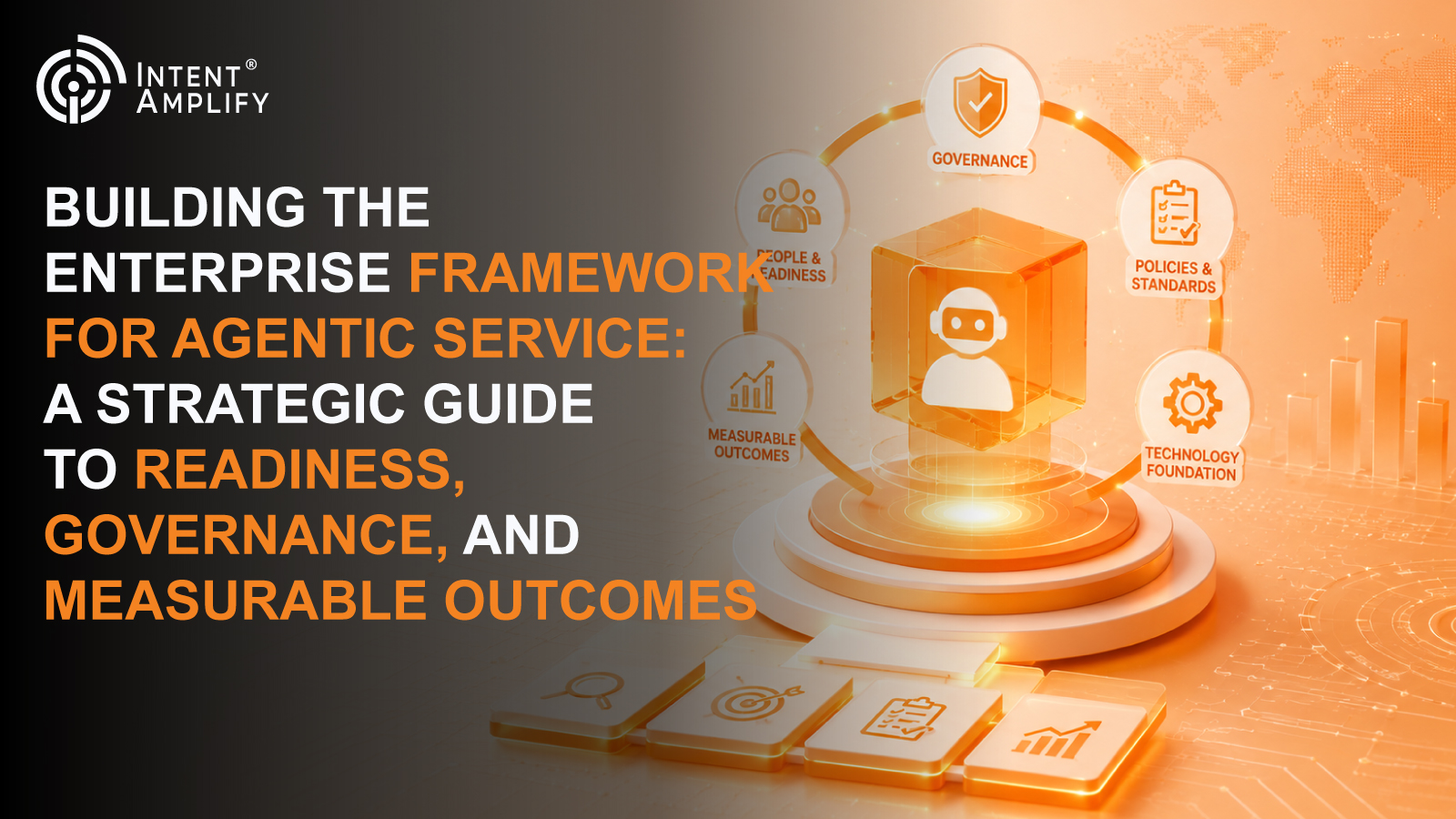
The Five Dimensions of Agentic Service Readiness™ provide a practical executive model for assessing whether an enterprise is ready to scale AI support agents responsibly. The framework moves the discussion beyond automation volume and focuses on the operating conditions required for sustainable agentic service: readiness discipline, trusted knowledge, workflow authority, human-AI collaboration, and measurable governance.
Intent Amplify Research Desk Observation: Organizations that achieve sustainable agentic service maturity invest in governance, trusted knowledge, workflow authority, and performance measurement before expanding AI autonomy. The strongest programs do not begin by asking how many interactions can be automated. They begin by determining which service decisions can be trusted, measured, explained, and safely improved over time.
Five Dimensions of Agentic Service Readiness | Executive Purpose | Readiness Question |
Use-Case and Readiness Discipline | Prioritize service journeys where AI can create measurable value | Which workflows are ready for safe AI assistance or autonomy? |
Trusted Knowledge Foundation | Ensure AI agents rely on accurate, current, permissioned content | Can the system retrieve the right answer from approved sources? |
Workflow Authority and Autonomy Design | Define what AI can recommend, decide, trigger, or escalate | Which actions can AI perform without increasing operational risk? |
Human-AI Operating Model | Clarify how agents, service teams, and AI systems collaborate | Where is human judgment required to protect trust and quality? |
Governance, Measurement, and Continuous Control | Monitor performance, risk, cost, quality, and compliance | Can leaders prove that agentic service is improving outcomes safely? |
The first dimension is Use-Case and Readiness Discipline. Leaders should identify where agentic AI can improve customer outcomes, reduce operational friction, strengthen service quality, or protect revenue. The strongest early use cases are usually high-volume, repeatable, policy-governed interactions where speed and consistency matter, such as order status, account changes, appointment scheduling, warranty intake, returns, entitlement checks, password resets, issue triage, proactive outreach, and internal service desk automation.
The second dimension is the Trusted Knowledge Foundation. Agentic service depends on accurate, current, permissioned, and retrievable enterprise knowledge. AI knowledge management is not a back-office documentation task; it is the foundation for reliable AI customer service. If the knowledge base is outdated, duplicated, poorly structured, or disconnected from workflow logic, AI agents will scale confusion rather than clarity.
The third dimension is Workflow Authority and Autonomy Design. Not every AI agent should have the same permissions. Some agents should retrieve information and suggest next steps. Others may draft responses, update records, route cases, trigger ticket deflection, initiate refunds, or coordinate service desk tasks. Authority should increase only when evidence supports higher autonomy. This staged approach turns the AI implementation roadmap into a risk-managed progression rather than a broad deployment mandate.
The fourth dimension is the Human-AI Operating Model. Agentic service should be designed around tiered collaboration. AI support agents should handle routine work, prepare context, detect patterns, and execute governed workflows. Human experts should handle ambiguity, emotional tension, reputational sensitivity, negotiation, complex judgment, and policy exceptions. Salesforce reports that 97% of customer service leaders with AI say it is affecting their approach to workforce planning.2
The fifth dimension is Governance, Measurement, and Continuous Control. Leaders need clear controls for privacy, cybersecurity, compliance, bias, hallucination risk, unauthorized actions, brand tone, and service continuity. This is where AI compliance, AI controls, AI observability, and responsible AI governance must be treated as operating requirements. A strong AI risk management framework should define what agents can access, what they can decide, what they can execute, when they must escalate, how incidents are reviewed, and how performance is measured over time.
The value of the Five Dimensions of Agentic Service Readiness is that it gives leaders a common language for evaluating scale. Instead of asking whether the enterprise has deployed AI agents, executives can ask whether the organization has the use-case discipline, knowledge quality, authority model, human oversight, and governance controls needed to expand autonomy without weakening trust.
Measuring Outcomes Beyond Automation
The easiest mistake in agentic service is measuring only automation volume. Ticket deflection, average handle time, and cost reduction matter, but they are not sufficient. If an AI system reduces tickets by pushing customers into weak self-service support, the enterprise may improve a dashboard while damaging loyalty.
Zendesk reports that 82% of leaders say promptable analytics unlock insights in seconds that once took analysts weeks, and 81% believe giving every employee the ability to ask questions will transform decision-making. 1
This opens a more mature approach to customer experience metrics. Leaders can ask which customer intents are best suited for automation, which workflows generate repeat contacts, which AI responses create dissatisfaction, where service quality declines, and which AI use cases produce measurable retention or cost outcomes. Promptable analytics also allows nontechnical service leaders to participate more directly in AI performance management.
Salesforce's 2026 findings reinforce the need for customer-centered measurement. After organizations deploy AI agents, customer satisfaction is the most improved key performance indicator, ranking ahead of service representative productivity, average handle time, customer retention, and first-response time.2
That finding is strategically important because it challenges a common assumption. Agentic service should not be evaluated only as an IT cost optimization initiative. It should be evaluated as a customer experience, workforce, risk, and revenue initiative. AI ROI should include operational savings, but it should also include retention, resolution quality, employee productivity, reduced escalation burden, faster MTTR, and stronger customer trust.
Financial discipline is becoming more urgent. IBM found that AI spend is projected to grow from just under 15% of IT budgets in 2025 to nearly 25% by 2027, a 71% increase in two years. The same research found that 85% of technology executives still lack full visibility into real-time AI spend.3
For executives, this means the AI action plan must include financial observability from the beginning. Without spending visibility, agentic service can become another technology expansion that is strategically attractive but economically under-managed.
Together, these measures shift executive reporting from AI activity toward customer, operational, financial, and governance outcomes.
Executive Scorecard for Agentic Service Performance
According to Intent Amplify Research Desk analysis, executive scorecards for agentic service should measure whether AI improves resolution quality, reduces customer effort, controls cost, preserves governance, and strengthens knowledge reliability.
Metric | What It Measures | Executive Relevance |
AI Resolution Quality | Accuracy, completeness, and usefulness of AI-handled resolutions | Shows whether automation is improving service quality, not only reducing ticket volume |
Human Escalation Rate | Share of AI interactions transferred to human agents | Reveals where autonomy is working and where human judgment remains necessary |
Customer Effort Score | How easy it is for customers to resolve issues through AI-supported journeys | Connects AI performance to customer experience and loyalty risk |
AI Cost per Resolution | Total AI operating cost divided by successful resolutions | Helps leaders assess whether AI service economics are improving over time |
Knowledge Quality Index | Freshness, accuracy, duplication, and permission integrity of knowledge sources | Measures whether the knowledge base can support reliable AI answers |
Governance Compliance Rate | Share of AI actions aligned with approved policies, escalation rules, and audit requirements | Shows whether agentic service is scaling within enterprise control boundaries |
This scorecard gives executives a more balanced view of agentic service performance. It connects customer outcomes, human oversight, AI economics, knowledge quality, and governance discipline into one operating view. That balance matters because a service model can appear efficient while still creating customer frustration, policy exposure, or hidden costs.
Where the Zendesk Webinar Fits
The Zendesk webinar, Build Frameworks to Scale Agentic Service, is timely because it addresses the enterprise challenge beneath the excitement: scaling agentic service requires a framework.
For executives, the value of this discussion is not simply learning what AI agents can do. Most leaders already understand the promise of an AI-powered customer service strategy. The sharper question is how to move from disconnected pilots to a governed enterprise agentic service framework that improves outcomes without weakening control.
Zendesk's broader 2026 research points in the same direction. Customers want instant resolution, contextual memory, multimodal support, and transparent AI decisions. Leaders want better service performance metrics, faster insights, and scalable AI operations. The webinar fits at the intersection of those priorities by helping leaders think through readiness, governance, workflow design, and measurable outcomes.
Access the webinar: Build Frameworks to Scale Agentic Service.
What Leaders Should Do Next
Enterprise leaders should begin with an AI readiness assessment that maps high-volume service journeys against data quality, knowledge maturity, workflow complexity, regulatory exposure, and customer effort. The best first use case is not always the most visible one. A lower-risk workflow with clean data, clear policy logic, and measurable value may produce stronger early proof than a complex use case with unclear ownership.
The next priority is governance design. Executives should establish a cross-functional AI governance council that includes customer experience, IT, cybersecurity, legal, compliance, data, operations, finance, and frontline service leadership. This group should define agent permissions, escalation thresholds, audit requirements, model evaluation standards, incident procedures, and AI performance metrics.
Leaders should also create an execution-ready AI implementation roadmap. That roadmap should identify priority AI use cases, required data improvements, workflow automation opportunities, AI knowledge management needs, employee training plans, integration dependencies, and measurable business outcomes. It should be practical enough for operators and strategic enough for executives.
Finally, enterprises should use the Five Dimensions of Agentic Service Readiness as a practical planning tool. The framework helps leaders test whether the organization has selected the right use cases, prepared trusted knowledge, defined workflow authority, designed human-AI collaboration, and established governance controls before expanding autonomy. AI agents will not create durable value if they are layered on top of broken processes, fragmented data, and siloed accountability.
Organizations that establish governance before expanding autonomy retain greater flexibility over AI deployment, compliance, customer trust, and future operating model evolution.
Register for the webinar: Build Frameworks to Scale Agentic Service
About Intent Amplify
Intent Amplify helps B2B revenue teams turn buyer intent into a qualified pipeline through go-to-market strategy, demand intelligence, research-led content, webinar programs, executive engagement, and pipeline activation. We help technology, SaaS, cybersecurity, artificial intelligence, manufacturing, agency, and business services organizations move beyond lead volume by identifying high-intent accounts, mapping buying-group signals, and building narrative-led campaigns that engage decision-makers at the right stage.
Conclusion
Agentic service will reward enterprises that treat autonomy as an operating model, not a software feature. Customers want faster answers, richer context, fewer repeated explanations, and clearer transparency. Employees need better tools, cleaner data, and redesigned roles. Executives need measurable outcomes, governance, financial visibility, and risk controls that scale at the same pace as AI deployment.
The next phase of service transformation will favor organizations that can prove readiness before expanding autonomy. The Five Dimensions of Agentic Service Readiness give executives a practical way to evaluate where AI agents should operate, which workflows require human judgment, how knowledge quality should be governed, and whether performance gains can be measured without weakening trust. That is the operating discipline behind scalable agentic service: readiness before scale, governance before autonomy, and measurable outcomes before technology enthusiasm.
References
Zendesk, CX Trends 2026, 2026
https://cxtrends.zendesk.com/Salesforce, New Research: AI Service Agents Are Scaling and Delivering CSAT, May 20, 2026
https://www.salesforce.com/news/stories/ai-service-agents-improve-customer-satisfaction/IBM Institute for Business Value, New IBM Study Finds CIOs and CTOs Face Growing AI Control Gap as Enterprise Deployment Scales, June 8, 2026
https://newsroom.ibm.com/2026-06-08-new-ibm-study-finds-cios-and-ctos-face-growing-ai-control-gap-as-enterprise-deployment-scalesPwC, 2026 Digital Trends in Operations: How AI Reinvents Enterprise Performance, 2026
https://www.pwc.com/us/en/services/consulting/supply-chain-operations/library/digital-trends-operations-survey.html