Enterprise growth creates contract complexity long before leaders see the full risk picture. As organizations add suppliers, expand customer commitments, enter new markets, and operate across more regulatory environments, every agreement becomes part of a larger network of obligations, renewal windows, service terms, pricing commitments, compliance duties, and liability exposure. The challenge is that many legal and procurement teams are still expected to manage that network through manual contract review, static repositories, shared folders, spreadsheet trackers, and inbox-based follow-up.
Agiloft’s report, Eliminating the Silent Threat: How Agiloft Minimizes Risk, addresses this problem by showing why contract risk management must evolve from reactive review toward AI-driven CLM governance. The report frames contract risk as something that often hides in fine print, clause exceptions, missed obligations, and inconsistent language until the business faces a dispute, audit issue, unfavorable renewal, or preventable cost.¹
For enterprise leaders, the value of contract lifecycle management is not only efficiency. Modern CLM software helps legal, procurement, finance, and executive teams reduce risk while keeping commercial activity moving, because trusted contract data makes it easier to see what has been agreed, what needs review, and where exposure is building before the issue becomes urgent.
The Risk Problem Is Becoming Too Large for Manual Processes
Manual contract review remains essential for judgment, negotiation, and high-value decisions, although it becomes weaker when teams depend on it as the primary way to monitor a large contract portfolio. A legal team may review the agreement before signature, but the contract continues to create risk after execution through renewals, obligations, supplier commitments, compliance requirements, and performance terms.
The broader AI market shows why enterprises are rethinking manual work. McKinsey found that 88% of organizations report regular AI use in at least one business function, up from 78% a year earlier. It also found that 62% of respondents say their organizations are at least experimenting with AI agents, including 23% that are scaling agentic AI somewhere in the enterprise and 39% that have started experimenting.²
Yet adoption does not automatically create value. McKinsey found that only about one-third of organizations have begun scaling AI programs across the enterprise, while 39% report enterprise-level EBIT impact from AI.²
The finding highlights an important CLM reality: AI contract review and contract automation create dependable value only when supported by trusted data, governed workflows, and clear ownership.
CLM Reduces Risk by Making Contract Data Visible
Risk becomes harder to control when contract data is hidden inside PDFs, shared drives, disconnected repositories, or legacy systems. A contract repository can help a team find a document, but it does not automatically reveal which clauses deviate from policy, which renewal windows are approaching, which supplier obligations are untracked, or which agreements carry compliance exposure.
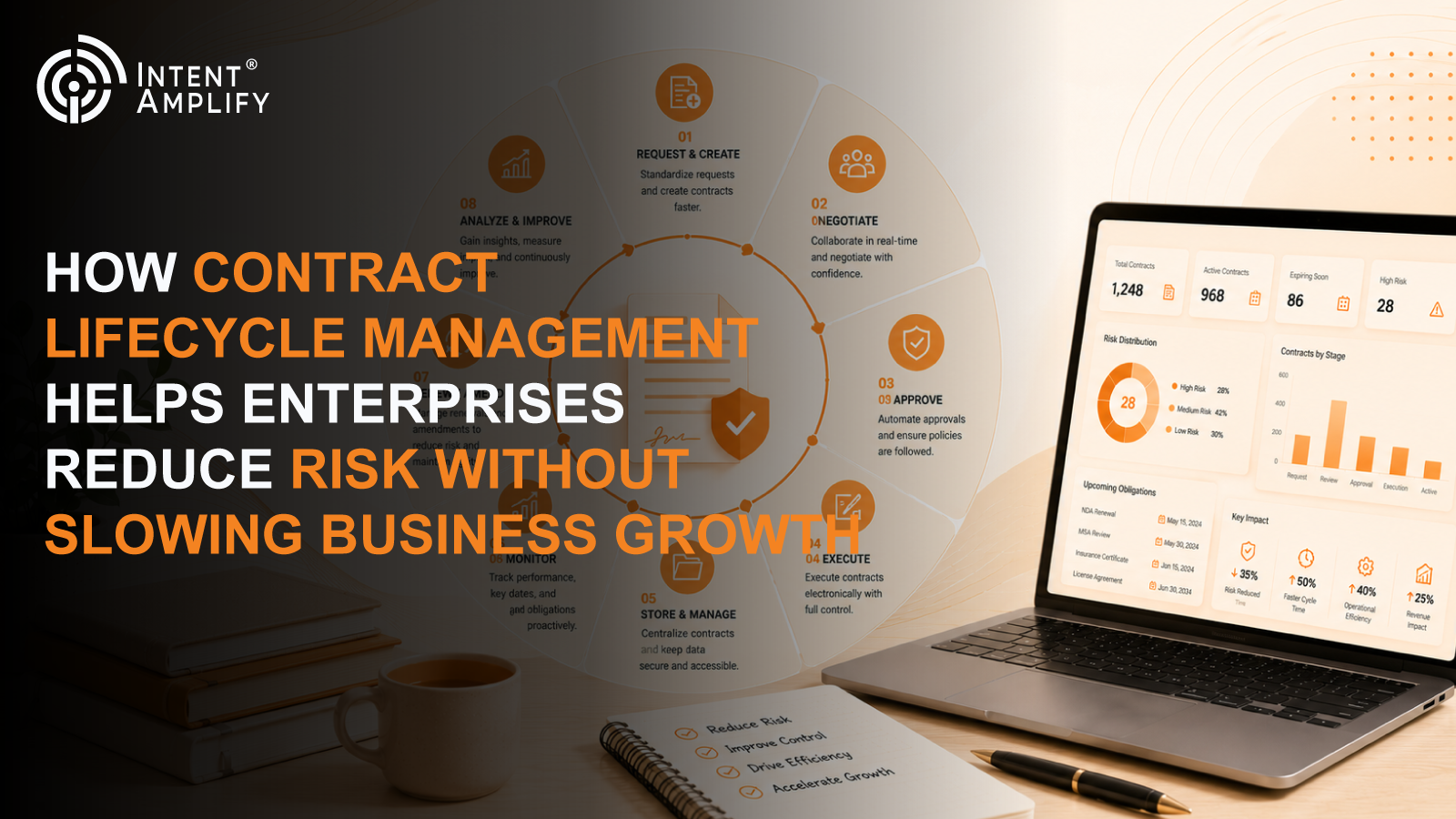
AI-powered CLM changes that operating model by turning static agreements into searchable and actionable contract intelligence. Contract data extraction can identify key clauses, renewal dates, service obligations, pricing terms, and compliance commitments. Contract analytics can reveal patterns across suppliers, contract types, and business units. Contract dashboards can give leadership a clearer view of renewal exposure, contract compliance, risk concentration, and business commitments.
Legal operations teams gain earlier visibility into nonstandard clauses and obligation gaps. For procurement leaders, vendor contract management becomes more disciplined because supplier commitments, renewal dates, and performance obligations are easier to monitor. For executives, contract visibility becomes a governance advantage because the business can answer risk and exposure questions without waiting for manual research.
Standardization Helps Growth Move with Control
Growth slows when every contract exception requires repeated interpretation, manual routing, and last-minute escalation. Standardized contract language, approved clause libraries, automated workflows, and deviation tracking reduce that drag by giving legal and procurement teams a more consistent way to manage variation.
Agiloft’s report emphasizes standardizing contract language and streamlining reviews as practical ways to reduce risk.¹
Teams can separate routine variation from material exposure more quickly. A supplier agreement with standard terms should not require the same review intensity as a contract with unusual liability language, missing compliance obligations, or unclear termination provisions.
CLM reduces risk without slowing business growth by making review more focused, consistent, and governable. It makes the review more focused, more consistent, and easier to govern, so the business can move faster without accepting hidden exposure.
AI Governance Makes Contract Automation Dependable
AI can accelerate contract review, contract summarization, clause analysis, and contract risk detection, but speed without governance can create false confidence. McKinsey found that 51% of respondents from organizations using AI report at least one negative consequence, with nearly one-third reporting consequences linked to AI inaccuracy.²
That finding matters for contract management because inaccurate outputs can affect legal risk, supplier obligations, compliance decisions, and financial commitments.
NIST’s AI Risk Management Framework emphasizes trustworthy AI across design, development, use, and evaluation.⁴
In contract lifecycle management, that principle should translate into approved data sources, validated extraction rules, role-based access, audit trails, human review for high-risk clauses, and clear accountability for AI-assisted decisions.
Microsoft’s 2026 Work Trend Index surveyed 20,000 AI-using workers across 10 countries and found that organizational factors account for 67% of reported AI impact, compared with 32% for individual mindset and behavior. Microsoft also found that only 19% of AI users are in the “Frontier” zone, where individual capability and organizational readiness reinforce each other, while 16% are stalled and 10% are blocked by organizations that have not caught up.³
For CLM leaders, the message is clear: AI contract management works best when the operating model is redesigned around reliable data, governed workflows, and human oversight.
What Agiloft Brings to the Conversation
Agiloft is positioned for this conversation because its risk-focused CLM message speaks to the practical concerns of legal, procurement, and executive teams. Legal leaders need earlier visibility into clause risk and compliance exposure. Procurement leaders need supplier contract intelligence, renewal tracking, and obligation monitoring. Executive sponsors need confidence that contractual risk can be seen, measured, and governed before it becomes a business problem.
The strongest contract lifecycle management strategy does not force enterprises to choose between risk control and business speed. It creates a governed operating model where AI contract management, contract analytics, standardized language, and workflow automation help teams identify risk earlier while keeping commercial activity moving.
Download Eliminating the Silent Threat: How Agiloft Minimizes Risk
Agiloft’s report gives legal, procurement, and executive teams a practical view of how AI-powered CLM can help standardize contract language, streamline reviews, empower decision-makers, and measure risk-reduction ROI.
About Intent Amplify
Intent Amplify helps organizations move from market insight to measurable growth through GTM strategy, demand intelligence, pipeline activation, executive roundtables, sponsored research, targeted content, webinars and panels, vendor intelligence, and strategic consulting.
Executive Takeaway
Contract lifecycle management helps enterprises reduce risk without slowing growth because it turns contract risk management from a manual checkpoint into a governed intelligence process. When trusted contract data, AI contract review, contract analytics, and workflow automation work together, legal and procurement teams can identify risk earlier, review exceptions more precisely, and support the business with greater confidence. In that model, CLM does not act as a brake on growth. It becomes the operating system that helps growth move with better control.
References
-
Agiloft and IntentTechPub (2026). Eliminating the Silent Threat: How Agiloft Minimizes Risk. Available at: https://intenttechpub.com/report/eliminating-the-silent-threat-how-agiloft-minimizes-risk/
-
McKinsey and Company (2025). The State of AI in 2025: Agents, Innovation and Transformation. Available at: https://www.mckinsey.com/capabilities/quantumblack/our-insights/the-state-of-ai
-
Microsoft (2026). 2026 Work Trend Index: Agents, Human Agency, and the Opportunity for Every Organization. Available at: https://www.microsoft.com/en-us/worklab/work-trend-index/agents-human-agency-and-the-opportunity-for-every-organization
-
National Institute of Standards and Technology (2026). AI Risk Management Framework. Available at: https://www.nist.gov/itl/ai-risk-management-framework