
Once a contract is signed, organizations often assume the most critical stage of risk management has passed. Legal has completed its review, procurement has secured negotiated terms, finance has approved the commercial structure, and operations begins preparing for execution under the assumption the agreement is fully under control.
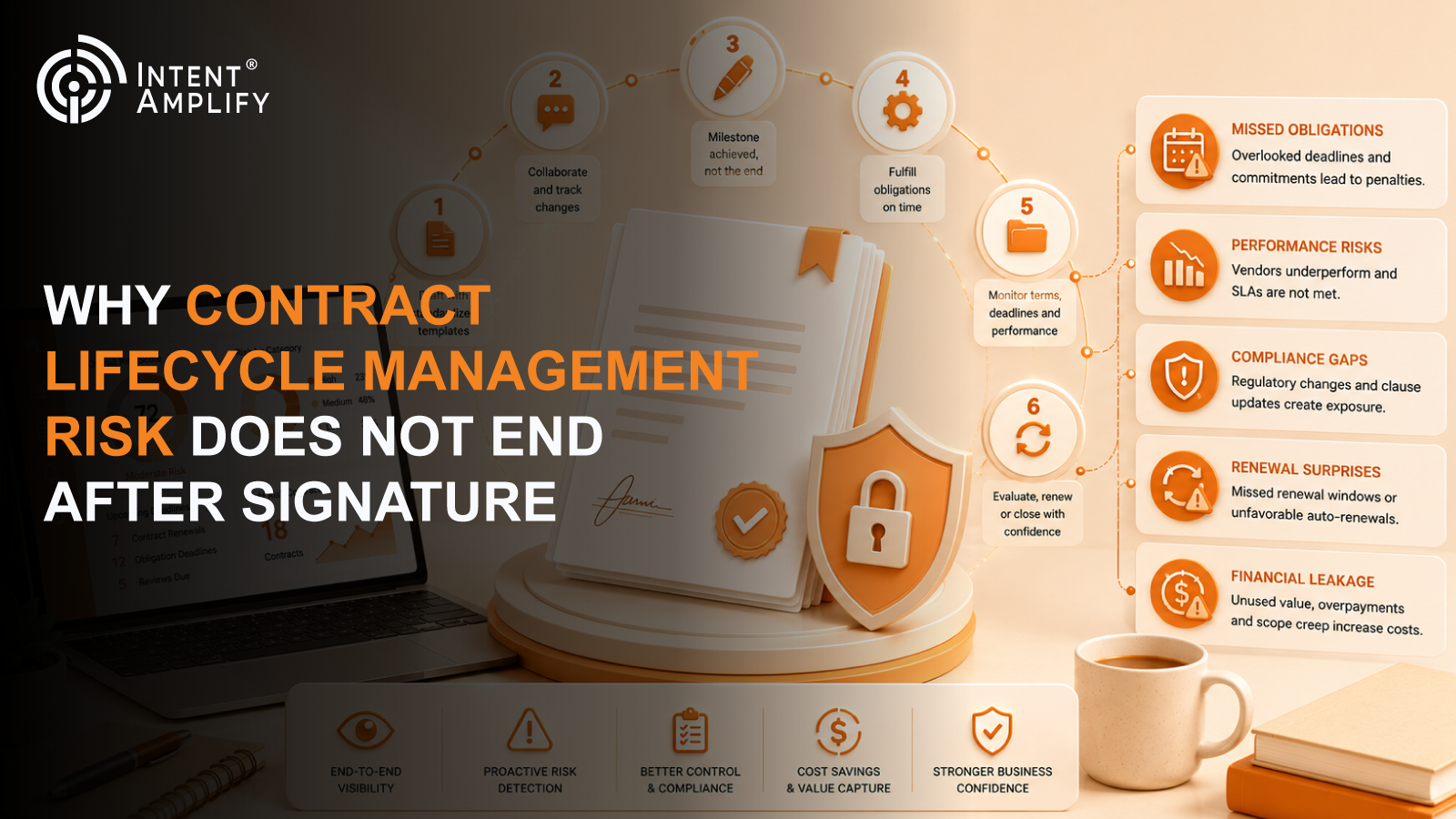
Signature does not mark the end of contract lifecycle management risk. It marks the point where risk becomes operational, moving through the business in the form of obligations, renewal windows, pricing commitments, supplier performance requirements, compliance duties, audit rights, and reporting deadlines. When those commitments are not visible, assigned, tracked, and measured, agreements shift from business assets to sources of unmanaged exposure.
For legal, procurement, finance, operations, and compliance teams, success depends on more than contract execution. Effective governance requires the organization to manage, monitor, and act on the commitments embedded in the agreement.
The Signature Is a Milestone, Not a Finish Line
Before signature, contract risk management usually lives in familiar places such as redlines, approval workflows, clause review, policy deviations, negotiation delays, and compliance checks. These risks are easier to identify because they sit directly inside the contracting process, where legal and procurement teams are actively watching the language and the approvals.
After the signature, the risk changes shape and moves into the daily work of the enterprise. The contract leaves the legal department’s desk. Procurement may own the supplier relationship. Finance may own payment accuracy. Operations may own delivery. Compliance may own evidence. Legal may still be expected to defend the agreement, even though the post-signature activity now happens somewhere else entirely. Naturally, the business calls this collaboration rather than a governance trap with better branding.
World Commerce & Contracting’s 2025 Benchmark Report found that 88% of executives understand that commercial and contract management excellence matters, while 87% of organizations are dealing with high levels of uncertainty. That matters because uncertainty increases the need for adaptive contract visibility, clearer ownership, and stronger post-signature contract management [1].
Where Post-Signature Contract Risk Hides
The most dangerous contract risks rarely appear in dramatic fashion at the beginning of the relationship. They sit quietly inside, missed obligations, unmanaged renewals, weak supplier accountability, and enterprise contract data that nobody fully trusts.
|
Hidden Risk Area |
What Usually Goes Wrong |
Why It Matters |
|
Contract obligation management |
Duties are not assigned or tracked |
Teams miss commitments, notices, or deliverables |
|
Contract renewals |
Auto-renewals and termination windows go unnoticed |
The business loses leverage or stays locked into poor terms |
|
Supplier performance management |
SLAs and vendor commitments are not monitored |
Procurement value erodes after the sourcing event |
|
Contract compliance management |
Audit, privacy, and reporting clauses stay buried |
Compliance teams lack evidence when scrutiny arrives |
|
Contract data management |
Metadata is incomplete or scattered |
Leaders cannot trust reporting dashboards or risk signals |
Poor contracting is not a paperwork issue. It is a value issue that reaches directly into revenue, cost control, supplier performance, and operational confidence. WorldCC’s 2025 contract management research reports that poor contracting practices erode value equivalent to almost 9% of annual revenue, and in complex industries, that figure can reach 15% or more. That is not process inefficiency. That is value leakage wearing a corporate badge [2].
A Contract Can Be Legally Sound and Operationally Risky
A contract can be well negotiated, properly approved, and legally enforceable while still creating operational risk after execution. Exposure emerges when obligations, entitlements, and governance requirements are not translated into ownership, monitoring, and action.
Quarterly compliance documentation may go untracked without automated alerts. Service credits may never be claimed when contract analytics remain disconnected from performance data. Renewal rights may be lost when critical dates remain buried in static documents. In each case, negotiated protections exist on paper but fail to deliver value in practice.
Icertis’ 2025 State of Contracting research found that 90% of CEOs and 82% of CFOs believe their organizations are leaving money on the table in contract negotiations.[3].
The finding highlights a broader reality: negotiated value depends on effective post-signature controls, including pricing discipline, obligation management, and renewal governance.
Readers seeking additional perspectives on contract visibility, risk management, and AI-powered contracting can explore the full guide.
Why CLM Has Become Cross-Functional
Modern contract lifecycle management can no longer sit neatly inside legal operations because contract data touches procurement analytics, finance forecasting, compliance evidence, supplier performance management, and executive decision-making. A contract that affects cost, risk, revenue, delivery, and compliance cannot be managed as though it belongs to one department, because business relationships have the nerve to ignore org charts.
Gartner’s 2025 Magic Quadrant summary notes that organizations are pursuing cross-functional CLM strategies, which is leading many to invest in or replace CLM solutions that no longer meet enterprise requirements. That shift says the quiet part clearly. Contract lifecycle management is now enterprise infrastructure, not just a contract repository with better manners [4].
The pressure is especially visible in legal operations. CLOC’s 2025 State of the Industry Report found that 83% of legal departments face growing demand, while AI adoption nearly doubled. Manual tracking, spreadsheet reminders, and heroic inbox archaeology are not scalable responses to rising contract volume unless the business strategy is to exhaust legal teams and call it transformation [5].
From Contract Repository to Contract Intelligence
A basic contract repository can answer one limited question, which is, where the agreement is stored. A stronger CLM system answers better questions, such as what obligations are due, which contracts renew next quarter, which suppliers are underperforming, which agreements contain high-risk clauses, which business unit owns the next action, and which executive contract dashboards show exposure across the portfolio.
That is where AI-powered CLM, contract automation, AI contract review, contract risk detection, and contract intelligence become practical rather than decorative. The point is not to use AI because everyone else is doing it and nobody wants to look spiritually behind. The point is to turn enterprise contract data into usable insight that helps teams act before risk becomes visible in the worst possible way.
Agiloft’s AI-powered CLM positioning focuses on reducing risk, organizing contract data, standardizing negotiations, monitoring obligations, and automating routine contract steps. For large enterprises managing high-value contracts, that matters because post-signature risk control depends on trusted data and timely action rather than memory and luck [6].
Agiloft also announced AI-driven Obligation Management in 2025 and described it as a way for enterprises to gain real-time visibility and control over post-signature obligations while reducing risk, enforcing compliance, and turning contract data into operational intelligence. In an enterprise environment, that shift matters because the goal is not simply storing contracts. The goal is to make them perform [6].
The Real Definition of Contract Completion
A contract is not complete when it is signed. It is complete only when the business fulfills obligations, captures negotiated value, manages renewals, proves compliance, monitors supplier performance, and uses contract insights to make better decisions.
That is why contract lifecycle management risk does not end after signature. The signature closes the negotiation, but it opens the responsibility of execution.
For modern enterprises, mature CLM is not about having a cleaner archive. It is about turning static agreements into living business intelligence and giving leaders the contract visibility, contract analytics, and control they need before risk surfaces too late.
If your organization is looking to engage legal, procurement, finance, and executive audiences with research-led content around CLM, contract intelligence, and enterprise risk.
Connect with Intent Amplify to build a campaign strategy aligned with high-intent decision-makers.
References
-
World Commerce & Contracting (2025) 2025 Benchmark Report. Available at: https://info.worldcc.com/benchmark-2025.
-
World Commerce & Contracting (2025) Contract Management Whitepaper / Value Leakage Research. Available at: https://info.worldcc.com/contract-management-aug-2025.
-
Icertis (2025) 2025 State of Contracting Report. Available at: https://www.icertis.com/research/webinars/the-state-of-contracting-managing-the-shift-from-paperwork-to-performance-with-ai/register/.
-
Gartner (2025) Magic Quadrant for Contract Life Cycle Management. Available at: https://www.gartner.com/en/documents/7159730.
-
CLOC (2025) 2025 State of the Industry Report. Available at: https://cloc.org/newsdesk/2025-state-of-the-industry-report/.
-
Agiloft (2025) AI Platform and AI-Driven Obligation Management Announcement. Available at: https://www.agiloft.com/solutions/ai-platform/; https://www.agiloft.com/news/agiloft-enterprise-grade-obligation-management-ai-native-era-of-contract-lifecycle-management/.