
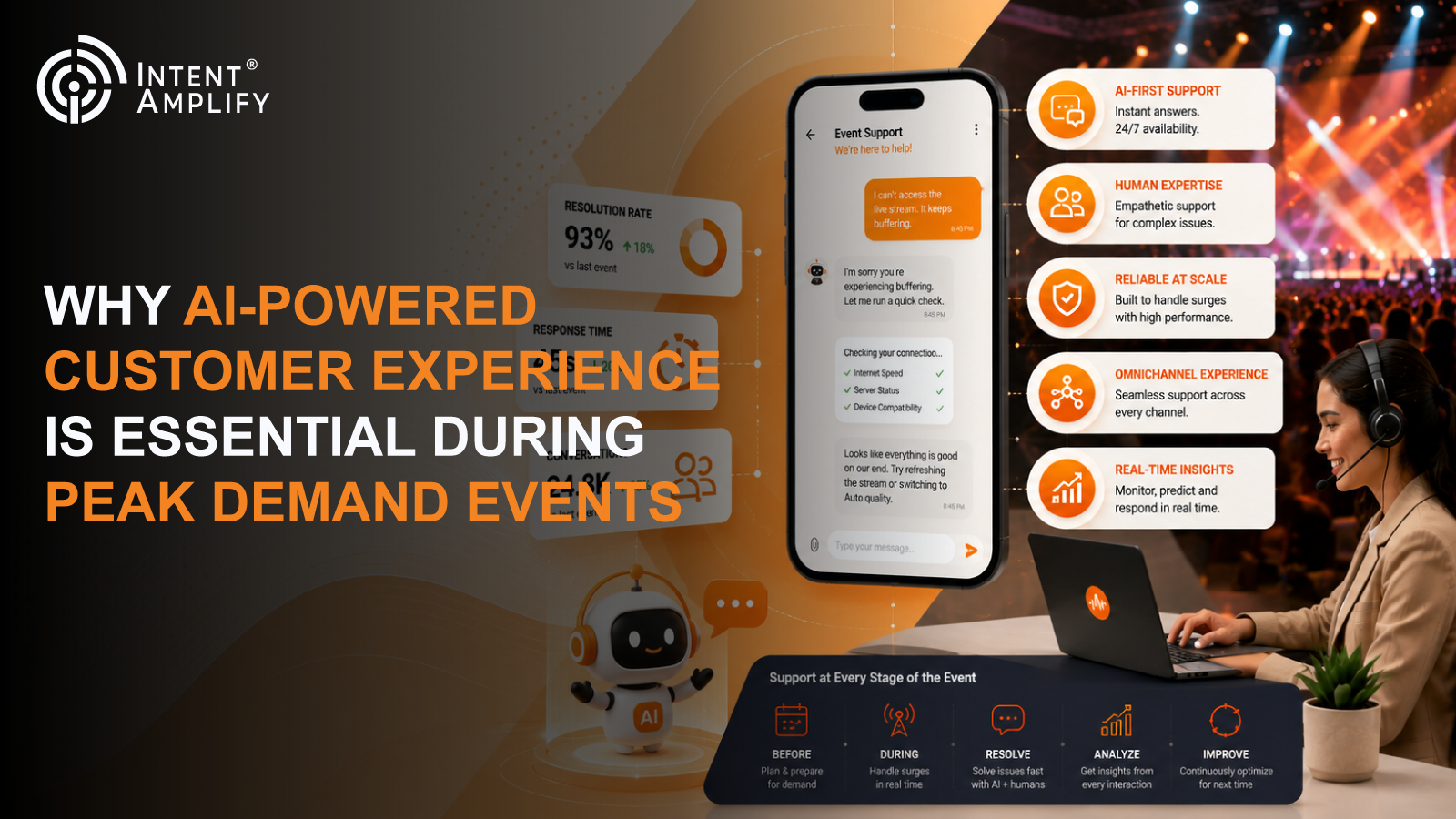
Customer experience is tested when attention, revenue, and reputational risk converge. For media, entertainment, gaming, digital commerce, travel, live events, and subscription businesses, a product launch, championship game, ticket release, streaming premiere, outage, or seasonal surge can compress months of customer demand into a few volatile hours.
During those moments, customers judge the brand through their ability to access content, complete transactions, resolve issues, and receive timely support. The contact center becomes more than a service function. It becomes a critical operating layer for preserving trust, loyalty, and business continuity.
Zendesk addresses many of the conditions that make surge management difficult, including fragmented channels, incomplete customer context, rising expectations for instant resolution, and the need to coordinate AI agents with human judgment. Zendesk’s 2026 CX Trends research found that 74% of consumers now expect customer service to be available 24/7 because of AI. 1 The implication is therefore clear: during high-stakes demand surges, AI-powered customer experience is not simply a productivity layer; it is the mechanism that helps enterprises preserve continuity, protect loyalty, and convert operational pressure into measurable business resilience.
Peak Demand Is Now a Board-Level Customer Risk
Peak demand management is increasingly defined by volatility rather than staffing levels alone. Demand surges generate uneven contact volumes, emotionally charged customers, shifting issue patterns, and operational blind spots that challenge traditional workforce-planning models. Zendesk's 2026 research found that 85% of CX leaders believe customers will leave a brand after an unresolved issue, even on first contact. 1
The finding elevates surge planning from an operational concern to an enterprise risk-management priority. Lost customer confidence during high-demand events can affect loyalty, retention, brand perception, and long-term customer value.
The challenge is especially acute for campaign audiences in customer experience, customer service, customer success, help desk, call center, service delivery, user experience, and technical support leadership roles. These teams are being asked to manage higher expectations without proportionally increasing headcount. Salesforce’s 2026 service research found that 85% of service organizations now use at least one form of AI, and adoption of AI agents in customer service organizations rose from 39% in 2025 to 66% in 2026, a 1.7x increase.2
The implication is straightforward: AI customer service is moving from experimentation to a competitive baseline.
AI Turns Surge Response From Queue Management Into Context Management
Traditional contact center analytics often describe a surge after it has already happened. Leaders see the spike, watch average handle time climb, and then try to rebalance teams manually. That approach is increasingly inadequate because customers do not experience the surge as a staffing problem. They experience it as repetition, inconsistency, and lack of recognition.
AI-powered customer experience changes the control point. Instead of treating every inbound interaction as a discrete ticket, AI can help interpret intent, retrieve context, recommend next actions, summarize prior exchanges, and route complex cases to the right human agent. Zendesk’s 2026 CX Trends report found that 83% of CX leaders say memory-rich AI agents are key to truly personalized customer journeys, while 74% of customers find it frustrating to repeat their story to different agents.1 For the surge readiness strategy, that is a critical distinction. The enterprise advantage is not only speed; it is continuity under pressure.
This is where Zendesk’s campaign objective becomes more specific. During a live event, release window, outage, subscription billing spike, or breaking support incident, customers rarely care which channel they started on. They care that the brand remembers what happened, understands the issue, and resolves it without forcing them to restart. Zendesk’s research reports that 76% of consumers would choose a company that lets them drop text, images, and video into the same conversation thread without restarting.2 For enterprises competing on audience loyalty and customer trust, multimodal support is no longer a feature discussion; it is a retention safeguard.
The Business Case: Faster Value, Better Customer Sentiment, and More Resilient Operations
Peak demand events make the economics of AI more visible because the cost of friction is concentrated. A poorly handled surge increases repeat contacts, escalations, refunds, negative social commentary, agent burnout, and management distraction. A well-designed AI customer service model reduces the need for customers to enter the queue in the first place, while giving agents better context when human intervention is necessary.
Salesforce’s 2026 research found that 70% of organizations with AI service agents observe measurable value within 60 days of deployment, and customer satisfaction was the top improved key performance indicator after AI agent deployment.2
This matters because the most valuable surge metric is not merely containment. It is whether the customer exits the interaction with confidence restored.
McKinsey’s February 2026 State of Customer Care analysis adds another layer. In its survey of 440 customer care leaders and executives, McKinsey identified a widening maturity gap: 67% of customer care leaders have invested in foundational AI use cases at scale, compared with 16% of laggards.3
The same research found that 42% of leaders reversed increasing inbound volumes through smarter self-service and digital deflection, while 40% reported significantly improved customer experience scores in the past 12 months, compared with 12% of laggards.3
For executives, those numbers make a practical point: customer support automation is not only about reducing labor intensity. The more strategic goal is to create a service architecture that can absorb demand spikes without sacrificing resolution quality, brand experience, or employee focus.
AI Readiness Determines Whether Automation Helps or Hurts During Surges
There is a dangerous assumption in many boardrooms that AI can be added to customer service shortly before a high-volume event. In reality, AI readiness is built before the spike. Data quality, knowledge governance, escalation rules, agent training, channel integration, compliance review, and customer transparency all determine whether automation reduces friction or creates a new category of failure.
That gap is particularly important during peak demand events. Customers under stress are less tolerant of opaque answers, circular bot flows, or unexplained denials.
Deloitte’s 2026 State of AI in the Enterprise research similarly shows why governance cannot lag adoption. The survey found that close to three-quarters of companies plan to deploy agentic AI within 2 years, yet only 21% report having a mature model for agent governance.5 Enterprise leaders should treat that as a warning. AI agents can scale action; without governance, they can also scale inconsistency.
Human + AI Collaboration Is the Real Surge Model
The strongest customer experience strategies do not replace people with automation. They reserve human attention for the interactions where empathy, judgment, negotiation, and exception handling matter most. McKinsey’s 2026 customer care research found that almost 70% of respondents agree that empathy and trust will always require human involvement, while AI is projected to unlock up to 60% of addressable care volume.3
This is the core of human-AI collaboration in customer service: AI handles recognition, routing, summarization, self-service, and repetitive resolution patterns, while agents focus on complex, high-emotion, high-value interactions. During a surge, that division of labor protects both the customer and the workforce. Agents are not buried under repetitive contacts; customers are not forced to wait for answers that software can safely provide; leaders get more reliable visibility into incident themes, sentiment, and resolution performance.
What Enterprise Leaders Should Do Before the Next Surge
The operational lesson is simple, but difficult to execute: design for the surge before the surge arrives. Enterprise CX leaders should begin by identifying the recurring reasons customers contact support during high-volume moments, mapping which issues can be resolved through AI-powered self-service, and defining when cases must move to human agents. They should then connect customer data, knowledge content, workflow rules, and analytics so the organization can act from a shared view of demand.
Deloitte’s 2026 AI research found that only 25% of respondents have moved 40% or more of their AI pilots into production, although 54% expect to reach that level in the next three to six months.4 That gap is meaningful for customer experience leaders. A pilot may demonstrate capability, but a peak demand event tests production discipline.
For Zendesk’s audience, the opportunity is to move from reactive surge handling to AI-powered CX operations that are scalable, contextual, and measurable. Relevant success metrics include first-contact resolution, containment quality, escalation accuracy, response latency, sentiment recovery, agent productivity, service quality management, and post-surge retention. The best scorecard does not ask only whether volume was handled. It asks whether the enterprise protected the relationship.
Turning High-Stakes Surges Into Successes
Peak demand events will not become easier. Customer expectations are rising, digital channels are multiplying, and the margin for service failure is narrowing. Yet the organizations that prepare well can turn these moments into proof points. They can show customers that the brand remains responsive when pressure is highest.
Zendesk helps customer experience and service leaders build support environments that preserve context, coordinate channels, support AI and human teams, and provide actionable operational visibility.
To explore how enterprise teams can prepare for high-stakes customer surges with more confidence, register for the Zendesk webinar, “Turning High-Stakes Surges into Successes.” The discussion is designed for customer experience, customer service, customer success, support, and service delivery leaders who need a practical path from peak demand pressure to measurable CX performance.
Register For the Webinar: Turning High-Stakes Surges into Successes.
About Intent Amplify
Intent Amplify helps B2B technology companies connect with high-intent enterprise audiences through research-led content, demand generation, and data-driven campaign programs. By combining audience intelligence, editorial strategy, and performance-focused outreach, Intent Amplify supports brands in building trust, accelerating engagement, and converting buyer interest into measurable pipeline opportunities.
For more details on how Intent Amplify can support your next enterprise campaign, contact us today.
References
-
Zendesk, CX Trends 2026, 2026
https://cxtrends.zendesk.com/ -
Salesforce, New Research: AI Service Agents Are Scaling and Delivering CSAT, May 20, 2026
https://www.salesforce.com/news/stories/ai-service-agents-improve-customer-satisfaction/ -
McKinsey & Company, Building Trust: How Customer Care Leaders Pull Ahead with AI, February 23, 2026
https://www.mckinsey.com/capabilities/operations/our-insights/building-trust-how-customer-care-leaders-pull-ahead-with-ai -
Deloitte, From Ambition to Activation: Organizations Stand at the Untapped Edge of AI’s Potential, Reveals Deloitte Survey, January 21, 2026
https://www.deloitte.com/us/en/about/press-room/state-of-ai-report-2026.html