
A security incident does not pause while someone finds the right camera, checks the right timestamp, and scrubs through hours of footage like a very tired detective in a poorly funded procedural drama. In enterprise environments, incidents move through loading docks, parking lots, retail aisles, production floors, campuses, offices, and access-controlled doors. The issue is rarely that organizations lack cameras. Most have plenty. The problem is that traditional video security was designed to record events, not necessarily help teams respond while those events are still unfolding.
That is why AI video security is becoming a practical priority for physical security, facilities, operations, risk, and loss prevention leaders. The value is not “more video.” Nobody needs another ocean of footage. The value is faster detection, smarter alerts, searchable evidence, and better coordination across people, sites, and systems.
The Problem with Video That Only Watches
Legacy surveillance is usually most useful after the event. It can show a vehicle entering the wrong access point, a person loitering near a restricted area, or unsafe activity inside a warehouse. That evidence matters, but it often arrives late. Recording an incident is not the same as helping teams understand and respond to it in time.
This strategy falls apart at the enterprise level. A manufacturing facility might require visibility into production sites, storage yards, and docks. A retail company might be concerned about visibility into entrances, stock rooms, check-out counters, and parking lots. Healthcare facilities and universities often have scores of buildings under management. When all those elements of video, access control, alarm, and incident response operate independently, getting a handle on what's happening becomes a treasure hunt.
Globally, the video surveillance market is estimated to be valued at USD 83.71 billion by 2025, indicating the ubiquity of this technology within commercial, industrial, residential, and governmental settings. However, the next step is not merely adding cameras but making them smart enough to enable action. 1
CyberTech Intelligence Perspective
CyberTech Intelligence views AI video security as an enterprise operational intelligence capability, not simply an upgrade to surveillance technology. The real value is not that cameras can record more footage or generate more alerts. The value is that video systems can help security, facilities, operations, and risk teams detect meaningful events faster, interpret them with context, and coordinate response across distributed environments.
As AI video, access control, alerts, and cloud-based administration converge, physical security becomes part of the broader enterprise decision layer. In this model, video security is no longer a passive record of what happened. It becomes a governed source of operational intelligence that supports investigation speed, situational awareness, evidence management, and resilience.
What AI Video Security Changes
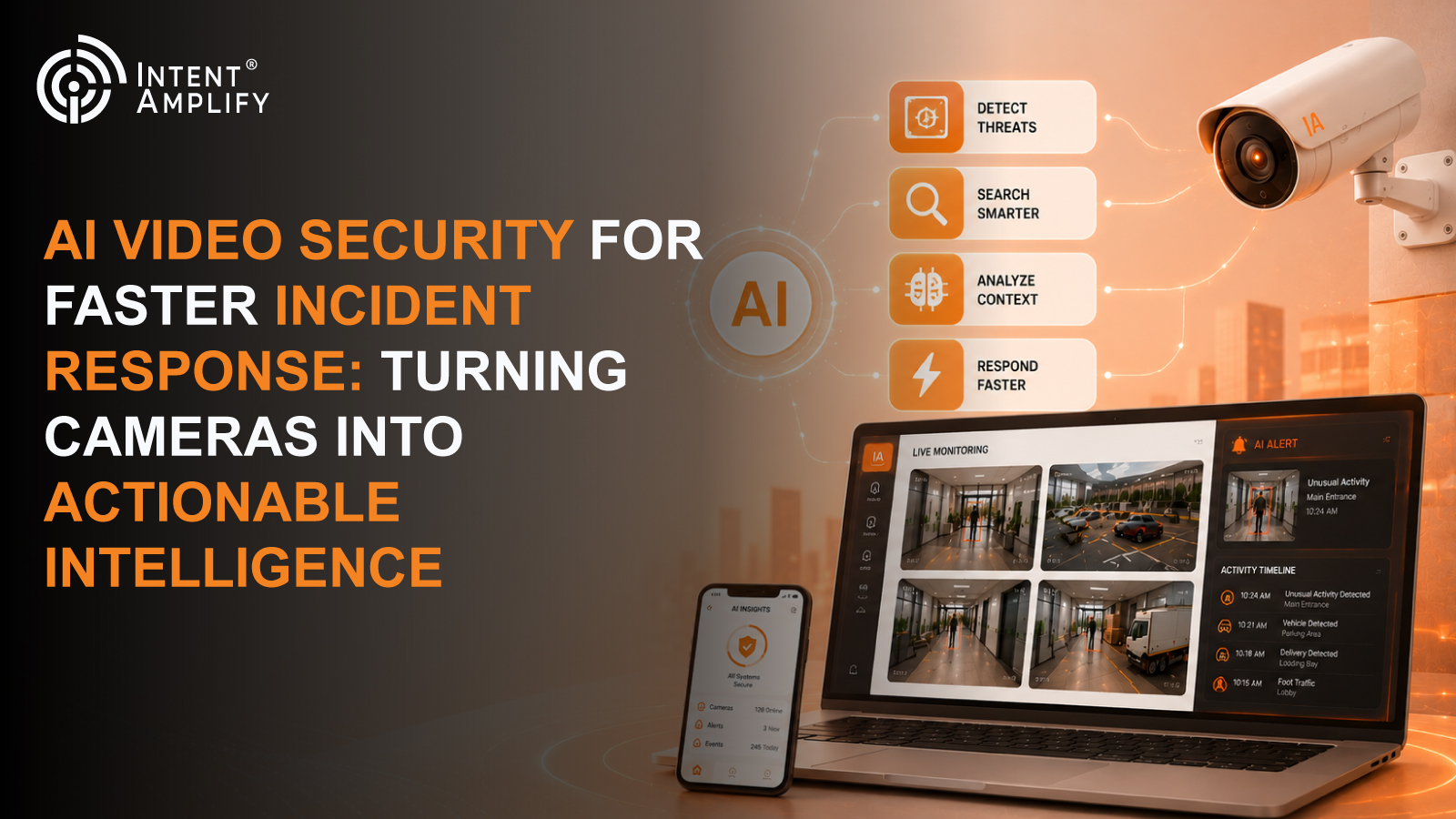
AI-based video surveillance enables the camera system to act as an active sensor rather than just a recording device. Instead of depending on the presence of motion and manually watching the screen, AI-enabled systems can detect the presence of people, vehicles, anomalous movements, loitering, congestion, crossing of lines, and many more events.
However, what makes AI-based systems stand out is the ability of these systems to send alerts about any occurrence to the concerned team almost instantly.
This is crucial as response timing varies based on the situation. An untargeted alert will require a team to start investigations from scratch. With AI, video analysis provides context, thus enabling the team to determine the nature of the event, location, and whether escalation is needed.
The global AI-powered video analytics market was forecast at USD 9.12 billion in 2024 and projected to reach USD 78.57 billion by 2032, with a compound annual growth rate of 30.89% between 2026 and 2032.2
For teams evaluating what a connected security model could look like in practice, the next step is usually not another abstract strategy deck. It is seeing how cloud-managed video, access control, alerts, and multi-site administration come together in a real operating environment.
CyberTech Intelligence Enterprise AI Video Response Framework
Faster incident response is not one feature. It is a governed workflow. CyberTech Intelligence recommends that enterprises evaluate AI video security through the CyberTech Intelligence Enterprise AI Video Response Framework™, which connects detection, verification, investigation, coordination, response, and review into a repeatable operating model.
|
Framework Stage |
What It Means |
|
Detect |
AI identifies activity that matches a risk pattern, policy exception, or operational anomaly. |
|
Verify |
Teams review visual context to confirm whether the alert requires action. |
|
Investigate |
Security teams search related footage, access events, locations, people, vehicles, or timelines. |
|
Coordinate |
The incident is routed to the right site leader, security team, operations group, or response owner. |
|
Respond |
Teams dispatch personnel, restrict access, escalate the event, or investigate remotely. |
|
Review |
Footage, event history, and response actions support reporting, compliance, insurance, and prevention. |
Executive Readiness Scorecard
|
Assessment Area |
1 = Low Readiness |
2 = Developing Readiness |
3 = High Readiness |
|
Detection Capability |
Alerts are mostly manual or reactive. |
AI detects selected scenarios. |
Detection is risk-based, tuned, and actionable. |
|
Investigation Speed |
Teams manually search footage. |
AI search reduces review time for some incidents. |
Evidence is searchable, contextual, and rapidly retrievable. |
|
AI Search Maturity |
Footage is hard to filter or index. |
Search works by time, location, object, or event type. |
Search supports fast investigation across sites and workflows. |
|
Response Coordination |
Escalation depends on manual communication. |
Some workflows route alerts to response teams. |
Alerts, evidence, and ownership are coordinated through defined workflows. |
|
Platform Integration |
Video, access, alarms, and incident tools are disconnected. |
Priority integrations exist, but coverage is uneven. |
Video connects with access, alerts, cloud administration, and response workflows. |
|
Operational Resilience |
Video supports recording, not resilience planning. |
Video improves investigations, but measurement is limited. |
AI video improves response speed, reporting, auditability, and risk reduction. |
Searchable Footage Is Where the Real Time Savings Show Up
While the discussion around AI-enabled video security is centered around alerting, the speed of investigation plays an equally important role in the process. The information regarding who the intruder was, how he moved around the site, what his transport mode was, through which door he gained entry, and if there is any pattern to the occurrence is critical after the incident.
The power of AI-driven searching comes to the fore here because it allows teams to find relevant footage without having to go through multiple hours of recorded videos from various cameras and locations. Be it tracking the movements of someone around the dock doors at a warehouse or investigating suspicious activity at certain spots within retail stores or hospitals/colleges, AI-based search can prove invaluable in such instances.
Here is why cloud-based physical security plays a crucial role. It allows you to manage your video footage, access control, alerts, and device status all through one platform in a centralized way without being confined to different locations. The concept of cloud physical security that Verkada provides can easily fit in this context.
Where Enterprises Feel the Impact
|
Environment |
How AI Video Supports Faster Response |
|
Manufacturing and Warehouses |
Detects unsafe zones, after-hours movement, dock activity, and operational disruptions faster. |
|
Retail and Loss Prevention |
Speeds up investigation of shrinkage, suspicious behavior, parking lot incidents, and store-level events. |
|
Healthcare and Education |
Improves visibility across entrances, sensitive areas, parking lots, and multi-building campuses. |
|
Corporate Facilities and Property Management |
Centralizes monitoring across distributed buildings without relying on disconnected local systems. |
According to Genetec, 43% of end users anticipate that hybrid models will be their top choice when it comes to implementing physical security technology within five years’ time, while only 18% plan on fully implementing their physical security system into the cloud environment, and 17% want to keep it all on-premise. In other words, businesses seek versatility. Evidently, bosses appreciate flexibility in their systems.3
CyberTech Intelligence Research Desk Observation
Enterprise video security is moving from passive surveillance toward AI-assisted operational decision support. Organizations that continue to treat cameras as recording devices will struggle with delayed investigations, fragmented evidence, and inconsistent response workflows.
The next stage of maturity will favor teams that connect detection, verification, investigation, coordination, response, and review into a single operating model. This is where AI video security becomes more than a monitoring tool. It becomes part of enterprise resilience, helping leaders reduce response friction, improve auditability, and make faster decisions when physical events create business risk.
Recommended Next Step: Enterprise AI Video Security Readiness Assessment
AI video security is becoming more than a surveillance upgrade. It is now an enterprise readiness question that affects detection quality, investigation speed, response coordination, evidence governance, cloud adoption, and operational resilience.
CyberTech Intelligence recommends that organizations conduct an Enterprise AI Video Security Readiness Assessment before expanding AI-enabled video, cloud-managed physical security, or multi-site response platforms. The assessment should evaluate AI video maturity, investigation workflows, cloud readiness, AI governance, response coordination, and platform integration.
For security, facilities, operations, risk, and executive teams, this creates a practical bridge between video security modernization and enterprise resilience. It helps identify where current systems remain reactive, where investigation workflows are fragmented, and where AI video security can improve response speed at scale.
Request an Enterprise AI Video Security Readiness Assessment
References
- Fortune Business Insights -- Video Surveillance Market Size, Share & Industry Analysis -- 2025
- Verified Market Research -- AI-Powered Video Analytics Market Size, Share, Trends, and Forecast -- 2025
- Genetec -- New 2025 State of the Physical Security Industry Report Shows Accelerating Hybrid Cloud Adoption and Its Growing Strategic Influence -- December 2024