
There is a quiet absurdity in how many enterprise security programs still depend on footage locked inside a box in a back room, watched over by dust, blinking lights, and one person who allegedly knows the password. For years, that was acceptable. Cameras recorded. Doors locked. Badges worked until they did not. If something happened, someone went hunting for the footage.
That model is running out of patience.
Enterprises now operate across plants, campuses, warehouses, hospitals, offices, retail locations, hotels, and distribution centers, where incidents do not wait for someone to drive across town and pull video from a recorder. Security leaders need faster context. Facilities teams need cleaner oversight. Operations teams need fewer blind spots. Risk and compliance leaders need systems that can prove what happened, not merely imply it after a long afternoon of manual searching.
Cloud-managed physical security is becoming important because the physical world has become more distributed, more connected, and less forgiving.
The Problem Is Not the Camera. It Is Everything Around It.
Most organizations do not struggle because they lack security equipment. They struggle because the equipment was bought in layers: a camera system here, a door access system there, a recorder in one building, a different platform in another, and a few workflows held together by habit and optimism. Naturally, this is called “infrastructure.”
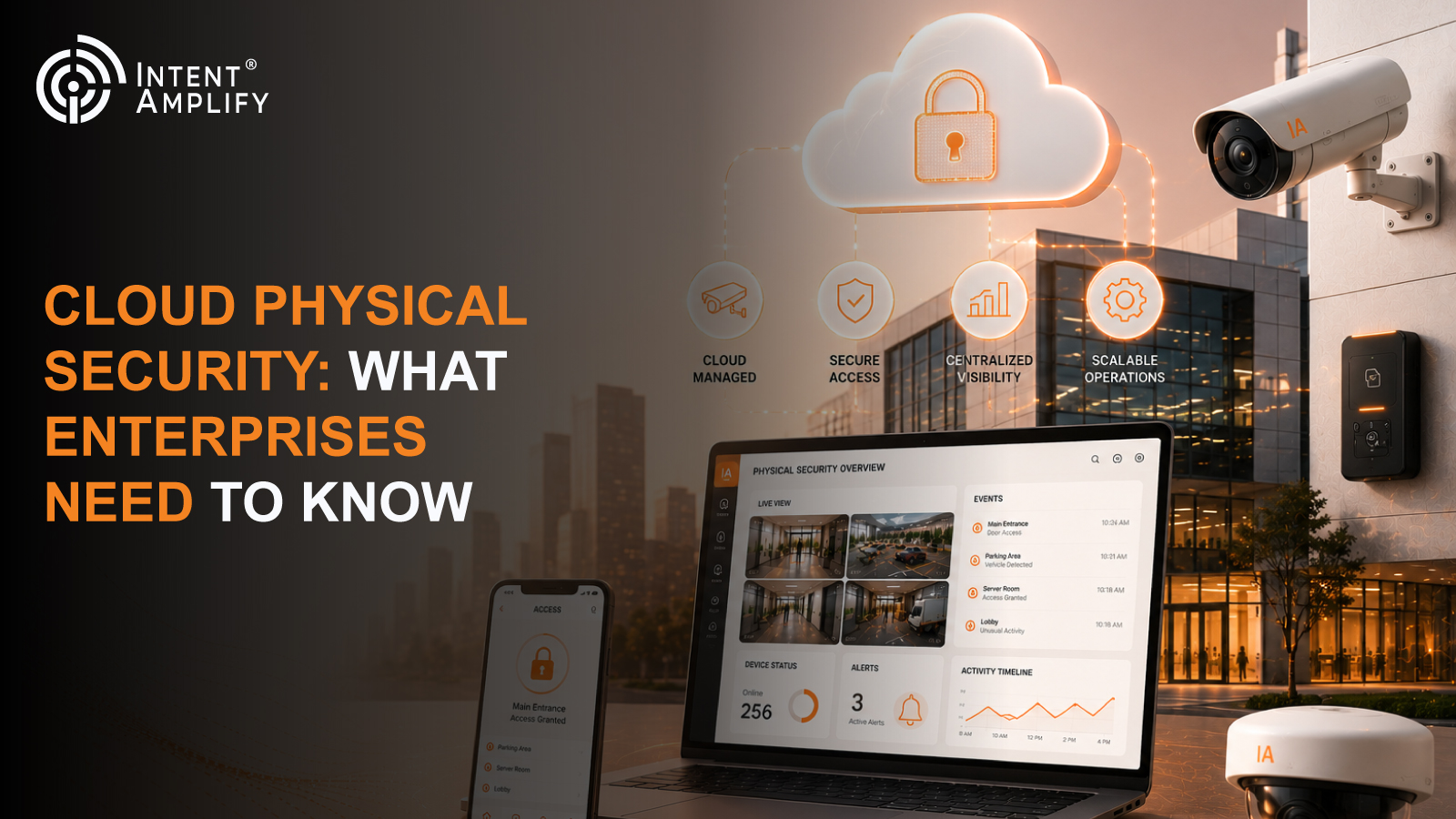
A cloud-based model changes the operating logic. Video surveillance, access control, sensors, alerts, and analytics can be managed through a centralized platform rather than scattered across disconnected local systems. Cameras and readers still exist at the edge. The difference is that security teams can view, search, update, and manage them remotely.
The market direction reflects that pressure. MarketsandMarkets estimates the global physical security market at USD 120.79 billion in 2025, with growth expected through 2030 as organizations invest in AI-enabled systems, remote monitoring, and integrated platforms. That number matters because it shows physical security modernization is no longer a facilities-only upgrade. It is becoming an enterprise infrastructure decision. 1
When “Multi-Site” Starts Meaning “Multi-Problem”
A single-site security setup can survive some inefficiency. A large enterprise cannot. Once an organization manages 20, 50, or 200 locations, small gaps become expensive patterns.
A badge policy updated manually at each site becomes a governance issue. A camera outage discovered after an incident becomes a liability issue. A loading dock event that takes hours to investigate becomes an operations issue. The same system that once looked “good enough” suddenly starts behaving like a very expensive filing cabinet with lenses.
Cloud-managed platforms help by giving teams one place to monitor device health, search footage, review access events, and respond across locations. For physical security directors, facilities leaders, logistics managers, and workplace teams, the value is not just convenience. It is consistency. The enterprise finally gets a common operating view instead of a patchwork of local guesses.
CyberTech Intelligence Perspective
CyberTech Intelligence views cloud physical security as an enterprise operational intelligence platform, not simply a replacement for on-premises video systems. As organizations manage more sites, more access points, more devices, and more incident data, the value of cloud-managed security comes from the ability to centralize visibility, standardize governance, and turn physical events into usable operational context.
For enterprise leaders, the shift is not just about storing footage differently or reducing dependence on local recorders. It is about giving security, facilities, operations, and risk teams a shared view of what is happening across the physical environment. In that model, cloud physical security becomes a decision-support layer for investigation speed, access governance, safety, resilience, and executive oversight.
The Useful Kind of AI, Not the Science-Fiction Kind
AI in physical security is most valuable when it removes work nobody should be doing manually. Searching hours of footage to find a person, vehicle, or movement pattern is not strategic work. It is a punishment with timestamps.
AI video security can help teams identify relevant moments faster, detect unusual activity, support real-time alerts, and connect video evidence to access events. In a warehouse, that could mean locating when a vehicle entered a restricted zone. In a hospital, it could mean verifying an unauthorized access attempt. In a retail environment, it could mean connecting transaction exceptions with video clips.
The key is not whether a platform “has AI.” That phrase has been beaten into paste by marketing departments. The better question is whether the analytics reduce false alerts, speed investigations, protect privacy, and fit the workflows security teams already use under pressure.
For teams evaluating how cloud-managed video, access control, and AI-driven search can work across distributed facilities, this demo deck offers a practical look at modern enterprise cloud physical security in action: Access the demo deck.
The Adoption Signals Are Loud, Even If the Industry Still Speaks in Acronyms
Cloud adoption in physical security is moving from experimental to expected. A Harris Poll-backed study commissioned by Verkada found that 92% of security leaders agree the future of physical security is cloud-based. Since the research comes from a cloud-security provider, it should be read as an industry signal rather than carved into stone tablets. Still, the number aligns with what many enterprise teams are already experiencing: fragmented local systems are becoming harder to justify at scale. 2
The same study found that 86% of organizations not yet fully cloud-based plan to migrate their physical security systems. That is the more practical finding. It suggests many organizations are not asking whether connected security platforms are viable anymore. They are asking how quickly they can move without disrupting operations, compliance, budgets, or site-level workflows.2
Budgets are following that direction. The study also reported that 7 in 10 organizations expect to increase physical security spending in 2025. For CFOs and COOs, the point is not simply higher spend. It is whether that spend reduces maintenance burden, improves response time, and gives teams more usable intelligence across facilities. 2
Access Control Deserves More Attention Than It Gets
Video tends to dominate the conversation because it is visible, searchable, and easy to understand. Access control is quieter, but often more strategic. It determines who can enter, where they can go, when access should change, and how quickly the organization can react when something goes wrong.
In a cloud-managed environment, administrators can revoke credentials, push role-based permissions, manage temporary access, review audit trails, and coordinate lockdowns across locations. When connected with video, access events become far more useful. A forced-door alert with the right camera view is in context. A badge event with no visual verification is merely a clue, such as wearing a lanyard.
CyberTech Intelligence Enterprise Cloud Physical Security Evaluation Framework
Moving physical security onto connected platforms also raises the stakes. Cameras, readers, and sensors are now part of the broader technology environment. That means vendor security, encryption, identity management, audit logs, data retention, and compliance posture all matter.
Genetec reported that 31% of physical security professionals said their organization was targeted by cybercriminals in the previous year. That should end any fantasy that physical systems sit outside cyber risk. A modern deployment needs strong access controls, secure device communication, regular updates, and clear governance. 3
|
Evaluation Pillar |
What to Assess |
|
Platform Security |
Encryption, secure access, audit logs, vendor security, and compliance posture. |
|
Identity & Access Governance |
Role-based access, credential lifecycle, temporary access, and admin permissions. |
|
AI Investigation Capability |
Search accuracy, alert quality, object detection, and false-alert reduction. |
|
Operational Visibility |
Device health, footage availability, access events, and site-level alerts. |
|
Enterprise Scalability |
Multi-site management, support model, integration options, and lifecycle readiness. |
The Bigger Shift
Cloud physical security is not just a replacement for older cameras or recorders. It is a shift toward treating security as a connected enterprise function. The best systems help teams see across sites, act faster, standardize policies, and use physical security data to support safety, operations, and resilience.
This is where Verkada fits naturally: unified, cloud-based, AI-enabled physical security for teams that need visibility without drowning in infrastructure.
For enterprises, the question is no longer whether physical security can become more connected. It already is. The real question is whether the systems protecting people, property, and operations are ready for the speed of the environments they are supposed to secure.
CyberTech Intelligence Enterprise Cloud Physical Security Evaluation Framework
|
Assessment Area |
1 = Low Readiness |
2 = Developing Readiness |
3 = High Readiness |
|
Cloud Migration Readiness |
Systems rely on local recorders and manual site management. |
Some sites use cloud tools, but migration is uneven. |
Cloud management is standardized across priority locations. |
|
Multi-Site Governance |
Sites follow separate processes with limited central oversight. |
Central visibility exists for key locations. |
Policies, devices, users, and evidence are governed centrally. |
|
AI Investigation Maturity |
Footage search is mostly manual. |
AI search supports selected use cases. |
AI accelerates search, verification, and incident review. |
|
Identity Integration |
Access control is separate from identity workflows. |
Some identity alignment exists, but updates are inconsistent. |
Access rights align with role, status, location, and policy. |
|
Device Lifecycle Visibility |
Device health is checked manually or after incidents. |
Key systems have basic health monitoring. |
Device status, uptime, updates, and failures are visible centrally. |
|
Operational Resilience |
Physical security supports recording, not resilience planning. |
Systems improve response, but measurement is limited. |
Security data supports response, auditability, continuity, and risk reduction. |
CyberTech Intelligence Research Desk Observation
Distributed operations are changing physical security from a site-level control into a governance and resilience challenge. Enterprises that continue to manage cameras, access systems, device health, and incident evidence through disconnected local workflows will face slower investigations, weaker auditability, and less consistent operational control.
The next stage of maturity will favor organizations that treat cloud physical security as part of enterprise governance. This means aligning infrastructure, identity, AI-enabled investigation, device lifecycle visibility, and response workflows into a common operating model that supports both security outcomes and operational resilience.
Recommended Next Step: Enterprise Cloud Physical Security Readiness Assessment
Cloud physical security is becoming more than a technology migration. It is now an enterprise readiness question that affects governance, identity control, investigation speed, cyber-physical integration, and operational resilience.
CyberTech Intelligence recommends that organizations conduct an Enterprise Cloud Physical Security Readiness Assessment before expanding cloud-managed video, access control, AI analytics, or multi-site physical security platforms. The assessment should evaluate cloud migration strategy, infrastructure maturity, identity governance, AI operational readiness, cyber-physical integration, and investigation workflows.
For security, facilities, operations, risk, and executive teams, this creates a practical bridge between physical security modernization and enterprise governance. It helps identify where current systems are fragmented, where operational blind spots exist, and where cloud-based physical security can improve resilience at scale.
Request an Enterprise Cloud Physical Security Readiness Assessment
References
- MarketsandMarkets -- Physical Security Market by Component, System, Service, Organization Size, Vertical, and Region - Global Forecast -- 2025
- Verkada -- The State of Cloud Physical Security: Top Findings -- 2025
- Genetec -- Zero Trust Strategies for Physical Security -- 2025