
Introduction: Why buyer intent data looks different in 2026
In 2026, buyer intent data is no longer a supporting input to demand generation. It is becoming the organizing layer of revenue operations. Not because intent data suddenly became perfect. It did not. But because the economics of growth changed.
B2B companies are operating in a market defined by slower deal velocity, larger buying committees, and increasingly invisible buyers.
According to Gartner, more than 75 percent of B2B buyers now prefer a rep-free experience for most of their journey. That insight has been repeated in various forms over the last few years.
When buyers delay direct engagement, first-party intent data arrives late by definition. Website visits, demo requests, and content downloads only surface after internal consensus has already started forming.
By the time a buyer shows up in your owned channels, the buying narrative, the short list, and often the budget assumptions are already shaped.
How Intent Signals Rewire Revenue
Boards want efficiency. CMOs are being asked to defend pipeline quality, not lead volume. CROs are dealing with bloated funnels where only a small fraction of accounts ever had a real buying problem.
Revenue teams that rely exclusively on first-party intent are optimizing for the end of the buying journey. Teams that incorporate third-party intent regain visibility into the beginning.
In a world where buyers avoid sellers until late-stage validation, that early visibility is the difference between entering a deal early or chasing one already half-decided.
This article examines how intent data is being used to drive revenue in 2026. Where it works, where it breaks, and what senior decision makers should demand from their teams and vendors.
Third-Party Intent Matters In A Privacy-First World
Privacy regulations and signal loss have forced most B2B organizations to invest heavily in first-party data. Website behavior, product usage, and content engagement. Necessary, but insufficient.
First-party intent tells you who is interacting with you. It does not tell you who is in the market but not yet visible. That is where third-party intent still matters. Not as a lead source. As market context.
In 2026, leading revenue teams combine both. First-party intent is used for prioritization within known accounts and pipeline acceleration. Third-party intent is used for account discovery, whitespace analysis, and competitive displacement plays.
As intent signals increasingly determine who enters a deal early versus who reacts late, revenue leaders need a clearer understanding of how intent data is actually generated, interpreted, and operationalized across modern go-to-market teams.
Intent Data Changes How ABM Is Funded And Measured
Account-based marketing promised precision. In many organizations, it delivered personalization theater.
The difference between high-performing ABM programs and the rest is not creative quality. It is the signal quality. Intent data has quietly become the budget allocation engine for ABM in 2026.
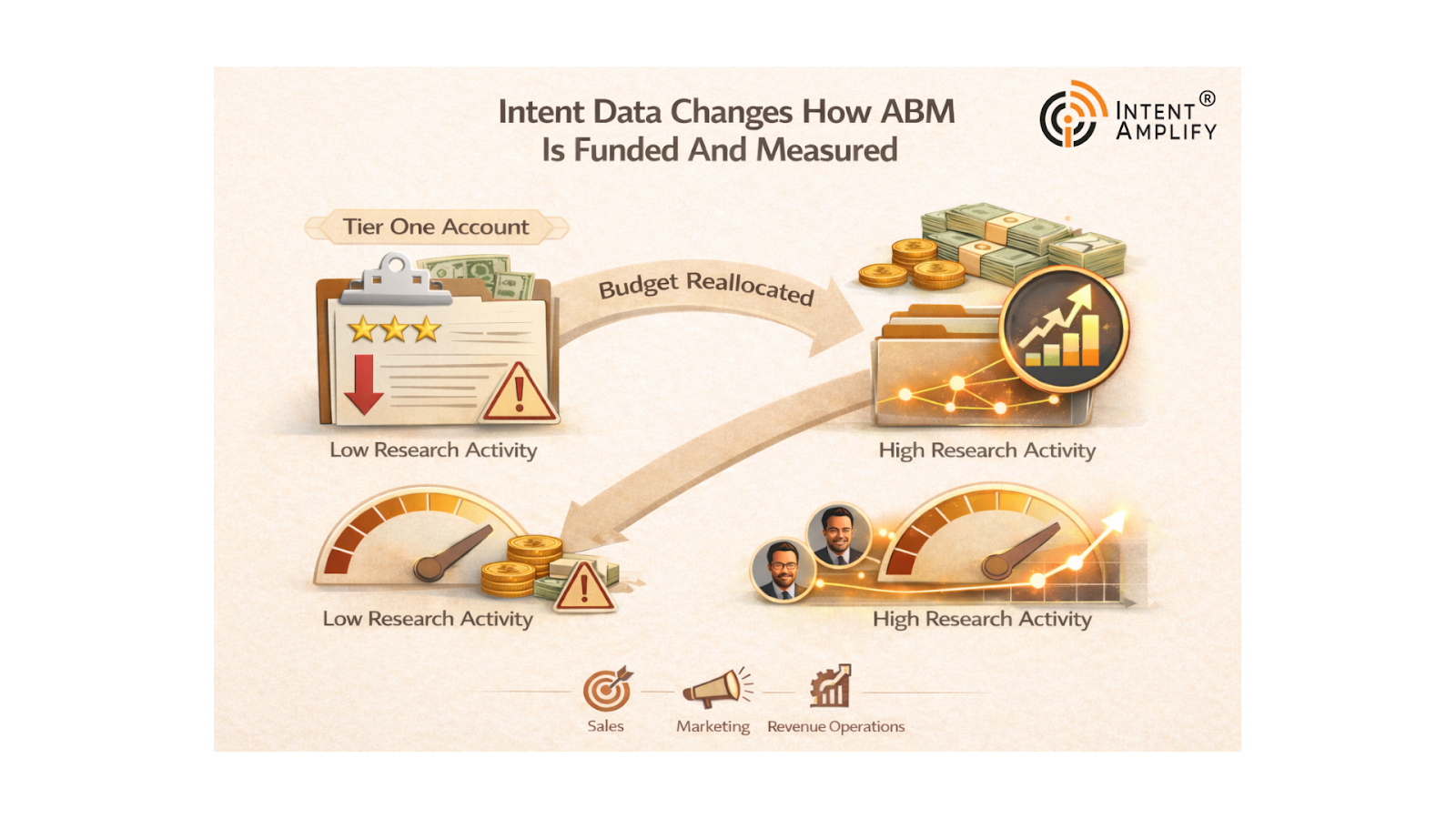
In practice, this looks like a CMO pulling spend from a Tier One account midway through the quarter. Not because the account no longer fits the ICP, but because the multi-stakeholder research activity stalled after early problem exploration.
The budget does not disappear. It is redirected to a small cluster of Tier Two accounts where research intensity is accelerating across security, finance, and procurement roles. Sales objects. The accounts were not on the original priority list.
Stop chasing signals. Start acting on intent. See how modern revenue teams turn buyer intent into a repeatable growth advantage.
Why Lists Fail B2B Intent Data and How Probabilistic Models Win
One of the most persistent mistakes in B2B is treating intent data as a list.
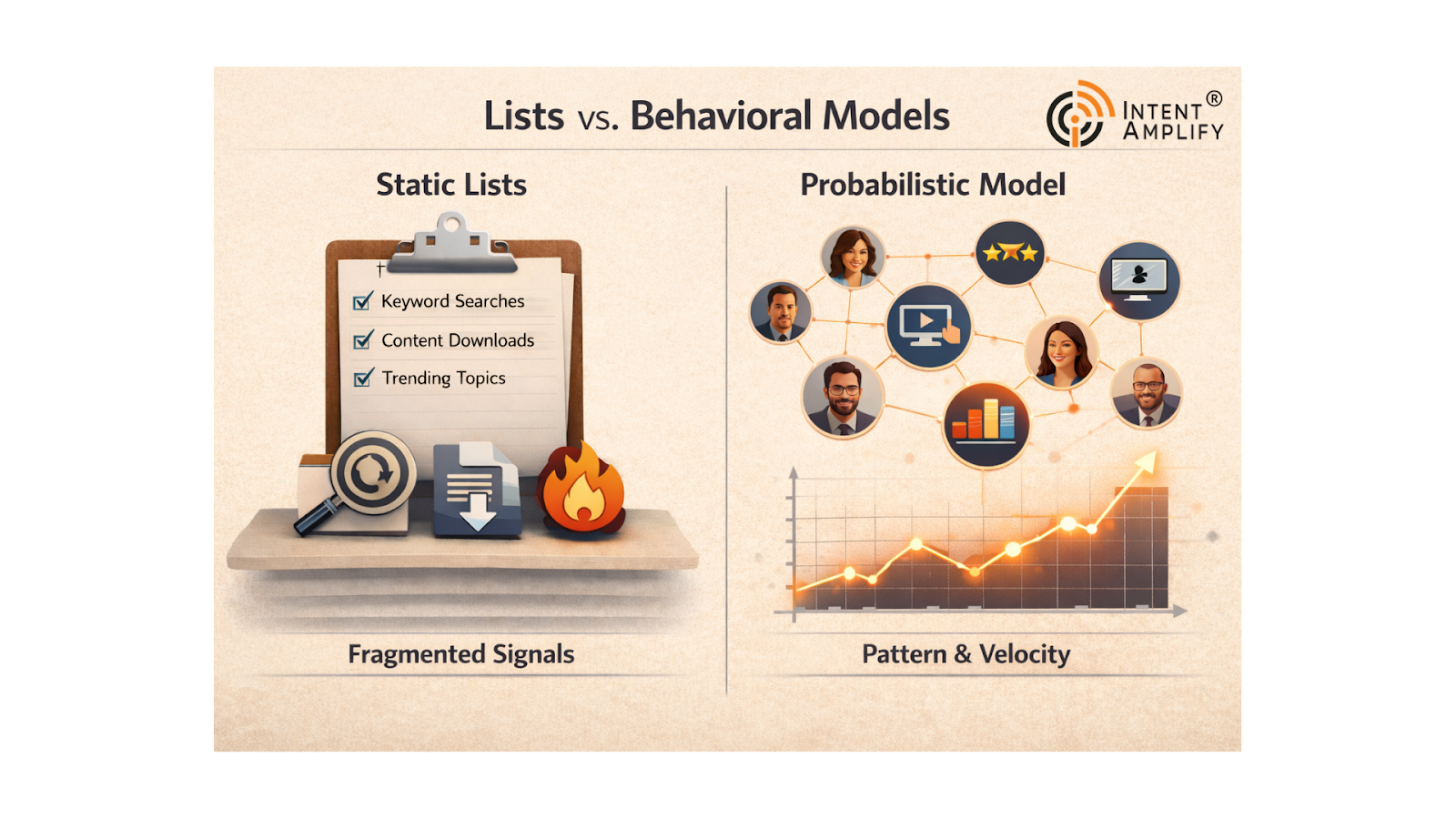
A list of accounts researching a keyword. A list of companies consuming content. A list of surging topics. Lists are easy to sell and easy to misuse.
In 2026, the organizations seeing revenue impact from the intent data approach will do so differently. They treat intent as a probabilistic behavioral model.
That distinction matters.
"Many B2B buyers feel overwhelmed and frustrated by the outreach they receive from sellers and the seller's organization. Bad prospecting actively damages relationships with potential customers," said Robert Blaisdell, VP Analyst in the Gartner Sales Practice.
When Fragmented Signals Reveal Buying Intent
Most buying committees do not announce themselves. They move in fragments. One stakeholder reads a peer review. Another watches a webinar. A third scans an analyst report.
Individually, these signals mean very little. Aggregated over time and normalized against baseline behavior, they become meaningful.
This is why modern intent platforms have moved away from raw activity counts toward relative consumption, velocity, and deviation from normal patterns. A spike only matters if it is unusual for that account and aligned to a commercial category.
Forrester's research reinforces what experienced revenue leaders already see in the field. Isolated spikes, a single content download, or a short burst of research activity rarely correlate with buying decisions.
High-performing B2B teams look instead at directional movement.
How research intensity is building. Whether topic consumption is shifting from problem framing to solution comparison. Or whether engagement sustains across multiple stakeholders over time.
That longitudinal view is what turns intent data from noise into a signal. It enables revenue teams to distinguish between casual interest and active buying cycles, and to intervene when momentum is genuine, not assumed.
Sales Skepticism Is Rational
Sales skepticism toward intent data is rational because most failures stem from broken workflows, not bad signals.
Fix the workflow, not the pitch.
Many sales leaders claim they tried intent data, and it did not work. Often, they are right. The failure is rarely the data. It is the workflow.
Sales teams do not want another alert. They want fewer bad conversations. Intent data helps only when it removes friction from their day.
In 2026, the most effective implementations share three characteristics:
1. Embedded delivery
Intent insights live inside CRM and sales engagement tools. Not in a separate dashboard. Reps should not have to interpret charts.
2. Actionable framing
Instead of "account is surging on topic X," the signal is framed as "legal and security stakeholders are actively researching alternatives to the current vendor."
3. Feedback loops
Sales disposition data feeds back into the intent model. False positives are suppressed. Wins are analyzed for signal patterns.
Intent Data Reshapes Pipeline Forecasting and Revenue Risk
Forecasting remains one of the least improved disciplines in B2B. CRM stages lag reality. Rep optimism distorts projections. Macro conditions change faster than quarterly plans.
Intent data does not solve forecasting. But it adds a missing dimension.
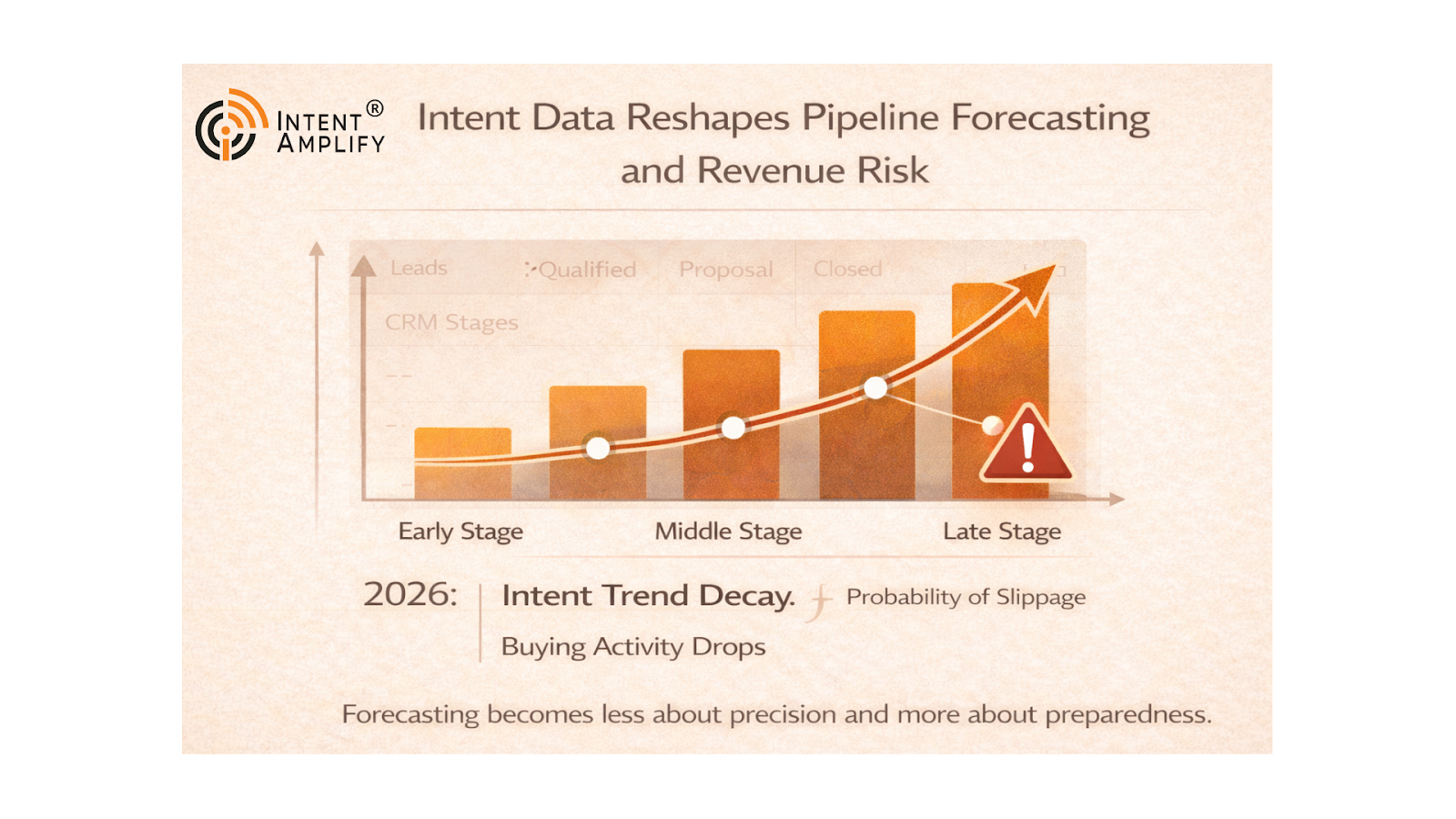
In 2026, revenue leaders increasingly use intent trend decay as an early risk indicator. When buying activity drops across multiple stakeholders in an active opportunity, the probability of slippage increases materially. Forecasting becomes less about precision and more about preparedness. The next challenge is knowing where intent helps and where it misleads.
Data Quality, Bias and The Limits of Intent
Intent data is not magic. It is messy, probabilistic, and biased toward digital behavior. Some industries research less online. Some buying signals happen in private channels. Some third-party data sources overrepresent certain geographies or company sizes.
There is also the risk of self-confirmation. Teams may overweight intent that aligns with existing beliefs and ignore contradictory signals. The answer is not to abandon intent data. It is to govern it.
High-maturity organizations establish clear guardrails. Intent informs prioritization, not qualification. It guides conversations, not replaces discovery. It is reviewed alongside qualitative feedback from the field.
As Harvard Business Review notes in its analysis of data-driven decision-making, organizations often misinterpret or over-rely on behavioral and analytical signals when they lack contextual judgment. The resulting risk is not bad data, but false certainty.
When intent signals are treated as definitive rather than directional, teams optimize for confidence instead of accuracy, leading to premature outreach, misallocated spend, and strategic decisions that harden assumptions instead of testing them.
What Changes in 2026 Specifically
Several structural shifts make intent data more consequential in 2026 than it was even two years ago.
1. AI-assisted research
Buyers increasingly use AI tools to summarize vendors and categories. This compresses research cycles and creates sharper intent spikes. Teams must detect and act faster.
2. Consolidated buying committees
Economic pressure has reduced the number of active initiatives. When intent appears, it is often tied to a real budget. Missing it is costly.
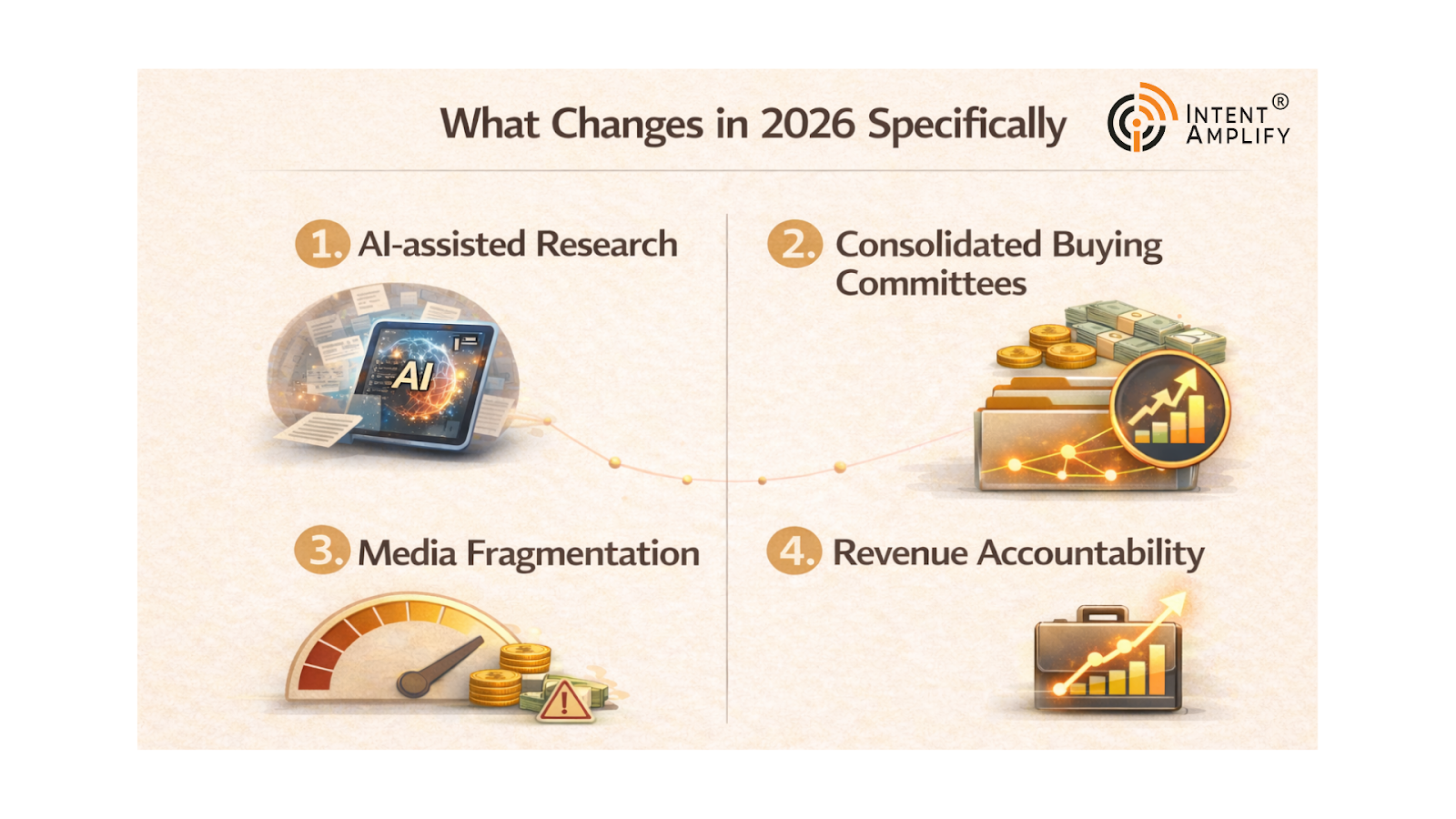
3. Media fragmentation
Buyers consume information across more channels. No single publisher or platform has a complete view. Intent aggregation matters more.
4. Revenue accountability
Marketing leaders are being measured on closed revenue contribution, not MQLs. Intent data provides defensible prioritization logic.
These forces are converging. The organizations that treat intent data as infrastructure rather than a campaign input are better positioned to navigate it.
Intent Maturity: A Leading Indicator of Revenue Resilience
By 2026, intent data maturity is quietly becoming a predictor of how organizations perform under pressure.
When budgets tighten or markets shift, companies with immature intent practices tend to respond bluntly. Broad cuts. Frozen spend. Indiscriminate sales pressure. The pipeline collapses unevenly.
Organizations with mature intent capabilities respond surgically, driven by digital research far earlier in the journey, resulting in successful ABM campaigns. They reduce spending where buying interest is absent, double down where momentum is real, and preserve sales capacity for accounts that matter now.
In uncertain markets, resilience does not come from having more opportunities. It comes from knowing which ones are real. Intent data, when operationalized correctly, provides that clarity earlier than any other signal available to revenue leaders today.
Trusting Intent Signals Pays Off in Downturns
Teams that trust intent signals are less likely to overcorrect. They avoid burning sales credibility through premature outreach. They preserve brand equity by not flooding inactive accounts with noise. Over time, this restraint improves response rates, rep morale, and win efficiency, especially in downturns.
The uncomfortable truth is that intent maturity exposes leadership behavior as much as buyer behavior. Organizations that struggle to act on intent data often struggle with focus, prioritization, and internal alignment more broadly.
According to Forrester, over 85 % of companies leveraging intent data report realizing tangible business benefits - including better response rates and more effective prospecting - underscoring why organizations that trust and operationalize intent signals are better equipped to navigate downturns.
This is why intent maturity increasingly separates organizations that merely survive downturns from those that quietly gain share. Not because they see more opportunities, but because they waste less effort chasing the wrong ones.
Intent as a Revenue Multiplier
As buyer behavior becomes harder to observe and growth becomes more expensive to capture, prioritization has become the central discipline of revenue leadership.
Intent data now sits at the core of that discipline. Not as a forecasting shortcut or a demand-generation input, but as a live signal of where real buying momentum exists. In 2026, it increasingly determines how sales capacity is deployed, how marketing spend is reallocated, and how risk is managed inside the pipeline.
Organizations that operationalize intent well move faster and waste less. They redirect effort earlier, disengage sooner from stalled initiatives, and ground revenue decisions in buyer behavior rather than internal assumptions. The result is no more activity. It is a higher-quality execution.
This is where intent data becomes a force multiplier. It does not replace judgment. It sharpens it. When embedded into revenue workflows and governed with discipline, intent data amplifies leadership decisions and exposes misalignment before it shows up in missed quarters.