
For most B2B leadership teams, intent data is no longer a novel capability. It is now infrastructure. First, it was a targeting experiment inside demand gen. Then sales operations started routing accounts based on surging topics.
Today, revenue forecasts, SDR staffing plans, and even product launch sequencing are influenced by behavioral buying signals.
And yet, despite widespread adoption, executive confidence in intent data remains uneven.
This article is not about features or integrations. It is about risk management, because that is what intent data has quietly become.
The Core Issue: False Precision
Executives rarely say this publicly, but many revenue leaders distrust intent platforms. Not because they reject the concept, but because they have lived through the experience.
The IAB's State of Data 2024 report showed 65% of marketers still struggle to validate third-party data accuracy and provenance. That number matters.
If leadership cannot trace how a signal was generated, they cannot assign operational confidence to it.
An intent partner in 2026 must do something vendors historically avoided: explain uncertainty.
You should be able to ask a provider a direct question: What percentage of these "in-market" accounts actually convert to opportunities within a defined time window?
If they cannot produce cohort-level outcome data, you are not buying intelligence. You are buying activity indicators.
Demand #1: Transparent Signal Construction
The most important question you can ask an intent provider is simple.
Where does the data actually come from?
You will hear terms like cooperative network, behavioral aggregation, and publisher ecosystem. These phrases often conceal very different data-generation methods.
Some networks rely primarily on content consumption across niche B2B publishers. Others infer interest from ad impressions and cookie behavior. Others model interest based on IP-level traffic patterns. These approaches do not carry equal predictive value.
Gartner's 2024 research on revenue technology effectiveness warned that more than half of B2B organizations cannot map external behavioral data to identifiable buying group members with confidence. That is a governance issue as much as a technology issue.
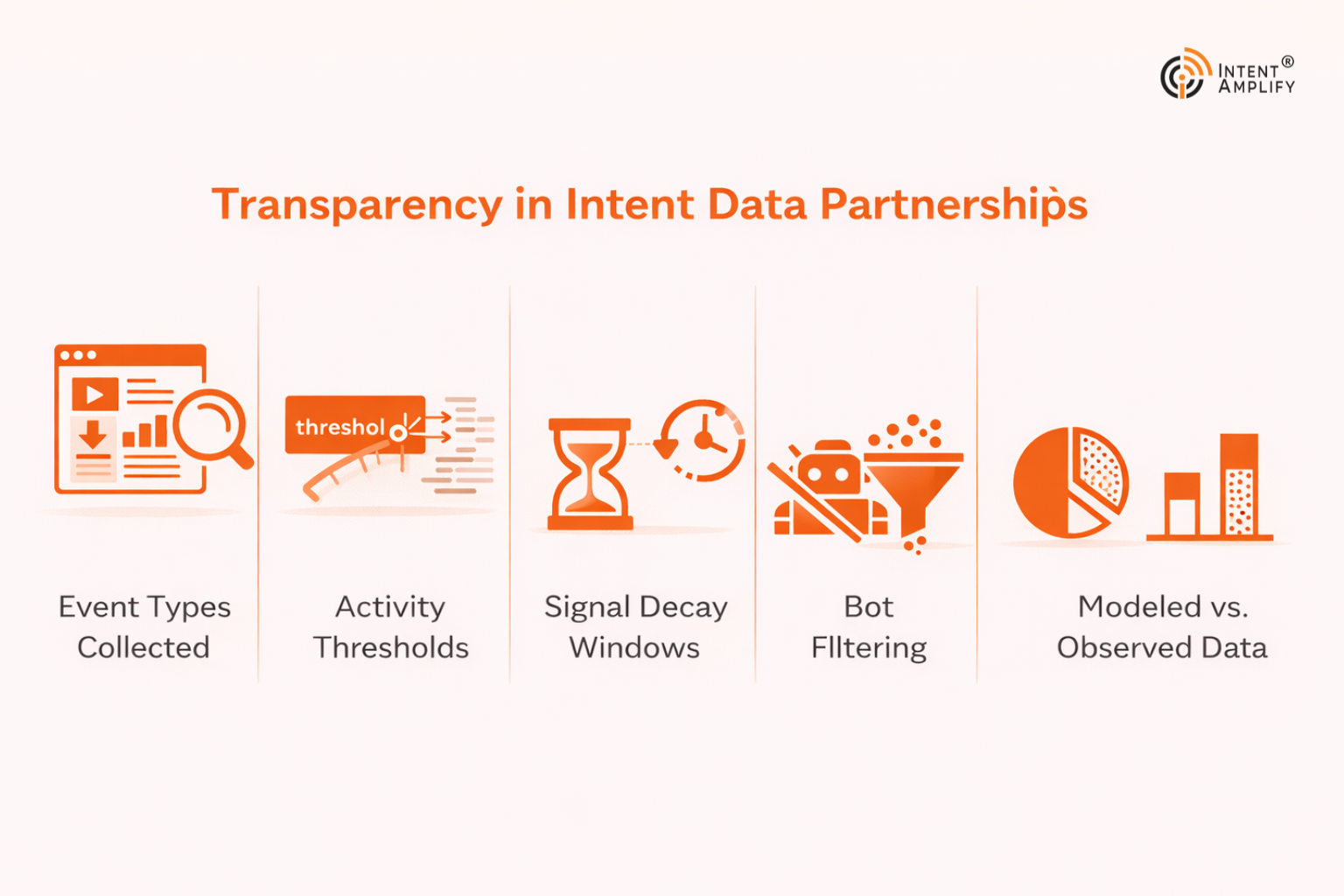
A credible intent partner should disclose:
Event types collected (article reads, research sessions, downloads, comparison activity).
Minimum activity thresholds before classification.
Signal decay windows.
How bots and automated traffic are filtered.
What portion of data is modeled versus observed.
In 2026, the risk is not missing opportunities. The risk is operationalizing bad data across sales, marketing, and forecasting systems.
Demand #2: Buying Group Visibility, Not Account Noise
Account-level intent worked when B2B selling meant engaging a single champion.
Enterprise deals involve distributed research behavior across departments and geographies. Procurement, security, IT architecture, operations, and finance all participate. Often asynchronously.
Here is the hidden failure mode of traditional intent data: It identifies interest at the organization level while buying decisions occur at the role level.
An effective partner should be able to indicate behavioral clustering. Not just "Company X is researching data security," but whether the activity comes from technical evaluators, financial stakeholders, or implementation teams.
Why this matters:
Technical research signals evaluation stage.
Procurement research signals vendor shortlist.
Implementation research signals near purchase.
Without buying-group resolution, SDR outreach timing becomes guesswork.
McKinsey's 2024 B2B Pulse survey reported that 70% of B2B buyers prefer minimal vendor contact during early research phases. Poorly timed outreach does not merely get ignored. It degrades brand credibility.
An intent partner should help you avoid engagement as often as it prompts it.
That is a more valuable capability than lead volume.
Demand #3: Verifiable Outcomes, Not Engagement Metrics
Many providers still report success through surrogate measures. Increased website visits. Higher open rates. Campaign engagement.
Executives do not operate on engagement. They operate on revenue predictability.
The right question is not whether intent data drives activity. It is whether it changes the win probability.
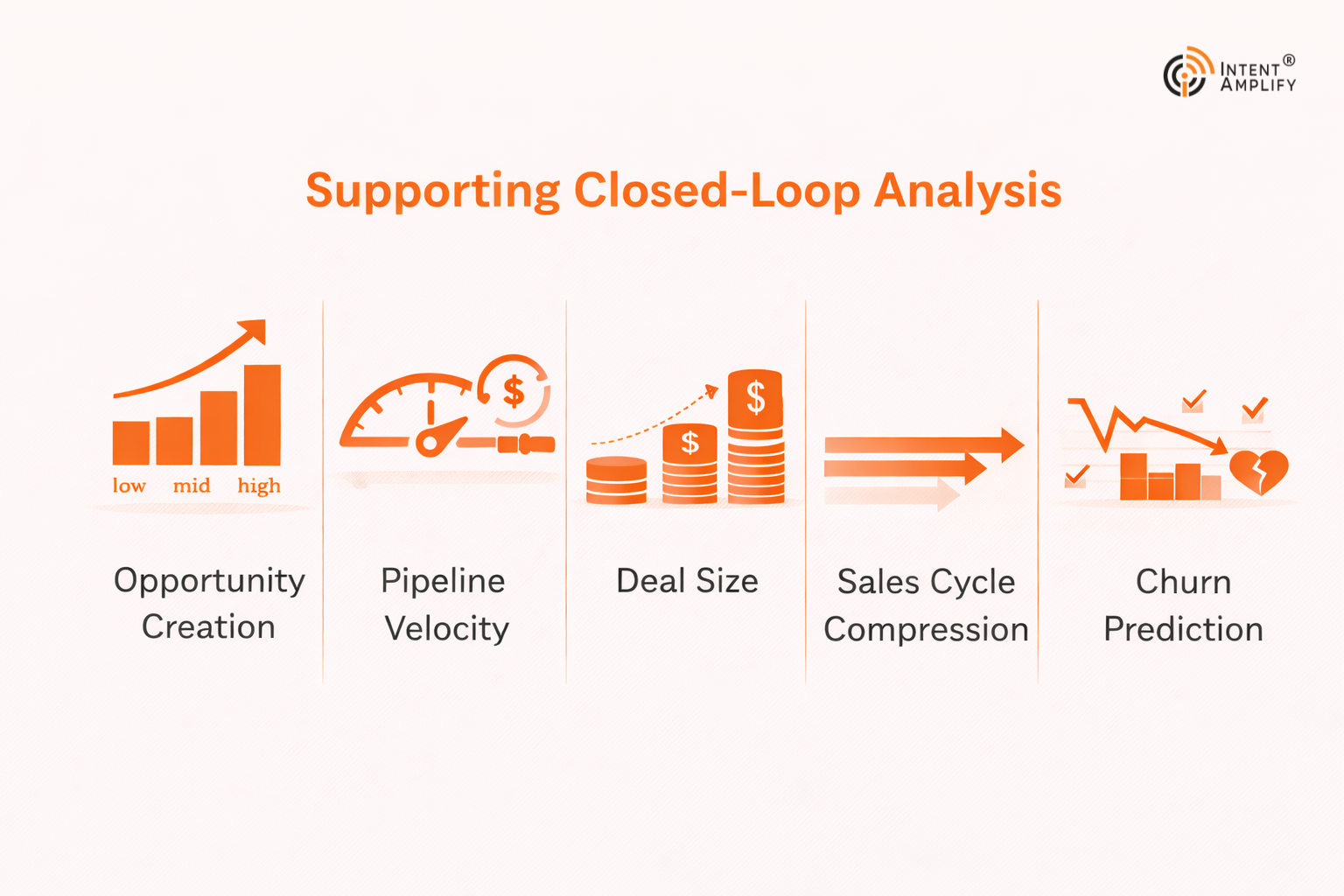
A partner should support closed-loop analysis:
Opportunity creation rate by intent tier.
Pipeline velocity impact.
Deal size correlation.
Sales cycle compression.
Churn prediction accuracy.
If a provider cannot tie their data to CRM outcomes, they are operating outside operational reality.
Salesforce's 2024 State of Sales report noted that 83% of high-performing sales teams now rely on data-driven prioritization to allocate seller time. However, the report also highlights a consistent issue. Reps ignore signals they perceive as unreliable.
This is crucial. Intent data adoption ultimately depends on sales trust, not marketing enthusiasm.
If your sellers do not believe the signals, the platform fails, regardless of technical quality.
Demand #4: Time Sensitivity and Signal Freshness
Intent data decays faster than most organizations realize.
Research behavior clusters tightly around internal project triggers: budget release, security audit, vendor contract renewal, and leadership mandate. These windows are brief.
Buyers narrow options early using independent research sources.
That means timing matters more than volume.
You should ask an intent provider two specific questions:
What is the average latency between behavior and delivery?
How often is the scoring recalculated?
Weekly updates are increasingly inadequate. For many software categories, meaningful buying windows last 30-45 days. If signals arrive late, your team is competing against an already-formed preference.
Freshness, not database size, determines usefulness.
Demand #5: Privacy Durability
Intent data now sits directly inside regulatory risk.
The decline of third-party cookies, the expansion of US state privacy laws, and stricter enforcement around personal data processing have changed what "data compliant" actually means.
Executives should understand the implications. You inherit the compliance risk of your data supplier.
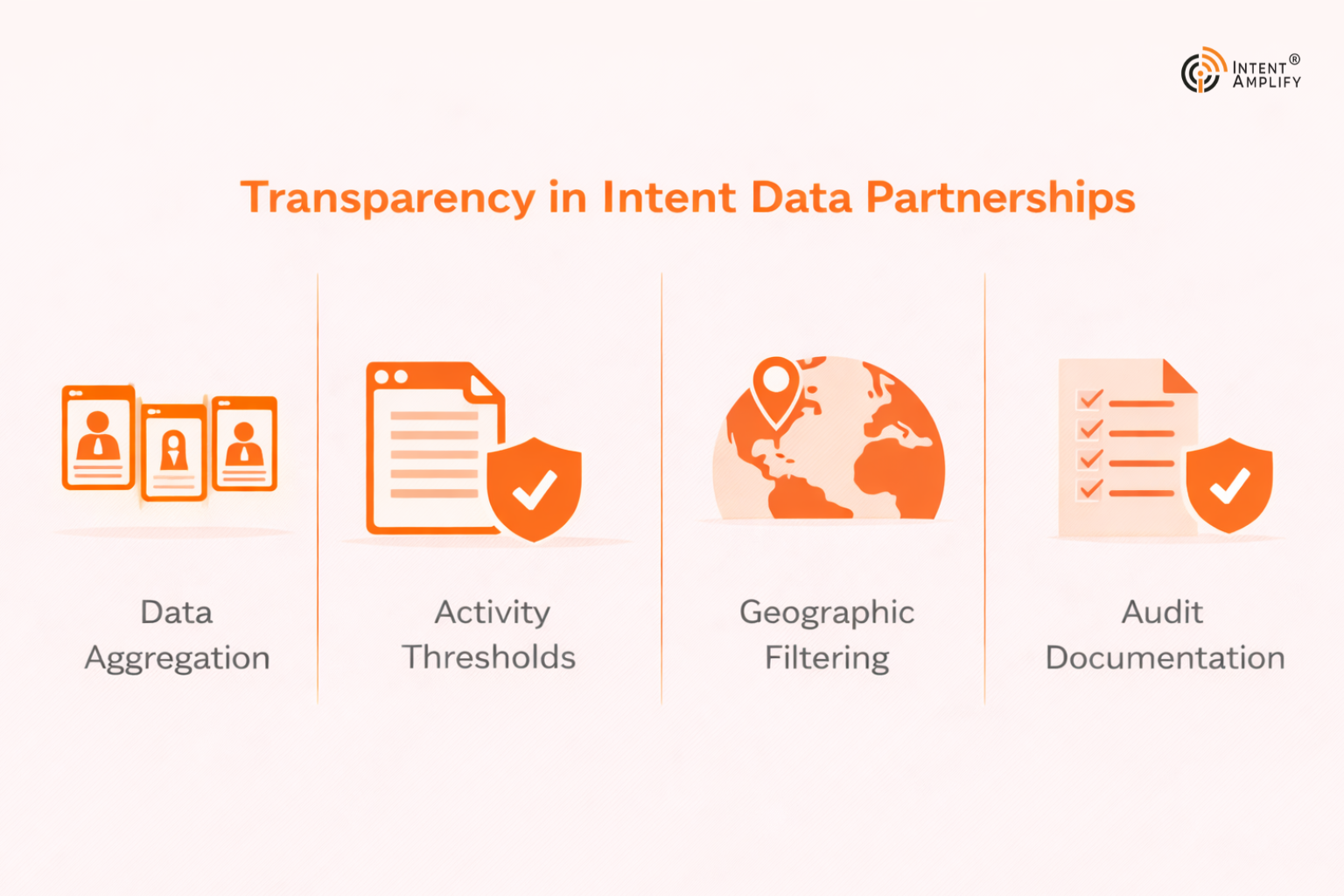
A credible partner should clearly state:
Whether signals are personal, pseudonymous, or aggregated.
Consent mechanisms used by publishers.
Geographic filtering.
Data retention policies.
Audit documentation availability.
This is no longer a legal footnote. It is a board-level governance concern, especially for public companies and those selling into regulated industries.
Demand #6: Operational Fit
The final and least discussed requirement: operational usability.
Most intent programs fail not because the data is wrong, but because the organization cannot act on it.
Intent data influences at least five functions simultaneously: marketing, SDR teams, account executives, customer success, and sometimes product marketing. If the partner only integrates into marketing automation, the organization will treat it as a campaign tool.
High-performing deployments embed intent into revenue operations workflows:
Territory planning
Call prioritization
Expansion targeting
Renewal risk detection
The partner should help design operational usage patterns, not merely provide feeds.
Otherwise, the technology remains an insight engine without execution capacity.
The Real Trade-Off
Intent data will never be perfectly accurate.
B2B buying behavior is messy, political, and often contradictory. Companies research competitors they never plan to buy. Teams explore ideas years before budgeting. Individuals conduct research unrelated to active projects.
The goal is not certain. It is a probabilistic advantage.
A strong intent data partner does not promise leads. They improve decision timing, resource allocation, and forecasting confidence.
Weak partners offer volume. Strong partners reduce wasted effort.
Executives should evaluate providers accordingly.
Conclusion
Intent data has moved out of marketing experimentation and into revenue infrastructure. That changes the evaluation standard.
You are not purchasing targeting enrichment. You are selecting an external intelligence source that will influence hiring plans, pipeline expectations, and market strategy.
In 2026, the defining characteristic of a credible intent data partner is not dataset size, publisher count, or UI sophistication.
It is operational honesty.
Transparency about how signals are created. Evidence connecting signals to business outcomes. Realistic communication about uncertainty. And practical guidance on how organizations should act on imperfect information.
Anything less turns intent data into noise with analytics attached.