
Generative AI (GenAI) is quickly becoming one of the most important shifts in modern B2B marketing. Not because GenAI suddenly makes content faster to produce, but since it changes how marketing systems learn from real buyer behavior.
At its core, the GenAI flywheel connects three things that have traditionally operated in silos. Community conversations, customer insight, and marketing execution.
Communities generate the raw signals. Questions, use cases, product frustrations, and emerging needs. GenAI analyzes those signals at scale, identifying patterns that would otherwise remain buried across thousands of conversations.
Marketing teams can then turn those insights into education, thought leadership, and resources that directly reflect what the market is already trying to understand.
When this loop works properly, marketing becomes less about guessing what buyers care about and more about responding to signals that already exist.
How the Community Is Replacing Traditional Trust Signals
Marketing teams still spend enormous effort refining brand messaging. The problem is that the credibility of brand messaging has been eroding for years.
Additionally, professionals trust people who have already used the product. Or those people who have solved similar problems. The closer the experience feels to their own reality, the stronger the signal.
The data reflects that shift. The Edelman Trust Barometer reports that 63% of people trust information from peers and technical experts more than information directly from companies.
That dynamic plays out very clearly in B2B buying groups.
A buyer might download a whitepaper or attend a webinar, but the real validation often happens somewhere else.
A Slack message to a colleague. A question in an industry community. A DM to someone who has already implemented the product.
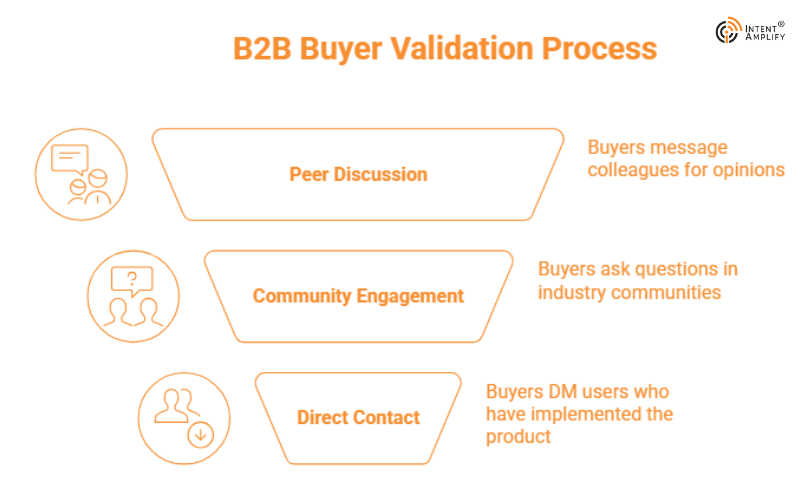
Those conversations do not appear in marketing dashboards. Yet they frequently determine which vendors survive the evaluation process.
Community marketing works because it operates inside that environment rather than trying to interrupt it.
And when communities become active knowledge hubs, trust compounds.
How Community-Driven Growth Transforms Marketing
Acquisition costs in B2B have been climbing steadily for more than a decade.
Part of the reason is simple saturation. Buyers are exposed to enormous volumes of content and outreach. Standing out requires increasingly large marketing budgets.
Communities shift the cost structure.
Instead of acquiring each customer individually through paid channels, companies benefit from the momentum created by existing users.
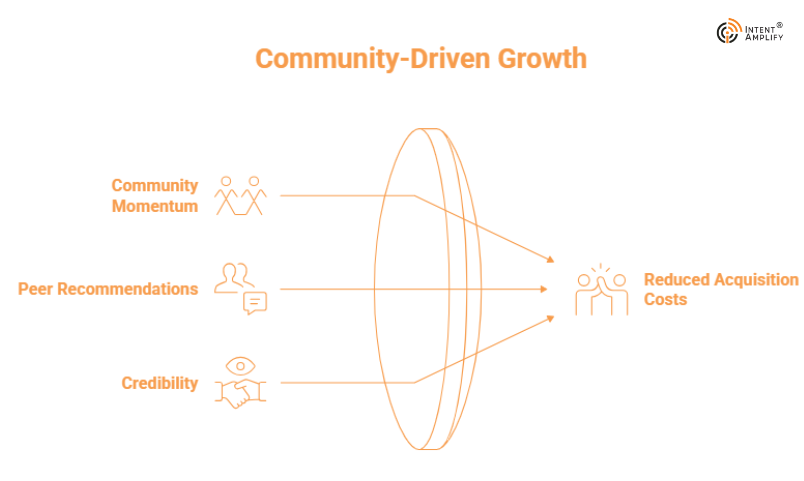
McKinsey data found that peer recommendations can increase purchase likelihood by two to three times compared with brand messaging alone. That change in credibility has direct financial implications.
It also changes how marketing teams think about growth.
When customers help other customers understand a product, onboarding accelerates. When experienced users answer questions in public forums, support costs decrease. When members share their own use cases, product education scales organically.
The Role of GenAI Inside the Community Flywheel
GenAI tends to be framed as a content creation tool. Faster blogs, faster emails, faster campaign assets.
That framing misses the more interesting opportunity.
Communities generate a constant stream of questions, problems, experiments, and workarounds. Historically, most of that knowledge remained trapped inside discussion threads.
AI changes that.
Large language models are very good at detecting patterns in unstructured conversations. They can identify recurring problems, emerging terminology, or unexpected use cases that product teams might otherwise miss.
Once those insights surface, marketing teams can transform them into structured knowledge.
AI accelerates the feedback loop between customer experience and market education. This shift is becoming increasingly visible across the customer experience landscape.
Conversations around how AI can translate customer interactions into operational insight are expected to feature prominently at industry gatherings such as Zendesk Relate 2026, where CX and technology leaders are exploring how customer data, automation, and engagement strategies are beginning to converge.
Industry data reflects this movement:
81% of consumers believe AI is now part of modern customer service.
Two-thirds of business leaders report performance improvements from AI in service operations.
59% of consumers expect AI to significantly change interactions within two years.
More than half of customers say they will switch brands after a single poor service experience.
The gains rarely come from pure automation.
They come from amplifying intelligence that already exists in the customer base.
Designing Communities That Actually Deliver Business Value
A surprising number of community initiatives fail.
Not because communities themselves do not work, but because they are launched without a clear purpose. Many organizations treat communities as engagement experiments rather than strategic infrastructure.
Successful communities almost always begin with a narrow operational objective.
Sometimes it is onboarding. Sometimes product education. Sometimes,s peer troubleshooting.
The focus matters. When communities try to serve every audience and every use case simultaneously, participation fragments quickly.
Customer lifecycle data reinforces this point. Retention benefits appear gradually. Communities rarely deliver immediate pipeline spikes. But over time, they change how customers interact with the product.
And how they talk about it.
Choosing the Right Community Platform
Choosing where a community should live sounds straightforward. However, in reality, it rarely is.
Some companies prefer owned community platforms because they provide governance and data visibility. CRM integration becomes possible, which allows marketing teams to connect engagement with revenue outcomes.
Other organizations prioritize speed. Slack groups, Discord servers, or LinkedIn communities reduce setup time and often attract early participation faster.
Both approaches have trade-offs.
Third-party platforms provide familiarity, but they restrict access to data. As communities grow, organizations often struggle to understand which interactions influence retention or expansion revenue.
Owned platforms solve that problem but introduce operational complexity. Moderation, security, and infrastructure suddenly become internal responsibilities.
There is no universal answer.
What matters is alignment between audience behavior and operational reality.
Participation Is the Real Growth Engine
Communities collapse when they behave like content distribution channels.
A steady stream of posts rarely sustains engagement for long. Participation does.
Moderated discussions. Live Q&A sessions. Peer-led tutorials. Feedback threads about new features. Moments where members feel invited to contribute rather than consume.
That participation has measurable consequences.
Community participation often creates a deeper emotional connection between customers and the brand. When users feel heard, supported, and involved in a shared ecosystem, that engagement begins to influence long-term value. Gallup research reinforces this dynamic, showing that fully engaged customers represent a 23% premium in share of wallet, profitability, revenue, and relationship growth compared with average customers.
Engagement does not happen through polished messaging.
It happens through involvement.
Peer Support Is an Underrated Strategic Asset
One of the most powerful dynamics inside communities is peer support.
Customers solving problems for other customers.
At first glance,ce this looks like a customer service mechanism. But the strategic implications are broader.
Peer explanations often carry more credibility than official documentation. They include practical workarounds, edge cases, and lessons learned from real deployments.
And as these conversations accumulate, they form a searchable knowledge base that grows organically.
Many organizations discover an unexpected side effect. Support costs decrease while product adoption improves.
Not because the company invested more resources into support, but because the community became part of the support infrastructure.
Connecting Community Engagement to CRM and Revenue Insight
Community programs often struggle to justify long-term investment.
Leadership teams want measurable outcomes.
This is where CRM integration becomes important. When community activity connects with lifecycle data, patterns begin to emerge.
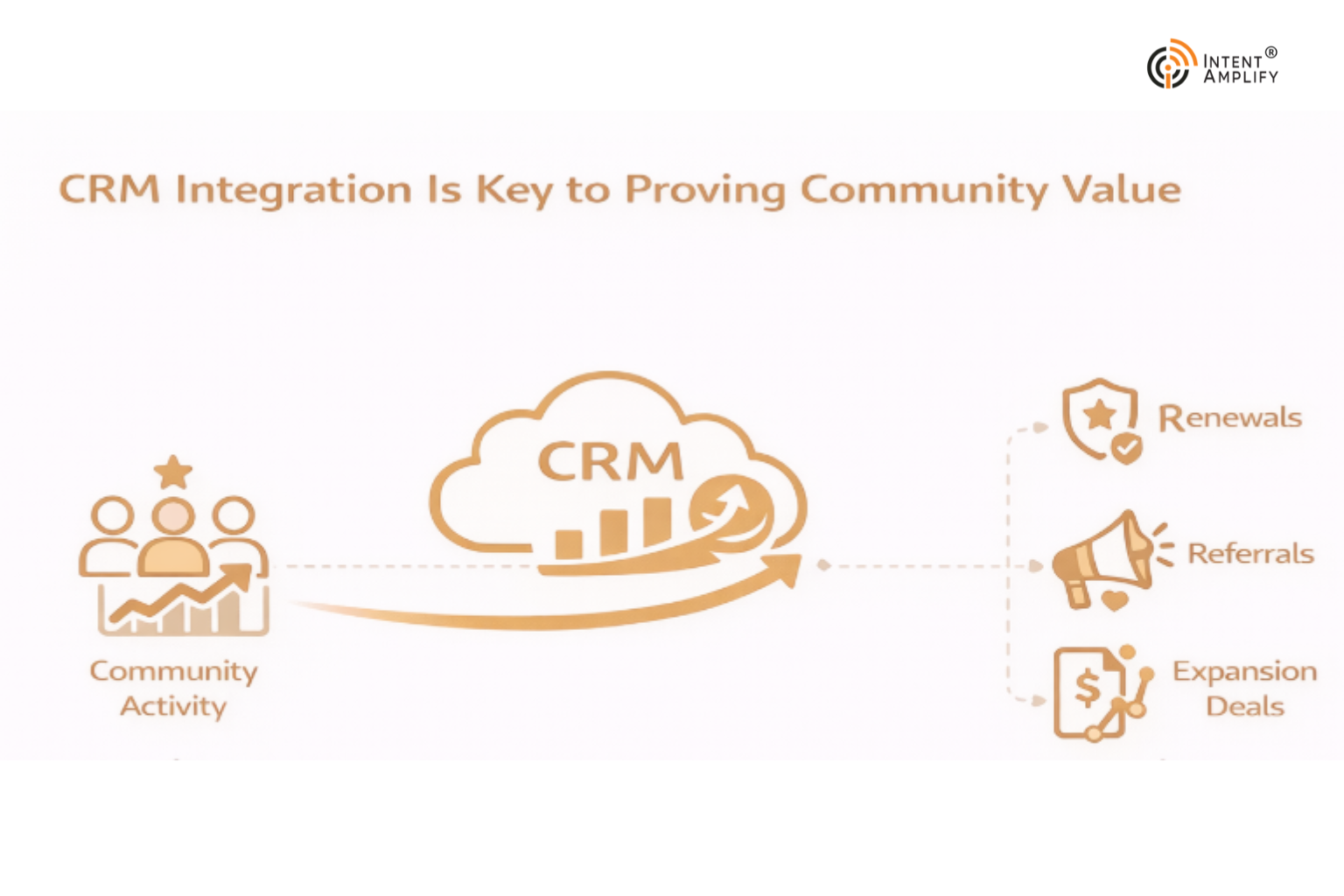
Which members renew more frequently? Which segments generate referrals? Which conversations appear before expansion deals?
Community participation becomes one of those engagement signals.
Without that visibility, communities risk being perceived as marketing experiments rather than revenue drivers.
The Real Work Happens After the Community Launch
Launching a community is relatively easy.
Sustaining one is not.
Participation fluctuates. Conversations drift. Moderation becomes demanding as membership grows. Community managers frequently face a balancing act between encouraging open discussion and protecting the environment from noise.
GenAI helps with some of the operational burden.
Automated summaries of discussions. Identification of unanswered questions. Content prompts generated from trending conversations. Even visual assets for events or announcements.
These tools do not replace human moderation.
The real value lies in freeing community managers to focus on relationships rather than administrative tasks.
Measuring What Actually Matters
Community success is rarely visible through vanity metrics.
Large membership numbers look impressive but reveal very little about value.
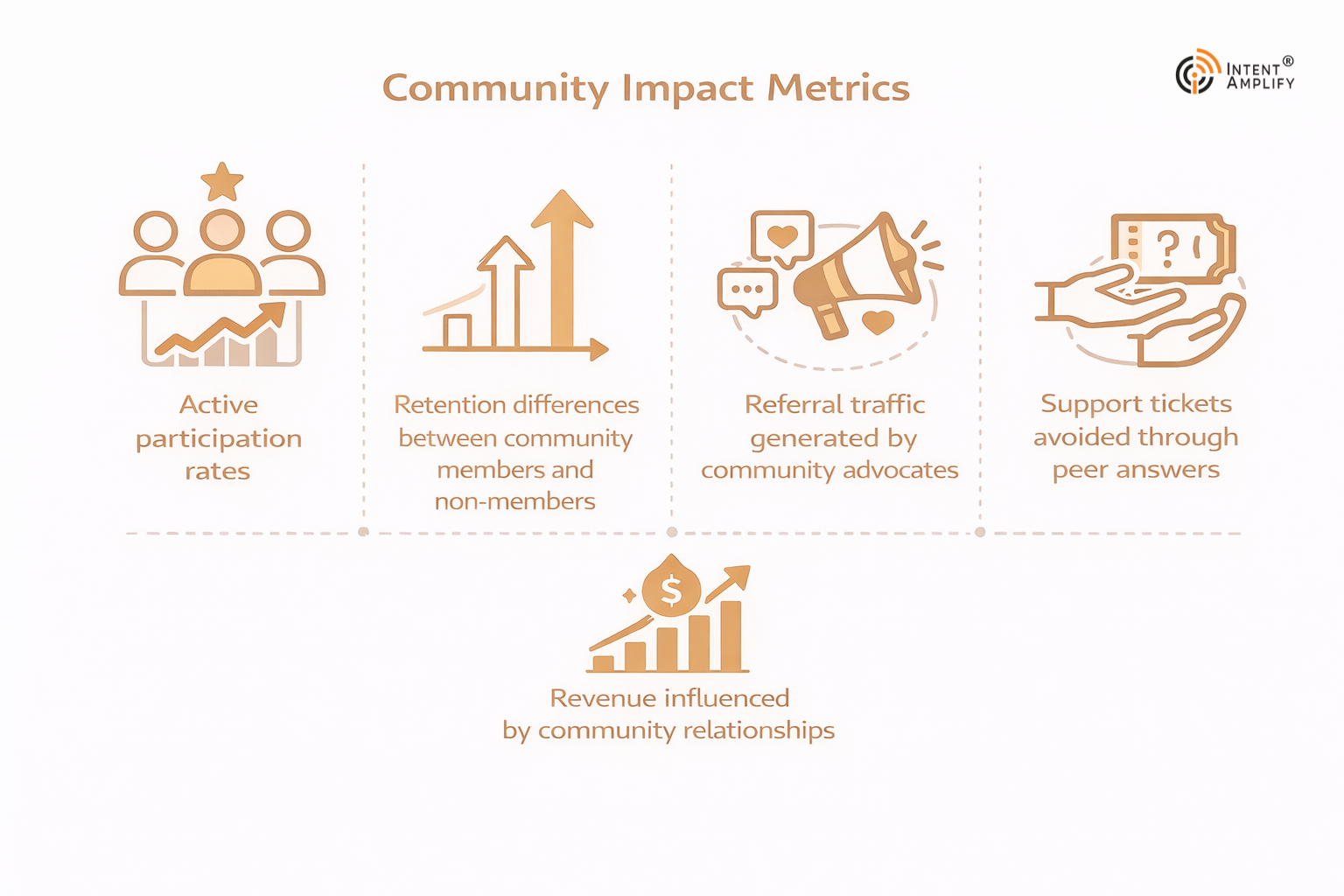
More meaningful indicators tend to include:
Active participation rates
Retention differences between community members and non-members
Referral traffic generated by community advocates
Support tickets avoided through peer answers
Revenue influenced by community relationships
These signals appear slowly.
However, once they emerge, the economics of the community model become difficult to ignore.
The Strategic Shift Ahead
GenAI is often described as a disruption to marketing.
In practice, its most interesting role may be quieter.
AI accelerates learning. Communities produce learning at scale. When the two systems connect, the feedback loop between customers and companies tightens dramatically.
That feedback loop is the real flywheel.
Communities generate insight. AI amplifies that insight into content and education. Education strengthens trust and advocacy. Advocacy brings new participants into the community.
Then the cycle repeats.
Companies that treat communities as peripheral marketing initiatives rarely see the full impact.
Those who treat them as strategic infrastructure. Integrated with product, support, and marketing, begin to see something different.
Not just engagement.
Momentum.