

Precision is key in B2B demand generation. Understanding the distinction between a Marketing Qualified Lead (MQL) and a Sales Qualified Lead (SQL) is not semantics but rather basic to how today's revenue teams function, align, and scale. And yet, so many organizations grapple with lead handoffs, misaligned KPIs, and poorly defined terms that cause friction between sales and marketing.
As buyer journeys become more complex and data-driven, defining MQLs and SQLs with clarity and optimizing the transition between them has become critical for accelerating the sales pipeline and maximizing return on marketing spend. In this article, we'll break down the difference between MQLs and SQLs, examine their roles in the sales funnel, explore real-world examples from leading B2B companies, and share current data that reveals how top-performing teams are approaching lead qualification in 2025.
What is an MQL, and What is an SQL?
It is crucial to understand the difference between MQL and SQL for any B2B business that wants to align marketing and sales activities perfectly. These two lead stages signify various levels of buyer intent, readiness, and engagement, and thus they necessitate unique approaches to conversion and nurturing.
What is a Marketing Qualified Lead (MQL)?
A Marketing Qualified Lead (MQL) is a lead who has expressed interest in your service or product based on certain marketing engagement cues. This interest can be gauged through activity such as downloading a whitepaper, viewing a webinar, opening a sequence of marketing emails, or repeating visits to your key product pages on your website.
MQLs are not yet qualified to be addressed by sales. Rather, they're top-of-or-middle-of-the-funnel folks looking at solutions, researching, or shopping for vendors. The objective here is to engage these leads with relevant content and individualized touchpoints and move them deeper into interest.
Most current B2B marketers apply lead scoring models to qualify MQLs by blending behavioral information (e.g., clicks, downloads, time spent on site) and firmographic information (e.g., firm size, job function, industry). Tools such as HubSpot, Marketo, and Intent Amplify's native BI platform allow teams to automate the process through real-time intent signals and content interaction insights.
As per Demand Gen Report's 2024 Benchmark Survey, 74% of B2B marketers utilize lead scoring to determine MQLs, but 53% confess that their sales teams regularly reject them because they are not ready.
That's why establishing the proper MQL criteria based on intent and fit is so important. A large-volume but poor-quality MQL pipeline wastes time, drives up costs per lead (CPL), and erodes trust between sales and marketing.
What is a Sales Qualified Lead (SQL)?
A Sales Qualified Lead (SQL) is an engaged prospect that has progressed past the initial engagement and is now deemed ready for direct sales contact. These leads have been qualified through automated qualification or manual check and exhibit definite buying intent and fit.
At this point, leads generally fit within a predefined list of attributes, including:
- The budget is available
- Authority to make decisions
- The need for your solution is confirmed
- The timeline for purchase is clear (commonly referred to as the BANT or CHAMP framework)
SQLs are not like MQLs; they are bottom-of-funnel (BOFU). Your salespeople should be confident to contact, realizing the lead has a pain your product is capable of addressing and is in an active consideration state.
This is where Intent Amplify's HQL and SQL delivery model makes the difference. Our pay-for-performance, human-verified strategy ensures leads are marketing-ready not just sales-conversion-ready, significantly enhancing connect rates and pipeline waste reduction.
According to HubSpot Statistics, around 13 out of 100 MQLs convert into SQLs in many B2B industries. Of those SQLs, approximately one in five (about 20%) eventually become closed-won deals. An effective SQL qualification means fewer dead ends for sales reps and faster movement toward revenue.
Key Differences Between MQL and SQL
While MQLs and SQLs are part of the same lead lifecycle, they serve different purposes in the funnel. Here's a side-by-side comparison to help clarify the most important distinctions:
Criteria | MQL (Marketing Qualified Lead) | SQL (Sales Qualified Lead) |
| Stage in Funnel | Top or middle of the funnel (TOFU/MOFU) | Bottom of the funnel (BOFU) |
| Qualification By | The marketing team uses behavioral and demographic data | Sales team using direct conversations and defined criteria |
| Typical Behavior | Content downloads, webinar sign-ups, repeated site visits | Requests a demo, fills out a contact form, and responds to SDR outreach |
| Intent Level | Indicates interest or research behavior | Indicates intent to buy or evaluate solutions |
| Fit Scoring Factors | Job title, company size, industry, engagement score | BANT/CHAMP: Budget, Authority, Need, Timeline |
| Lead Source | Inbound campaigns, paid ads, and content syndication | Outbound follow-up, SDR qualification, warm handoffs |
| Ownership | Marketing team | Sales team |
| Action Needed | Nurture with content, email drip, retargeting | Direct contact from SDR/AE, product consultation, pricing discussion |
| Risk of Misalignment | Too many unqualified leads are passed too early | Sales dismisses leads without marketing feedback |
| Goal | Move the lead closer to sales-readiness | Convert lead into a sales opportunity or a pipeline deal |
Case Studies in the Real World: How Top B2B Players Streamlined MQL-to-SQL Alignment
1. Adobe: Clarifying MQL Criteria to Maximize SQL Conversion Rates
Challenge:
Adobe marketing team was generating large quantities of MQLs from inbound campaigns, webinars, and content downloads. However, much of this quantity was failing to translate into SQLs. Sales teams complained that an excessive number of leads lacked buying intent, even though they had met the minimum MQL criteria.
Solution:
Adobe's demand generation team worked in close partnership with sales to re-tune MQL scoring models. They added beyond simple engagement metrics and added intent data, firmographics, and behavioral velocity (i.e., how quickly a lead is engaging through touchpoints). Adobe also used machine learning to sort leads by likelihood to convert.
Results:
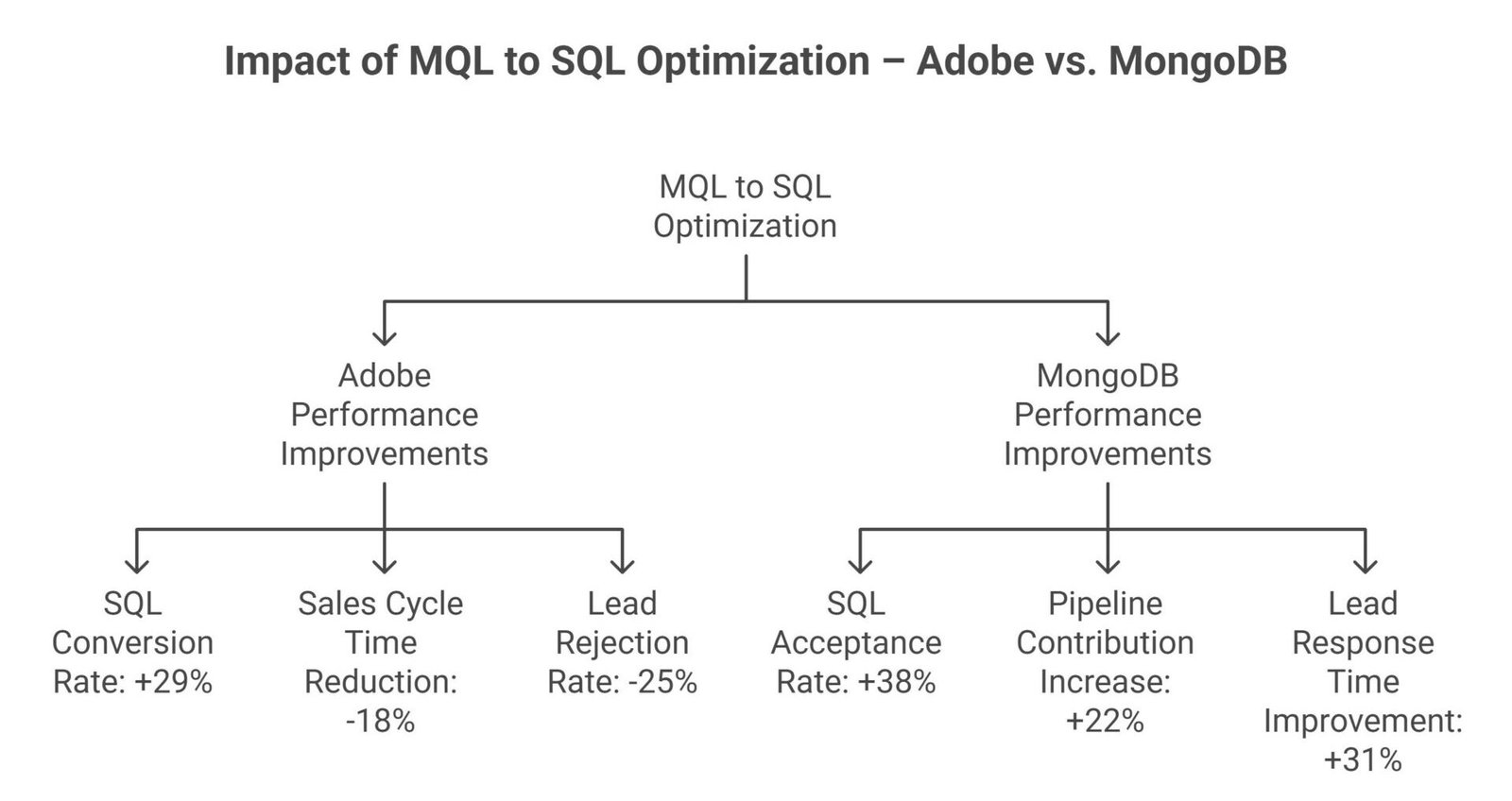
29% SQL conversion from MQLs in 3 quarters
18% reduction in sales cycle length
25% decline in rejection rate of lead by SDRs
Source:
Adobe Digital Marketing Insights - B2B Marketing Exchange
2. MongoDB: Sales and Marketing SLA Drives Revenue Growth
Challenge:
MongoDB was generating a huge number of inbound leads by offering trials, tutorials, and gated content. Yet, marketing and sales were not aligned on when a lead should be handed over to sales. Marketing was pushing too early, and sales was benching them, leading to lost opportunities.
Solution:
MongoDB imposed a strict Service Level Agreement (SLA) between marketing and sales. This included collaborative definitions of MQL and SQL, lead scoring adjustments, and real-time feedback cycles. They also added a human validation layer before sending MQLs to SDRs to ensure qualification accuracy.
Outcomes:
38% SQL acceptance rate increase
22% contribution to pipeline from marketing-sourced leads
31% decrease in lead response time
Source:
TOPO Case Study through Gartner: MongoDB Lead Qualification Strategy
These cases show how even big, data-intensive businesses like Adobe and MongoDB keep investing in MQL and SQL tuning refinements and enjoy quantifiable benefits when they do. They also demonstrate the necessity for a combination of automation with human oversight, something Intent Amplify® incorporated into its own delivery performance approach.
Why the MQL-SQL Distinction Matters More Than Ever in 2025
Modern Buyers Don't Wait for a Sales Pitch
Today's B2B buyers do their homework. Before filling out a demo form or accepting a sales call, they've likely browsed your website, read product reviews, compared pricing pages, and skimmed through competitor solutions. This behavior shift means a lead's digital engagement carries more weight than ever. But not all engagement is equal, and not every curious visitor is ready to buy.
When marketing hands over every mildly interested lead, sales teams end up chasing shadows. The result? Frustration, disconnect, and eventually, missed opportunities. That's why clearly defining the threshold between an MQL and SQL has become essential. It's not about gating the funnel, it's about protecting your pipeline's focus.
Quality Over Quantity Is No Longer Optional
High-volume lead generation used to be the benchmark for marketing success. But sheer numbers don't close deals. In 2025, enterprise buyers expect relevance, personalization, and precise timing. A lead who downloaded an eBook a month ago might not even remember your brand when contacted, and passing them too early creates drag in your system.
A smart MQL-SQL framework filters out noise and allows both teams to concentrate on what matters: genuine interest, qualified intent, and clear fit. That shift from quantity to quality doesn't just improve efficiency; it directly affects deal velocity and sales morale.
Misalignment Still Breaks Pipelines
Despite all the Martech available today, many B2B teams still struggle with marketing and sales alignment. Often, it's not because they lack the tools, it's because they haven't agreed on shared definitions. If marketing celebrates hitting their MQL quota, but sales rejects half the leads, the problem isn't lead flow, it's clarity.
A well-defined MQL is a promise: this lead meets the criteria, has shown engagement, and is worth your time. When that promise breaks, trust breaks too. That's why leading growth teams revisit and refine their qualification rules regularly, using feedback loops and conversion data to keep the system honest.
The Handoff Is Just as Important as the Lead
One of the most overlooked aspects of the MQL-to-SQL journey is the actual handoff process. It's not enough to simply assign a lead in your CRM and assume it's now "sales' problem." Timing, context, and communication all matter.
Imagine a lead who downloaded a whitepaper last week and now gets a cold outreach call with no mention of that content. It feels disconnected because it is. In contrast, when the sales rep follows up referencing the specific content, uses behavioral cues, and offers next-step value, the experience feels aligned.
This kind of seamless handoff only works when both sides understand what qualifies a lead and why that lead is moving forward.
Adaptability Is the New Standard
B2B cycles aren't static, and neither are your buyers. What defines a qualified lead today might not hold next quarter. A strong MQL-SQL model isn't rigid. It's designed to evolve with your GTM motion, product roadmap, and ICP shifts.
More and more companies are using flexible scoring systems, layering in first-party engagement data with third-party intent signals. Others are adding human review before an MQL becomes an SQL. The key is staying proactive, not reactive, when it comes to refining the flow between marketing and sales.
How to Align Sales and Marketing Around MQLs and SQLs
Marketing and sales can't afford to work in silos anymore. For your lead pipeline to perform, both teams need shared clarity on what makes a lead qualified and when it's ready to move forward.
Start by agreeing on what qualifies as an MQL and what turns it into an SQL. Keep the criteria realistic, actionable, and relevant to your ideal customer profile. It should be obvious to both teams when a lead moves from interest to intent.
Refine Lead Scoring
Scoring should reflect more than form fills. Combine firmographics with actual engagement patterns and buyer intent. A lead who downloads a guide once isn't the same as one who revisits your pricing page three times in a week.
Improve the Handoff
When leads move from marketing to sales, context matters. Sales reps should know what content the lead engaged with, what pages they visited, and why they were qualified. A smooth handoff leads to better conversations and fewer missed opportunities.
Create Feedback Loops
Keep communication open. Let sales flag weak leads. Let marketing adjust campaigns based on what converts. The most valuable insights often come after a lead is handed over.
Precision Wins the Pipeline
The gap between an MQL and an SQL may seem small on paper, but in practice, it's where most revenue is won or lost. When marketing and sales operate from different definitions, even the most promising leads can fall through the cracks. But when both teams align, leads don't just move, they convert.
In 2025, the most effective B2B companies are those that treat lead qualification as a dynamic, shared responsibility, not a handoff. They adapt their criteria, stay close to buyer behavior, and fine-tune their pipeline with real feedback, not assumptions.