
logo
logo
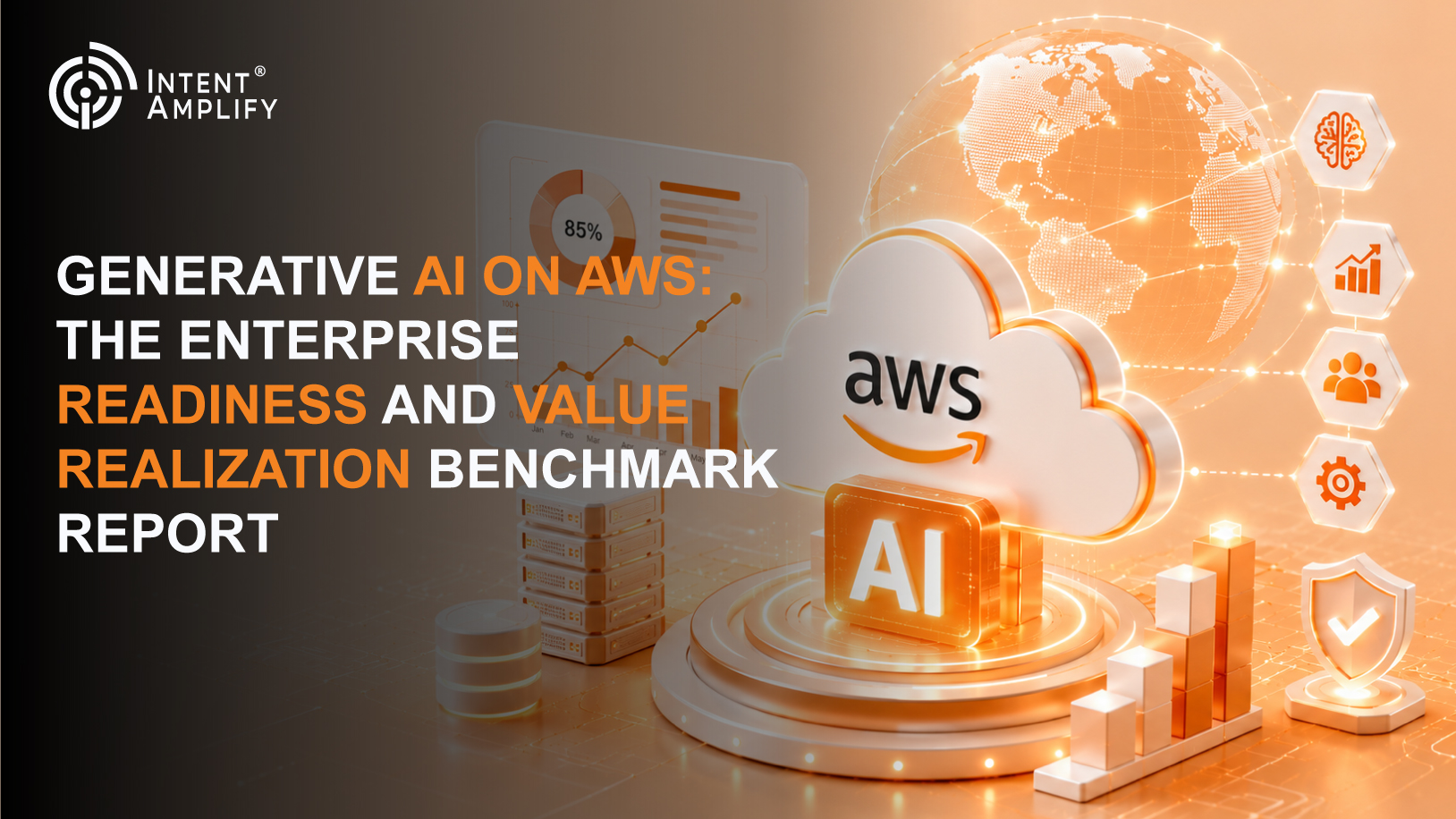
Generative AI on AWS: The Enterprise Readiness and Value Realization Benchmark Report

REPORT

Generative AI on AWS: The Enterprise Readiness and Value Realization Benchmark Report

Discover how enterprises are using generative AI on AWS to move from experimentation to measurable business value through secure architecture, AI governance, and scalable implementation strategies.

Executive Summary: AI Strategy Has Entered Its Proof Phase

Enterprise generative AI has moved out of the experimentation lane and into the performance review. The early rush to launch pilots and test copilots proved that AI could change how work gets done, although it did not always prove that AI could create measurable outcomes at scale.

Executive AI strategy is now judged by whether organizations can convert AI adoption into governed, measurable business value. Most already are. The stronger question is whether the organization has the readiness strategy, AWS architecture, governance model, operating discipline, and measurement framework needed to turn generative AI into real business value.

For enterprises running on AWS, this report examines how generative AI readiness is becoming an enterprise performance question. The focus is on the ability to move from pilot to production, reduce AI time to value, and build repeatable patterns for scaling generative AI across the enterprise.

1. From AI Ambition to AI Accountability

The first stage of enterprise GenAI was driven by curiosity and urgency. Leaders wanted to know what was possible, teams wanted tools that could summarize, draft, code, and search, and technology groups wanted to evaluate foundation models before competitors built a lead.

That phase was necessary, but it also created a familiar pattern in which too many disconnected AI experiments moved forward without enough production discipline or ownership. In many enterprises, generative AI has become a collection of promising initiatives rather than a transformation program.

The 2025 data shows why the conversation has changed. McKinsey's 2025 State of AI survey found that 88% of organizations report regular AI use in at least one business function, yet only about one-third have begun scaling AI programs, and only 39% report enterprise-level EBIT impact from AI. This matters because it separates adoption from value. AI usage is now common. Scaled financial impact is not. [1]

The core gap is between AI adoption and operational value realization. Enterprise AI transformation does not happen because a business adopts a model. It happens when AI is connected to trusted data and embedded into workflows and governed through clear controls while being measured against outcomes that executives actually care about.

2. The 2025 Enterprise AI Paradox

The market is not losing confidence in AI. It is becoming more demanding because budgets are expanding while tolerance for vague AI outcomes continues to shrink.

BCG's AI Radar 2025 found that 75% of executives rank AI or GenAI as a top-three strategic priority, while only 25% say their companies have created significant value from AI initiatives. That gap is the clearest sign that AI ambition has outpaced enterprise readiness. The issue is rarely whether the technology is impressive. The issue is whether the organization can operationalize it through focused implementation, process redesign, and executive alignment. [2]

Deloitte adds another layer to the paradox. Its 2025 AI ROI research found that 85% of organizations increased AI investment in the past 12 months, and 91% plan to increase investment again, yet only around one in five organizations qualify as AI ROI leaders. Spending is moving ahead, but ROI discipline has not caught up everywhere. That makes measuring generative AI ROI a board-level and operating-model issue rather than a reporting afterthought. [3]

Wharton's 2025 AI Adoption Report found that 82% of enterprise leaders use generative AI at least weekly, with 46% using it daily. This is a major signal for AI enablement because generative AI is no longer limited to innovation labs or technical teams. It is moving into leadership workflows, analysis, planning, customer operations, and knowledge work. [4]

The same research found that 72% of enterprises are formally measuring GenAI ROI, and three out of four leaders report positive returns from GenAI investments. That finding shows a transition from casual experimentation to AI performance measurement. Leaders are starting to ask not only whether people use AI but whether AI changes the economics of work. [4]

3. Benchmark Signals: What the Numbers Reveal

Readiness Signal

2025 Finding

Why It Matters

Enterprise AI use

88% use AI in at least one function

Adoption is mainstream but not always mature

Enterprise EBIT impact

39% report EBIT impact

Value realization is still uneven

Strategic priority

75% rank AI as top three.

AI is now an executive agenda item

Significant AI value

25% report significant value

Impact remains concentrated among mature organizations

AI investment

91% plan to increase investment

Budget exists, but scrutiny is rising

GenAI usage

82% of enterprise leaders use GenAI weekly

AI is entering daily decision workflows

ROI measurement

72% formally measure GenAI ROI

Measurement discipline is becoming standard

AWS customization

58% plan custom apps using pre-existing models

Enterprise value depends on tailored implementation

Source: Intent Amplify Analysis based on referenced reporting.

The table points to a truth many executives already feel in operating reviews. AI activity is abundant, but readiness is uneven. Adoption does not tell leaders whether the organization has changed the workflow, secured the data, measured the value, or prepared the deployment path.

4. AWS as the Enterprise GenAI Operating Layer

For organizations already using AWS Cloud, generative AI readiness is not only about model selection. It is about building an enterprise architecture that can support secure deployment, governed data access, reliable scaling, observability, cost control, and workflow integration.

AWS's enterprise-ready generative AI guidance emphasizes reliable infrastructure, foundation model selection, security and governance, and repeatable application patterns. That matters because production AI is not a single application decision. It is an architecture and operating model decision. [5]

This is where services such as Amazon Bedrock and Amazon Q Business become strategically relevant without becoming the entire story. The larger opportunity is to create approved patterns for production deployment that teams can reuse across functions.

AWS's 2025 Generative AI Adoption Index found that 58% of organizations plan to build custom applications using pre-existing models, while 55% plan to build applications on fine-tuned models using proprietary data. This is a crucial finding because it shows where the market is heading. Enterprises are not relying only on off-the-shelf AI. They want AI that understands their data, workflows, customers, products, policies, and operating realities. [6]

That is why reusable deployment patterns and industry-specific acceleration models are becoming more important. A generic assistant may help an employee draft faster, but it will not redesign claims processing, plant maintenance, product content operations, or trade promotion workflows without enterprise data and workflow integration.

For many AWS-based enterprises, the challenge is no longer whether generative AI can support the business. It is whether the organization can move from use-case selection to first value fast enough to keep executive confidence intact. Leaders evaluating that next step can explore how AWS-native AI acceleration connects readiness, implementation, and measurable outcomes in the Live in 45 with Amazon Quick Business: First Value Fast brochure.

Download the Brochure.

5. Where GenAI Programs Stall

Most generative AI programs do not fail because the model cannot produce impressive outputs. They stall because the enterprise around the model is not ready.

The Strategy Gap

AI initiatives often begin with tool enthusiasm instead of business prioritization. A stronger enterprise AI strategy starts with the outcome, whether that means lower cost, faster cycle time, better decision quality, stronger customer experience, or improved risk control. The model should follow the business case rather than lead it.

The Data Gap

AI becomes valuable when it can work with a trusted enterprise context. That means governed data, permission-aware access, clean knowledge sources, connected systems, and clear lineage. Without that foundation, AI outputs can become inconsistent, incomplete, or risky.

The Governance Gap

AI governance is not a committee meeting. It is an operating capability. Mature organizations embed responsible AI, risk management, access controls, output validation, auditability, and human oversight into the workflow itself.

The cybersecurity implications are serious. IBM's 2025 Cost of a Data Breach research found that 20% of organizations experienced breaches tied to shadow AI, and those incidents added an average of $670,000 to breach costs. For enterprise leaders, this changes the readiness conversation. Uncontrolled AI use is not only a productivity issue. It is a security and financial exposure. [7]

The Production Gap

A proof of concept is not a production system. Production-ready GenAI requires observability, cost management, output evaluation, security testing, incident response, lifecycle management, and integration with the enterprise environment. Moving from pilot to production requires engineering discipline rather than only innovative energy.

6. Enterprise AI Readiness Benchmark Framework

The following benchmark can help executives assess whether their organization is prepared to move from AI experimentation to measurable business outcomes.

Readiness Dimension

Benchmark Question

Mature-State Indicator

Strategic alignment

Is AI tied to executive business priorities?

Use cases are prioritized by value, feasibility, and sponsorship

Business case

Is investment justified by measurable outcomes?

Funding links to ROI, time-to-value, and operational impact

Data foundation

Can AI access trusted enterprise context securely?

Data is governed, permission-aware, and workflow-ready

AWS architecture

Can GenAI workloads scale securely on AWS?

Approved patterns exist for model access, monitoring, and deployment

Governance model

Can teams move fast without unmanaged risk?

Controls are embedded into access, validation, audit, and review

Workflow integration

Is AI inside the flow of work?

AI supports real business processes rather than isolated tasks

Operating model

Is ownership clear across teams?

Business, data, technology, and risk teams share delivery accountability

ROI discipline

Can value be proven within a defined timeline?

KPIs are defined before deployment and tracked after launch

This framework is broader than a technical checklist because enterprise readiness combines strategy, architecture, governance, talent, workflows, and value measurement.

7. What Value Realization Looks Like by Industry

Enterprise AI value becomes easier to understand when it is placed inside the workflows that matter. The target industries for this campaign share the same need for faster value, but the point of impact looks different in each sector.

Industry

Where GenAI Value Often Shows Up

Readiness Requirement

Insurance

Claims summarization, underwriting assistance, policy intelligence, fraud signal analysis, and customer service automation

Secure access to policy, claims, customer, and compliance data

Manufacturing

Maintenance assistants, quality issue analysis, production troubleshooting, engineering knowledge search, and supplier intelligence

Reliable operational data, technical documentation, and workflow integration

Retail

Product content generation, associate assistants, returns analysis, customer support automation, and personalization

Scalable content, customer, product, and channel data foundations

CPG

Consumer insight synthesis, trade promotion analysis, innovation research, sales enablement, and regulatory workflows

Connected brand, sales, supply chain, and regulatory data

Across these sectors, the pattern is consistent. AI business outcomes improve when use cases are specific, data is trusted, AWS deployment patterns are reusable, and value metrics are defined before scaling.

The industry lesson is also a warning against broad AI ambition with no operating anchor. A retailer needs better product data and faster content operations. A manufacturer needs faster access to technical knowledge and reduced downtime. The more clearly the use case maps to work, the more likely the business is to see value.

8. From Generative AI to Agentic AI

The next stage of enterprise AI maturity is agentic AI. Generative AI helps users create, summarize, analyze, and retrieve information. Agentic AI can execute multi-step workflows, call tools, coordinate tasks, and support process automation. That makes it powerful, but it also raises the bar for governance.

McKinsey's 2025 State of AI research found that 23% of organizations are scaling an agentic AI system somewhere in the enterprise, while another 39% are experimenting with AI agents. This shows that agentic AI is no longer theoretical, although most enterprises are still early in the scaling curve. [1]

Agentic AI requires more than a chatbot interface. It needs identity and access control, workflow orchestration, observability, human approval points, exception handling, and policy enforcement. That makes enterprise governance more important rather than less.

AWS is moving directly into this production-readiness problem. Quantiphi's AWS Marketplace Agentic Factory Rapid Deployment offering, for example, is positioned around a repeatable and secure framework on AWS for building and deploying production-ready AI agents using Amazon Bedrock AgentCore. Its description emphasizes reusable blueprints, observability, enterprise integration, APIs, cost controls, and Bedrock Guardrails. [8]

Enterprises increasingly need AWS-native implementation patterns that can shorten time-to-value while keeping agentic systems governed and observable. Partners with cloud implementation depth and industry-specific AI delivery experience become relevant when teams need to move quickly without turning speed into unmanaged risk.

9. The Executive Playbook for Reducing AI Time to Value

The strongest AI programs share a practical discipline. They do not chase every possible use case. They select the right use cases, build the right architecture, and measure the right outcomes.

BCG found that leading companies prioritize an average of 3.5 AI use cases compared with 6.1 for other companies, and they expect 2.1 times greater ROI. Focus is not a limitation on AI ambition. It is often what makes value realization possible. [2]

A useful executive playbook starts with five moves.

  • First, build the AI business case around measurable outcomes rather than model novelty.
  • Second, run use case discovery workshops that prioritize value, feasibility, and data readiness.
  • Third, establish an AWS implementation pattern that covers security, governance, monitoring, and cost from the start.
  • Fourth, define an operating model so business, technology, data, and risk teams know who owns what.
  • Fifth, measure value before scaling.

Conclusion: The New Benchmark Is Measurable AI Value at Scale

Generative AI on AWS is becoming an enterprise readiness test. The organizations that lead will not simply be the ones with the largest AI budgets, the most pilots, or the fastest access to foundation models. They will be the ones who turn AI capability into secure, governed, measurable, and scalable business outcomes.

The benchmark has changed. Leaders now need to ask whether each AI initiative has a clear business case, trusted data access, embedded governance, workflow integration, and a measurable path to ROI.

For enterprises in insurance, manufacturing, retail, and CPG, the opportunity is substantial. Generative AI can improve decisions, accelerate operations, reduce manual work, and create new forms of productivity. But value will come from an operating model that connects AWS cloud readiness, responsible controls, performance measurement, and implementation speed.

For AWS-based enterprises evaluating the next stage of generative or agentic AI, the practical next step is to assess which use cases are ready for production, which foundations need work, and where implementation support can shorten time-to-value.

Enterprise AI growth will depend on the ability to connect clear value narratives with qualified buying conversations. Intent Amplify supports that journey through content-led demand generation, audience intelligence, and campaign execution built for complex B2B buying cycles. To discuss how your organization can activate a more focused go-to-market motion, contact Intent Amplify.

References

  1. McKinsey & Company (2025) The State of AI in 2025. Available at: https://www.mckinsey.com/capabilities/quantumblack/our-insights/the-state-of-ai.
  2. Boston Consulting Group (BCG) (2025) Closing the AI Impact Gap. Available at: https://web-assets.bcg.com/0b/f6/c2880f9f4472955538567a5bcb6a/ai-radar-2025-slideshow-jan-2025-r.pdf.
  3. Deloitte (2025) AI Investment: Where the Real ROI Lies. Available at: https://www.deloitte.com/ca/en/services/consulting/perspectives/ai-investment-where-the-real-roi-lies.html.
  4. Wharton AI & Analytics Initiative (2025) 2025 AI Adoption Report. Available at: https://ai.wharton.upenn.edu/wp-content/uploads/2025/10/2025-Wharton-GBK-AI-Adoption-Report_Full-Report.pdf.
  5. Amazon Web Services (AWS) (2025) Strategy for an Enterprise-Ready Generative AI Platform. Available at: https://docs.aws.amazon.com/prescriptive-guidance/latest/strategy-enterprise-ready-gen-ai-platform/introduction.html.
  6. Amazon Web Services (AWS) (2025) Generative AI Adoption Index. Available at: https://press.aboutamazon.com/aws/2025/5/generative-ai-adoption-index.
  7. IBM (2025) Cost of a Data Breach Report. Available at: https://www.ibm.com/think/insights/data-matters/cost-of-a-data-breach.
  8. Amazon Web Services (AWS) Marketplace (2025) Quantiphi Agentic Factory Rapid Deployment. Available at: https://aws.amazon.com/marketplace/pp/prodview-wxnv5xo2yimyq.
Prabhanshi   Singh

Prabhanshi Singh

Research Analyst

Contact us for Report