

Modern marketing has entered a new operational reality. Buyers now interact with brands across dozens of touchpoints before making a decision, while internal teams are expected to demonstrate measurable ROI for every campaign, platform, and initiative.
At the same time, the volume of marketing data has exploded. Digital channels generate behavioral signals continuously, from community participation and content engagement to pipeline progression and product usage.
Marketing teams are not struggling with a lack of data. They are struggling with a lack of clarity.
Every campaign, channel, and customer interaction generates signals. Yet most organizations still rely on delayed reporting to understand performance, long after opportunities to influence outcomes have passed.
This gap between data availability and decision-making is becoming a competitive risk.
AI-powered marketing analytics is changing that dynamic. Instead of looking backward, organizations can now interpret behavioral signals in real time, identify high-intent audiences as they emerge, and adjust strategy while revenue opportunities are still in motion.
The Shift Toward Real-Time Marketing Intelligence
There's a tendency to frame AI in marketing as acceleration. Faster reporting. Faster insights. Faster optimization.
That's not where the real value shows up.
The real shift is in when you can act with confidence.
According to McKinsey, organizations with mature AI adoption in marketing are already seeing 22% efficiency gains, with expectations to reach 28% within two years.
Why this works:
Much more recent.
Ties directly to operational impact, not vague growth claims.
Shows trajectory, which leadership cares about.
Real-time analytics aren't about watching dashboards refresh. It's about recognizing intent signals while they're still forming. Before the pipeline gets locked. Before budgets are exhausted. Before competitors show up.
Most teams aren't there yet.
Peer-Led Communities Deliver High-Value Signals
There's a blind spot in most marketing analytics setups.
We track clicks. Impressions. Conversions. Campaign attribution paths that look clean in a slide deck and fall apart under scrutiny.
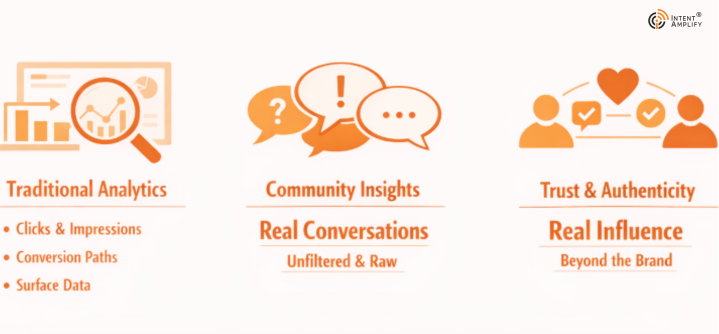
What we don't capture well is how people actually make decisions.
Communities expose that layer.
Not in a structured way. That's the problem. And also the value.
People ask messy questions. They contradict each other. They share half-formed opinions, frustrations and workarounds. None of it looks like clean data. All of it is a signal.
That's why trust behaves differently here.
The shift isn't toward "authentic content." It's away from everything else.
Deloitte's marketing trends research highlights a growing erosion of trust in AI-saturated environments, which is why authenticity is starting to influence not just engagement, but actual pricing power.
Community Marketing Reduces Customer Acquisition Costs
There's a common narrative that community marketing reduces acquisition costs.
Technically true. Practically misleading.
In the early stages, communities are expensive. Time, moderation, content, internal alignment. None of it looks efficient. Especially compared to paid acquisition, where input-output feels more predictable.
The shift happens later.
When peer-to-peer support starts replacing tickets. When user-generated content begins ranking better than your campaigns. When referrals come in without being engineered.
At that point, CAC doesn't just decrease. It becomes less volatile.
That's a different kind of advantage.
Designing Programs That Deliver Results
A lot of community programs fail in a very specific way.
They try to serve too many purposes at once.
Support channel. Content engine. Advocacy layer. Product feedback loop. Brand-building exercise.
All valid. Together, they create noise.
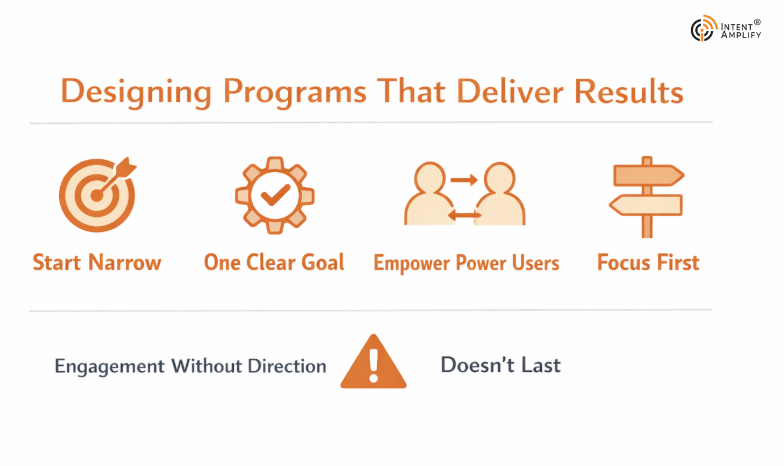
The strongest communities are narrow at the start.
Fix onboarding friction. That's it. Reduce support dependency. Create a space for power users to exchange workflows.
One outcome. Everything else follows later, if it should.
Without that constraint, you get engagement. Not direction.
Engagement without direction doesn't survive budget reviews.
Community Data and AI-Powered Marketing Analytics
This is where things get political inside organizations.
Slack, Discord, LinkedIn Groups. Easy to start. Familiar. Low friction.
Also difficult to measure properly.
Owned platforms. Harder to launch. Require buy-in. Integration work. Governance decisions.
However, they answer a different question. Not "where will people engage" but "what will we be able to learn from that engagement"
Eventually, someone is going to ask: Is this driving revenue?
If your data lives in silos, you won't have a clean answer. You'll have stories. Screenshots. Anecdotes.
That doesn't help a brand scale.
Measuring Community Marketing ROI
There's a lot of optimism around AI in marketing analytics right now.
AI can surface patterns across conversations. Identify emerging topics. Summarize thousands of interactions into something usable. Flag sentiment shifts before they become visible in churn data.
That's real progress.
AI can surface patterns across conversations and flag sentiment shifts before they show up in churn data. That's real progress.
Adoption is outpacing understanding. McKinsey's latest global AI research shows that while most organizations are using AI, only a small fraction are capturing meaningful business impact, largely due to issues with data quality and interpretation.
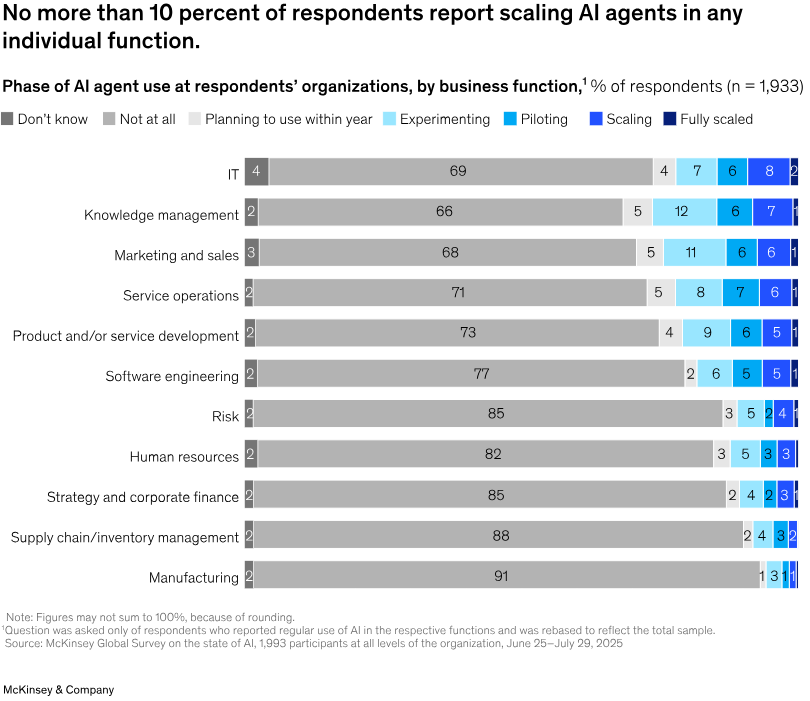
AI makes interpretation easier. However, it doesn't guarantee correctness.
If your underlying signals are biased, incomplete, or skewed toward your most vocal users, AI will confidently amplify those distortions.
That's the risk.
It will come from how critically you interpret what it tells you.
Where AI Analytics Strengthens Community Programs
When community data connects to CRM records, things change.
You start seeing patterns:
Who participates before renewal.
Which members drive referrals.
Where conversations show up before expansion.
Not perfectly. Not cleanly. However, enough to challenge assumptions.
Engagement only matters when it connects to outcomes that leadership cares about.
Pipeline. Retention. Revenue.
Not All Engagement is Equal
One of the more misleading metrics in community programs is total activity.
Posts. Comments. Reactions.
They look good and give a sense of momentum.
However, they don't tell you who is engaging.
A small group of highly active users can create the illusion of a healthy community. Meanwhile, the broader base stays passive.
Meta's internal research showed that optimizing for engagement often amplified the wrong signals. Content that performed well wasn't necessarily valuable or accurate. It was simply more reactive.
That same dynamic exists in marketing analytics. High engagement doesn't always signal demand. Sometimes it signals friction, confusion, or controversy.
High activity doesn't always equal high value.
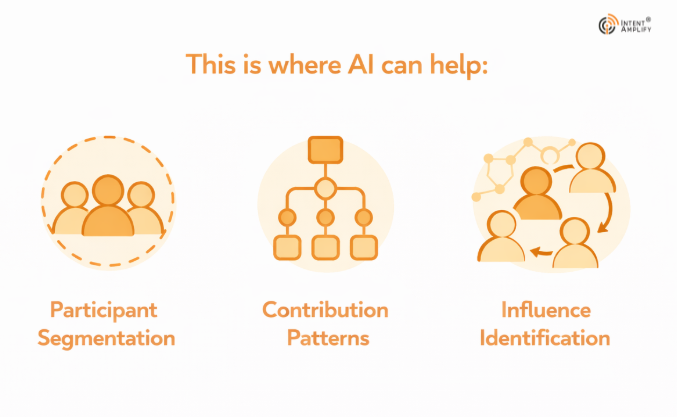
Sometimes the most important signals are quieter. A thoughtful answer. A detailed workflow. A user helping another user solve something specific.
Future of AI-Powered Marketing Analytics
Marketing analytics is evolving from retrospective reporting to predictive intelligence.
In the coming years, several shifts will shape how organizations measure marketing performance.
AI-powered marketing analytics will keep improving. Models will get better at interpreting messy data. Attribution will become more sophisticated. Real-time decisioning will become more accessible.
However, the underlying challenge won't change.
Most valuable signals in marketing are still human. Contextual. Imperfect.
Communities just happen to surface more of them.
The organizations that figure this out won't be the ones with the most advanced tools.