
logo
logo

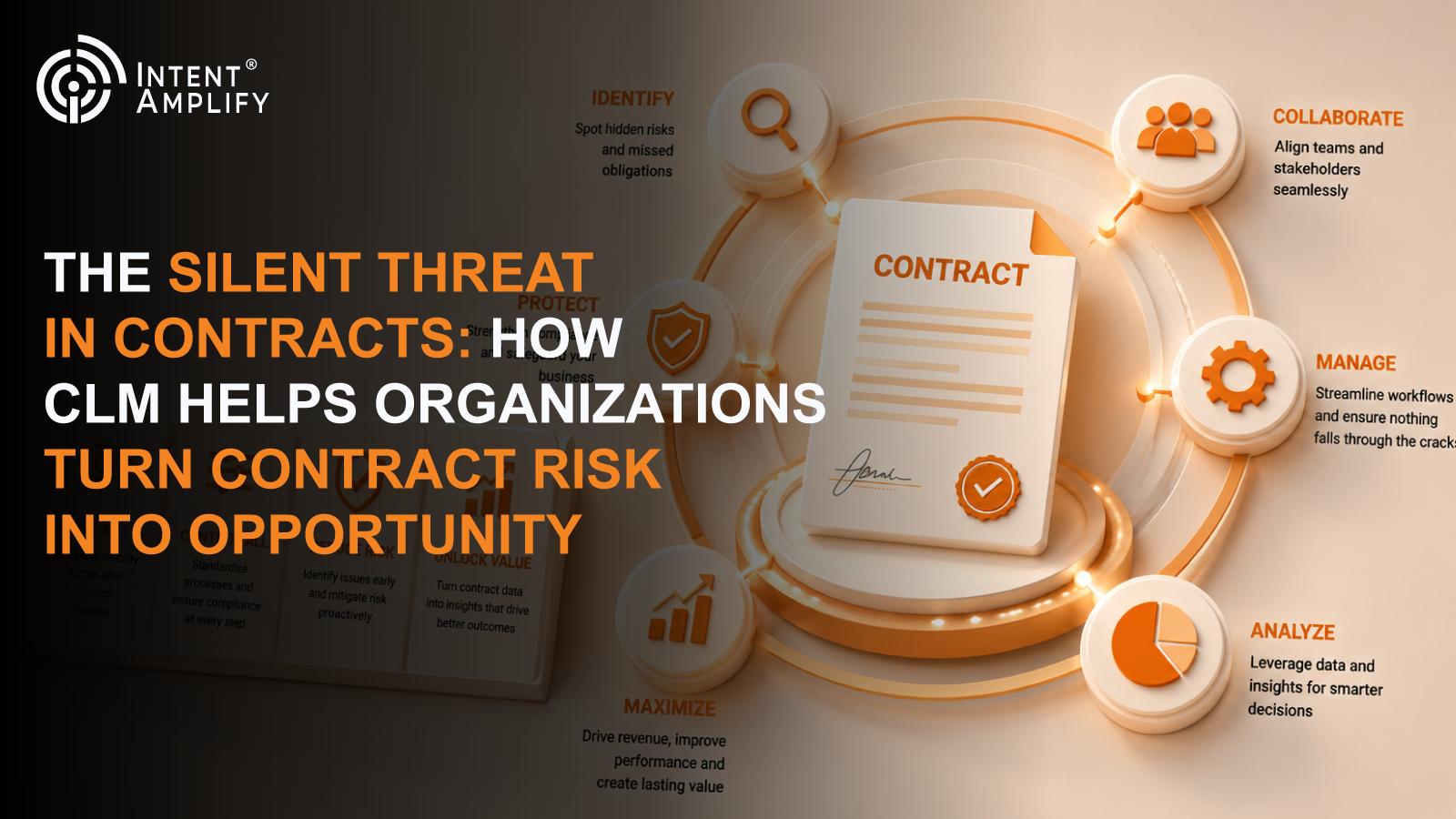
The Silent Threat in Contracts: How CLM Helps Organizations Turn Contract Risk into Opportunity

Discover how CLM transforms hidden contract risk into business opportunity through contract intelligence, obligation tracking, analytics, governance, and AI-powered visibility.

The Silent Threat in Contracts: How CLM Helps Organizations Turn Contract Risk into Opportunity

Executive Overview: Why Contract Risk Has Become a Leadership Issue

Contracts are among the most important operating assets in an enterprise, yet they are often managed as static records after signature. That gap creates a silent threat. Risk does not always announce itself through litigation, supplier failure, missed revenue, or regulatory scrutiny. More often, it builds quietly inside untracked obligations, non-standard clauses, missed renewal windows, inconsistent service-level commitments, unmanaged third-party dependencies, and contractual terms that no longer match the business environment.

The strategic issue is not that organizations lack contracts. The issue is that many lack the visibility, governance, and intelligence needed to understand how contract terms affect enterprise risk after agreements are executed. 

High-value customer agreements, supplier contracts, technology partnerships, outsourcing arrangements, and regulated service agreements can all carry obligations that influence revenue protection, compliance readiness, cyber resilience, operational continuity, and executive accountability.

Contract Lifecycle Management (CLM) addresses this exposure by transforming contract data into governed, searchable, and actionable intelligence. Mature platforms centralize agreements, standardize templates and clauses, automate workflows, track obligations, monitor deviations, and provide leaders with a clearer view of risk across the portfolio. The result is stronger governance, greater commercial discipline, and more informed decision-making. Organizations that apply these capabilities effectively can convert contractual risk into strategic advantage.

Gartner’s 2025 Magic Quadrant for Contract Life Cycle Management states that organizations are pursuing cross-functional CLM strategies, often driving new investment or replacement of CLM solutions that no longer meet enterprise requirements. 1

This ebook examines how contract risk becomes hidden, why post-signature visibility is now essential, and how CLM helps organizations move from reactive contract administration to proactive risk intelligence.

For a deeper companion perspective, readers can access Listening for the Silent Threat: How Contract Lifecycle Management (CLM) Transforms Risk into Opportunity. 

Download Now

Chapter 1: The Silent Threat Hidden Inside Enterprise Contracts

Contract risk is rarely limited to the legal language of a single agreement. It is a portfolio-level problem. When contracts are distributed across shared drives, procurement systems, customer relationship management platforms, email inboxes, local business units, and legacy repositories, leaders lose the ability to see where risk is concentrated.

This creates a difficult operating reality. Legal teams may know what was negotiated, but business owners may not know what they are required to perform. Procurement may understand supplier commercial terms, but compliance may not have visibility into audit obligations. 

Deloitte’s contract excellence research found that contract value erosion varies significantly across organizations, with top performers keeping losses low while weaker performers face substantial value leakage. 2

The evidence supports a broader thesis: as organizations become more digital, regulated, outsourced, and data-dependent, contracts become one of the primary places where operational risk is formalized. 

Every exception, obligation, indemnity position, service commitment, or renewal condition is a potential future decision point. If these decision points are not visible, the organization is not managing contract risk. It is waiting for contract risk to surface.

Chapter 2: Why Post-Signature Risk Often Goes Undetected

Most enterprises focus heavily on pre-signature process control. They invest in drafting, negotiation, approvals, redlining, and execution. These stages are visible and time-sensitive, so they naturally attract attention. The post-signature phase is different. Once the agreement is signed, risk shifts into execution, ownership, and monitoring.

The silent nature of these risks explains why contract oversight often becomes reactive. Leaders discover exposure through disputes, audit findings, service failures, supplier issues, customer escalations, or missed savings. By that point, the contract is no longer a governance asset. It has become a source of remediation costs.

McKinsey’s recent analysis of corporate legal management notes that procurement discipline, data transparency, and AI are redefining legal management, and that general counsel and procurement leaders should invest in technology foundations that create visibility across matters, vendors, and outcomes. 3

For CLM leaders, the implication is clear. Post-signature visibility cannot depend on individual memory, decentralized spreadsheets, or manual follow-up. It requires a system of record, a system of workflow, and increasingly a system of intelligence.

Chapter 3: How CLM Converts Contract Records into Risk Intelligence

A basic contract repository answers one question: where is the document? Mature CLM answers a more important question: what risk, obligation, and opportunity does this document create?

This distinction matters. A repository can reduce search friction, but it does not automatically improve governance. CLM creates value when contract data becomes structured, classified, reportable, and connected to business workflows. This includes metadata such as contract value, contract type, counterparty, region, governing law, renewal date, termination window, business owner, risk rating, obligation category, and clause deviation status.

Once contract data is structured, leaders can move from document retrieval to risk intelligence. They can identify which contracts contain non-standard liability terms, which suppliers have critical service obligations, which customer agreements include strict data protection terms, which renewals require executive review, and which business units carry higher contractual exposure.

Gartner’s 2025 Critical Capabilities for Contract Life Cycle Management describes its purpose as helping technology leaders understand CLM vendor product and service offerings and identify which CLM products are best suited for common usage scenarios. 4

This market direction reflects a larger shift. Buyers are no longer evaluating CLM only as a document workflow tool. They are assessing how well platforms support business-specific use cases: procurement contracting, sales contracting, enterprise legal operations, risk oversight, compliance monitoring, and portfolio analytics.

When CLM becomes a source of contract intelligence, leaders can stop treating risk as an after-the-fact discovery problem. They can evaluate exposure before renewal, before supplier failure, before audit pressure, and before contractual commitments become operational liabilities.

Chapter 4: Standardization as the First Line of Contract Risk Control

Silent contract risk often begins with inconsistent contracting practices. Different regions may use different templates. Business units may negotiate different fallback positions. Legal teams may approve exceptions without a consistent taxonomy. Procurement may negotiate supplier terms without full visibility into enterprise standards. Sales may accept bespoke customer obligations that later become difficult to fulfill.

This creates a fragmented risk environment. Each exception may appear manageable in isolation, but across hundreds or thousands of agreements, variation becomes a governance problem.

CLM helps reduce this exposure through contract standardization. Standard templates, clause libraries, approval workflows, fallback positions, and playbooks give teams a common operating model. The goal is not to remove negotiation flexibility. The goal is to define where flexibility is acceptable, who can approve deviations, and how those deviations are tracked over time.

Microsoft’s June 2025 Responsible AI Transparency Report emphasizes the importance of operational governance through policies, roles, responsibilities, proactive risk management, and processes that turn high-level governance principles into practice. 5

Although Microsoft’s report focuses on responsible AI, the governance lesson applies directly to CLM. Controls do not work because they are documented. They work when they are embedded into operating workflows. In contract management, this means template rules, clause playbooks, approval thresholds, exception handling, and audit trails must be integrated into the way contracts are created, negotiated, executed, and monitored.

For high-value contracts, standardization is especially important in areas such as indemnity, liability caps, termination rights, audit access, security requirements, subcontracting, data protection, payment terms, service-level agreements, and renewal provisions. These clauses are not administrative details. They define the organization’s future risk boundary.

Chapter 5: Obligation Management Turns Risk Awareness into Accountability

Obligation management is one of the most important post-signature capabilities in CLM. A signed agreement has limited value if the organization cannot translate its commitments into action. Obligations define what must happen, who must act, when performance is due, what evidence is required, and what consequences may follow if performance fails.

In many organizations, obligations remain trapped in contract language. A business owner may know that a supplier has service-level commitments, but not the specific reporting cadence. 

A compliance team may know that audit rights exist, but not which contracts include them. 

A finance team may expect pricing adjustments, but not know when review rights must be exercised. 

A security team may be accountable for breach notification, but not have immediate visibility into contractual notification windows across customer agreements.

CLM changes this by converting obligations into structured tasks. It can assign owners, set reminders, create escalation paths, attach evidence, track completion, and surface overdue items in dashboards. That is the difference between contract storage and contract control.

Deloitte’s contract lifecycle and legal matter management perspective notes that CLM is more than a structured contract database; it supports cooperation between business, procurement, and legal teams through templates, approval flows, and monitoring of contractual obligations. 6

The strategic value of obligation management is accountability. Once obligations are visible, they can be owned. Once they are owned, they can be measured. Once they are measured, leaders can identify performance risk before it becomes breach risk, value leakage, or customer dissatisfaction.

Chapter 6: Contract Analytics Helps Leaders Find Patterns Before They Become Losses

The value of CLM increases when leaders can analyze contract patterns across the portfolio. Contract analytics helps teams understand where risk is recurring, where negotiation standards are weakening, where operational commitments are accumulating, and where commercial value may be leaking.

For example, analytics can reveal that a specific business unit frequently accepts non-standard termination rights. It can show that certain suppliers repeatedly negotiate weaker audit clauses. 

It can identify customer agreements with unusually strict service-level penalties. It can flag contracts that contain sensitive data obligations but lack assigned privacy owners. It can also highlight agreements approaching renewal without a business review.

These insights matter because contract risk is often systemic before it is visible. A single non-standard clause may not appear material. A pattern of non-standard clauses across a high-value portfolio can indicate a governance weakness.

Accenture’s procurement analysis states that AI-powered sourcing, contract automation, spend intelligence, and risk sensing can turn procurement into a strategic engine that unlocks savings, boosts resilience, and accelerates smarter decisions. 7

For CLM, this reinforces the role of analytics in moving from administration to intelligence. Leaders should not only ask whether contracts are being processed faster. They should ask whether CLM is revealing risk patterns that were previously hidden. 

The strongest CLM programs use analytics to improve templates, refine negotiation playbooks, strengthen approval rules, and prioritize legal or business review based on risk.

Chapter 7: AI-Enabled CLM Expands the Opportunity, but Governance Remains Essential

Artificial intelligence is increasing the potential value of CLM. AI-enabled capabilities can support clause extraction, contract summarization, obligation identification, metadata generation, deviation analysis, and portfolio review. These capabilities are particularly valuable when organizations need to analyze large contract volumes or legacy agreements.

However, AI does not remove the need for governance. Contract language is contextual. A term that appears low-risk in one business model may be material in another. An obligation may require interpretation across jurisdiction, customer type, regulatory environment, or commercial exposure. For this reason, AI-enabled CLM should be implemented with clear controls, human validation, defined use cases, and measurable accuracy thresholds.

McKinsey’s 2025 State of AI research found that while AI tools are widely used, most organizations have not embedded them deeply enough into workflows and processes to realize material enterprise-level benefits; adoption is expanding, but scaling remains uneven. 8

This finding is highly relevant to CLM transformation. AI features may accelerate contract analysis, but they will not create enterprise value unless embedded into the contracting operating model. 

The organization still needs clean contract data, clear ownership, integrated workflows, defensible risk taxonomies, and governance for how AI outputs are reviewed and applied.

Accenture’s 2025 State of Cybersecurity Resilience research reported that 90% of organizations lack the maturity to counter AI-enabled threats, underscoring the governance challenge that accompanies rapid AI adoption. 9

For contract leaders, the message is straightforward. AI can help CLM detect risk faster, but it should not obscure accountability. High-value contracts, regulated obligations, data protection clauses, and material deviations should remain subject to human review. The opportunity is not blind automation. It is a better-informed judgment.

Chapter 8: Turning Contract Risk into Business Opportunity

The phrase “contract risk” often leads organizations to think defensively. That is understandable, but incomplete. Mature CLM does more than reduce exposure. It also helps organizations capture opportunities.

First, CLM can improve commercial performance. Better renewal visibility can support renegotiation, prevent unwanted renewals, and protect pricing opportunities. Obligation tracking can help ensure that entitlements, rebates, credits, and service commitments are enforced. Contract analytics can identify value leakage and recurring negotiation issues.

Second, CLM can improve operational resilience. When leaders understand which agreements support critical processes, suppliers, technology platforms, or customer commitments, they can prioritize continuity planning and escalation.

Third, CLM can strengthen compliance and audit readiness. Centralized records, approval histories, clause standards, and obligation evidence make it easier to demonstrate control maturity.

Fourth, CLM can improve cross-functional collaboration. Legal, procurement, finance, compliance, operations, sales, security, and executive teams can work from the same contractual source of truth.

Deloitte’s perspective on future-proofing contract management transformation states that modern CLM platforms support real-time insight, automation, and decision-making, and that organizations should treat CLM as a business transformation rather than only system installation. 10

The opportunity is strongest when CLM is positioned as an enterprise capability. Legal may be a major stakeholder, but contract intelligence should support decision-making across the business. 

A mature CLM program can help leaders answer questions that directly affect enterprise value: Which contracts create the highest risk? Which obligations are most urgent? Which counterparties create dependency exposure? Which agreements are approaching commercial inflection points? Which contract standards need to be improved?

Chapter 9: A Practical CLM Maturity Model for Risk-to-Opportunity Transformation

Organizations can use the following maturity model to assess how effectively CLM supports contract risk reduction and opportunity creation.

Stage 1: Fragmented Contract Management

Contracts are stored across multiple systems, drives, inboxes, and business units. Search is manual. Metadata is inconsistent. Renewal and obligation tracking depend on individuals. Risk visibility is limited.

Leadership opportunity: The organization cannot reliably identify exposure across high-value contracts.

Stage 2: Centralized Repository

Executed agreements are stored in a central repository. Search improves, but metadata and obligation tracking remain incomplete. Reporting is limited.

Leadership opportunity: Establish a single contractual source of truth and reduce document retrieval friction.

Stage 3: Standardized Contracting

Templates, clause libraries, approval workflows, and fallback positions are defined. Deviations are tracked. Contract creation and review become more consistent.

Leadership opportunity: Reduce avoidable variation and improve governance before risk scales.

Stage 4: Post-Signature Governance

Obligations, renewals, service-level commitments, audit rights, and compliance requirements are tracked. Owners are assigned. Dashboards show overdue actions and risk indicators.

Leadership opportunity: Move from reactive issue management to proactive contract control.

Stage 5: Contract Intelligence

Analytics, AI-enabled review, portfolio reporting, and integration with enterprise systems help leaders identify risk patterns and commercial opportunities.

Leadership opportunity: Use contract data to inform strategic decisions across legal, procurement, finance, compliance, operations, and risk leadership.

This model is intentionally practical. It helps organizations avoid the common mistake of treating CLM maturity as a software deployment milestone. True maturity is reflected in visibility, accountability, governance, and decision quality.

Chapter 10: What Leaders Should Evaluate Before Scaling CLM

Before investing in or expanding CLM, leaders should assess the operating model that will surround the technology. The following questions can help create a stronger implementation path.

1. Which contracts create the highest enterprise exposure?
Prioritize high-value agreements, regulated contracts, critical supplier relationships, major customer commitments, technology contracts, outsourcing agreements, and data-processing arrangements.

2. What contract data must be structured?
Define required metadata, including value, counterparty, owner, renewal date, obligation type, clause deviations, risk rating, jurisdiction, and business unit.

3. Which clauses require governance?
Focus on liability, indemnity, termination, audit rights, security obligations, data protection, subcontracting, payment, renewal, service levels, and compliance reporting.

4. Who owns obligations after signature?
Assign accountability across legal, procurement, finance, compliance, operations, sales, security, and business teams.

5. How will risk be reported to leadership?
Create dashboards that show high-risk contracts, upcoming renewals, overdue obligations, unresolved deviations, value leakage indicators, and critical counterparty dependencies.

6. What AI controls are required?
Define approved AI use cases, review workflows, validation rules, escalation thresholds, and controls for high-risk contract analysis.

7. How will CLM integrate with enterprise systems?
Evaluate integration with procurement, enterprise resource planning, customer relationship management, finance, compliance, security, and data platforms.

These questions create the foundation for a CLM program that is not only operationally efficient but strategically useful.

Chapter 11: Where Intent Amplify Helps

For CLM providers, legal technology companies, procurement technology firms, and consulting organizations, buyer education has become more important. Enterprise buyers are not only looking for software features. They are looking for defensible business cases, risk narratives, implementation clarity, and evidence-backed guidance.

IntentAmplify helps organizations translate complex technology value propositions into research-led assets that speak to executive priorities. For CLM campaigns, that means moving beyond generic claims about faster approvals or centralized storage. 

The stronger message is that CLM helps organizations detect silent contractual risk, create post-signature accountability, improve governance, and convert contract intelligence into business value.

Our research-led content approach connects market evidence, buyer pain points, risk implications, and solution relevance. We help build ebooks, whitepapers, expert insights, reports, and campaign assets that give decision-makers a clear reason to engage.

For organizations exploring how CLM can transform hidden risk into measurable opportunity, the next step is to study how contract visibility, obligation tracking, analytics, and governance work together. 

Readers can access Listening for the Silent Threat: How Contract Lifecycle Management (CLM) Transforms Risk into Opportunity.

Conclusion: Contract Intelligence Is Becoming a Strategic Control Layer

Contracts are not passive documents. They are operating instructions for commercial relationships, supplier dependencies, customer commitments, compliance duties, financial terms, and risk allocation. When those instructions are not visible after signature, organizations accept avoidable exposure.

CLM gives leaders a way to change that posture. It centralizes contract records, standardizes controls, automates workflows, tracks obligations, monitors deviations, supports analytics, and strengthens accountability. More importantly, it helps organizations see contract risk before it becomes a loss.

The strategic takeaway is clear: the silent threat in contracts is not the presence of risk. Risk is inherent in commercial relationships. The real threat is unmanaged invisibility. 

Organizations that use CLM to create visibility, governance, and intelligence can turn contract risk into opportunity, protecting value, improving compliance, strengthening operations, and giving leaders the insight needed to make better decisions.

Contact Intent Amplify to identify the accounts, buying committees, and intent signals already forming around AI-powered knowledge access, member retention, and association digital transformation.

References

[1] Gartner (2025) Magic Quadrant for Contract Life Cycle Management. Available at: https://www.gartner.com/en/documents/7159730

[2] Deloitte (2025) Contract lifecycle management framework. Available at: https://www.deloitte.com/in/en/services/audit-assurance/solutions/contract-lifecycle-management-framework.html

[3] McKinsey & Company (2026) Procurement power plays: Unlocking value from legal spend. Available at: https://www.mckinsey.com/capabilities/operations/our-insights/operations-blog/procurement-power-plays-unlocking-value-from-legal-spend

[4] Gartner (2025) Critical Capabilities for Contract Life Cycle Management. Available at: https://www.gartner.com/en/documents/7180730

[5] Microsoft (2025) Our 2025 Responsible AI Transparency Report. Available at: https://blogs.microsoft.com/on-the-issues/2025/06/20/our-2025-responsible-ai-transparency-report/

[6] Deloitte (2025) Contract lifecycle and legal matter management. Available at: https://www.deloitte.com/be/en/services/consulting-risk/research/contract-lifecycle-and-legal-matter-management.html

[7] Accenture (2026) A targeted AI approach to maximizing value in procurement. Available at: https://www.accenture.com/us-en/blogs/supply-chain/maximize-value-ai-procurement

[8] McKinsey & Company (2025) The State of AI in 2025. Available at: https://www.mckinsey.com/capabilities/quantumblack/our-insights/the-state-of-ai

[9] Accenture (2025) Only One in 10 Organizations Globally Are Ready to Protect Against AI-Augmented Cyber Threats. Available at: https://newsroom.accenture.com/news/2025/only-one-in-10-organizations-globally-are-ready-to-protect-against-ai-augmented-cyber-threats

[10] Deloitte (2025) How to Future Proof Your Contract Management Transformation. Available at: https://www.deloitte.com/au/en/services/consulting/blogs/how-future-proof-contract-management-transformation.html


Download E-Book

The Silent Threat in Contracts: How CLM Helps Organizations Turn Contract Risk into Opportunity