
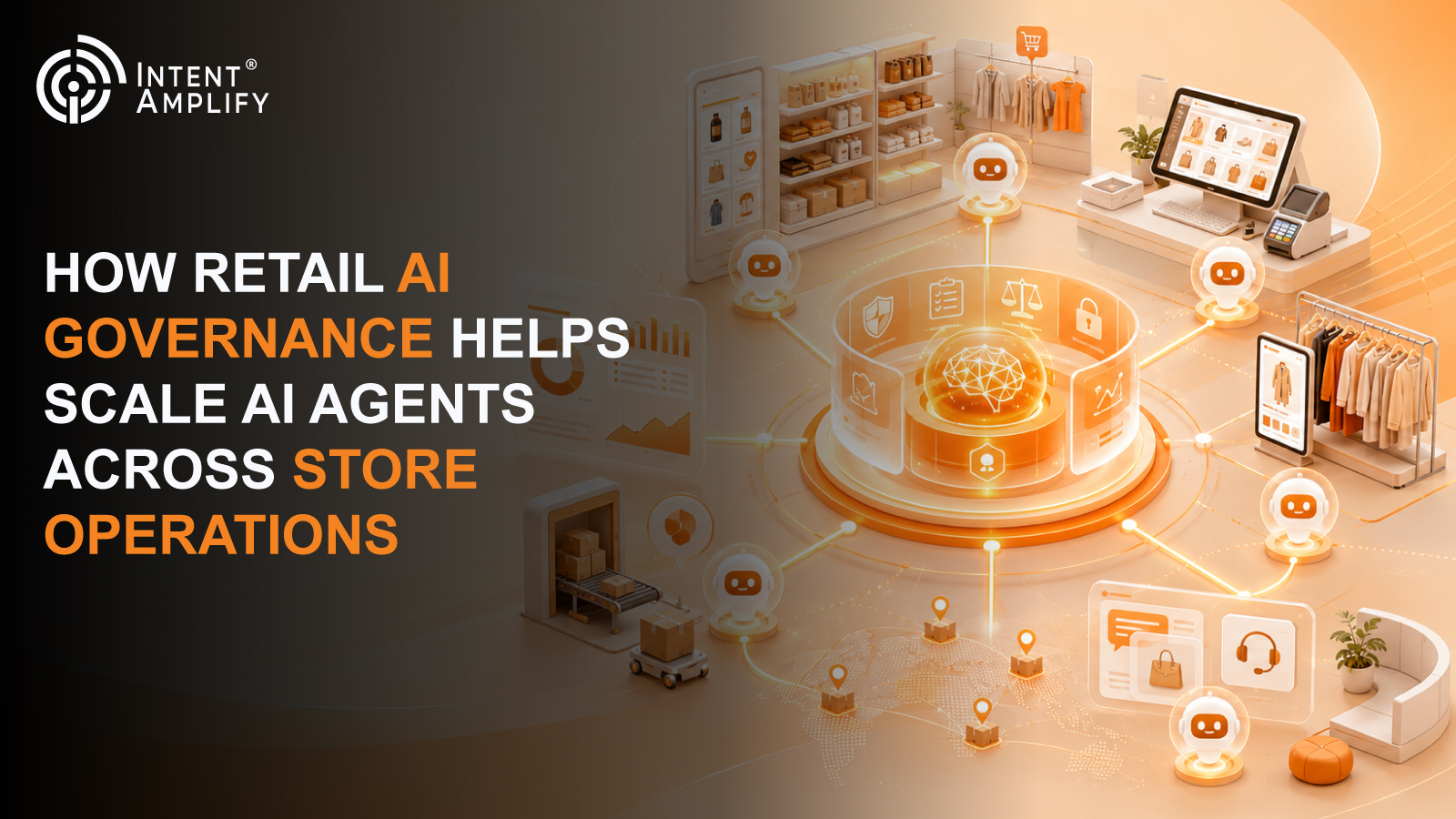
Executive Overview
AI in retail is moving from isolated digital experimentation into the operational core of physical stores. Retailers are now evaluating how AI agents can support product discovery, checkout readiness, associate assistance, inventory lookup, shelf visibility, returns triage, customer service, and localized store execution. For grocery, convenience, quick-service restaurants, specialty retail, and large-format operators, the opportunity is not limited to automation. The greater opportunity is to improve how stores sense demand, respond to customers, guide associates, and coordinate tasks during peak operating periods.
RETHINK Retail’s AI Agents Inside the Physical Store campaign is timely because retailers are now asking more practical questions about intelligent retail. They need to understand how AI improves physical retail stores, which AI agents in retail stores are ready for broader use, how AI-powered retail operations should be supervised, and what governance is required when automation begins to influence customers, associates, inventory records, checkout flows, and brand trust.¹
This expert analysis argues that Retail AI Governance is the foundation for scaling AI agents across store operations. Intent Amplify views retail AI maturity as a governance challenge, not only a technology adoption challenge. Retailers need to define trusted data, human oversight, customer transparency, escalation rules, and measurable outcomes before AI agents influence product discovery, checkout, associate support, returns, inventory, merchandising, and store execution.
Intent Amplify Perspective
Intent Amplify views Retail AI Governance as the operating discipline that helps retailers move from AI pilots to governed intelligent retail execution. AI maturity will not be defined by how many agents a retailer deploys, but by whether those agents use trusted data, explain recommendations, support associates, protect customer trust, and improve store outcomes.
As AI agents move into product discovery, checkout, inventory lookup, associate assistance, returns, merchandising, and store execution, retailers must know which use cases can remain assistive, which require human approval, and which should become autonomous only when risk controls are mature.
Intent Amplify Research Desk Observation
The physical store is a fast-changing environment where traffic patterns, staffing levels, inventory accuracy, promotional activity, queue pressure, and customer expectations can shift within the same day. An AI agent working in that setting may need to interpret partial signals, assist associates, guide shoppers, recommend replenishment, or flag operational exceptions when the store is under pressure.
Retail AI Governance matters because speed alone is not enough. Store leaders need confidence that an AI recommendation is based on reliable data, appropriate customer context, and clear escalation logic. A product discovery assistant may create low operational risk, while an AI loss-prevention alert, age-verification workflow, or returns recommendation may affect customer treatment and brand perception.
Retail AI initiatives rarely fail because organizations deploy too little AI. They fail because governance, data quality, operational ownership, and human accountability do not evolve at the same pace as automation. Governance is becoming the operating architecture that allows intelligent retail to scale with confidence across product discovery, checkout, inventory, customer service, associate workflows, and store execution.
Key Figures at a Glance
The financial scale of modern retail shows why AI governance must be treated as a business priority. Adobe’s official 2025 Holiday Shopping report found that U.S. consumers spent $257.8 billion online between November 1 and December 31, 2025, representing 6.8% year-over-year growth. Adobe also reported $145.2 billion in mobile spend during the same period, with mobile revenue share reaching 56.4%, which shows how strongly customer journeys now move across digital and physical touchpoints.²
Payment behavior adds another layer to the store experience. Adobe reported $20.0 billion in buy now, pay later spending during the 2025 holiday season, with $16.4 billion of that BNPL volume coming through mobile.²
These figures are important for physical retail because shoppers increasingly expect the same speed, payment flexibility, and product confidence across mobile, store, and assisted commerce experiences.
AI-driven shopping behavior is accelerating as well. Adobe reported 693.4% year-over-year growth in traffic from AI sources, including LLM-driven referrals, to retail sites during the 2025 holiday season.²
Salesforce’s Shopping Index page states that related commerce research draws on insights from 2,700 commerce leaders and 1.5 billion customers.³
Together, these official figures highlight why AI agents, Retail AI, AI customer experience, and frictionless checkout must be governed as part of a connected operating model rather than treated as standalone technology upgrades.
AI Agents Are Becoming Retail Operations Infrastructure
AI agents extend beyond traditional retail automation by interpreting operational context, retrieving relevant information, recommending actions, and orchestrating workflows across multiple enterprise systems. Within retail operations, they support associates with product information, inventory location, shelf availability, task prioritization, service issue resolution, and checkout monitoring while improving the speed and consistency of operational execution.
Enterprise value emerges through workflow orchestration rather than isolated automation. AI agents strengthen product discovery, guide associates to inventory, prioritize replenishment based on stock movement, surface operational insights for store management, and coordinate activities across merchandising, inventory, fulfillment, customer service, and workforce operations. Operational responsiveness improves as analytical insight is translated into coordinated execution across the retail environment.
AI agents increasingly function as enterprise operating infrastructure connecting people, business processes, operational data, and execution workflows. Recommendations involving workforce deployment, inventory escalation, merchandising actions, or checkout intervention require transparent reasoning, defined approval authorities, and accountable human oversight. Effective governance establishes the policies, decision rights, monitoring, and auditability needed to integrate AI agents into day-to-day retail operations with confidence.
Governance Defines Assistance, Recommendation, and Autonomy
Retail AI governance benefits from distinguishing three operating models: assistance, recommendation, and autonomy. Assistance supports store associates with product information, inventory lookup, and customer guidance. Recommendation prioritizes replenishment, workforce allocation, queue management, and operational responses while preserving human approval. Autonomy enables AI agents to execute defined workflows within established policy boundaries and therefore requires stronger governance, transparent decision logic, continuous monitoring, and accountable oversight.
Appropriate levels of automation depend on operational risk, business impact, regulatory requirements, and customer consequences. Inventory lookup, task summarization, and associate guidance represent suitable applications for AI-assisted execution. Checkout exceptions, returns authorization, identity verification, fraud detection, and shrink-related investigations require more rigorous approval controls, defined decision rights, and comprehensive auditability because these workflows directly influence financial performance, customer trust, and operational integrity.
Microsoft's retail AI guidance highlights AI shopping assistants, inventory planning, predictive visibility, AI-assisted associates, store execution, and autonomous shopping as emerging enterprise capabilities.⁴ Google Cloud similarly identifies AI agents, agentic commerce, customer experience, inventory management, and store operations as strategic priorities for retail and consumer packaged goods organizations.⁵
Together, these developments indicate that AI governance must extend across data management, customer experience, workforce operations, operational execution, risk management, and enterprise accountability rather than individual technology deployments.
Customer Trust, Associate Adoption, and Data Quality
AI becomes part of the customer experience when shoppers interact with in-store assistants, self-service kiosks, AI-powered checkout flows, product discovery tools, returns workflows, or personalized recommendations. Retailers need transparency rules that explain when AI is involved, how data is used, what human support is available, and how disputes are handled.
The same principle applies to associates. Store teams are more likely to trust AI when recommendations are explainable, practical, and connected to daily work. A replenishment prompt should explain whether it is based on shelf sensing, point-of-sale activity, online order pressure, or supplier delay. A labor recommendation should show whether it is based on queue length, traffic patterns, service targets, or task backlog.
Data quality is the foundation for both trust and adoption. Product information, inventory records, POS activity, returns history, loyalty data, workforce schedules, traffic signals, and fulfillment activity must be accurate enough to support operational recommendations. If the data is delayed or incomplete, AI can amplify store execution problems instead of solving them.
Revenue, Cost, and Execution Metrics Must Work Together
Retail AI Governance should define value before AI agents scale across locations. Revenue lift, labor efficiency, customer experience, shrink reduction, inventory accuracy, checkout speed, and associate productivity should be evaluated together, as store performance is shaped by interconnected workflows.
A practical scorecard should measure whether shoppers find products faster, associates spend less time searching for inventory, queues move more smoothly, exception alerts are sufficiently accurate to trust, and AI checkout reduces friction without undermining customer confidence. The goal is not to prove that one AI agent completed a task. The goal is to show that AI-powered retail operations improved the commercial and operational quality of the store.
Intent Amplify Retail AI Governance Framework™
Intent Amplify recommends that retailers use a common governance framework before scaling AI agents across store operations. The framework should help leaders decide what AI can do, what it should not do, when human review is required, and how performance should be measured.
|
Framework Pillar |
What It Means |
|
Trusted Operational Data |
AI agents should use reliable store, inventory, customer, workforce, transaction, and fulfillment data. |
|
AI Decision Governance |
AI recommendations should follow clear decision rights, approval rules, and escalation paths. |
|
Human Oversight |
Associates and managers should know when to review, challenge, approve, or override AI. |
|
Risk-Based Automation |
AI use cases should be governed based on customer impact, financial risk, and operational sensitivity. |
|
Performance & Trust Measurement |
AI should be measured across revenue, cost, customer trust, associate adoption, shrink, and execution quality. |
This framework helps retailers separate low-risk productivity tools from high-impact customer-facing systems. AI product discovery, associate support, and task summarization may need lighter controls, while checkout exceptions, returns decisions, identity workflows, and loss-prevention alerts require stronger review and auditability.
Executive Retail AI Governance Scorecard
|
Readiness Area |
What Leaders Should Check |
|
Governance Maturity |
Are AI agents governed through common standards across stores and functions? |
|
Data Quality |
Are inventory, POS, workforce, customer, and store data reliable enough for AI recommendations? |
|
Human Oversight |
Do associates and managers have clear review, override, and escalation rights? |
|
AI Explainability |
Can teams understand why a recommendation appears and what action is expected? |
|
Customer Trust |
Are customer-facing AI use cases transparent, fair, and supported by human help? |
|
Execution Readiness |
Can the use case scale with training, measurement, and operational ownership in place? |
Roadmap for Scaling AI Agents Across Store Operations
Retailers should begin with workflows where AI improves execution without creating unnecessary customer risk. Good starting points include inventory lookup, associate knowledge support, replenishment prioritization, queue visibility, task summarization, and AI-powered product discovery.
Higher-impact workflows such as frictionless checkout, returns triage, localized customer engagement, loss prevention, AI merchandising, and store-level decision-making should come later. These areas require stronger governance because they affect customer trust, associate accountability, brand perception, and financial outcomes.
Flowchart: Retail AI Agent Scaling Path
Identify store workflows with measurable revenue, cost, or customer experience friction.
↓
Validate data quality, privacy boundaries, and operational ownership.
↓
Pilot AI agents with associate and manager review
↓
Measure impact on sales, labor, inventory, shrink, and customer experience
↓
Expand to more locations with documented governance controls.
↓
Scale autonomy only where trust, accuracy, and escalation rules are mature
This roadmap helps retailers avoid deploying AI agents as disconnected tools. Store AI should evolve with associated workflows, customer expectations, and operating discipline so that intelligent retail becomes scalable rather than fragmented.
What RETHINK Retail Brings to the Conversation
RETHINK Retail is positioned for this discussion because it focuses on a critical question for the next phase of physical retail: what happens when AI agents move inside the store and begin shaping customer and operational moments in real time? That question matters for retailers that want faster service, stronger associate support, better store execution, and more intelligent retail operations without weakening trust.
For grocery, convenience, QSR, and large-format retailers, the value lies in separating AI experimentation from Retail AI Governance. Store leaders need to know which AI agent use cases are ready, which require human review, and which need stronger transparency before they reach shoppers. The retailers that lead this next phase will not simply deploy more automation. They will build governance models that allow AI agents to operate safely, clearly, and usefully across the store network.
Retail AI Governance Readiness Assessment
RETHINK Retail’s report, AI Agents Inside the Physical Store, helps retail leaders understand how AI agents are entering physical store operations and where they can support associates, customers, inventory, checkout, service, and store execution.
The next step is to assess whether the organization has the governance model required to scale AI agents safely and consistently. A Retail AI Governance Readiness Assessment can evaluate governance maturity, AI deployment readiness, operational intelligence, customer trust, data governance, workflow orchestration, human oversight, and execution maturity.
View the report as a starting point for a structured governance conversation on intelligent retail operations.
About Intent Amplify
Intent Amplify helps organizations turn market insight into measurable growth through research-led content, demand intelligence, executive engagement, sponsored reports, webinars, roundtables, vendor intelligence, and GTM consulting. For retail technology and transformation teams, Intent Amplify connects audience insight, content strategy, and campaign execution into a practical demand generation engine.
Conclusion
AI agents can improve how physical stores operate, but they will scale successfully only when governance keeps pace with adoption. Retailers need to define how agents use data, when human review is required, how customers are informed, how associates are supported, and how performance is measured across locations.
The executive priority is clear: retail AI must move from isolated experimentation to governed store execution. The retailers that lead this next phase will be those that can trust their data, explain AI recommendations, support associates, protect customer experience, and measure outcomes across the store network.
References
- RETHINK Retail and IntentTechPub (2026) AI Agents Inside the Physical Store. Available at: https://intenttechpub.com/report/ai-agents-inside-the-physical-store/
- Adobe (2026) 2025 Holiday Shopping Statistics, Trends & Insights. Available at: https://business.adobe.com/resources/holiday-shopping-report.html
- Salesforce (2026) Ecommerce Trends & Online Shopping Statistics Dashboard. Available at: https://www.salesforce.com/retail/shopping-index/
- Microsoft (2026) Microsoft for Retail: AI-Powered Retail Solutions. Available at: https://www.microsoft.com/en-us/industry/retail/microsoft-cloud-for-retail
- Google Cloud (2026) Retail and Commerce Solutions. Available at: https://cloud.google.com/solutions/retail
- Oracle (2026) Oracle Cloud for Retail. Available at: https://www.oracle.com/industries/retail/
- SAP (2026) Retail Industry Software. Available at: https://www.sap.com/industries/retail.html