
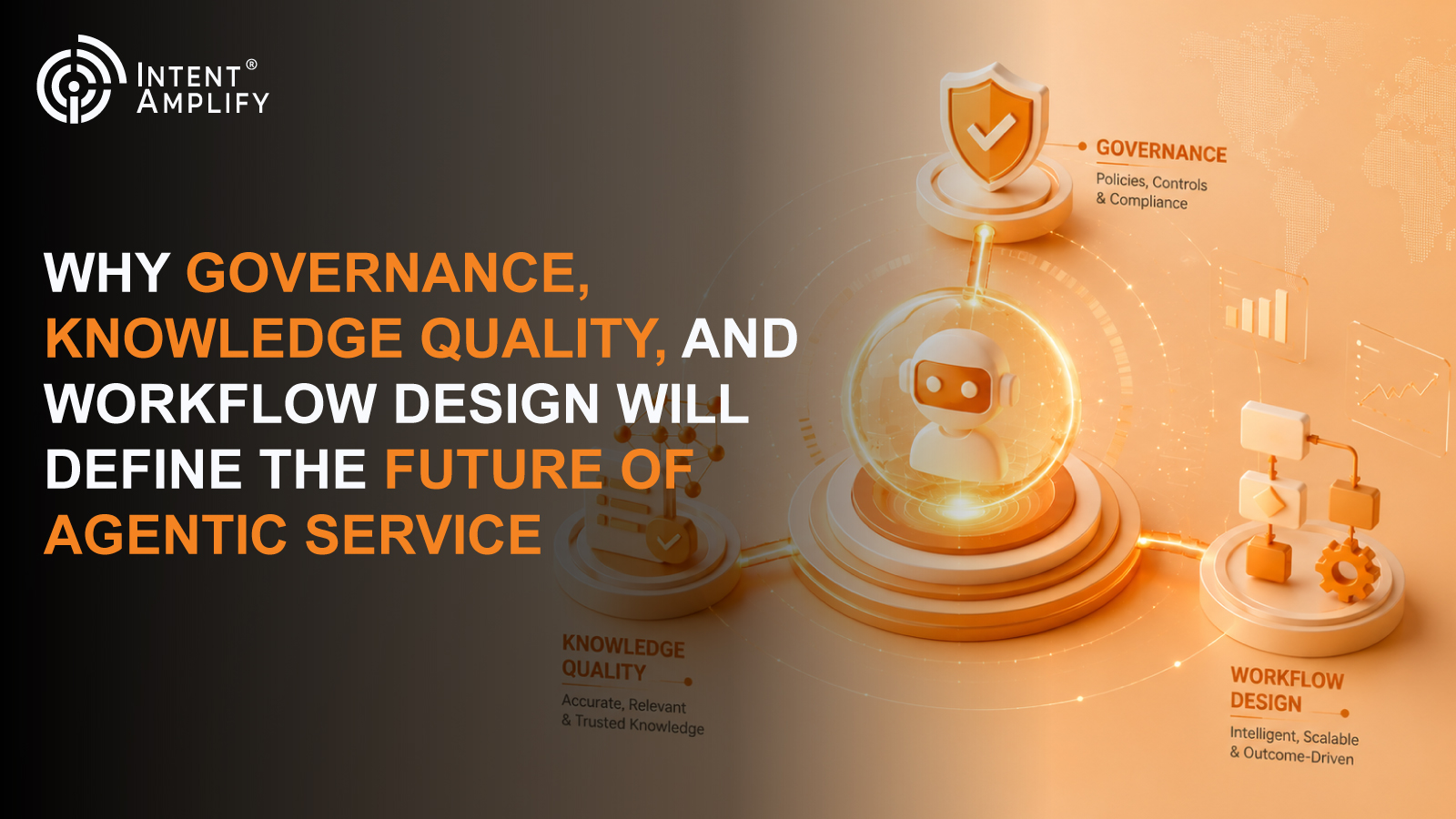
Agentic service is moving customer support from reactive response management toward autonomous issue resolution, yet the organizations that scale it successfully will not be the ones that simply deploy the most AI agents. They will be the ones who build the strongest foundations around governance, knowledge quality, workflow design, AI monitoring, and service performance management.
Zendesk’s Build Frameworks to Scale Agentic Service Masterclass is positioned around that reality. The webinar is designed to help CX and IT leaders assess agentic service readiness, build a practical action plan, evaluate knowledge, workflows, data, and governance, and define outcome metrics and guardrails before scaling AI across service operations.¹
Register Now for the Live Workshop
That framing matters because agentic AI changes the operating model of customer service. Traditional automation follows predefined rules, while agentic service can reason across context, take action through tools, adapt to workflows, and resolve more complex customer needs. The opportunity is significant, but so is the operational burden. If the knowledge base is outdated, if escalation logic is unclear, or if guardrails are weak, the AI customer experience can quickly become inconsistent, risky, or expensive to manage.
The next phase of AI customer service will therefore be defined less by experimentation and more by operational discipline. Viewed strategically, the conversation around agentic service has shifted from AI capability to enterprise operating maturity. Organizations increasingly differentiate themselves not by how many AI agents they deploy, but by how effectively they govern, monitor, and continuously improve them.
The Market Signal: AI Service Is Becoming Mainstream
Zendesk’s CX Trends 2026 report states that 83% of CX leaders say memory-rich AI agents are the key to truly personalized customer journeys. The same research found that 85% of CX leaders believe customers will drop brands over unresolved issues, even on first contact.²
These figures explain why enterprises are moving beyond basic customer service automation and toward more intelligent, context-aware support models.
The pressure is also visible in customer expectations. Zendesk found that 74% of consumers say AI has increased their expectation that customer service should be available around the clock.²
For service teams, this is where knowledge quality becomes a growth issue rather than a documentation issue. If the system cannot remember context, retrieve the right answer, and guide the next step, the customer experiences the AI as another layer of friction.
Salesforce’s 2025 service research adds another signal, showing that AI is expected to handle 50% of all customer service cases by 2027, up from 30% today. The same research found that AI moved from the number 10 priority for service leaders to the number 2 priority in just one year.³
KEY FIGURES AT A GLANCE
The agentic service market is accelerating because customer expectations and enterprise deployment are moving at the same time. Zendesk reports that 83% of CX leaders view memory-rich AI agents as essential to personalized customer journeys, while 85% believe customers will leave brands over unresolved issues, even on first contact. Customers are also raising the standard for availability and continuity. ²
Service organizations are already shifting from pilots toward measurable deployment. Salesforce found that AI is expected to handle 50% of customer service cases by 2027, compared with 30% today, while its later AI agents research found that adoption of AI agents in customer service organizations rose from 39% in 2025 to 66% in 2026, a 1.7x increase.³ ⁴
Salesforce also reported that 70% of organizations with AI service agents observe measurable value within 60 days of deployment, while 85% of service organizations now use at least one form of AI.⁴
The operating model challenge is equally clear. Microsoft’s 2026 Work Trend Index surveyed 20,000 workers using AI across 10 countries and analyzed trillions of anonymized Microsoft 365 productivity signals, reinforcing that the biggest AI value gaps are increasingly organizational rather than individual.⁵
Zendesk’s webinar responds to that exact gap by guiding leaders through readiness assessment across knowledge, workflows, data, and governance before they scale agentic service.¹
Why Governance Must Come Before Scale
Governance should function as an operational capability embedded within service delivery rather than as a policy framework reviewed only during audits. Agentic AI in service creates a different risk profile from traditional service automation. A rules-based bot may give a limited answer or route a ticket incorrectly, but an AI support agent connected to enterprise systems can retrieve knowledge, interpret customer intent, recommend actions, trigger workflows, and escalate issues. That additional agency makes AI governance a front-line operating requirement.
For CX leaders, governance should answer practical questions. What can the AI agent do independently? Which actions require human review? Which knowledge sources are approved? How are AI performance metrics monitored? What happens when confidence is low? How are customer-facing errors detected, corrected, and learned from?
Zendesk’s masterclass is built around this maturity problem by helping teams define guardrails, outcome metrics, and an AI action plan before scaling.¹ That is a more realistic approach than treating agentic AI as a plug-in improvement to existing service workflows, because autonomous customer service only performs well when policies, escalation logic, and accountability are designed into the operating model.
Knowledge Quality Is the Hidden Multiplier
Agentic service depends on knowledge quality more than many teams expect. If the enterprise knowledge base is fragmented, inconsistent, or stale, AI support agents may still respond quickly, but speed without reliable grounding can damage service quality management and customer trust.
Zendesk’s CX research highlights this issue through memory and continuity. When 74% of customers are frustrated by repeating their story, the problem is not only agent handoff.²
It is a knowledge management problem, a context management problem, and a workflow design problem. The service system must understand what has already happened, what the customer wants, what policy applies, and what the next step should be taken.
An AI-ready knowledge base should be structured, searchable, current, governed, and connected to the workflows that agents and AI systems actually use. That means support content, product policies, troubleshooting steps, escalation rules, and internal procedures should not live as disconnected documents. They should operate as a service intelligence layer that improves both human and AI performance.
Workflow Design Is Where Agentic Service Succeeds or Stalls
Many AI customer service projects underperform because teams automate isolated tasks without redesigning the workflow around the customer outcome. Agentic service requires a different question: what resolution should the system produce, and which sequence of knowledge retrieval, validation, action, escalation, and measurement is required to get there safely?
Workflow optimization matters because AI agents do not operate in a vacuum. They depend on system access, case history, identity data, product context, entitlement rules, service level agreements, and escalation pathways. If those components are poorly connected, the AI may become another interface layered atop broken service operations.
Zendesk’s masterclass focuses on knowledge, workflows, data, and governance, which is therefore strategically important.¹
Agentic service succeeds when workflows are redesigned around customer outcomes rather than simply automating individual tasks. Workflow orchestration, knowledge access, identity, and governance must operate together as a unified service system.
What Zendesk Brings to the Conversation
Zendesk is positioned for this conversation because its agentic service message is centered on resolution rather than automation for its own sake. The campaign’s promise is practical: assess readiness, identify high-impact gaps, define guardrails, and build a sequenced plan that service and IT teams can use to scale responsibly.¹
This matters for organizations evaluating AI customer service best practices, service desk automation, AI workflow optimization strategy, and enterprise AI adoption. Zendesk’s approach helps leaders move from curiosity to readiness by connecting strategic questions to operational details: what knowledge can be trusted, which workflows are ready, which data is usable, what governance exists, and which performance metrics will demonstrate value.
The most mature service organizations will not measure agentic AI only by ticket deflection. They will measure resolution quality, customer effort, containment accuracy, escalation health, agent productivity, compliance, and improvement over time.
Register for Build Frameworks to Scale Agentic Service
Zendesk’s expert-guided masterclass helps CX and IT leaders assess agentic service readiness, identify the highest impact gaps across knowledge, workflows, data, and governance, and build a practical plan to operate, monitor, and improve AI in service.
About Intent Amplify
Intent Amplify helps organizations move from market insight to measurable growth through GTM strategy, demand intelligence, pipeline activation, executive roundtables, sponsored research, targeted content, webinars and panels, vendor intelligence, and strategic consulting. For teams that need sharper positioning, stronger executive engagement, and more effective activation, Intent Amplify connects strategy, content, and market intelligence into a practical growth engine.
Executive Takeaway
The future of agentic service will not be defined by whether AI can answer more questions. It will be defined by whether service organizations can govern AI decisions, maintain high-quality knowledge, design workflows around real resolutions, and measure customer experience outcomes with discipline. As AI agents move deeper into customer support and IT service operations, the winners will be the organizations that treat governance, knowledge, and workflow design as the foundation of scale rather than the cleanup work after deployment.
References
- Zendesk and Intent Tech Insights (2026). Build Frameworks to Scale Agentic Service. Available at: https://intenttechpub.com/webinar/build-frameworks-to-scale-agentic-service/
- Zendesk (2026) CX Trends 2026. Available at: https://cxtrends.zendesk.com/
- Salesforce (2025) AI Expected to Resolve Half of Service Cases by 2027, Data Shows. Available at: https://www.salesforce.com/news/stories/state-of-service-report-announcement-2025/
- Salesforce (2026) AI Service Agents Improve Customer Satisfaction. Available at: https://www.salesforce.com/news/stories/ai-service-agents-improve-customer-satisfaction/
- Microsoft (2026). 2026 Work Trend Index: Agents, Human Agency and the Opportunity for Every Organization. Available at: https://assets-c4akfrf5b4d3f4b7.z01.azurefd.net/assets/2026/05/2026_Work_Trend_Index_Annual_Report_Key_Takeaways_050526-4_69fa647c6d8f1.pdf