
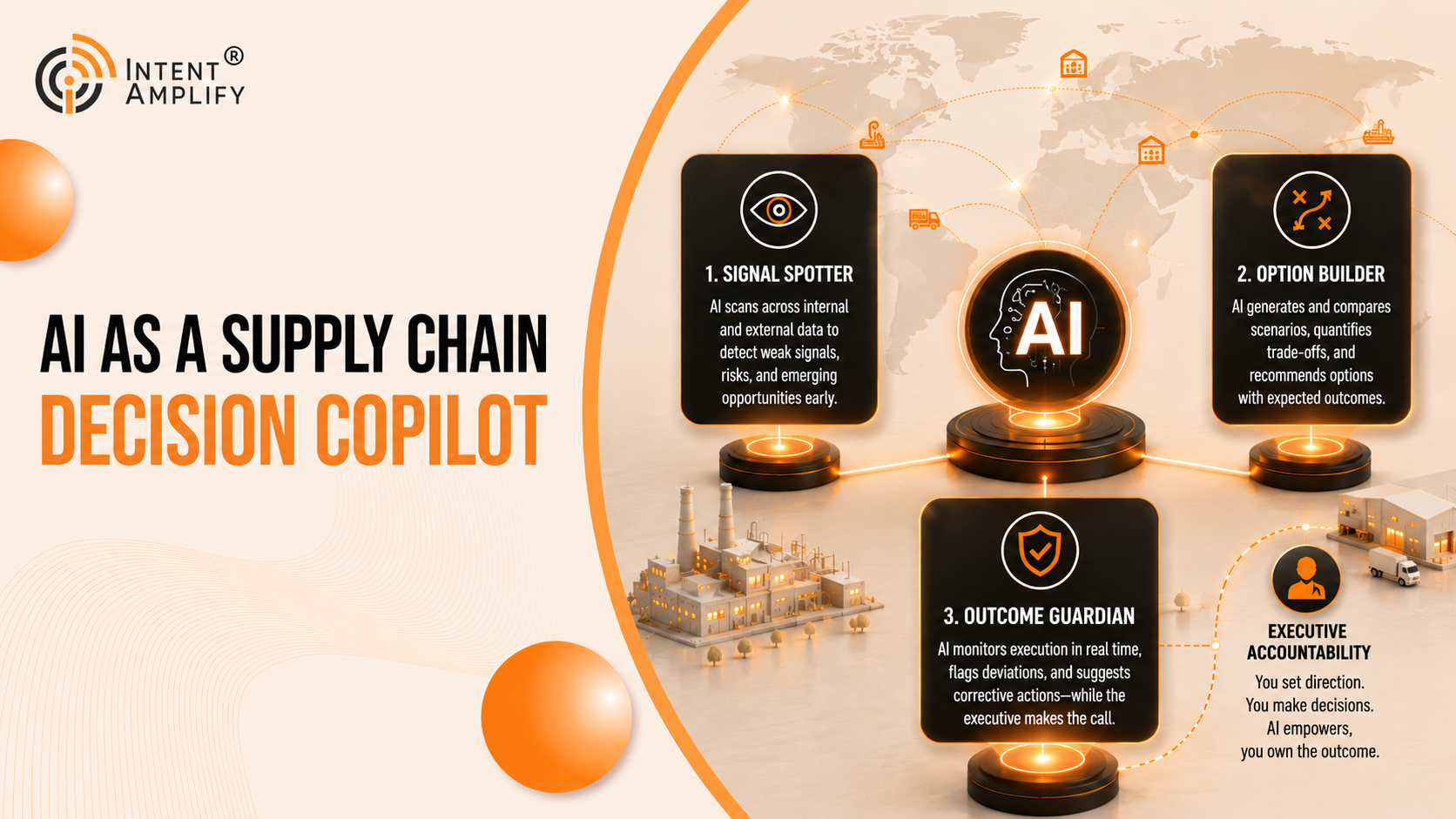
The most credible near-term role for AI in supply chain management is not to replace decision makers. It is to reduce the friction surrounding decisions.
In volatile environments, teams spend valuable time finding signals, assembling context, comparing options, and documenting rationale. AI can support those tasks while leaving accountability with the people authorized to make material trade-offs.
ROLE 1: SIGNAL TRIAGE
Supply chains generate large volumes of events. AI can help identify patterns, cluster related exceptions, and prioritize signals against defined business criteria. The important design choice is to rank by decision relevance, not simply anomaly severity.
A signal becomes important when it threatens a meaningful commitment and the response window is narrowing.
ROLE 2: CONTEXT ASSEMBLY
Decision owners often need information from multiple systems. AI can help summarize affected orders, inventory, capacity, customers, suppliers, milestones, and constraints when those data connections exist and are governed appropriately.
This is where the data layer matters. AI cannot reliably compensate for undefined identifiers, stale inputs, or inaccessible operational context. Better prompts do not replace trusted data.
ROLE 3: OPTION COMPARISON
AI can help structure scenario analysis by comparing available responses against constraints and decision criteria. It can surface dependencies, questions, and trade-offs that a human owner should evaluate.
The goal is not an unreviewed recommendation. The goal is a faster, more consistent decision brief.
WHAT AI SHOULD NOT OWN
Material decisions still require appropriate human accountability, especially where actions affect customers, financial commitments, safety, compliance, or strategic relationships. Organizations should define which decisions may be automated, which require human approval, and which should only receive analytical support.
THE EXECUTIVE TEST
For every AI use case, identify the specific latency it is expected to remove. Signal triage? Context assembly? Scenario preparation? Documentation? If the use case cannot be tied to a measurable workflow improvement, it may not be a priority.
A second test is traceability. Can the decision owner see the evidence, data freshness, assumptions, and constraints behind the output? Decision support should increase clarity, not create a new black box.
AI SHOULD MAKE IMPORTANT CHANGE EASIER TO SEE
For awareness, the most useful AI is often not the model producing the most elaborate prediction. It is the capability that helps a team recognize which change deserves attention and explains why. Supply chain environments produce too many signals for every event to receive equal investigation. AI can help compress that complexity when it ranks signals against explicit business criteria.
The design principle is important: relevance should be grounded in exposure, time sensitivity, and remaining choice. An unusual event is not automatically a material event. A decision copilot should help users understand the connection between the signal and the business commitment it may affect.
THE DECISION-COPILOT BRIEF
A practical copilot output can be structured as a short decision brief: what changed, what is affected, what is at risk, how much response time remains, what options are available, what constraints apply, what evidence is uncertain, and who owns the decision. This format supports both operational action and executive awareness.
The brief should link back to authoritative data where possible. If information is stale, conflicting, or missing, the output should make that visible rather than filling the gap with an assumption. Confidence is part of decision context.
WHERE AI CREATES DIFFERENTIATED VALUE
Signal triage reduces attention cost. Context assembly reduces search cost. Option comparison reduces analysis preparation. Documentation reduces coordination cost. These are distinct sources of latency and should be measured separately.
Organizations can start with one bounded workflow rather than attempting broad autonomy. Select a recurring decision class with known friction, document the current process, introduce AI support at one or two stages, and compare the resulting workflow using verified timestamps and quality checks.
TRUST IS A VISIBILITY REQUIREMENT
AI awareness is useful only when users understand why an output deserves attention. Decision owners should be able to inspect the source, freshness, assumptions, and relevant constraints behind a summary or prioritization. Traceability makes the model’s role visible and keeps accountability with the human owner.
This is especially important when multiple functions are involved. A planning team, logistics team, and customer team may each hold different pieces of context. AI can help synthesize those inputs, but the synthesis should not erase disagreement or uncertainty.
WHAT LEADERS SHOULD ASK BEFORE SCALING
Before scaling an AI use case, ask whether it reduces a defined form of decision latency, whether the required data is reliable, whether users can trace material outputs to evidence, whether the human authority boundary is explicit, and whether the chosen action can be executed through existing workflows. If these conditions are weak, scaling the model may scale ambiguity rather than value.
THE HUMAN-IN-THE-LOOP DESIGN IS THE PRODUCT
The phrase “human in the loop” is often used as a governance reassurance, but it is too vague to guide an operating model. A useful design specifies exactly where human judgment enters, what evidence the person receives, what authority that person holds, and what happens when confidence is low or evidence conflicts. Without those details, human review can become a ceremonial click rather than meaningful accountability.
For a bounded supply chain copilot, there are at least four useful control points. A human can define the business criteria used to prioritize signals. A human can validate whether assembled context is complete enough for the decision class. A human can choose among options when the trade-off crosses an agreed authority threshold. And a human can review outcomes to determine whether the workflow, data, or model needs adjustment. These are different responsibilities and should not be collapsed into a generic approval step.
This distinction also matters for speed. If every low-risk output requires senior approval, the copilot may add latency instead of removing it. If material recommendations bypass review because the system appears confident, the organization may create an accountability gap. The design objective is therefore not maximum automation or maximum oversight. It is a deliberate allocation of machine assistance and human authority based on consequence, reversibility, evidence quality, and time sensitivity.
MEASURE THE WORKFLOW, NOT THE NOVELTY
AI pilots can attract attention because the interface is impressive or the generated summary appears sophisticated. Those qualities are not sufficient evidence of operational value. The stronger evaluation question is whether the supported workflow performs better on dimensions that matter to the business.
For signal triage, teams can compare the time from event availability to qualified attention and inspect whether high-priority events are being surfaced consistently. For context assembly, they can measure the time required to prepare a decision brief, the proportion of required evidence fields that are available, and the frequency of manual searches or reconciliations. For option comparison, they can examine scenario-preparation time, whether material constraints are represented, and whether the decision owner receives viable alternatives before the response window closes.
Quality checks matter alongside speed. A faster brief that omits a customer commitment, uses stale inventory, or hides conflicting evidence is not an improvement. Measurement should therefore pair latency indicators with evidence-completeness, freshness, traceability, and decision-owner acceptance checks. The organization should define those checks before the pilot so that success is not retrofitted around whichever outputs look most favorable.
The same discipline applies to financial claims. Time saved in a workflow is not automatically revenue created, cost avoided, or working capital released. Those outcomes require their own evidence and attribution. Until that evidence exists, the credible claim is narrower: the workflow became faster, more complete, more traceable, or more consistent according to verified operating data.
FAILURE MODES TO DESIGN OUT EARLY
Several failure modes can make a decision copilot look useful while weakening the operating system around it. The first is false completeness: a polished summary can create the impression that all relevant context has been assembled even when a critical source is missing. The output should therefore distinguish verified evidence, missing evidence, and inferred or model-generated interpretation.
The second is confidence without provenance. A prioritization score or recommendation may be difficult to challenge if users cannot see which data, rules, assumptions, and time stamps contributed to it. A credible copilot should make the path back to authoritative evidence easy enough for a decision owner to inspect under operating pressure.
The third is automation of unresolved policy. If two functions disagree about service priorities, allocation rules, or escalation thresholds, adding AI does not settle the policy question. It can simply encode one interpretation and make the disagreement less visible. Policy and authority should be resolved explicitly before they are operationalized through a model-assisted workflow.
The fourth is orphaned execution. A copilot may identify the right issue and prepare a strong option set, but value still stalls if the chosen action cannot move into the systems and teams responsible for execution. The end-to-end design should include the handoff from decision to action, with an execution owner and a way to confirm that the action was initiated.
A PRACTICAL PILOT FOR ONE DECISION CLASS
A useful pilot begins with a recurring decision, not with a broad request to “apply AI to supply chain.” Choose a decision class where the trigger is recognizable, the owner can be named, the required context can be defined, and the response window matters. Examples might include a constrained allocation decision, an expedite decision, a supplier exception, or a customer-commitment risk, but the organization should select the class from verified operating friction rather than from a generic use-case list.
First, baseline the current workflow. Capture when the signal becomes available, when someone recognizes that a decision is needed, how long context assembly takes, which sources are consulted, when the accountable owner receives the issue, when a choice is made, and when execution begins. This baseline establishes where latency actually exists.
Second, define the copilot’s bounded role. It might prioritize incoming exceptions and assemble the initial evidence package while leaving scenario selection and approval to the decision owner. Or it might prepare a structured comparison after a planner validates the affected scope. The role should be narrow enough that the team can identify what changed in the workflow.
Third, define the evidence contract. Specify the fields that must be present, the authoritative source for each field, freshness expectations, how conflicting values are displayed, and what the system should do when required evidence is unavailable. “Unknown” is a valid output when the alternative is an invented answer.
Fourth, run the workflow through enough real or controlled cases to observe normal and difficult conditions. Include missing data, conflicting data, a low-confidence case, a time-critical case, and a case that requires escalation. The objective is to test the operating design, not merely the model’s ability to produce fluent text.
Finally, compare the new workflow with the baseline using the pre-defined measures. If latency falls but evidence quality deteriorates, the design is not ready to scale. If users receive better context but execution still stalls, the next constraint is downstream. Scaling should follow demonstrated workflow improvement, not enthusiasm for the interface.
A 30-DAY EXECUTIVE PATH TO EVIDENCE
In the first week, select the decision class and establish the baseline. The executive sponsor should insist on a concrete workflow, a named decision owner, and a clear business reason for reducing latency. Avoid starting with a platform-wide autonomy ambition.
In the second week, define the evidence and authority model. Agree which data sources are authoritative, what minimum context the owner needs, which decisions can remain within existing delegated authority, and which conditions require escalation. This is also the point to identify data gaps that would make model outputs unreliable.
In the third week, configure and test the bounded copilot workflow. Focus on signal triage, context assembly, or option comparison rather than attempting all possible capabilities at once. Make uncertainty visible and preserve source traceability. Test difficult cases deliberately.
In the fourth week, review operating evidence. Compare the supported workflow with the baseline, inspect exceptions and user overrides, and determine whether the next action is to scale, redesign, improve data, clarify policy, or stop. A disciplined stop decision can be as valuable as a scale decision when the evidence shows that the real bottleneck sits elsewhere.
EXECUTIVE TAKEAWAY
The strongest awareness case for AI in supply chain is practical: help people see what matters sooner, understand the relevant context faster, and compare viable choices while time remains. A decision copilot does not remove accountability. It makes the path from signal to accountable action more visible and less friction-heavy.
CONCLUSION
AI creates practical value in a decision-ready supply chain when it reduces the time between signal and action. Its strongest role is as a copilot: helping teams identify what deserves attention, assemble trusted decision context, and compare viable options while time remains. The technology supports the decision process; accountable owners remain responsible for material business trade-offs.
Download The Decision-Ready Supply Chain
REFERENCES
1. NIST. “Artificial Intelligence Risk Management Framework (AI RMF 1.0).” January 2023. Framework for trustworthy, transparent and accountable AI risk management. https://www.nist.gov/itl/ai-risk-management-framework
2. NIST. “Artificial Intelligence Risk Management Framework: Generative Artificial Intelligence Profile.” July 2024. Guidance for managing risks specific to generative AI systems. https://www.nist.gov/publications/artificial-intelligence-risk-management-framework-generative-artificial-intelligence
3. Gartner. “Supply Chain Leaders Should Prioritize Advanced Data Visibility and Scenario Planning to Drive Competitive Advantage Amid Global Uncertainty.” May 19, 2025. https://www.gartner.com/en/newsroom/press-releases/2025-05-19-gartner-says-supply-chain-leaders-should-prioritize-advanced-data-visibility-and-scenario-planning-to-drive-competitive-advantage-amid-global-uncertainty
4. APL Logistics. “ShipmentOptimiser™.” Digital forwarding platform using predictive analytics and shipment visibility to support exception management. https://www.apllogistics.com/apl-logistics-launches-shipmentoptimiser/
5. McKinsey & Company. “Supply chains: Still vulnerable.” October 14, 2024. Research on supply-chain resilience, visibility and response under disruption. https://www.mckinsey.com/capabilities/operations/our-insights/supply-chain-risk-survey-2024
6. IntentTechPub. “The Decision-Ready Supply Chain.” Campaign page for APL Logistics, IA-168 - 26-08-001. https://intenttechpub.com/ebook/the-decision-ready-supply-chain/?mtm_campaign=APL_logistics&mtm_kwd=supply_chain_now&mtm_source=website&mtm_medium=cta_download_now&mtm_content=website