
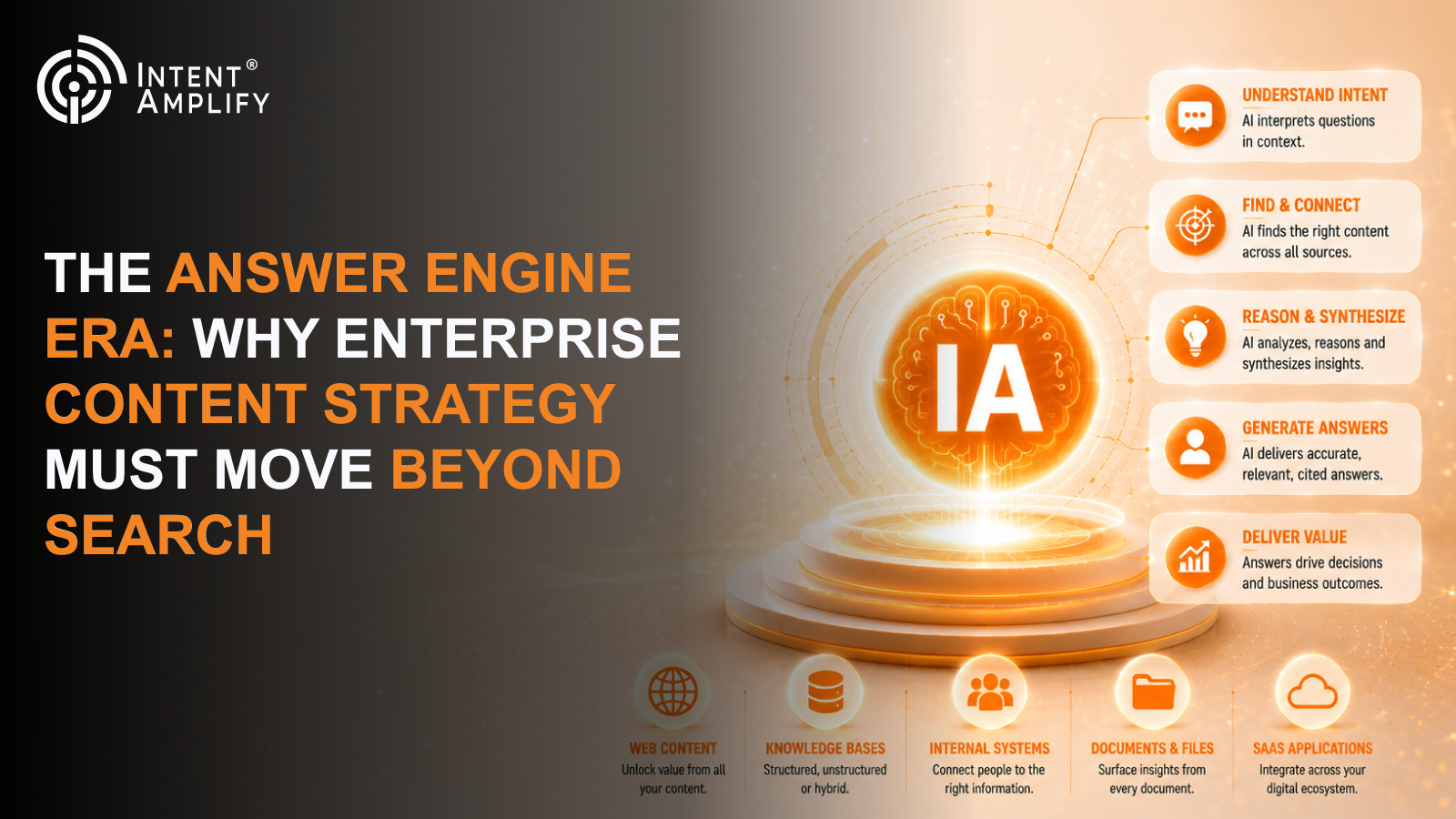
Enterprise search is entering a structural reset. For years, organizations treated website search as a utility: a box that helped visitors find pages, documents, videos, or support resources. That model is no longer sufficient. Enterprise users now expect direct answers, not search results. They want context, source traceability, relevance, and speed. More importantly, they expect those answers to come from trusted enterprise content rather than from fragmented third-party sources or ungoverned AI tools.
This is the shift Progress Software Corp addresses through its ebook: Websites Supercharged: Content Storage Transformed into an Answer Engine. The core proposition is timely: existing website and content management system assets can be transformed into a contextual answer engine using generative search and agentic retrieval-augmented generation, or RAG. The opportunity is not merely a better search. It is a new operating model for enterprise content.
Search Retrieves Content, but Enterprises Need Trusted Answers
Most enterprise websites are rich in content and poor in accountability. A buyer looking for security documentation, a customer looking for product guidance, or an employee searching for policy context may find dozens of links. What they often do not find is a concise, verified answer that reflects the latest approved knowledge.
That gap creates operational friction. Sales teams repeat explanations. Support teams absorb avoidable tickets. Digital teams keep producing new content because existing content is hard to reuse. Security and compliance teams worry that outdated or incomplete information may shape stakeholder decisions.
Microsoft’s 2025 Digital Defense Report states that Microsoft processes more than 100 trillion security signals daily, blocks 4.5 million net-new malware files each day, and analyzes 38 million identity risk detections on an average day. For enterprise leaders, the broader lesson is that information volume alone is not strategic value; interpretation, prioritization, and trusted retrieval are. 1
The same challenge exists in website content. Enterprises have more digital assets than ever, but the discovery layer has not kept pace with user expectations. Traditional search still depends heavily on keyword matching, metadata quality, content hierarchy, and user patience. In high-stakes enterprise environments, that is a weak foundation.
For cybersecurity and technology buyers, the risk is sharper. A CISO assessing an AI platform, a CSO evaluating operational resilience, or a CIO reviewing architecture documentation needs accurate answers tied to approved sources. If the official website cannot provide that clarity, the buyer may turn to public AI tools, outdated analyst summaries, peer forums, or internal assumptions. That can dilute brand control and weaken trust.
Accenture’s June 2025 State of Cybersecurity Resilience report found that 90% of companies lack the maturity to counter today’s AI-enabled threats, while 77% lack essential data and AI security practices to protect critical business models, data pipelines, and cloud infrastructure. 2
This is why enterprise content strategy must move beyond publishing and indexing. Content must become usable intelligence. The website should not only host knowledge; it should resolve intent.
Progress’s eBook frames this problem directly. It highlights how traditional content management systems and keyword-based search bury valuable content, slow buying decisions, and limit the value of unstructured assets such as PDFs, videos, web pages, and support material.
The Answer Engine is Becoming the New Enterprise Interface
The answer engine era is not defined by chatbots. It is defined by a deeper architectural change: enterprise systems are beginning to retrieve, reason, cite, and respond from approved knowledge bases.
Retrieval-augmented generation is central to that shift. Instead of relying only on a model’s general training data, RAG retrieves relevant enterprise content and uses it to generate grounded responses. Agentic RAG adds another layer. It can reason through a query, select retrieval paths, work across multiple content formats, and produce more contextual answers.
Enterprise users increasingly ask complex, multi-dimensional questions that extend beyond traditional search behavior. A visitor may not ask, “Show me product page X.” They may ask, “How does this platform help my organization reduce compliance risk while supporting multilingual customer experiences?” Keyword search struggles with that kind of intent. An answer engine can retrieve across product content, compliance resources, case studies, documentation, and FAQs to assemble a more useful response.
McKinsey’s 2025 Global Survey on AI found that 88% of respondents report regular AI use in at least one business function. It also found that 23% of respondents are scaling agentic AI somewhere in the enterprise, while another 39% have started experimenting with AI agents. 3
The market is moving quickly, but enterprise maturity remains uneven. Many organizations are experimenting with AI while still managing content through disconnected repositories, manual workflows, and limited governance. That creates a gap between user expectation and enterprise readiness.
Gartner’s 2025 outlook reinforces the strategic direction. The firm predicts that 40% of enterprise applications will be integrated with task-specific AI agents by the end of 2026, up from less than 5% at the time of publication. 4
Enterprise search is evolving from a static website function into an AI-mediated interface for customer experience, employee productivity, support, sales enablement, and knowledge management.
However, the move toward answer engines must be governed. For CISOs and CSOs, this is the central point. An answer engine that retrieves from unclassified, outdated, or restricted content can introduce risk. It may surface claims that are no longer approved. It may summarize documents without preserving nuance. It may expose content to the wrong audience if access controls are weak. It may also create false confidence if citations are missing or poorly mapped.
The goal should not be “deploy AI search” as a feature. The goal should be to create a governed answer layer that improves measurable outcomes: faster decision-making, better buyer education, lower support burden, stronger content reuse, and more transparent digital engagement.
Deloitte’s 2025 consumer research adds a trust dimension that applies directly to enterprise digital experiences. Its June 2025 survey of about 3,500 US consumers found that consumers are embracing generative AI and digital tools, but they also want transparency, control, and data security as technology advances. 5
The findings highlight growing expectations for transparency, explainability, and data security. Users are willing to engage with AI, but they expect explainability. In an enterprise context, that means answer engines must show where answers come from, how they were generated, and whether the cited source is authoritative.
Progress’s Agentic RAG positioning is relevant here. Progress states that its solution can replace link-based search results with precise, context-rich answers, allowing users to ask natural-language questions and receive the exact passage, timestamp, or snippet they need from across the content ecosystem.
Answer engines differ from traditional search by synthesizing source material, preserving traceability, and reducing the distance between question and action. Search points to possible sources. An answer engine synthesizes the relevant source material, preserves traceability, and reduces the distance between question and action.
Build a Content Strategy Around Governed Answerability
Enterprises should not treat the answer engine era as a user interface upgrade. It is a content strategy transformation.
The first requirement is content authority mapping. Organizations need to know which assets are current, approved, audience-ready, and appropriate for generative retrieval. Product pages, legal-approved claims, support articles, technical documentation, compliance assets, and customer-facing FAQs should be classified by purpose and sensitivity. Without that foundation, generative discovery risks amplifying content disorder.
The second requirement is structured and multimodal ingestion. Modern enterprise knowledge is not limited to web pages. It lives in PDFs, videos, transcripts, diagrams, policy documents, support portals, and internal repositories. The answer layer must be able to ingest and retrieve across those formats without forcing a full replatforming effort.
Progress’s eBook specifically highlights structured ingestion, multimodal search, modular pipelines, and large language model-agnostic flexibility as core requirements for enterprise-grade generative search.
The third requirement is identity-aware access control. This is especially important for CISOs and CSOs. The answer engine must respect permission boundaries. A public website visitor, a logged-in customer, a partner, a support agent, and an internal employee should not all retrieve from the same content universe. The system must prevent direct and indirect leakage of restricted knowledge.
The fourth requirement is citation and auditability. Every generated answer should be linked to source evidence. Progress states that its Agentic RAG solution provides source citations, retrieval logs, and governance-ready audit trails, with outputs linked back to the exact sentence, paragraph, or timestamp used.
That capability matters because answer engines will increasingly shape customer journeys, employee decisions, and buying committee perceptions. If the organization cannot audit what was answered and why, it cannot fully manage risk.
The fifth requirement is business outcome alignment. The success metrics should be concrete: fewer failed searches, shorter content discovery time, higher self-service resolution, better conversion from high-intent pages, fewer repeated support questions, and stronger engagement with strategic content assets.
McKinsey’s 2025 AI research emphasizes that while AI use is now widespread, most organizations have not embedded AI deeply enough into workflows and processes to realize material enterprise-level benefits.
This is where many organizations will need a more disciplined approach. Answer engines only create value when they are connected to workflows, buyer journeys, and measurable business problems. A homepage chatbot may generate interest. A governed answer engine tied to trusted content can generate impact.
For enterprise leaders evaluating this shift, Progress Software Corp’s Websites Supercharged: Content Storage Transformed into an Answer Engine is a strong starting point. It explains how generative search powered by agentic RAG can transform existing website and CMS content into a trusted answer engine that supports customer journeys, internal teams, and content-driven decision-making.
Strategic Implications for CISOs, CSOs, and Enterprise Decision-Makers
The answer engine era changes ownership. Website search can no longer sit only with digital marketing or web operations. It now touches security, governance, compliance, data architecture, customer experience, and revenue strategy.
For CISOs, the priority is risk control. They should assess whether answer engines preserve access boundaries, prevent sensitive content exposure, support audit trails, and reduce reliance on unapproved external AI tools.
For CSOs and customer-facing leaders, the priority is trust and consistency. They should evaluate whether the system produces answers that align with approved positioning, current documentation, and buyer expectations.
For CIOs and IT decision-makers, the priority is integration. They should assess whether the answer engine can work with existing content systems, data sources, application environments, and identity frameworks.
For marketing and digital experience teams, the priority is content performance. They should identify which assets are underused, where search fails, and where generative discovery can shorten the path from question to conversion.
Competitive advantage will increasingly depend on the ability to make enterprise content answerable, trustworthy, and actionable at the moment of intent.
Contact Intent Amplify to identify the accounts, buying committees, and intent signals already forming around AI-powered knowledge access, member retention, and association digital transformation.
References
- Microsoft (2025), Microsoft Digital Defense Report 2025.
- Accenture (2025), State of Cybersecurity Resilience 2025, published June 25, 2025.
- McKinsey & Company (2025), The State of AI: Global Survey 2025.
- Gartner (2025), Gartner Predicts 40% of Enterprise Apps Will Feature Task-Specific AI Agents by 2026, published August 26, 2025.
- Deloitte (2025), 2025 Connected Consumer: Innovation with Trust.