
Industry Context: Physical Stores Are Becoming Decision Environments
Physical stores have evolved into operational decision environments where inventory accuracy, associate effectiveness, customer intent, fulfillment execution, checkout performance, and operational risk converge continuously throughout the trading day. Across omnichannel retailers, grocery chains, and wholesale operators in the United States and Canada, store performance increasingly reflects the quality of operational decisions made in real time rather than transactional efficiency alone.
AI is therefore moving closer to store operations. Enterprise value increasingly derives from augmenting human decision-making through AI agents, retail analytics, and intelligent store systems that improve operational timing, contextual awareness, and execution quality. Fully autonomous stores will continue to evolve in selected environments, while broader retail adoption is expected to focus on AI-assisted workforce execution and governed operational workflows.
IBM and the National Retail Federation reported in 2026 that 72% of surveyed consumers continue to shop in physical stores, while 45% use AI during their buying journeys.¹ The findings illustrate a broader shift in retail behavior. AI increasingly shapes customer expectations before shoppers enter a store, engage with an associate, compare products, or complete a purchase.
Store operations now operate within the same AI-enabled customer journey. Customers increasingly arrive with AI-assisted product research, price comparisons, dietary preferences, fit recommendations, and substitution expectations. Store associates, however, often continue working across fragmented applications, inconsistent inventory visibility, and disconnected operational systems. Customer expectations therefore evolve faster than store execution capabilities, creating a widening gap between digital intelligence and physical retail operations.
Intent Amplify Perspective: Human Judgment Is Becoming the Retail AI Advantage
Retail competitiveness increasingly depends on how well organizations augment human judgment with operational intelligence. Physical stores are no longer only transaction points. They are dynamic decision environments where associates, managers, asset protection teams, customer experience leaders, and operations teams must respond to changing inventory conditions, customer needs, labor constraints, checkout pressure, and service risks in real time.
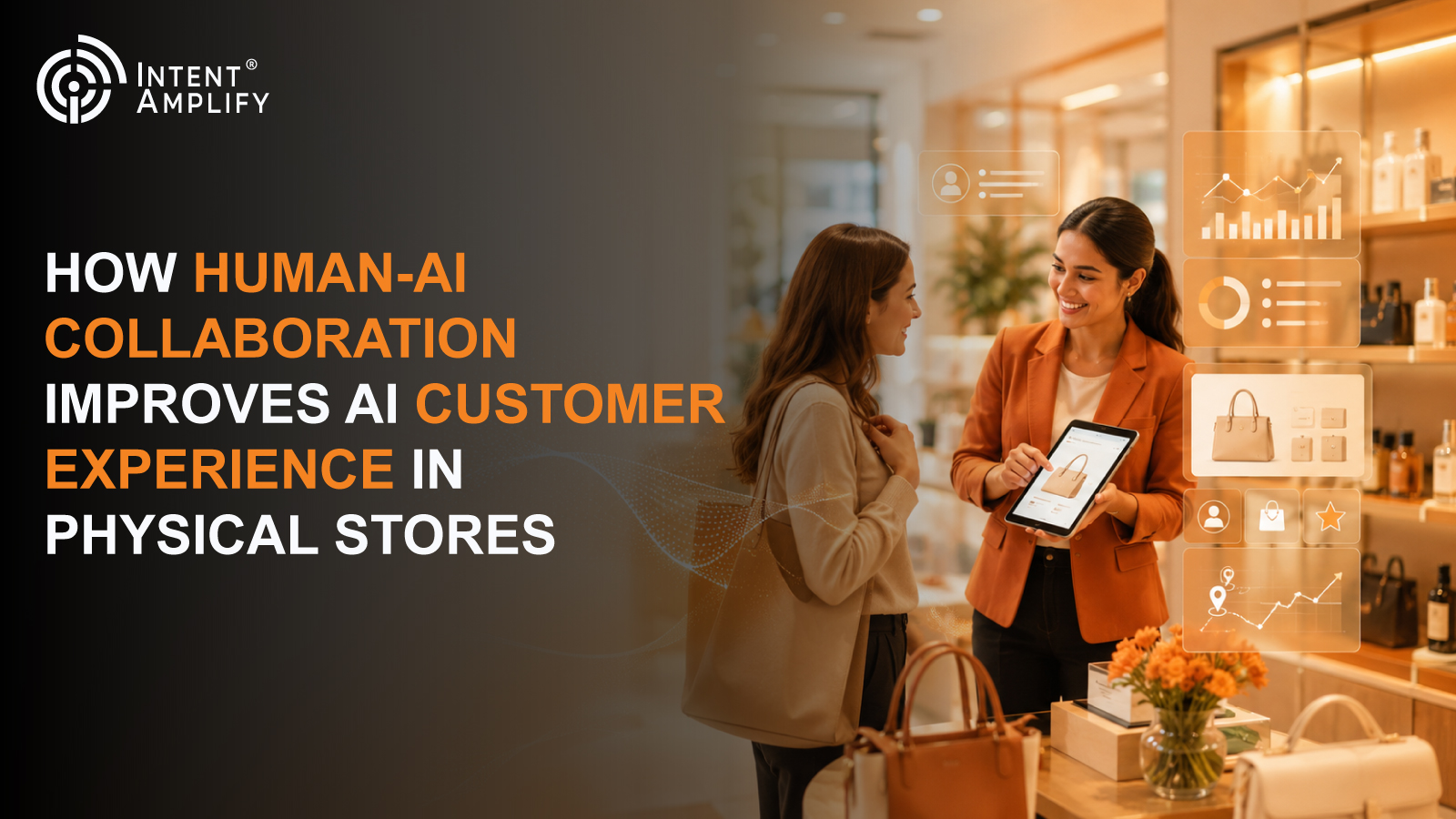
AI can improve this environment when it helps people make faster, better-informed, and more consistent decisions. The objective is not to replace store judgment with automation. It is to give frontline teams the context they need to act with confidence, especially when customer expectations are shaped by AI-assisted discovery before they enter the store.
For retailers, the next maturity stage will be defined by the quality of human-AI collaboration. Organizations that combine operational intelligence with accountable human decision-making will be better positioned to improve customer experience, store execution, associate productivity, and trust than those that pursue automation as a standalone objective.
Emerging Trend: AI Is Moving From Automation to Store-Level Orchestration
Retail automation has historically focused on isolated task efficiency. Self-checkout reduced cashier dependency. Workforce tools improved scheduling. Computer vision helped identify shelf gaps. Recommendation engines personalize digital merchandising. Each capability has value, but none fully solves the physical store problem when it operates as a disconnected system.
The emerging model is AI orchestration across store workflows. In this model, AI agents help identify where customer intent, inventory conditions, labor availability, and service risk are misaligned. Human teams then act with better context. This is the difference between AI as another tool and AI as operational intelligence.
Salesforce’s 2025 Connected Shoppers research found that 39% of consumers already use AI for product discovery. For retailers, that indicates a shift in how product consideration begins. AI product discovery is not limited to online search; it increasingly shapes in-store questions, product comparisons, and expectations around availability. When store teams cannot access the same level of context, the customer experience becomes uneven.[2]
This is especially relevant in grocery and wholesale environments. A customer asking about an out-of-stock product may not only want a replacement. They may need dietary suitability, package-size comparison, brand equivalence, promotion eligibility, or location-specific availability. AI for retail associates can compress that decision path, but the associate still provides judgment, reassurance, and service recovery when the answer is not obvious.
Intent Amplify Research Desk Observation
Human-AI collaboration succeeds when AI reduces cognitive load rather than decision ownership. Retailers that combine operational intelligence with accountable human judgment will deliver more consistent customer experiences than those pursuing automation alone.
This distinction matters because physical retail depends on context. A store associate may need to resolve an out-of-stock question, recommend a substitute, explain a product attribute, support checkout, or escalate a customer concern while balancing speed, empathy, policy, and operational reality. AI can improve the quality of those decisions when it surfaces the right information at the right moment, but the final customer-facing judgment often still requires human interpretation.
The strongest retail AI models will therefore be built around decision support, not decision removal. AI should simplify store work, clarify priorities, improve response time, and make execution more consistent across locations while preserving human accountability where trust, safety, service recovery, and customer experience are at stake.
Expert Perspective: The Human Role Becomes More Valuable When AI Is Designed Around Workflows
The strongest argument for human-AI collaboration in retail stores is not that AI can answer more questions. It is that physical stores contain too many operational exceptions for automation alone to handle well.
A store manager deals with labor gaps, incomplete replenishment, shrink risk, customer complaints, weather-driven demand changes, local promotions, and supplier variability. An associate may need to balance service speed with empathy. A loss prevention team must distinguish suspicious patterns from legitimate behavior. These are not edge cases. They are normal store conditions.
Deloitte’s 2025 retail and consumer products GenAI research found that at least 42% of respondents were still in the initial stages of GenAI integration, even as leaders expected a 2.7x mean ROI increase from GenAI investments. That gap between early maturity and high expected return should make retail executives cautious. ROI will not come from scattered pilots. It will come from workflow redesign, operating discipline, and governance.[3]
Intent Amplify Human-AI Retail Collaboration Framework
1. Store Signal Layer
This layer includes point-of-sale data, inventory records, shelf conditions, loyalty signals, workforce systems, returns, promotions, customer search intent, and supplier feeds. The quality of AI insights depends on whether these signals are timely, clean, and connected to store execution.
2. AI Agent Layer
AI agents should be assigned to defined retail workflows such as product discovery, substitution support, checkout exception handling, queue visibility, replenishment prioritization, fraud pattern detection, and associate coaching. Broad agents create confusion because store operations require speed, role clarity, and accountability.
3. Human Decision Layer
Associates, store managers, customer experience teams, and asset protection leaders should retain authority over service recovery, escalation, safety-sensitive decisions, and policy exceptions. AI can recommend and explain. Humans must decide where judgment, empathy, and accountability matter.
4. Governance Layer
Retail AI governance should define what data AI systems can use, which recommendations require approval, how overrides are logged, and how customers are informed when automated decisioning affects their experience. For U.S. and Canadian retailers, this also requires attention to privacy obligations, biometric data constraints where applicable, and brand-level trust expectations.
For a deeper view of where agentic AI fits inside store workflows, download the AI Agents Inside the Physical Store report.
Market Implications: Better Store Intelligence Changes the Economics of Experience
The economic case for AI transformation in physical stores is strongest where customer experience and operating performance are inseparable.
Inventory is the first area. IHL Group reported in 2025 that global retail inventory distortion costs reached $1.73 trillion annually because of overstocks and out-of-stocks. This is not only a supply chain loss. It is a store experience failure that appears as unavailable products, poor substitutions, avoidable markdowns, wasted labor, and lower customer confidence.[4]
Checkout is the second area. Frictionless checkout and AI checkout are often discussed as speed initiatives, but the better frame is trust under pressure. A checkout system that reduces wait time but increases exception anxiety will not improve loyalty. AI-powered checkout optimization should help detect queue buildup, payment failures, mis-scans, age-restricted product exceptions, and abandoned baskets, while store teams resolve the customer-facing issue quickly.
Loss prevention is the third area. NRF and the Loss Prevention Research Council reported in 2025 that retailers saw an 18% increase in average annual shoplifting incidents in 2024 versus 2023, and threats or acts of violence during theft events rose 17%. Those numbers make AI store operations more complex because high-risk interventions still require human control, training, and policy discipline.[5]
Customer service is the fourth area. Gartner predicted in 2025 that by 2029, agentic AI will autonomously resolve 80% of common customer service issues, contributing to a 30% reduction in operational costs. Physical retail will not absorb that forecast by removing people from the experience. More likely, routine service questions will be handled faster, while associates spend more time on judgment-heavy interactions that influence loyalty, basket size, and repeat visits.[6]
Recommendations: What Retail Leaders Should Prioritize Before Scaling
Retail leaders should start by identifying where poor information damages the in-store experience. The strongest candidates are product discovery, inventory availability, substitution decisions, checkout exceptions, shrink response, associate task prioritization, and service recovery. These workflows are frequent, measurable, and operationally visible.
Second, assign ownership before deploying AI agents. IT should own architecture and integration standards. Store operations should own workflow fit. Customer experience leaders should own service impact. Asset protection should own safety and escalation design. Legal, privacy, and compliance teams should define governance boundaries. Without this ownership model, retail AI becomes a pilot portfolio rather than an operating capability.
Third, design AI for retail associates as decision support, not surveillance. Retail workforce AI should reduce cognitive load, shorten search time, and improve task clarity. If associates experience AI as another monitoring layer, adoption will suffer. If they experience it as a practical assistant that helps them serve customers and complete work faster, adoption becomes easier to defend.
Fourth, measure outcomes that executives already care about. Useful measures include assisted conversion, substitution acceptance, shelf-gap resolution time, checkout dwell time, complaint reduction, shrink investigation quality, associate task completion, override rates, and customer satisfaction after service recovery. AI-driven retail decision-making should be evaluated through store performance, not model activity.
Executive Collaboration Scorecard
|
Executive Collaboration Scorecard |
Maturity Question |
|
Workflow readiness |
Are priority store workflows clearly mapped before AI agents or automation tools are deployed? |
|
Associate enablement |
Does AI help associates reduce search time, improve task clarity, and resolve customer issues faster? |
|
AI governance |
Are permission boundaries, approval rules, override paths, privacy controls, and audit trails clearly defined? |
|
Operational intelligence |
Are store signals connected across inventory, checkout, workforce, loyalty, promotions, and customer intent? |
|
Decision accountability |
Is there clear ownership for decisions that affect service recovery, safety, customer trust, and policy exceptions? |
|
Customer experience |
Does AI improve product discovery, substitution support, checkout flow, service consistency, and customer confidence? |
|
Store execution maturity |
Are AI-supported workflows measured against task completion, issue resolution, shrink response, conversion, and satisfaction outcomes? |
Conclusion: Intelligent Retail Still Needs Human Judgment
Human-AI collaboration is becoming the most credible model for improving AI customer experience in physical stores because it respects the reality of retail work. Stores are variable environments. Customers ask imperfect questions. Inventory data can be wrong. Checkout pressure changes behavior. Loss prevention decisions carry safety implications. Associates often have to make the right call with incomplete context.
AI agents, retail automation, conversational commerce, retail search, smart checkout, and retail operations intelligence can improve that environment when they are designed around the people who run the store. The objective is not to remove human judgment. It is to make that judgment faster, better informed, and more consistent across locations.
Human-AI Retail Readiness Assessment
As AI moves deeper into physical retail, leaders need a clearer way to assess whether their store operating model is ready for effective human-AI collaboration. The question is not only whether the organization has AI agents, automation tools, analytics, or customer experience platforms. It is whether those capabilities are connected to store workflows, associate adoption, governance, operational intelligence, and measurable execution performance.
Intent Amplify’s Human-AI Retail Readiness Assessment helps evaluate:
- Workflow maturity
- AI readiness
- Associate adoption
- Governance maturity
- Customer experience impact
- Operational intelligence
- Execution performance
The assessment helps retail technology providers and solution leaders create a stronger transition from executive education to advisory engagement by positioning AI as a practical store execution capability built around human judgment, trust, and measurable outcomes.
Start your Human-AI Retail Readiness Assessment
References
- IBM Institute for Business Value and National Retail Federation (2026) IBM-NRF Study: Brands and Retailers Navigate a New Reality as AI Shapes Consumer Decisions Before Shopping Begins. Available at: https://newsroom.ibm.com/2026-01-07-ibm-nrf-study-brands-and-retailers-navigate-a-new-reality-as-ai-shapes-consumer-decisions-before-shopping-begins.
- Salesforce (2025) Connected Shopper Report 2025: With AI Adoption Surging, Shopping Behavior Is at an Inflection Point. Available at: https://www.salesforce.com/news/stories/consumer-shopping-ai-trends-2025/.
- Deloitte (2025) Unlocking Generative AI Value in Retail and Consumer Products. Available at: https://www.deloitte.com/us/en/what-we-do/capabilities/applied-artificial-intelligence/articles/unlocking-value-generative-ai-retail.html.
- IHL Group (2025) Retail Inventory Crisis Persists Despite $172 Billion in Improvements. Available at: https://www.ihlservices.com/news/analyst-corner/2025/09/retail-inventory-crisis-persists-despite-172-billion-in-improvements/.
- National Retail Federation and Loss Prevention Research Council (2025) New Study Finds Retailers Continue to Contend with Rising Levels of Theft and Violence. Available at: https://nrf.com/media-center/press-releases/new-study-finds-retailers-continue-to-contend-with-rising-levels-of-theft-and-violence.
- Gartner (2025) Gartner Predicts Agentic AI Will Autonomously Resolve 80% of Common Customer Service Issues Without Human Intervention by 2029. Available at: https://www.gartner.com/en/newsroom/press-releases/2025-03-05-gartner-predicts-agentic-ai-will-autonomously-resolve-80-percent-of-common-customer-service-issues-without-human-intervention-by-20290.