
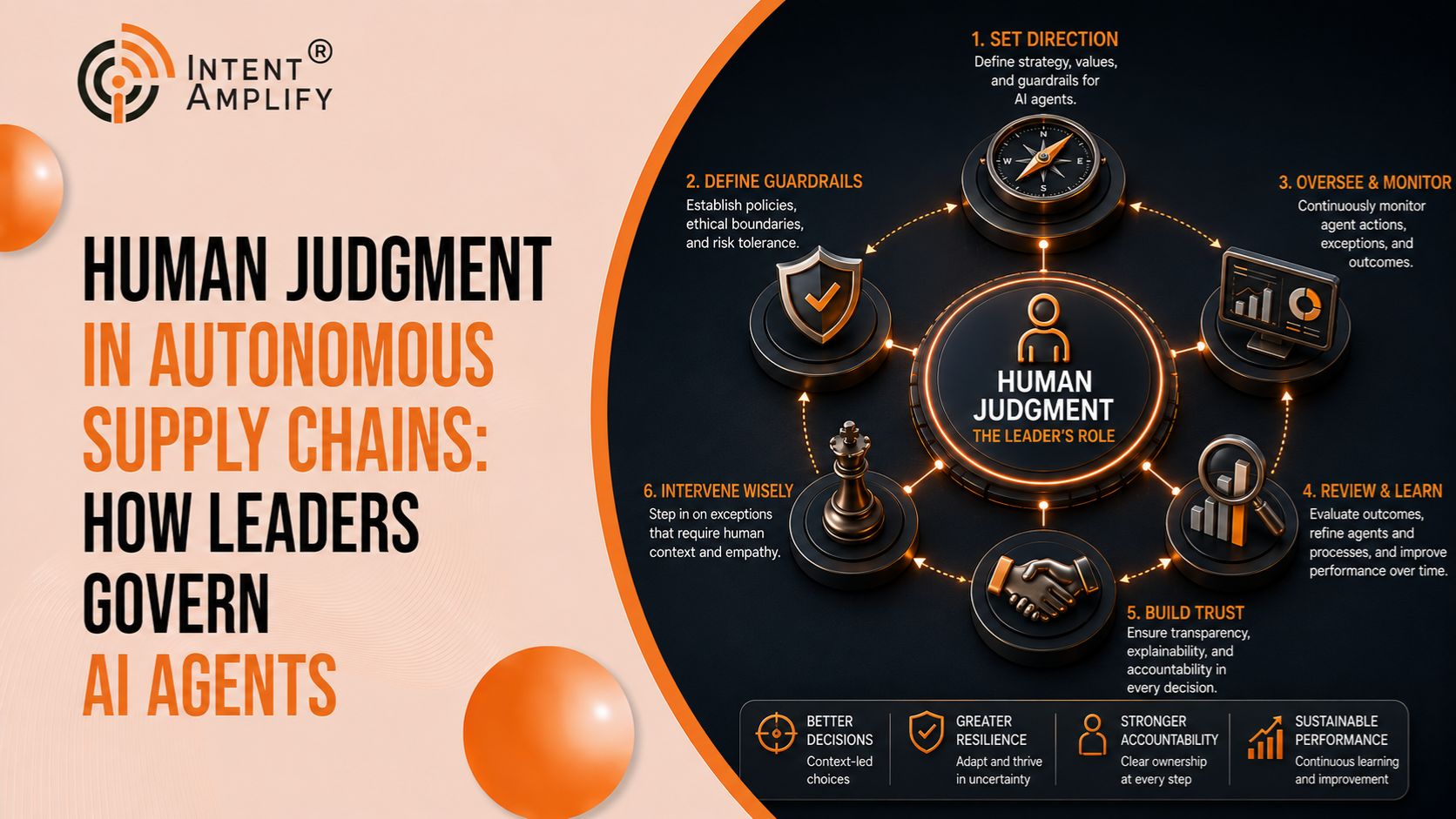
The arrival of AI agents creates an understandable question for supply chain professionals: if systems can detect problems, build scenarios, and execute tasks, what remains uniquely human?
The answer is not “everything strategic,c” and it is not “nothing operational.” The human advantage becomes most visible where the decision contains ambiguity, competing values, accountability,ty or consequences that cannot be reduced to a stable rule.
Agentic AI can change the distribution of work. It does not eliminate the need for judgment.
EVIDENCE BOUNDARY — PRODUCT DIRECTION VS. OPERATING-MODEL ANALYSIS
This insight separates verified product direction from the leadership framework developed here. SAP sources support the direction of Joule Assistants and AI agents across planning, logistics, manufacturing, and business-network workflows. NIST provides a general risk-management reference. The judgment matrix, escalation design, override-learning model, role architecture, and leadership exercises below are original campaign frameworks; they should not be read as SAP or NIST prescriptions.
No verified workforce reduction, productivity uplift, adoption rate, ROI, pipeline impact, or implementation-readiness claim is made. The operating-model implications will vary by organization, process, data quality, policy maturity, and deployment scope.
THE WORK AI IS WELL SUITED TO ABSORB
Supply chain teams spend significant time on activities that are necessary but cognitively expensive: retrieving context, reconciling records, monitoring queues, summarizing exceptions, comparing scenarios, and preparing routine workflows.
These are strong candidates for AI assistance because they involve repeated evidence gathering and structured analysis.
SAP’s 2026 Planning, Logistics and Manufacturing Assistants illustrate this direction. Planning agents are positioned around exception management and shortage resolution. Logistics capabilities are designed to coordinate warehousing and transportation decisions. Manufacturing agents can support disruption analysis and next-best-action scenarios.
As these capabilities mature, the human role can shift away from being the person who manually connects every system.
THE WORK THAT BECOMES MORE IMPORTANT
Three human capabilities become more important as routine coordination is automated.
First: objective setting.
An AI system can optimize only against the objectives and constraints it receives. Leaders must decide whether service, cost, working capital, resilience, customer priority, or another outcome should dominate in a given decision.
Second: policy judgment.
Real operations produce edge cases. A strategic customer may justify an exception to standard allocation policy. A supplier relationship may carry context that is not captured in a transaction record. A plant may face a temporary constraint that changes what “optimal” means.
Third: accountability.
Organizations still need identifiable people who own policy, approve material exceptions,s and answer for consequential decisions. Delegating execution to an agent does not remove organizational accountability.
THE NEW OPERATIONS LEADER: DESIGNER OF DECISION SYSTEMS
Operations leaders have traditionally designed processes, teams, KPIs, and escalation paths. Agentic AI adds another responsibility: designing the decision system itself.
That means specifying:
- Which decisions deserve automation?
- Which evidence is authoritative?
- Which objectives should the AI optimize?
- Which trade-offs require human judgment?
- Which thresholds trigger escalation.
- Which actions can be executed without approval?
- How overrides are captured.
- How the organization learns from failures.
This is not primarily a prompt-engineering job. It is operations design.
ESCALATION BECOMES A CORE CAPABILITY
A mature autonomous system should know when not to act.
That makes escalation one of the most important capabilities in the architecture.
An agent should escalate when required evidence is missing, policies conflict, the decision exceeds a materiality threshold, the action is difficult to reverse, or the scenario falls outside the system’s validated operating boundaries.
The receiving human also needs the right context. An escalation that simply says “confidence low” pushes the investigation back onto the operator. A better escalation explains what is known, what is missing, which options were considered, and why the system stopped.
The goal is not to eliminate escalation. It is to make escalation intelligent.
OVERRIDES ARE DATA
When a planner or manager rejects an AI recommendation, the organization should capture why.
Was the inventory record stale? Was there an undocumented customer priority? Did the model miss a capacity constraint? Was the recommended action technically valid but commercially unacceptable?
These override reasons are among the most valuable sources of evidence for improving an autonomous workflow.
A high override rate does not automatically mean the AI is poor. It may indicate weak data, an incomplete policy, or a decision class that still depends heavily on human judgment.
Likewise, a low override rate does not prove success. Humans may be over-trusting the system. Outcome measurement is still required.
THE JUDGMENT MATRIX
- Leaders can classify decisions along two dimensions: ambiguity and consequence.
- Low ambiguity + low consequence: strong candidate for automation.
- Low ambiguity + high consequence: AI can prepare the decision, but approval may remain human.
- High ambiguity + low consequence: AI may experiment within reversible boundaries, with monitoring.
- High ambiguity + high consequence: human-led decision with AI analysis support.
- This matrix helps prevent a common error: assuming that frequent decisions are automatically safe to automate or that rare decisions should never use AI.
THE MANAGEMENT SYSTEM MUST CHANGE TOO
If AI agents take on more routine work, traditional productivity metrics may become misleading.
A planner who manually closes fewer exceptions may be creating more value if AI handles routine cases and the planner focuses on complex trade-offs. A manager may spend more time reviewing policy and less time chasing status updates.
THE HUMAN CONTROL TOWER: FROM QUEUE MANAGER TO JUDGMENT OWNER
The phrase “human in the loop” is too vague for an autonomous supply chain. It can mean anything from clicking approve on every recommendation to intervening only when a system reaches a defined boundary. Those are fundamentally different operating models.
A better design starts by defining the human role for each decision class.
The reviewer checks evidence and validates a recommendation before execution. This role is useful where the process is stable, but the consequence remains high.
The exception owner receives decisions the system cannot resolve because evidence is incomplete, policies conflict, or the situation is outside validated boundaries.
The policy owner decides the objectives, thresholds, and prohibited actions that govern a class of decisions. This is a leadership role, not a transactional approval role.
The outcome owner monitors whether automated and human-approved decisions are producing the intended operating result. This person looks beyond whether the workflow completed successfully.
The learning owner reviews overrides, failures,s and recurring escalations to determine whether data, policy, training, or system design should change.
One person may hold several of these roles in a small operating model. In a large enterprise, they may sit across planning, procurement, logistics, manufacturing, customer operations, risks,k and technology. What matters is that each responsibility is explicit.
This is the human control tower: not a room full of people watching dashboards, but a defined accountability system for supervising machine-supported decisions.
DESIGNING ESCALATIONS THAT PRESERVE HUMAN ATTENTION
Escalation can become the hidden failure mode of agentic automation. If every uncertain case is pushed to a person, the organization simply replaces one queue with another. If too few cases are escalated, the system may act beyond its reliable operating boundary.
The answer is not a universal confidence threshold. Escalation should be designed around the reason human judgment is required.
Evidence escalation occurs when the system lacks an authoritative input or when sources conflict.
Policy escalation occurs when two valid rules point toward different actions, for example, a service commitment conflicts with a working-capital constraint.
Materiality escalation occurs when the financial, customer, production, safety, contractual,al or reputational consequence exceeds delegated authority.
Novelty escalation occurs when the situation falls outside the patterns or scenarios for which the workflow has been validated.
Irreversibility escalation occurs when an action is difficult or expensive to undo.
Cross-functional escalation occurs when the best local action creates a material consequence for another function,ion and no approved trade-off rule exists.
This classification improves both speed and learning. The receiving leader immediately knows why the system stopped. The organization can also measure which type of escalation dominates and address the underlying cause rather than treating every exception as an AI problem.
THE ESCALATION PACKET: WHAT A HUMAN NEEDS TO MAKE A GOOD DECISION
A useful escalation should arrive as a decision packet, not an alert.
The packet should state the decision required, the triggering event, the relevant business objects, the authoritative evidence available, the missing or conflicting evidence, the options considered, the key trade-offs, the policy or threshold that caused escalation, the latest safe decision time, and the actions that will follow approval.
This changes the economics of human oversight. The person is not being asked to reconstruct the situation from multiple applications. The machine does the context assembly; the person contributes judgment.
For example, a shortage escalation should not merely say that supply is insufficient. It should identify affected materials and orders, current inventory status, expected receipts, customer or production priorities where verified, alternative actions, the cost or service trade-offs that can be calculated, the unresolved ambiguity, and the deadline by which a decision is needed.
The quality of the escalation packet is therefore a meaningful operating metric. A system that escalates the right cases but sends poor context will still consume large amounts of human time.
JUDGMENT DEBT: THE RISK OF AUTOMATING BEFORE POLICY IS CLEAR
Organizations often discover that the hardest part of automation is not technical integration. It is that experienced operators have been resolving ambiguity through unwritten judgment for years.
This creates judgment debt: business decisions depend on tacit knowledge that has never been converted into explicit objectives, policies, evidence requirements,s or escalation rules.
Agentic AI exposes that debt because the system must be told how to act when priorities collide. If a planner knows that a specific customer commitment outweighs the standard allocation policy, where is that rule recorded? If a transportation manager knows that a certain route should not be used during a seasonal constraint, is that represented in the operating context? If a plant manager routinely accepts a particular trade-off because of a downstream quality concern, can the system see that concern?
The wrong response is to encode every historical human habit as a permanent rule. Some habits are workarounds for old system limitations. Others are local optimizations that should be challenged.
The better approach is to use automation design as a policy-discovery exercise. Ask experienced operators to explain not only what they do, but what evidence changes their decision, which trade-offs they are protecting, and when they would choose differently.
That conversation converts tacit expertise into an inspectable decision model.
THE OVERRIDE REVIEW: TURNING HUMAN DISAGREEMENT INTO SYSTEM LEARNING
Overrides should be reviewed as a portfolio rather than as isolated events.
A monthly or quarterly override review can classify disagreements into a small set of causes: stale or missing data; incomplete policy; model or analytical weakness; unrepresented business context; changed operating conditions; user preference without supported evidence; or a genuinely novel event.
Each category implies a different response.
Data failures should be fixed at the source or in the context pipeline.
Policy failures require the business owner to clarify the rule or acknowledge that the decision should remain discretionary.
Analytical failures require model, optimization, or agent improvement.
Missing-context failures may require a new data source or a structured way for operators to supply relevant context.
Changed-condition failures may indicate that the workflow needs a temporary boundary or revalidation.
Unsupported preference is different. Human override is not automatically superior to the machine recommendation. If a person repeatedly rejects a recommendation without evidence and outcomes do not support the override, the learning opportunity may be human rather than technical.
This is why override governance must avoid two simplistic assumptions: “the AI was wrong because a person disagreed” and “the AI was right because the person approved.” Outcome evidence matters.
A NEW MANAGEMENT CADENCE FOR AGENTIC OPERATIONS
As AI absorbs more routine coordination, leaders need a management cadence that focuses on the quality of the decision system.
Daily operations can monitor open material escalations, failed executions, aging decisions,s and decisions approaching their latest safe action time.
Weekly reviews can examine recurring escalation categories, unresolved policy conflicts, abnormal override patterns, and cross-functional bottlenecks.
Monthly reviews can evaluate decision-cycle time, evidence quality, automation boundaries, policy changes, and the outcomes associated with major decision classes.
Quarterly reviews can reassess which decisions should move toward greater automation, which should move back toward human control,l and which new capabilities require training or operating-model changes.
This cadence is different from traditional AI governance because it sits inside operations. It treats agentic AI as part of the management system rather than as a separate technology program.
METRICS THAT REWARD JUDGMENT, NOT ACTIVITY
The transition to agentic operations creates a measurement problem. Traditional productivity measures often reward visible activity: cases closed, transactions processed, alerts handled, or hours saved. Those measures can become misleading when machines perform more routine work.
A stronger scorecard starts with decision performance.
Decision-cycle time measures how long it takes to move from a qualifying event to an approved action.
Escalation aging measures how long decisions wait for human judgment after the system reaches a boundary.
Escalation completeness measures whether the required evidence and options were present when the case reached the human owner.
Override classification measures why people reject or alter recommendations, without assuming that either the human or the AI was correct.
Execution accuracy measures whether the approved action was carried out as intended.
Recovery performance measures how quickly the organization detects and contains a poor action.
Outcome measures connect decisions to service, inventory, cost, resilience,e or other business results only where attribution is credible.
These measures encourage leaders to improve the system rather than maximize automation volume.
THE ROLE ARCHITECTURE: WHAT CHANGES FOR PLANNERS AND OPERATIONS LEADERS
Agentic AI is unlikely to change every supply chain role in the same way. The more useful question is which responsibilities move, which remain, and which become more important.
For planners, routine context assembly and repetitive exception triage may increasingly move toward AI-supported workflows. The planner’s comparative advantage shifts toward scenario judgment, commercial context, policy interpretation,n and high-consequence exceptions.
For managers, status aggregation may become less central. Their role expands toward defining decision rights, monitoring escalation quality, resolving cross-functional policy conflicts, and coaching teams on evidence-based overrides.
For functional leaders, the critical responsibility becomes portfolio design: deciding which decision classes should be automated, assisted, or human-led and ensuring that authority aligns with consequence.
For transformation and technology teams, success depends less on deploying a general assistant and more on creating reliable context, integrations, observability,y and controls around defined decisions.
For executives, the strategic task is to determine where human judgment creates enterprise value and to protect attention for those decisions.
This is a more credible workforce narrative than claiming that AI simply “frees people for strategic work.” Strategic work does not appear automatically when routine work disappears. Roles, measures, escalation paths, and management expectations must be redesigned to make that shift real.
A 90-DAY LEADERSHIP PILOT
Leaders can test the operating model without making broad workforce or autonomy claims.
- Days 1–30: Choose one recurring decision class and observe it. Record the trigger, evidence gathered, human participants, common judgment calls, escalation reasons, cycle time, and outcome measures that are already available. Do not automate yet.
- Days 31–60: introduce AI-supported context assembly and recommendation while keeping human approval. Require structured override reasons and classify every escalation. Review whether the system is reducing investigation work or merely moving it.
- Days 61–90: refine policy, evidence requirements, and escalation packets. Consider bounded automation only for low-ambiguity, reversible cases with reliable context. Compare decision-cycle time, escalation quality, override causes, and execution accuracy against the baseline where evidence permits.
At the end of the pilot, the decision should not be “Did people like the AI?” It should be “Which parts of this decision system are reliable enough to delegate, which still require judgment, and what evidence supports the next boundary change?”
Performance management should therefore evolve toward decision quality, exception aging, escalation effectiveness, override learning, and business outcomes—not raw activity volume.
SKILLS FOR THE AGENTIC OPERATING MODEL
Supply chain professionals will need stronger capabilities in five areas.
Decision framing: defining the real business decision behind an alert.
Policy design: expressing objectives, boundaries,s and escalation rules clearly.
Evidence evaluation: identifying whether the available context is sufficient and trustworthy.
Scenario judgment: evaluating trade-offs that cannot be reduced to one metric.
AI supervision: interpreting recommendations, challenging weak reasoning, and learning from overrides.
These are extensions of core supply chain leadership skills, not replacements for them.
A PRACTICAL LEADERSHIP EXERCISE
Take one recurring decision from your team’s weekly workload.
Write down what the person actually does: which data they gather, which judgment they apply, which policies they use, whom they consult, and what they are authorized to change.
Then separate the work into three columns:
Machine-strength work: retrieval, monitoring, structured comparison, and workflow preparation.
Shared work: scenario generation, recommendation,n and policy application.
Human-strength work: ambiguous trade-offs, material approvals, novel exceptions, and accountability.
That exercise produces a much more useful automation roadmap than asking which jobs AI can replace.
CONCLUSION
The autonomous supply chain does not remove people from the operating model. It changes where human attention creates the most value.
As agents absorb more monitoring, context assembly,y and routine coordination, people can concentrate on objectives, policy, ambiguity, accountability, and learning.
The organizations that benefit most will not be those that minimize human involvement. They will be those that deliberately place human judgment where consequence and uncertainty make it valuable.
Join “SAP AI Inside the Supply Chain: From Silo to Orchestration” to examine how supply chain roles, decisions, and oversight evolve as Joule Assistants and AI agents enter operational workflows.
Reference Links:
- SAP — Joule Agents and Joule Assistants for Supply Chain Management: https://www.sap.com/india/products/artificial-intelligence/ai-assistant/scm.html
- AP — Planning Assistant: https://www.sap.com/india/use-cases/joule-assistant/supply-chain-planning-ai
- SAP — Logistics Assistant: https://www.sap.com/india/use-cases/joule-assistant/logistics-ai
- SAP — Manufacturing Assistant: https://www.sap.com/india/use-cases/joule-assistant/manufacturing-ai
- SAP — Business Network Assistant: https://www.sap.com/india/use-cases/joule-assistant/business-network-ai
- SAP News Center — Building the Autonomous Supply Chain: https://news.sap.com/2026/05/more-autonomous-supply-chain/
- SAP News Center — Orchestrating Supply Chains Through Business Networks and AI: https://news.sap.com/2025/10/orchestrating-supply-chains-business-networks-ai/
- NIST — Artificial Intelligence Risk Management Framework: https://www.nist.gov/itl/ai-risk-management-framework