
Agentic Service is Becoming the Service Model
For years, service automation focused primarily on repetitive, rules-based activities such as ticket routing, password resets, and knowledge recommendations. These capabilities improved operational efficiency but rarely changed how service organizations were designed or managed.
Agentic AI service changes the equation because AI agents can interpret intent, reason across context, trigger workflows, retrieve knowledge, escalate exceptions, and resolve issues across connected environments. That shift makes agentic service readiness a strategic priority because the question is no longer whether AI can support service operations but whether those operations are ready for AI that can act.
The significance of agentic service lies less in AI itself than in the operating model it requires. Once AI begins retrieving knowledge, invoking systems, and executing workflows, governance, architecture, and service design become business-critical capabilities rather than implementation details.
AI is gaining traction across CX and IT service environments faster than many organizations are building the readiness needed to support it properly.
From Automation to Agentic Service
Traditional service automation works best when the path is predictable. Password resets, order updates, appointment changes, and FAQ responses are useful workflows, but they are still rule-based and limited by logic defined in advance.
Agentic service is different because it can use context to understand a request, identify the relevant system, retrieve information, determine the next step, and decide whether to act or escalate. That makes it more like an operational layer for AI-powered customer service.
Gartner predicts that by 2029, agentic AI will autonomously resolve 80% of common customer service issues without human intervention and help reduce operational costs by 30%, which signals a major change in how service work may be structured, measured, and governed.1
For CX leaders, this creates an opportunity to improve speed, personalization, trust, and service quality. For IT leaders, it creates an architecture challenge involving system access, data governance, security controls, observability, and AI workflow automation. The result is a broader operational responsibility. As AI assumes greater participation in service delivery, CX leaders increasingly focus on customer trust and experience, while IT leaders are responsible for the architecture, governance, and operational controls that enable AI to perform reliably at scale.
The Readiness Gap Is Where the Strategy Gets Real
Enterprise AI adoption is no longer theoretical. McKinsey's 2025 State of AI research found that 88% of organizations report regular AI use in at least one business function, which shows the market has moved into active deployment.2
The problem is scale because McKinsey also found that only about one-third of organizations have begun scaling AI programs across the enterprise. That gap matters because agentic service depends on reliable workflows, shared knowledge, governance, measurement, and cross-functional ownership.2
The agentic AI adoption curve is even more revealing because McKinsey reports that 23% of respondents say their organizations are scaling agentic AI somewhere in the enterprise, while 39% are still experimenting with AI agents. Many companies are testing the future of service, but fewer have built the operational foundation to trust it at scale.2
Taken together, these findings suggest that AI availability is no longer the primary constraint on enterprise adoption. Operational readiness has become the differentiator. Organizations that successfully scale agentic service are investing as much in governance, workflow redesign, and organizational alignment as they are in AI technology itself.
For CX Leaders, Readiness Is a Customer Trust Issue
Customer experience AI is only valuable when it improves the customer's experience. Many organizations continue to deploy AI without addressing the underlying service processes it depends on. As a result, automation often scales existing inefficiencies rather than improving customer outcomes.
Zendesk's 2025 CX Trends research found that companies using AI effectively in customer service are 128% more likely to report high ROI from AI, which matters because impact depends on. How effectively AI is woven into the broader service strategy, day-to-day workflow design, and customer experience operations matters more than simply having the technology in place.3
For CX leaders, readiness starts with resolving the tough operational questions before customers are forced to discover the gaps themselves. The knowledge base must be accurate, escalation paths must be clear, AI must personalize support without mishandling sensitive data, and service must remain consistent across channels.
Agentic service can improve speed and consistency, but only if it is grounded in strong knowledge management and well-designed support operations. Without that foundation, it simply scales confusion faster and gives the confusion a more confident voice.
For IT Leaders, Readiness Is an Infrastructure Challenge
From an enterprise architecture perspective, AI agents extend the service control plane beyond applications into decisions, workflows, and operational actions. IT readiness, therefore, depends on governing not only infrastructure but also the permissions, knowledge sources, integrations, and monitoring capabilities that shape AI behavior.
An agentic AI service depends on access because AI agents may need to interact with ticketing platforms, CRM systems, help desk tools, knowledge bases, identity platforms, billing systems, and internal workflows. That makes IT a central owner of agentic service readiness rather than an afterthought.
Salesforce's 2025 State of Service report found that AI is expected to handle 50% of customer service cases by 2027, up from 30% today, which means IT leaders will need to prepare service environments for far more AI-driven activity across customer support and IT service operations.4
Security is already shaping AI adoption because Salesforce also found that 51% of service leaders say security concerns have delayed or limited AI initiatives. This is where AI governance stops being a slide title and becomes a deployment requirement because AI agents need permission boundaries, audit trails, access controls, approval rules, and monitoring.4
For IT operations and ITSM transformation teams, AI-powered ITSM, AI service desk automation, and IT service optimization can reduce repetitive work, but only when workflows are mapped and policies are clear.
As CX and IT teams move from AI experimentation to operational readiness, the next challenge is building frameworks that can scale without adding risk or complexity. To explore how enterprise leaders are approaching this shift, register for the agentic service webinar.
Governance, Knowledge, and Workflow Are Not Optional
CallMiner's 2025 CX Landscape Report found that 96% of global contact center and CX leaders view AI, including generative and agentic AI, as a key strategy, yet 67% are implementing AI without adequate governance structures. This finding highlights how AI deployment can outpace governance maturity, creating operational risk as AI systems assume greater responsibility across customer and IT service workflows.5
The finding highlights a widening gap between AI deployment and governance maturity. As organizations expand AI use, governance increasingly determines whether those systems operate safely, consistently, and in alignment with business objectives.
AI governance needs to define where AI can act, when it must escalate, what data it can access, how performance is reviewed, and who owns outcomes when something goes wrong. Agentic service readiness requires governance that is embedded within operational processes rather than documented only through policy.
Knowledge quality is just as important because agentic systems rely on enterprise knowledge to answer questions and take action. If knowledge is outdated, duplicated, fragmented, or politically owned by six departments, AI will distribute the problem at scale with impressive efficiency.
CallMiner also found that 98% of organizations struggle to align CX data and feedback across departments, which is a major blocker for AI readiness because agentic service depends on shared context rather than isolated repositories and fragmented ownership across departments. 5
Workflow design completes the picture because leaders need to decide where AI assists, where it acts, and where humans remain essential. McKinsey's findings reinforce that AI delivers greater value when organizations redesign workflows around new operating models rather than simply automating existing processes.
The Human Role Is Becoming More Specialized
The best agentic service models do not remove humans from the service equation because they move people toward higher-value work, such as complex cases, emotional judgment, exception handling, customer recovery, knowledge improvement, and AI oversight.
Salesforce found that service representatives using AI spend 20% less time on routine cases, which frees roughly four hours per week for more complex work and shows the practical value of service automation when it is done well.4
This is why employee readiness belongs inside the broader AI strategy. Service teams need to understand when to trust AI, when to intervene, and how to improve the system through feedback, because without that understanding, even the most advanced agentic service framework becomes another tool people quietly work around.
The long-term objective is not workforce replacement but workforce specialization. As AI assumes repetitive operational tasks, employees increasingly contribute through judgment, exception handling, relationship management, governance, and continuous improvement.
Before Scaling, Ask the Uncomfortable Questions
Before moving from pilot to scale, CX and IT leaders should ask which service journeys are safe enough for agentic AI, whether the knowledge base is accurate and governed, what actions AI agents can take without human approval, how AI performance monitoring and escalation reviews will work, and which metrics will prove better outcomes rather than just higher automation volume.
Accenture's Technology Vision 2025 found that 69% of executives believe AI creates new urgency around enterprise reinvention and how technology systems and processes are designed, built, and operated. That is exactly why agentic service readiness is strategic because it is not simply a software feature but an operating model decision.6
Together, these questions shift AI discussions from technology selection toward operational readiness. These represent a transition that increasingly distinguishes pilot programs from enterprise-scale deployments.
The Strategic Takeaway
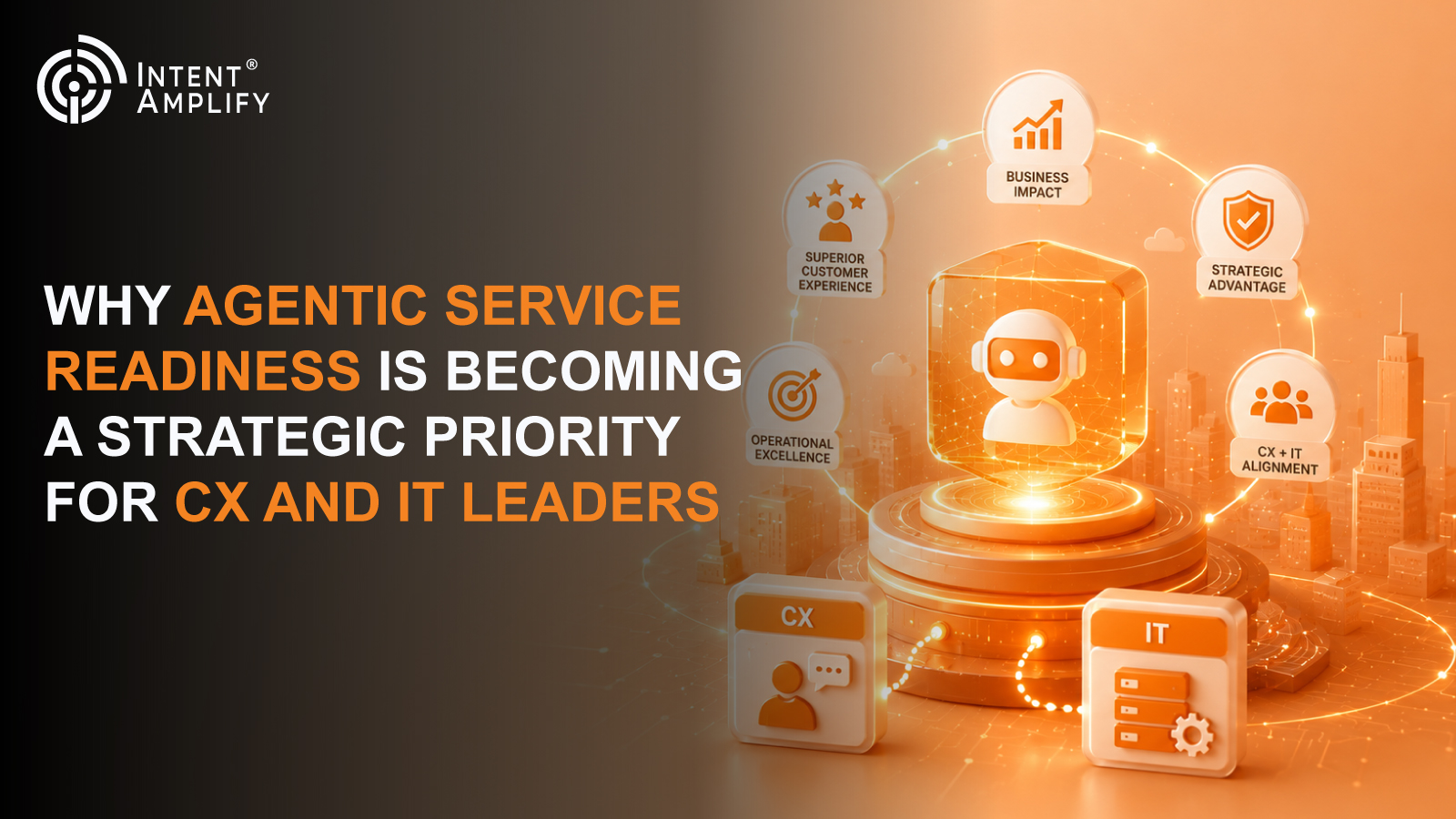
Agentic service readiness is becoming a priority because AI agents are moving closer to real service execution. CX leaders need readiness to protect customer trust, improve customer service AI outcomes, and strengthen service quality management, while IT leaders need readiness to secure access, govern workflows, integrate systems, and make AI observable across service environments.
For enterprises evaluating AI transformation, the advantage will not come from launching the most AI agents first. It will come from building the strongest foundation across governance, knowledge quality, workflow design, integration, measurement, and human readiness.
Agentic service readiness is evolving into a board-level operating priority because AI increasingly influences customer experience, enterprise workflows, and business performance.
To create campaigns that reach those decision-makers with timely, insight-driven content, get in touch with Intent Amplify and explore how strategic audience engagement can support stronger demand generation, better campaign alignment, and more meaningful connections with the CX leaders preparing for their next high-stakes customer surge.
References
- Gartner (2025) Gartner Predicts Agentic AI Will Autonomously Resolve 80% of Common Customer Service Issues Without Human Intervention by 2029. Available at: https://www.gartner.com/en/newsroom/press-releases/2025-03-05-gartner-predicts-agentic-ai-will-autonomously-resolve-80-percent-of-common-customer-service-issues-without-human-intervention-by-20290.
- McKinsey & Company (2025). The State of AI 2025: Agents, Innovation, and Transformation. Available at: https://www.mckinsey.com/~/media/mckinsey/business%20functions/quantumblack/our%20insights/the%20state%20of%20ai/november%202025/the-state-of-ai-2025-agents-innovation_cmyk-v1.pdf.
- Zendesk (2025) CX Trends Report 2025. Available at: https://www.zendesk.com/newsroom/articles/2025-cx-trends-report/.
- Salesforce (2025) State of Service Report 2025. Available at: https://www.salesforce.com/news/stories/state-of-service-report-announcement-2025/
- CallMiner (2025) CallMiner CX Landscape Report. Available at: https://callminer.com/callminer-cx-landscape-report.
- Accenture (2025) Technology Vision 2025: New Age of AI to Bring Unprecedented Autonomy to Business. Available at: https://newsroom.accenture.com/news/2025/accenture-technology-vision-2025-new-age-of-ai-to-bring-unprecedented-autonomy-to-business.